“Sisyphus, Known as the Craftiest of Men” — Roberto Bolaño


Then, incomprehensibly, he began to make faces that in some way linked him to the wife of the writer from Mainz, to such a degree that Bubis thought they must be brother and sister and only thus could one fully understand the presence of the writer and his wife at the meal. It was also possible, thought Bubis, that they were lovers, because it was common knowledge that lovers often began to resemble each other, usually in their smiles, their opinions, their points of view, in short, the superficial trappings that all human beings are obliged to bear until their deaths, like the rock of Sisyphus, yes Sisyphus, known as the craftiest of men, son of Aeolus and Enarete, founder of the city of Ephyra, which is the old name for Corinth, a city that the good Sisyphus turned into the staging ground of his happy misdeeds, because with his characteristic nimbleness of body and intellectual inclination to see every turn of fate as a chess problem or a detective story to unravel, and his instinct for laughter and jokes and jests and cracks and quips and gags and pranks and punch lines and spoofs and stories and gibes and taunts and send-ups and satires, he turned to theft, in other words parting all passersby from their belongings, even going so far as to steal from his neighbor Autolycus, also a thief, perhaps with the remote hope that one who steals from a thief is granted one hundred years of forgiveness, and at the same time smitten by his neighbor’s daughter, Anticlea, because Anticlea was very beautiful, a treat, but the girl had an official suitor, she was promised to Laertes, of subsequent fame, which didn’t daunt Sisyphus, who could count on the complicity of the girl’s father, the thief Autolycus, whose admiration for Sisyphus had sprung up like the regard of an objective and honorable artist for another artist of superior gifts, so that even though it could be said that as a man of honor he remained true to his promise to Laertes, he didn’t look unkindly upon the romantic attentions Sisyphus lavished on his daughter or treat them as disrespect or mockery of his future son-in-law, and in the end his daughter married Laertes, or so it’s said, but only after surrendering to Sisyphus one or two or five or seven times, possibly ten or fifteen times, always with the collusion of Autolycus, who wanted his neighbor to plant the seed of a grandchild as clever as Sisyphus, and on one of these occasions Anticlea was left with child and nine months later, now the wife of Laertes, her son would be born, the son of Sisyphus, called Odysseus or Ulysses, who in fact turned out to be just as clever as his father, though Sisyphus never gave him a thought and continued to live his life, a life of excesses and parties and pleasure, during which he married Merope, the dimmest star in the Pleiades precisely because she married a mortal, a miserable mortal, a miserable thief, a miserable gangster in thrall to his excesses, blinded by his excesses, among which not least was the seduction of Tyro, the daughter of Sisyphus’s brother Salmoneus, whom Sisyphus pursued not because he was interested in Tyro, not because Tyro was particularly sexy, but because Sisyphus hated his own brother and wanted to cause him pain, and for this deed, after his death, he was condemned in hell to push a stone to the top of a hill only to watch it roll down to the bottom and then push it back up to the top of the hill and watch it roll again to the bottom, and so on eternally, a bitter punishment out of all proportion to his crimes or sins, the vengeance of Zeus, it’s said, because on a certain occasion Zeus passed through Corinth with a nymph he had kidnapped, and Sisyphus, who was smarter than a whip, seized his chance, and when Asopus, the girl’s father, came by in desperate search of his daughter, Sisyphus offered to give him the name of his daughter’s kidnapper, but only if Asopus made a fountain spring up in the city of Corinth, which shows that Sisyphus wasn’t a bad citizen or perhaps he was thirsty, to which Asopus agreed and the fountain of crystalline waters sprang up and Sisyphus betrayed Zeus, who, in a blind rage, sent him ipso facto to Thanatos, or death, but Sisyphus was too much for Thanatos, and in a masterstroke perfectly in keeping with his craftiness and sense of humor he captured Thanatos and threw him in chains, a feat within reach of very few, truly very few, and for a long time he kept Thanatos in chains and during all that time not a single human being died on the face of the earth, a golden age in which men, though still men, lived free of the anxiety of death, in other words, free of the anxiety of time, because now they had more than enough time, which is perhaps what distinguishes a democracy, spare time, surplus time, time to read and time to think, until Zeus had to intervene personally and Thanatos was freed and then Sisyphus died.

But the faces Junge was making didn’t have anything to do with Sisyphus, thought Bubis.

From “The Part About Archimboldi,” 2666, by Roberto Bolaño.


Nude at the Stove — Felix Vallotton

The Egyptian Book — Lucian Freud

List with No Name #1

  1. Bleak House
  2. A Frolic of His Own
  3. Babbitt
  4. Fathers and Sons
  5. The Magic Mountain
  6. Middlemarch
  7. Moll Flanders
  8. The Tin Drum
  9. Life and Fate
  10. R.U.R.
  11. The Dwarf
  12. Zeno’s Conscience

“True Love” — Thomas Bernhard


True Love

An Italian who owns a villa in Riva on Lake Garda and can live very comfortably on the interest from the estate his father left him has, according to a report in La Stampa, been living for the last twelve years with a mannequin. The inhabitants of Riva report that on mild evenings they have observed the Italian, who is said to have studied art history, boarding a glass-domed deluxe boat, which is moored not far from his home, with the mannequin to take a ride on the lake. Described years ago as incestuous in a reader’s letter addressed to the newspaper published in Desencano, he had applied to the appropriate civil authorities for permission to marry his mannequin but was refused. The church too had denied him the right to marry his mannequin. In winter he regularly leaves Lake Garda in mid-December and goes with his beloved, whom he met in a Paris shop-window, to Sicily, where he regularly rents a room in the famous Hotel Timeo in Taormina to escape from the cold, which, all assertions to the contrary, gets unbearable on Lake Garda every year after mid-December.

“True Love,” by Thomas Bernhard. From The Voice Imitator.


Mouth (Brigitte Bardot’s Lips) — Gerhard Richter

JFK, Gore Vidal, and Tennessee Williams

20120731-234434.jpg

RIP Gore Vidal

20120731-234021.jpg

RIP Gore Vidal, 1925-2012

A Skull on the Open Book — Vladimir Tatlin

Samson’s Fight with the Lion — Lucas Cranach the Elder

Man with a Movie Camera — Dziga Vertov (Full 1929 Film with Score by The Cinematic Orchestra)

“The Wish To Be a Red Indian” — Franz Kafka

The Wish To Be a Red Indian

If one were only an Indian, instantly alert, and on a racing horse, leaning against the wind, kept on quivering jerkily over the quivering ground, until one shed one’s spurs, for there needed no spurs, threw away the reins, for there needed no reins, and hardly saw that the land before one was smoothly shorn heath when horse’s neck and head would be already gone.

“The Wish To Be a Red Indian” by Franz Kafka.

Untitled (Book) — Philip Guston

See A.K., Chris Marker’s Film About Akira Kurosawa

RIP Chris Marker

RIP French filmmaker Chris Marker, 1921-2012

Like any kid who took way too many film studies courses in college, I was lucky to be introduced to the strange films of Chris Marker, who died at 91 yesterday in Paris. Marker is most famous for his film La jetéea sci-fi post-apocalyptic meditation shot as a series of still photos (the film was later adapted by Terry Gilliam into 12 Monkeys). Marker’s film San Soleil had a particular impact on me: it’s a beautiful, strange film essay, or travel novel, or I don’t know what you call it. Just find it and see it. Here’s the intro:

The Guardian has a proper obituary.

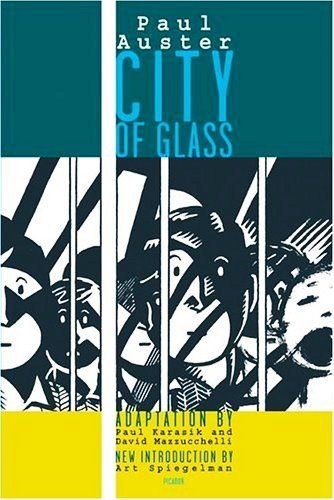
I Review City of Glass, A Comic Book Doppelgänger of Paul Auster’s Postmodern Detective Novel

Paul Auster’s 1985 novel City of Glass explores doubling, shadowing, and what it means to wear another person’s skin, so it’s fitting that the book has its own doppelgänger in the form of a graphic novel by Paul Karasik and David Mazzucchelli (maestro Art Spiegelman served as catalyst and counselor). I should admit upfront that although I’ve read a few of Auster’s books, I haven’t read City of Glass, considered by many to be his masterpiece. I have read Mazzucchelli’s excellent novel Asterios Polyp (and plenty of stuff by overseer Spiegelman), so the adaptation intrigued me. I wasn’t disappointed. I read Karasik and Mazzucchelli’s City of Glass in one brisk sitting and thoroughly enjoyed it. What’s it about?

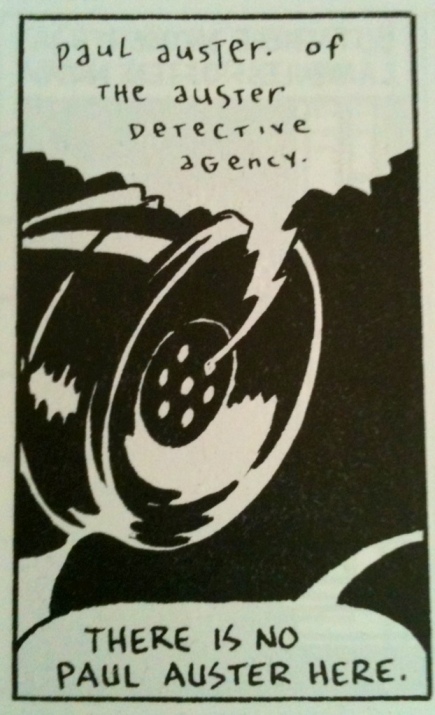
Okay, so there’s this novelist, Quinn (“rhymes with twin”), who, after the death of his wife and son, takes up writing boilerplate detective novels under the pseudonym William Wilson. Late in the book, Quinn (if he’s still Quinn at that point, which I’ll get to) identifies the pseudonym with the “real” name of NY Mets center fielder (and future coach) Mookie Wilson—but savvy readers will also recognize “William Wilson” as the name of an Edgar Allan Poe story about a man haunted by a doppelgänger of himself to the point that he goes insane. In the Poe story, Wilson and his doppelgänger (whose name is, of course, William Wilson as well) share the same birthday, January 19th, which also happens to be E.A. Poe’s birthday (and my brother’s too, although that is not germane to this review). Auster is clearly working from Poe’s story, although he never announces this explicitly (at least not in the comic-bookization). Arthur Hobson Quinn, for example, wrote an exhaustive biography of Poe (published in 1941). Crossing from the real to the fictional, from authorial to character, Auster inserts himself into the story from its outset. At the beginning of the book, protagonist Quinn gets a mysterious call, like something out of the noir novels he writes:

20120728-125217.jpg

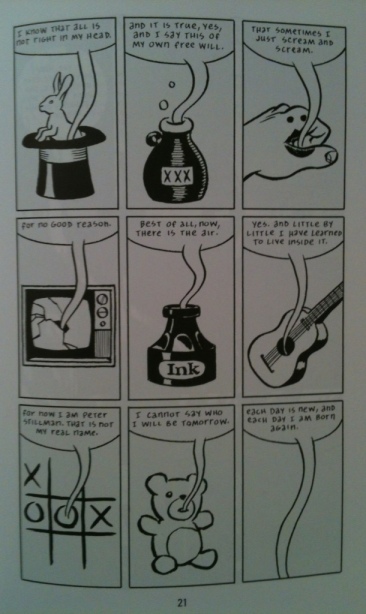
Bored, or perhaps ventriloquized by a force he doesn’t understand, Quinn takes up the identity of detective Paul Auster and agrees to take on a case for Peter Stillman, a man who, as a boy, suffered feralization at the hands of his insane father, who hoped to discover the Ur-language of god through the boy. Stillman’s monologue is one of the highlights of the book, showcasing the malleability of language—and also, significantly, the malleability of speakers:

20120728-125225.jpg

Stillman hires Quinn/Auster to track his father, also named Peter Stillman (Peter is also the name of Quinn’s dead son). Actually, it’s Stillman the Younger”s wife/speech pathologist who hires Quinn/Auster; she’s certain that Stillman the Elder, freshly released from a mental asylum, will return to harm his son.

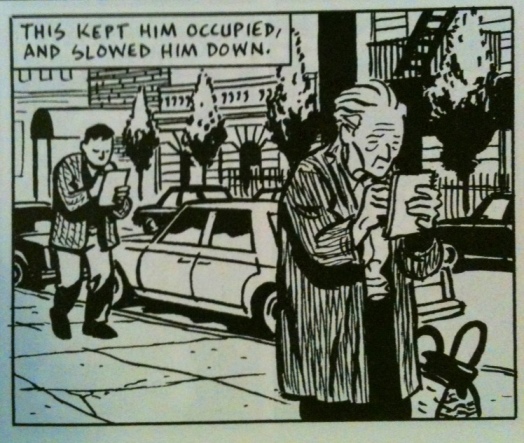
Quinn/Auster slides into the role of Max Work, his noir novel protagonist—or, perhaps more accurately, William Wilson’s noir protagonist—and begins tracking Stillman the Elder (or a version of Stillman the Elder—I won’t spoil the novel’s strangest, most maddening metaphysical gambit here). And, predictably, as Quinn/Auster/Wilson/Work  shadows Stillman Sr., he morphs into yet another doppelgänger:

20120728-125233.jpg

Quinn/Auster/Wilson/Work eventually confronts Stillman, and the pair have a series of fascinating conversations about language, Milton, Humpty Dumpty, and the Tower of Babel. The motifs and themes are telegraphed fairly straightforward here, but also communicated through a lens of madness that comes to dominate the book’s third act—an act that initiates in a meeting between Q/A/W/W and the “real” Paul Auster, a writer who’s working on an essay about the authorship of Don Quixote. The Don Quixote conversation is perhaps too overt, the sort of postmodern cleverness that I increasingly find a big turnoff, but it’s not clumsy or awkward. Still, there’s something mildly irritating about an author tipping his hand and then showing you how he’s tipping his hand.

The third act of City of Glass feels compressed, rushed even, and will definitely disappoint readers who wandered in for a detective stories, hoping for concrete answers and a neat and tidy plot. However, the book’s themes of fantasy and reality, play and work, sanity and madness, and character and author are rich if frustrating in their circuitousness. Mazzucchelli’s art is evocative and fitting, recalling at times the rough-hewn pop art of Raymond Pettibon and the traditional prowess of masters like Kirby and Eisner. (I’ll bring up Spiegelman again too, who introduces the volume. A friend of Auster’s, he brokered the project and oversaw its development, and his work as a creative director here is evident in the book’s cohesion). I imagine fans of Auster’s New York Trilogy, of which City of Glass is the first book, will be interested in checking this one out. Having come first to the graphic novel, I now look forward to reading its doppelgänger, Paul Auster’s City of Glass. Good stuff.

Wheat Field with a Lark — Vincent van Gogh