The Dream — Frida Kahlo

the-dream-the-bed-1940

In Cold Blood (Full Film)

“All visible objects, man, are but as pasteboard masks” (Moby-Dick)

Hark ye yet again—the little lower layer. All visible objects, man, are but as pasteboard masks. But in each event—in the living act, the undoubted deed—there, some unknown but still reasoning thing puts forth the mouldings of its features from behind the unreasoning mask. If man will strike, strike through the mask! How can the prisoner reach outside except by thrusting through the wall? To me, the white whale is that wall, shoved near to me. Sometimes I think there’s naught beyond. But ’tis enough. He tasks me; he heaps me; I see in him outrageous strength, with an inscrutable malice sinewing it. That inscrutable thing is chiefly what I hate; and be the white whale agent, or be the white whale principal, I will wreak that hate upon him. Talk not to me of blasphemy, man; I’d strike the sun if it insulted me. For could the sun do that, then could I do the other; since there is ever a sort of fair play herein, jealousy presiding over all creations. But not my master, man, is even that fair play. Who’s over me? Truth hath no confines.

From Chapter 36 of Herman Melville’s Moby-Dick. The speaker, of course, is Ahab.


Check out Film Critic Armond White’s 2012 Better Than List

Critic/contrarian Armond White has released his 2012 “Better Than” list, where he uses one film to pick on another. Great stuff, even if you disagree. A few samples:

Sacrifice > The Master
Chen Kaige finds the roots of culture in patriarchal responsibility; P.T. Anderson loses culture’s meaning in anti-religious hysteria and high-art folly. Chen also featured superior acting by competing father figures You Ge and Xuegi Wang.

Holy Motors > Cosmopolis
Leos Carax’s dreamy limousine kineticism shamed Cronenberg’s oft-entrancing limousine stage drama. Carax parked and bloomed. Cronenberg parked then harangued.

Dark Horse > The Turin Horse
Todd Solondz’s modern soap opera steadily, comically bored into our self-deceptions, while Bela Tarr’s highbrow jape steadily bored us.

The Lady > Lincoln
Luc Besson’s bio-pic examined Aung San Suu Kyi’s marital and political commitment, while Spielberg’s unholy marriage to Tony Kushner pushed the cult of personality. Aphorisms vs. Propaganda.

Ghost Rider: Spirit of Vengeance, Taken 2 > Zero Dark Thirty
Neveldine-Taylor and Olivier Megaton revealed the post-9/11 zeitgeist in genre tropes, while Bigelow reduced the zeitgeist to an enigmatic comic strip, a “mission accomplished” delusion.

A Thousand Words > Argo
Brian Robbins and Eddie Murphy dared the most personal Hollywood critique since Clifford Odets’ The Big Knife; Ben Affleck trivialized Hollywood accountability.


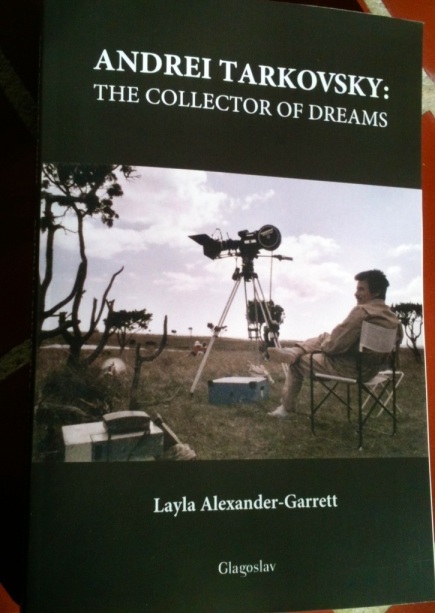
Andrei Tarkovsky: The Collector of Dreams (Book Acquired, 12.29.2012)

20130107-202014.jpg

Layla Alexander-Garrett’s memoir Andrei Tarkovsky: The Collector of Dreams is new from Glagoslav. Their blurb:

The Sacrifice is Andrei Tarkovsky’s final masterpiece. The film was shot in Sweden, during the summer of 1985, while Tarkovsky was in exile; it turned out to be his final testament. Day after day, while the film was being made, Layla Alexander-Garrett – Tarkovsky’s on-site interpreter – kept a diary which forms the basis of her award-winning book Andrei Tarkovsky: The Collector Of Dreams. In this book the great director is portrayed as a real, living person: tormented, happy, inexhaustibly kind but at times harsh, unrelenting, conscience-stricken and artistically unfulfilled.

I’ve been riffling through it over the past few days. Alexander-Garrett describes her time with Tarkovsky in vivid detail—there’s a concrete richness to the book, and the author doesn’t try to psychoanalyze or interpret or otherwise interpose herself between the reader and the subject. More to come.

Little Nemo Strip — Winsor McCay

“A Reflection” — Kate Chopin

“A Reflection” by Kate Chopin—

Some people are born with a vital and responsive energy. It not only enables them to keep abreast of the times; it qualifies them to furnish in their own personality a good bit of the motive power to the mad pace. They are fortunate beings. They do not need to apprehend the significance of things. They do not grow weary nor miss step, nor do they fall out of rank and sink by the wayside to be left contemplating the moving procession.

Ah! that moving procession that has left me by the road-side! Its fantastic colors are more brilliant and beautiful than the sun on the undulating waters. What matter if souls and bodies are failing beneath the feet of the ever-pressing multitude! It moves with the majestic rhythm of the spheres. Its discordant clashes sweep upward in one harmonious tone that blends with the music of other worlds—to complete God’s orchestra.

It is greater than the stars—that moving procession of human energy; greater than the palpitating earth and the things growing thereon. Oh! I could weep at being left by the wayside; left with the grass and the clouds and a few dumb animals. True, I feel at home in the society of these symbols of life’s immutability. In the procession I should feel the crushing feet, the clashing discords, the ruthless hands and stifling breath. I could not hear the rhythm of the march.

Salve! ye dumb hearts. Let us be still and wait by the roadside.


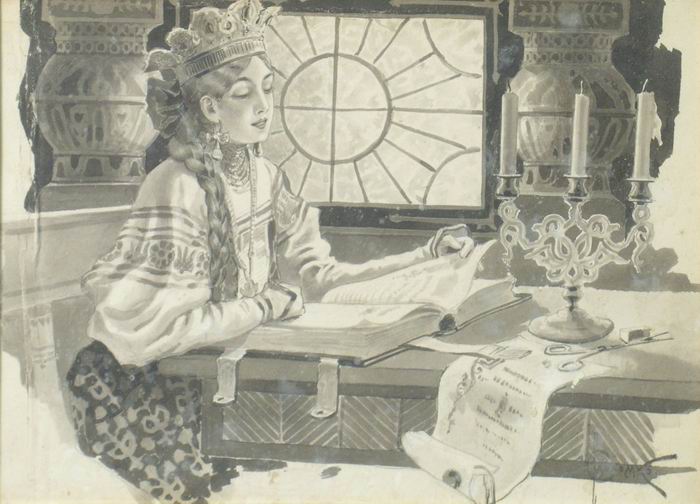
Reading — Sergey Solomko

ssreading