Image of James Joyce — Louis Le Brocquy

Image of James Joyce 1977 by Louis Le Brocquy born 1916

(Via).

Selections from One-Star Amazon Reviews of Orwell’s 1984

[Ed. note: The following citations come from one-star Amazon reviews of George Orwell’s novel 1984. I think 1984 is an important dystopian work (although I think Huxley gave us a better book and a more accurate vision in his novel Brave New World). Anyway, I find myself fascinated by one-star Amazon reviews for some reason (see also: See also: Melville’s Moby-Dick, Joyce’s Ulysses and Markson’s Wittgenstein’s Mistress) and to be clear, I think some of the one-star reviews of 1984–including ones I cite here—make some pretty valid points (others are atrocious, of course). I’ve preserved the reviewers’ unique styles of punctuation and spelling].

1984 is a fictional novel by George Orwell.

I don’t really like futuristic based books…

1984 might have been scary 100 years ago, but not now.

…the plot is fairly simplistic but with redundant lines. “Oceania has always been war with Eastasia.” “Freedom is slavery.” “Big Brother is watching you.” In other words, it was nothing but a lot of nonsensical fillers.

I truly believe that Orwell’s sole purpose for writing this novel was to encourage anarchy, and to convince his readers to be subordinate to authority.

The text was so long and unelaborate.

George Orwell is no wordsmith and his style of writing stinks and flows like verbal diarrhea.

i give this book one star i had to read it for class and i know it’s suposed to be a “classic” but god itis awful. first of all its NOTHING like the future is probly going to turn out. second of all every one says the aurthor george orwell is so trippy and wierd but i think he’s just trying to cover up for the fact that HE CAN’T WRITE. please george do us all a faver and stop writing books.

I am not at all intrested in the goverment. This may be part of the reason that I didnt like it.

I personally think big brother is the man.

It is crude, heavy-handed, superficial propaganda.

…a boring, unoriginal one-hit wonder who wanted to make a buck rehashing much-talked-of, much-written-of themes.

It is dark, depressing, and I finished reading it feeling like less of a human than when I started.

Quote from “1984”: “Humanity is nothing more than one man shoving another man’s face in the mud.” So, “1984” tells us that humans are completely useless and we have no reason to exist.

It was just thoughts of a sad man with perverse and suspicouis thoughts. The main character constantly dwelled on how horrible everything was and eventually how he was going to fight against it. But never did, unless you count having an affair and writing in a journal or buying an old paperweight.

Keep your dictionary handy.

I was greatly dissapointed with the redundent and unecessary words.

For me the book took a downword turn during the time where Winston started having a love affair with some girl.

…it doesn’t make any sense to think that a novel like this one is really any better than say, Michael Crichton or Stephen King.

The main character, Winston, daydreams about raping Julia, who later becomes his dirty mistress. Then about a hundred pages later, they get caught by the Thought Police, thrown into “prison,” and are brain washed. That’s pretty much what happens.

…and must we really keep reading in full detail the horror and disgust of Winston’s vericose veins?!

Today, his book is the modern bible of the paranoid disgruntled white male and other conspiracy nutcases.

Human beings are BETTER than this…

In addiction, the contradictions throughout the novel were frustrating.

On the surface it seems to be an interesting glance at the “future” that our grandparents envisioned. This however could not be farther from the truth. 1984 is in fact a lame, boring, and novel that attempts to be philosophical.

…a monumental ode to nothingness, an ideologically streamlined state of unbelievable being.

And please for the love of God don’t read that “Brave New World” book by Hoxley. It is twice as worse as 1984.

Last time I ever read a history book by this Orwell scrub. He doesn’t know a thing about the 80s. Not ONCE did he mention Def Leppard or Karma Chameleon.
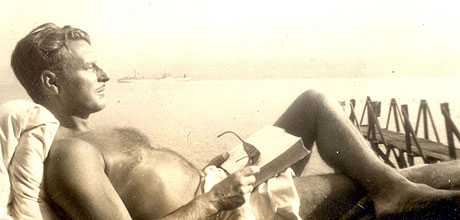
Topless Malcolm Lowry (Again)

lowry

(Via/props).

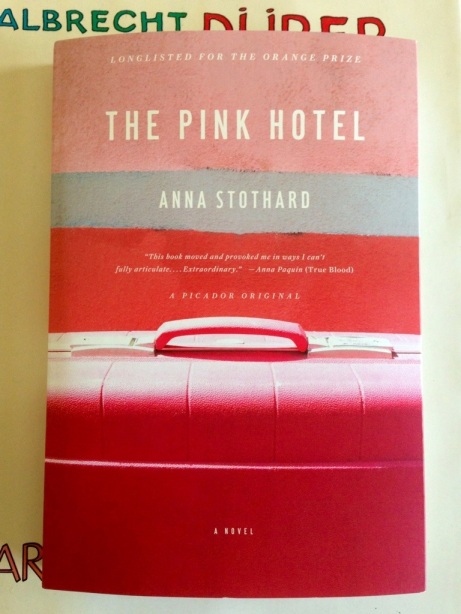
The Pink Hotel (Book Acquired, 4.02.2013)

20130402-161554.jpg

The Pink Hotel by Anna Stothard is new from Picador. Their blurb:

A raucous, drug-fueled party has taken over a boutique hotel on Venice Beach—it’s a memorial for Lily, the now-deceased, free-spirited proprietress of the place. Little do the attendees know that Lily’s estranged daughter—and the nameless narrator of this striking novel—is among them, and she has just walked off with a suitcase of Lily’s belongings.

Abandoned by Lily many years ago, she has come a long way to learn about her mother, and the stolen suitcase—stuffed with clothes, letters, and photographs—contains not only a history of her mother’s love life, but perhaps also the key to her own identity. As the tough, resourceful narrator tracks down her mother’s former husbands, boyfriends, and acquaintances, a risky reenactment of her life begins to unfold. Lily had a knack for falling in love with the wrong people, and one man, a fashion photographer turned paparazzo, has begun to work his sinuous charms on the young woman.

Told with high style and noirish flare, Anna Stothard’s The Pink Hotel is a powerfully evocative debut novel about wish fulfillment, reckless impulse, and how we discover ourselves.

Excerpt:

Her bedroom reeked of cigarette ash and stale perfume. Two ashtrays were packed with lipstick-stained filters as if she’d just popped out for another pack. A suspender belt hung from a chest of drawers, a mink scarf was curled like roadkill at the floor next to her bed. A mirror opposite the bed reflected an image of me lying fully clothed and out of place on the crinkled sheets. My haircut and body could have been that of a boy, but my oversized eyes made me look like a Gothic Virgin Mary from a museum postcard. I wore a sweat-stained T-shirt and a pair of navy-blue tracksuit bottoms. My skin still smelt faintly of grease and coffee from Dad’s café in London, but now the smell was mingled with dehydrated aeroplane air and smog from Los Angeles traffic.

Read the rest of the excerpt.


Crashed Aeroplane — John Singer Sargent

“The Philosophy of Composition” — Edgar Allan Poe

“The Philosophy of Composition” by Edgar Allan Poe

Charles Dickens, in a note now lying before me, alluding to an examination I once made of the mechanism of Barnaby Rudge, says—”By the way, are you aware that Godwin wrote his Caleb Williams backwards? He first involved his hero in a web of difficulties, forming the second volume, and then, for the first, cast about him for some mode of accounting for what had been done.”

I cannot think this the precise mode of procedure on the part of Godwin—and indeed what he himself acknowledges is not altogether in accordance with Mr. Dickens’s idea—but the author of Caleb Williams was too good an artist not to perceive the advantage derivable from at least a somewhat similar process. Nothing is more clear than that every plot, worth the name, must be elaborated to its dénouement before anything be attempted with the pen. It is only with the dénouement constantly in view that we can give a plot its indispensable air of consequence, or causation, by making the incidents, and especially the tone at all points, tend to the development of the intention.

There is a radical error, I think, in the usual mode of constructing a story. Either history affords a thesis—or one is suggested by an incident of the day—or, at best, the author sets himself to work in the combination of striking events to form merely the basis of his narrative—-designing, generally, to fill in with description, dialogue, or autorial comment, whatever crevices of fact or action may, from page to page, render themselves apparent.

I prefer commencing with the consideration of an effect. Keeping originality always in view—for he is false to himself who ventures to dispense with so obvious and so easily attainable a source of interest—I say to myself, in the first place, “Of the innumerable effects or impressions of which the heart, the intellect, or (more generally) the soul is susceptible, what one shall I, on the present occasion, select?” Having chosen a novel first, and secondly, a vivid effect, I consider whether it can be best wrought by incident or tone—whether by ordinary incidents and peculiar tone, or the converse, or by peculiarity both of incident and tone—afterwards looking about me (or rather within) for such combinations of events or tone as shall best aid me in the construction of the effect.

I have often thought how interesting a magazine paper might be written by any author who would—that is to say, who could—detail, step by step, the processes by which any one of his compositions attained its ultimate point of completion. Why such a paper has never been given to the world, I am much at a loss to say—but perhaps the autorial vanity has had more to do with the omission than any one other cause. Most writers—poets in especial—prefer having it understood that they compose by a species of fine frenzy—an ecstatic intuition—and would positively shudder at letting the public take a peep behind the scenes, at the elaborate and vacillating crudities of thought—at the true purposes seized only at the last moment—at the innumerable glimpses of idea that arrived not at the maturity of full view—at the fully-matured fancies discarded in despair as unmanageable—at the cautious selections and rejections—at the painful erasures and interpolations,—in a word, at the wheels and pinions, the tackle for scene-shifting, the step-ladders and demon-traps, the cock’s feathers, the red paint, and the black patches, which, in ninety-nine cases out of the hundred, constitute the properties of the literary histrio. Continue reading ““The Philosophy of Composition” — Edgar Allan Poe”

New York Rooftops, My Windows in New York — Mstislav Dobuzhinsky

new-york-rooftops-my-windows-in-new-york-1943