Hell — Hans Memling

Heavy Dreams (Sigizmund Krzhizhanovsky)

Quantin followed the procession for a few minutes out of morbid curiosity. The choice of narrower side streets, where it was easier to enlist the wall’s support, was probably deliberate, he thought, but then a long notice stuck to the stone exactly at eye level arrested his attention and, with it, his progress. The notice—in the manner of a proper, not overly pushy advertisement—listed the advantages ofso-called heavy dreams. Having come across the subject once before, Quantin read the fine print carefully, line by line: “The main advantage of the heavy industry of nightmares over the light industry of golden threads plunged into brain fibrils, over the production of so-called sweet dreams, is that in marketing our nightmares we can guarantee that they will come true, we can hand our customers ‘turnkey dreams.’ Sweet dreams cannot withstand reality, sleepy reveries wear out faster than socks; whereas a heavy dream, a simple but well-made nightmare, is easily assimilated by life. Where dreams unburdened by anything disappear like drops of water in the sand, dreams containing a certain harshness will, as they evaporate in the sun, leave a hard kernel on the roof of Plato’s famous cave: these dposits will collect and accrue, eventually forming a swordlike stalactite.

“Speaking in more modern terms,” the fine print went on, “our nightmares, weighing as they do on the brain, gradually form a sort of moral ceiling that is always about to come crashing down on one’s head: some of our customer’s call this ‘world history.’ But that’s not the point. The point is the durability, unwakeability, high depressiveness, and wide availability of our nightmares: mass-market products good for all eras and classes, nighttime and daytime, moonlight and sunlight, closed eyes and open.”

From Sigizmund Krzhizhanovsky’s short story “The Branch Line,” collected in NYRB’s Memories of the Future (translation by Joanne Turnbull).

Henry Miller/Georg Büchner (Books Acquired, 4.30.2013)

20130430-165618.jpg

Needing another book the same way I need another hole in the head, I nevertheless dropped by my local used bookstore to browse—the place is huge, and a day of grading term papers made me feel zapped and perhaps depressed. Anyway. Spotted a beautiful Penguin edition of Henry Miller’s The Colossus of Maroussi and had to have it. Here’s a passage some soul saw fit to dogear:

20130430-165623

I had never heard of Georg Büchner or his novella fragment Lenz, but it was shelved next to Blake Butler’s Scorch Atlas and both stood out because of their odd shapes.

20130430-165633.jpg

Here are the blurbs for Lenz, which more or less sold me:

20130430-165639.jpg

Finally, I did not buy yet another edition of Moby-Dick, despite this midcentury Rinheart cover—but I had to snap it to share:

20130430-165646.jpg


“Can’t Go Wrong Without You” — His Name Is Alive/Brothers Quay

“I dreamt that the Earth was finished” — Roberto Bolaño

31. I dreamt that Earth was finished. And the only
human being to contemplate the end was Franz
Kafka. In heaven, the Titans were fighting to the
death. From a wrought-iron seat in Central Park,
Kafka was watching the world burn.

32. I dreamt I was dreaming and I came home
too late. In my bed I found Mário de Sá-Carneiro
sleeping with my first love. When I uncovered them
I found they were dead and, biting my lips till they
bled, I went back to the streets.

33. I dreamt that Anacreon was building his castle
on the top of a barren hill and then destroying it.

34. I dreamt I was a really old Latin American
detective. I lived in New York and Mark Twain
was hiring me to save the life of someone without
a face. “It’s going to be a damn tough case, Mr.
Twain,” I told him.

35. I dreamt I was falling in love with Alice Sheldon.
She didn’t want me. So I tried getting myself killed
on three continents. Years passed. Finally, when I
was really old, she appeared on the other end of the
promenade in New York and with signals (like the
ones they use on aircraft carriers to help the pilots
land) she told me she’d always loved me.

36. I dreamt I was 69ing with Anaïs Nin on an
enormous basaltic flagstone.

Read more short poems from Roberto Bolaño’s Tres (New Directions) in translation by Laura Healy.

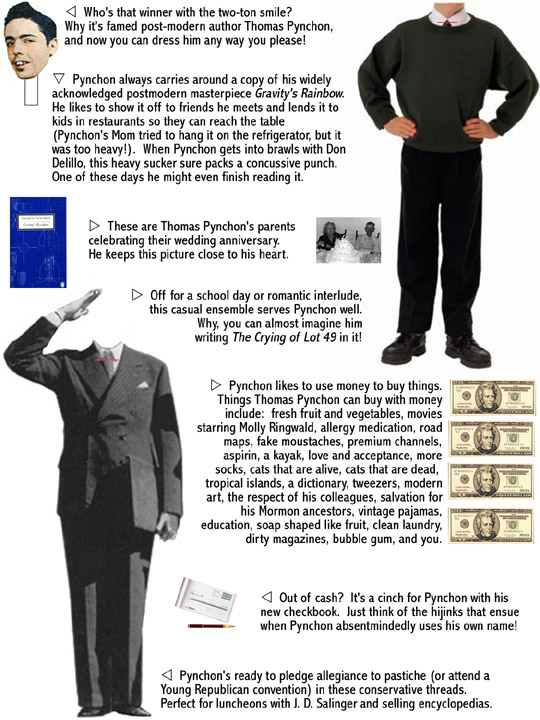
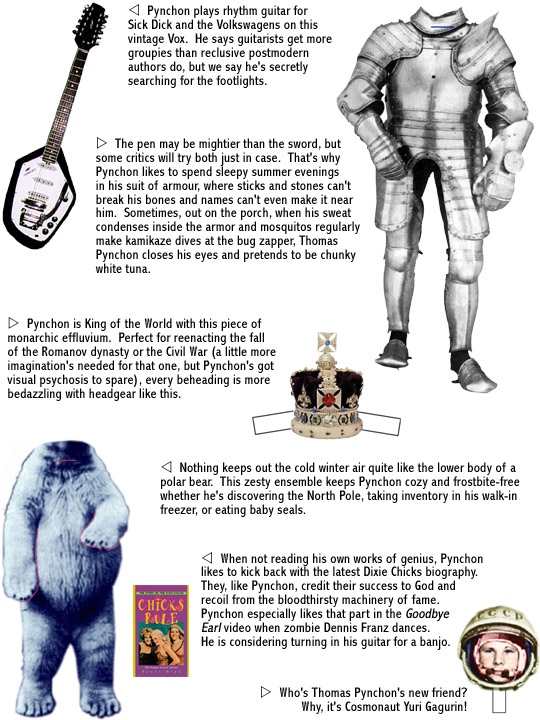
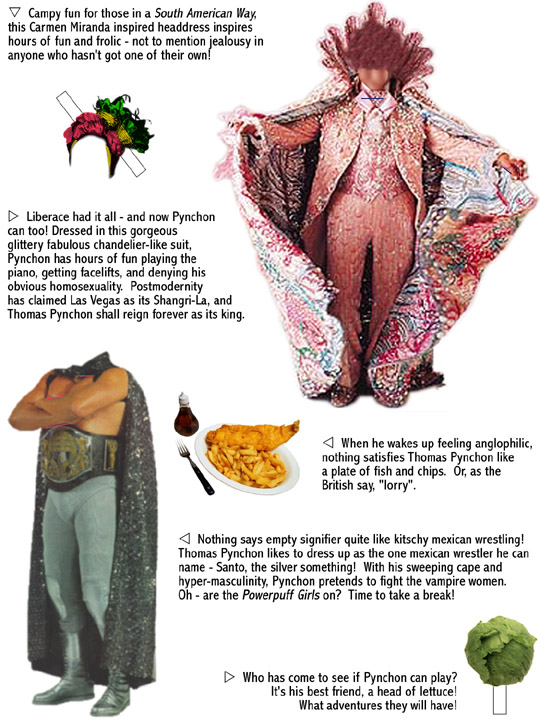
Thomas Pynchon Paper Dolls

030130_paperpynchon1030130_paperpynchon2030130_paperpynchon3

(Via).

Katherine Anne Porter on Being a Southern Writer (And Eloping)

Katherine Anne Porter in her Paris Review interview:

INTERVIEWER

But it seems to me that your work suggests someone who was searching for new—perhaps broader—meanings . . . that while you’ve retained the South of your childhood as a point of reference, you’ve ranged far from that environment itself. You seem to have felt little of the peculiarly Southern preoccupation with racial guilt and the death of the old agrarian life.

PORTER

I’m a Southerner by tradition and inheritance, and I have a very profound feeling for the South. And, of course, I belong to the guilt-ridden white-pillar crowd myself, but it just didn’t rub off on me. Maybe I’m just not Jewish enough, or Puritan enough, to feel that the sins of the father are visited on the third and fourth generations. Or maybe it’s because of my European influences—in Texas and Louisiana. The Europeans didn’t have slaves themselves as late as my family did, but they still thought slavery was quite natural. . . . But, you know, I was always restless, always a roving spirit. When I was a little child I was always running away. I never got very far, but they were always having to come and fetch me. Once when I was about six, my father came to get me somewhere I’d gone, and he told me later he’d asked me, “Why are you so restless? Why can’t you stay here with us?” and I said to him, “I want to go and see the world. I want to know the world like the palm of my hand.”

INTERVIEWER

And at sixteen you made it final.

PORTER

At sixteen I ran away from New Orleans and got married. And at twenty-one I bolted again, went to Chicago, got a newspaper job, and went into the movies.

INTERVIEWER

The movies?

PORTER

The newspaper sent me over to the old S. and A. movie studio to do a story. But I got into the wrong line, and then was too timid to get out. “Right over this way, Little Boy Blue,” the man said, and I found myself in a courtroom scene with Francis X. Bushman. I was horrified by what had happened to me, but they paid me five dollars for that first day’s work, so I stayed on. It was about a week before I remembered what I had been sent to do; and when I went back to the newspaper they gave me eighteen dollars for my week’s nonwork and fired me!

I stayed on for six months—I finally got to nearly ten dollars a day—until one day they came in and said, “We’re moving to the coast.” “Well, I’m not,” I said. “Don’t you want to be a movie actress?” “Oh, no!” I said. “Well, be a fool!” they said, and they left. That was 1914 and world war had broken out, so in September I went home.


Young Woman Reading — Pierre-Auguste Renoir