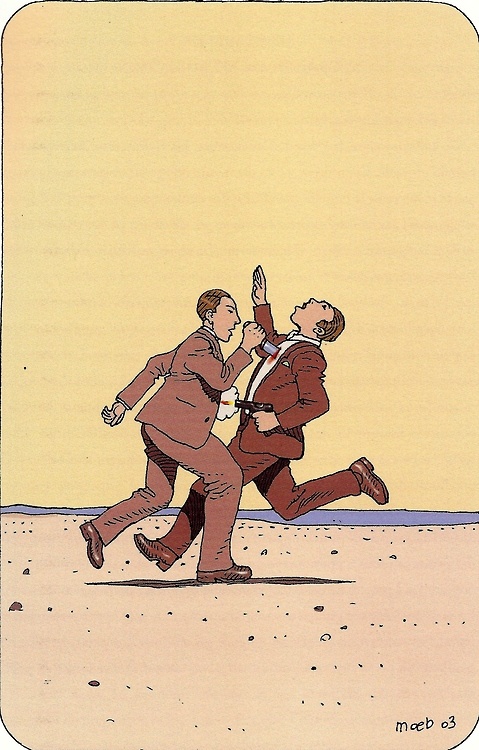
Double Murder — Moebius

double murder moebius

“Herman Melville” — Conrad Aiken

“Herman Melville” by Conrad Aiken:

‘My towers at last!’—
What meant the word
from what acknowledged circuit sprung
and in the heart and on the tongue
at sight of few familiar birds
when seaward his last sail unfurled
to leeward from the wheel once more
bloomed the pale crags of haunted shore
that once-more-visited notch of world:
and straight he knew as known before
the Logos in Leviathan’s roar
he deepest sounding with his lead
who all had fathomed all had said.

Much-loving hero—towers indeed
were those that overhung your log
with entries of typhoon and fog
and thunderstone for Adam’s breed:
man’s warm Sargasso Sea of faith
dislimned in light by luck or fate
you for mankind set sail by hate
and weathered it, and with it death.
And now at world’s end coasting late
in dolphined calms beyond the gate
which Hercules flung down, you come
to the grim rocks that nod you home.
Depth below depth this love of man:
among unnumbered and unknown
to mark and make his cryptic own
one landfall of all time began:
of all life’s hurts to treasure one
and hug it to the wounded breast,
in this to dedicate the rest,
all injuries received or done.
Your towers again but towers now blest
your haven in a shoreless west
o mariner of the human soul
who in the landmark notched the Pole
and in the Item loved the Whole.


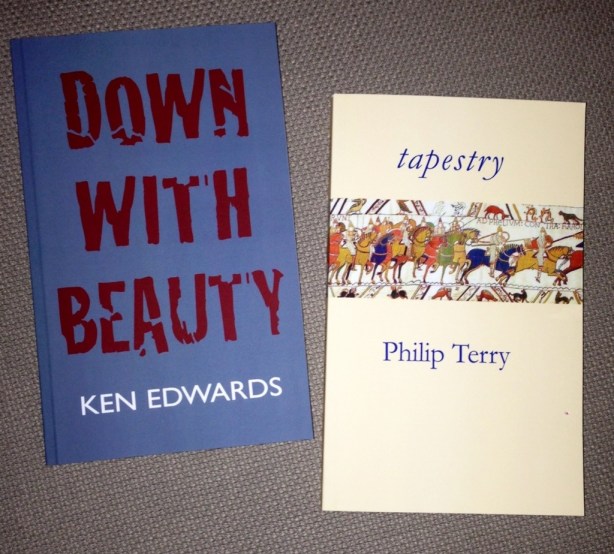
Down with Beauty/tapestry (Books Acquired, 7.17.2013)

20130723-112451.jpg

Two very intriguing new titles from Reality Street: Ken Edwards’s Down with Beauty, and tapestry by Philip Terry.

Here’s the publisher’s blurb for Down with Beauty:

DOWN WITH BEAUTY explores, in a series of linked dialogues, dramatic monologues and short fictions, the themes of exile, the aftermath of war, paranoia, improvised music and nothingness. The collection is completed with the full text of NOSTALGIA FOR UNKNOWN CITIES, previously published separately.  Some samples herehere and here – others will be revealed.

A very strange, scattered book—lovely.

Here’s Reality Street’s blurb for tapestry:

Taking as its starting point marginal images in the Bayeux Tapestry, which have been left largely unexplained by historians, Terry retells the story of the Norman Conquest from the point of view of the tapestry’s English embroiderers. Combining magic realism and Oulipian techniques, this is a tour de force of narrative and language.

tapestry also got a great review from The Guardian’s Nicholas Lezard:

By showing a language in flux,tapestry draws you into its world: that of the creation of the Bayeux tapestry (which, as we are reminded in the book by an exasperated narrator, isn’t a tapestry at all, but a work of embroidery) by a group of nuns in the late 11th century at a priory in Kent. …

Medieval works lend themselves to the picaresque, or multiple narration – think of The Decameròn or The Canterbury Tales. So while there is an overarching narrative, that of the commission and creation of the tapestry, work is paused while each nun tells a story related to her work. If you look at the tapestry, you will remember, or notice, that there are numerous extraneous designs along the borders that would appear to have nothing to do with the matter of the Norman usurpation. Terry has noticed, as have others, the Aesopian motifs that occur, and includes slender, playful versions, sometimes modernised, of Aesop’s fables himself. My favourite is one in which a lion, confronting Aesop, asks him to tell him a fable before the lion eats him. So Aesop says he was confronted by a lion who asked him to tell a fable … and so on; and eventually the lion gets bored and goes away.

Great to see some new stuff that’s, well, really new

Don Quixote and Sancho Panza in the Terrifying Forest at Night — Gustave Doré

(More at Gustave Doré’s Don Quixote)

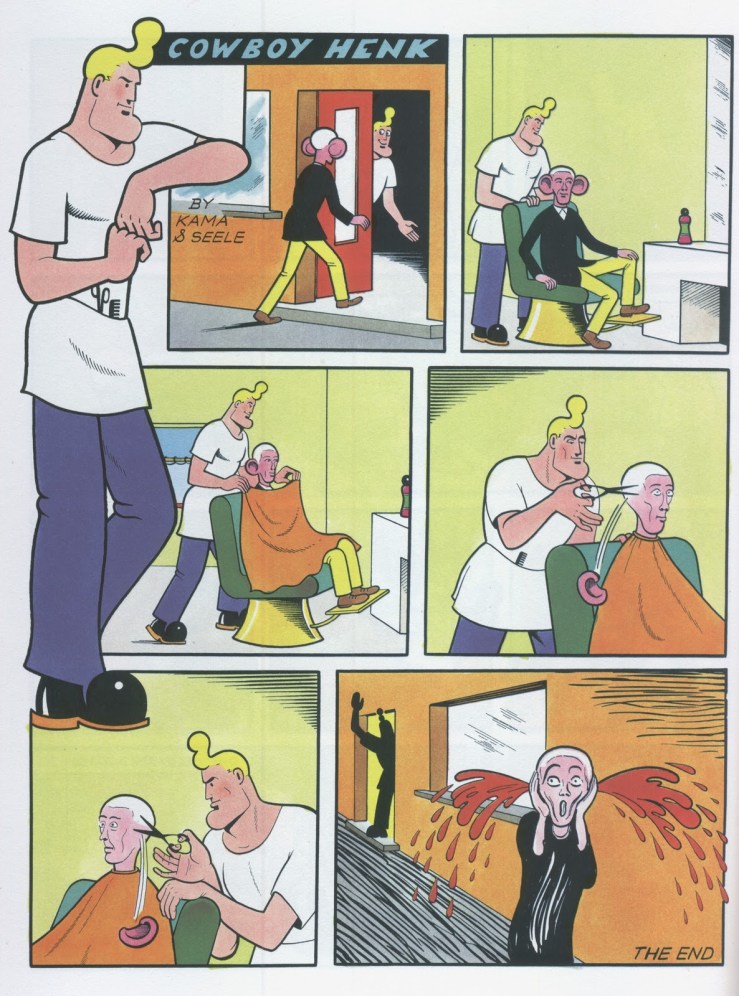
The Scream (Kamagurka & Herr Seele’s Cowboy Henk)

henk scream

Six Ideas and Images from Nathaniel Hawthorne’s Note-Books

  1. In an old London newspaper, 1678, there is an advertisement, among other goods at auction, of a black girl, about fifteen years old, to be sold.
  2. We sometimes congratulate ourselves at the moment of waking from a troubled dream: it may be so the moment after death.
  3. The race of mankind to be swept away, leaving all their cities and works. Then another human pair to be placed in the world, with native intelligence like Adam and Eve, but knowing nothing of their predecessors or of their own nature and destiny. They, perhaps, to be described as working out this knowledge by their sympathy with what they saw, and by their own feelings.
  4. A singular fact, that, when man is a brute, he is the most sensual and loathsome of all brutes.
  5. A snake taken into a man’s stomach and nourished there from fifteen years to thirty-five, tormenting him most horribly. A type of envy or some other evil passion.
  6. A sketch illustrating the imperfect compensations which time makes for its devastations on the person,–giving a wreath of laurel while it causes baldness, honors for infirmities, wealth for a broken constitution,–and at last, when a man has everything that seems desirable, death seizes him. To contrast the man who has thus reached the summit of ambition with the ambitious youth.

Notations from Nathaniel Hawthorne’s American Note-Books.

Map Reading — Stanley Spencer