
- Fargo
- A Serious Man
- The Big Lebowski
- Miller’s Crossing
- Barton Fink
- Blood Simple
- No Country for Old Men
- O Brother, Where Art Thou?
- The Man Who Wasn’t There
- Raising Arizona
- Burn After Reading
- True Grit
- The Hudsucker Proxy
- The Ladykillers
- Intolerable Cruelty
Day: August 7, 2013
Untitled (Cubism and Abstract Art) — Steve Wolfe

theNewerYork, a Worthy Alternative to Your iPhone
Like many (maybe most) Americans, my first impulse when I have to wait somewhere is to pull out my smart phone and dick around. I like to dick around on Twitter, which often leads me to stuff that I scan or gaze or graze through, with a kind of distracted, even half-hearted, attention. Because I’m also attending to something else—the waiting.
I had to wait, or be patient, or be a patient, or what have you several times last month, and each time I brought with me the newest or forthcomingest issue of theNewerYork—issue 3 (or III, depending on press materials). It fits neatly in my pocket and most of the pieces are a page at most—a perfect alternative to my iPhone, with none of the eye-deadening numbness that so often happens with long binges on a tiny screen.
theNewerYork describes itself as
a weird sort of literary mag. Our rule: no short stories, no poetry, no essays. We want to play around with literary form and narration, we want to screw with your mind! There will be personal letters, flash-fictions, glossaries, aphorisms, manuals, lists and other absurdities. We received over 600 submissions from all over the world. We’ve got flash fictions of sex and drugs, teenage romances, philosophical treatises, pretentious definitions, web forums, silly, sappy, scary stuff.
That’s a pretty apt description. To hijack and cannibalize my write-up of the last issue, theNewerYork’s “willingness to showcase experimentation in what goes on paper for people to look at and read is both a strength and a weakness.” This third issue sees an all-around increase in quality, from the production design, to the art, to the writing.
Highlights include Panayotis Pakos’s “Les Innumerables (A Binary Tale),” a Calvinoesque flash that imagines the dream-life of numbers, and Shane Jesse Christmass’s “My Delicate Response to a Child’s Writing Prompt Website” (quick sample: “If there were no television I’d beach my television set down within the dunes…”). Zach Davidson’s “Unstandardized Testing” claims (truthfully?) to present a set of scrambled questions from a trash bin; the testtaker is tasked with creating proper order (sample: “too lazy to do lazy something you are if you are still?”)
The most affecting piece in the collection is Anton Nimblett’s “Show & Tell: An American Game,” an analysis posing as a chronology. I’ll share only the nineteenth century portion, and, at the risk of spoiling, let you know that the story ends with the line “Show birth certificate (again, again, again).”

The list-form, along with (or combined with) the second-person POV seems a favorite for “experimental” fiction, which can occasionally be grating (but only when it doesn’t work)—but most of the pieces here work. And if they don’t, there’s something coming up that does.
Despite the disparate tones, approaches, and geographies of its contributors, theNewerYork coheres—the little magazine has a clear (if discursive vision). Good stuff. Check out their website for more.
“Indifference” — Edna St. Vincent Millay

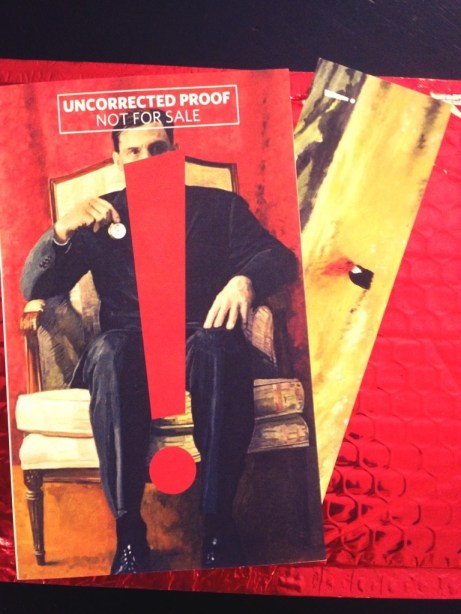
Son of a Gun (Book Acquired, 8.5.2013)

Son of a Gun, Justin St. Germain’s memoir, explores the life and death of his mother, who was killed by her fifth husband. Here’s publisher Random House’s blurb:
Tombstone, Arizona, September 2001. Debbie St. Germain’s death in her remote trailer, apparently at the hands of her fifth husband, is a passing curiosity. “A real-life old West murder mystery,” the local TV announcers intone before the commercial break, while barroom gossips snicker cruelly. But for her twenty-year-old son, Justin St. Germain, the tragedy marks the line that separates his world into before and after.
Justin decides to confront people from his past and delve into the police records in an attempt to make sense of his mother’s life and death. All the while he tries to be the type of man she would have wanted him to be. Brutally honest and beautifully written, Son of a Gun is a brave, unexpected and unforgettable memoir.
Here’s Publishers Weekly’s write-up:
A young man wrestles with his heartache over his mother’s murder in this lacerating memoir of family dysfunction. St. Germain was a 20-year-old college student when his mother Debbie was shot to death in 2001 by her fifth husband in a desolate trailer in the Arizona desert, a disaster that threw into sharp relief the chaos of his working-class background. St. Germain revisits Debbie’s unstable life as an Army paratrooper and businesswoman, the string of men she took up with (some physically abusive), and his own boyhood resentment at their presence and at incessant domestic upheaval. Intertwined is a jaundiced, somewhat self-conscious meditation on St. Germain’s claustrophobic hometown of Tombstone—all sun-bleached ennui, arid hardpan, and tourist kitsch—and its presiding spirit, Wyatt Earp, archetype of the violent, trigger-happy machismo that he blames for killing his mother, yet feels drawn to as a touchstone of manhood. St. Germain makes harsh judgments of the men in his past (as well as of his sullen, callous adolescent self), but as he seeks them out later, he arrives, almost against his will, at a subtler appreciation of their complexities. At times his trauma feels more dutiful than deeply felt, but his memoir vividly conveys the journey from youthful victimization toward mature understanding.
Eight Notes from Nathaniel Hawthorne’s Note-Books
- Would it not be wiser for people to rejoice at all that they now sorrow for, and vice versa? To put on bridal garments at funerals, and mourning at weddings? For their friends to condole with them when they attained riches and honor, as only so much care added?
- If in a village it were a custom to hang a funeral garland or other token of death on a house where some one had died, and there to let it remain till a death occurred elsewhere, and then to hang that same garland over the other house, it would have, methinks, a strong effect.
- No fountain so small but that Heaven may be imaged in its bosom.
- Fame! Some very humble persons in a town may be said to possess it,–as, the penny-post, the town-crier, the constable,–and they are known to everybody; while many richer, more intellectual, worthier persons are unknown by the majority of their fellow-citizens. Something analogous in the world at large.
- The ideas of people in general are not raised higher than the roofs of the houses. All their interests extend over the earth’s surface in a layer of that thickness. The meeting-house steeple reaches out of their sphere.
- Nobody will use other people’s experience, nor have any of his own till it is too late to use it.
- Two lovers to plan the building of a pleasure-house on a certain spot of ground, but various seeming accidents prevent it. Once they find a group of miserable children there; once it is the scene where crime is plotted; at last the dead body of one of the lovers or of a dear friend is found there; and, instead of a pleasure-house, they build a marble tomb. The moral,–that there is no place on earth fit for the site of a pleasure-house, because there is no spot that may not have been saddened by human grief, stained by crime, or hallowed by death. It might be three friends who plan it, instead of two lovers; and the dearest one dies.
- Comfort for childless people. A married couple with ten children have been the means of bringing about ten funerals.
Notations from Nathaniel Hawthorne’s American Note-Books.
Arranged — Jim Hodges

 Biblioklept