

Sylwia Chrostowska’s novel Permission—got it in the mail on Saturday. I’d been swimming in the river, in the relentless August sun, for most of the day, and when I got home I just wanted to watch a film and drink some wine and pass out.
But I started reading. And reading. And then I looked up and and I was like fifty pages in.
Here’s publisher Dalkey Archive’s blurb:
Composed of anonymous e-mail messages sent by the author to an acclaimed visual artist over the course of a year, Permission is the record of an experiment: an attempt to forge a connection with a stranger through the writing of a book. Part meditation, part narrative, part essay, it is presented to its addressee as a gift that asks for no thanks or acknowledgment—but what can be given in words, and what received?Permission not only updates the “epistolary novel” by embracing the permissiveness we associate with digital communication, it opens a new literary frontier.
And here’s novelist Teju Cole’s blurb, from the back of the book (for some reason not posted at Dalkey):
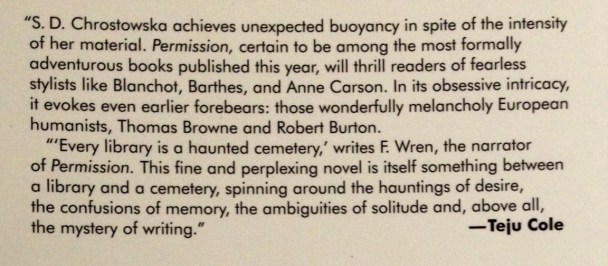
Permission’s central premise (if such a work so soaked in deconstruction could be said to have a center) immediately recalled to me Jacques Derrida’s discussions of the paradox of giving:
To rephrase my experimental question: can I give away what is inalienable from me (my utterance, myself) without the faintest expectation or hope of authority, solidarity, reciprocity? Can my giving be unhinged from a sense of both investment and pointless expenditure?
The first few “chapters” — the narrator’s weekly missives to the unnamed artist — are thoroughly soaked in deconstruction and continental philosophy; this is a novel that cites Blanchot and Deleuze in its first twenty pages. However, the narrator promises that her book, “through its progressive dissolution, towards the final solution of this writing (my work) . . . becomes progressively less difficult, less obscure.”
This promise seems true, as subsequent passages flow into personal memory, reflection—storytelling. We get a brief tour of cemeteries, a snapshot of the narrator’s father (as a child) at a child’s funeral, a recollection of the narrator’s first clumsy foray into fiction writing, a miniature memoir of a failed painter, color theory, the sun, the moon.
Strange and lovely stuff. More when I finish.



 Biblioklept