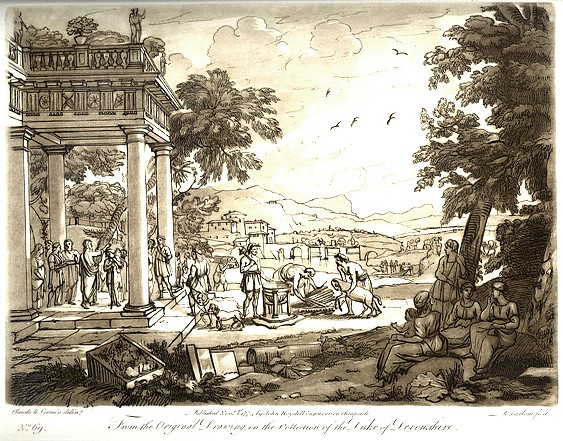
Claude Lorrain’s “Landscape with Samuel Anointing David.”
In my last riff on Gerald Murnane, I wrote about his book Inland, and that he wanted to “craft a universally mutable and relational ‘I.'” And I started off with a quote. I’m going to do that now. This is a short passage from Ludwig Wittgenstein’s The Blue and Brown Notebooks.
The word “I” does not mean the same as “L.W.” even if I am L.W., nor does it mean the same as the expression “the person who is now speaking”. But that doesn’t mean: that “L.W.” and “I” mean different things. All it means is that these words are different instruments in our language.
Think of words as instruments characterized by their use, and then think of the use of a hammer, the use of a chisel, the use of a square, of a glue pot, and of the glue. (Also, all that we say here can be understood only if one understands that a great variety of games is played with the sentences of our language: Giving and obeying orders; asking questions and answering them; describing an event; telling a fictitious story; telling a joke; describing an immediate experience; making conjectures about events in the physical world; making scientific hypotheses and theories; greeting someone, etc., etc.) The mouth which says “I” or the hand which is raised to indicate that it is I who wish to speak, or I who have toothache, does not thereby point to anything. If, on the other hand, I wish to indicate the place of my pain, I point. And here again remember the difference between pointing to the painful spot without being led by the eye and on the other hand pointing to a sac on my body after looking for it. (“That’s where I was vaccinated”.)—The man who cries out with pain, or says that he has pain, doesn’t choose the mouth which says it (67-8).
The “I” in Barley Patch, as it is ostensibly used in the literary sense, merely implies the presence of the author. The “I” is as much of a fiction as the collection of words around it. Barley Patch is a strange, strange fiction. I’m honoring the narrator’s/implied author’s/personage’s/ghostly presence’s/reader’s/image-person’s wishes by not calling it a novel, an essay, a memoir, an autobiography. And though Barley Patch is all of these forms, often simultaneously, ultimately it is a “report,” to use the narrator’s term, of how a story becomes removed from itself. Some questions BP asks: How do I know that am I me? Am I the imagined personage of a writer in a “country on the far side of fiction?” How do I know where I am is really where I am?
People have bones so insects won’t flood their limbs and inflate their bodies to normal size. A person who is insect-controlled often sits and drinks tea, though an insect fluid called blood flows quickly beneath her skin. She has an accurate walking style and can converse in one or more languages. She sleeps lying down, and uses a filter called hair to attract her mates. The small people in her house call her “Mom,” and she answers them by collapsing the tension in her face, a surrendering of control that passes for listening. When she pursues an upper-level-difficulty slalom run of housekeeping throughout her house, she has most likely failed to seal her bones from escape with fixatives called clothing. Her actions become commanded for the good of something larger, such as a naked man who resembles her father, although he might be younger and smaller and weaker, as if playing the part of her husband, though not convincingly. Her motion is voice-activated. When he addresses her, she stands on her toes and lets her arms raise up at her sides. She does a forward bend in the morning to be sure her blood pools at the top of her head. If you sliced her arm open, you would hear a faint buzzing. She has one pair of eyes, and they are often tired and red. When she uses her arms to prop up a document of regret known as a book, her bones form an ancient shape, and a brief, flashing signal is sent out through the window into the fields beyond her house, where the hive is.
From Ben Marcus’s story “Origins of the Family.” Collected in Leaving the Sea.



 Biblioklept