Ugetsu — Kenji Mizoguchi (Full Film)

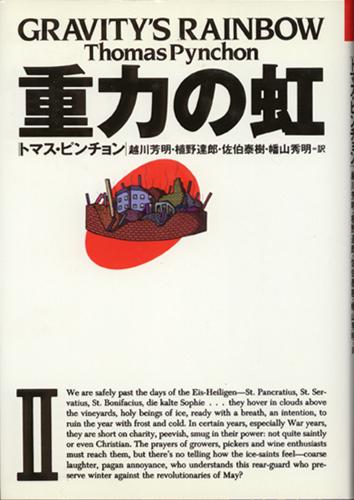
Selections from One-Star Amazon Reviews of Thomas Pynchon’s Gravity’s Rainbow

[Ed. note: The following citations come from one-star Amazon reviews of Thomas Pynchon’s novel Gravity’s Rainbow. Yes, I’ve done this a few times before (see also: George Orwell’s 1984, Melville’s Moby-Dick, Joyce’s Ulysses and Markson’s Wittgenstein’s Mistress) and to be clear, I think some of the one-star reviews of Gravity’s Rainbow make some interesting points–although most of the reviewers seem to be upset over the book’s reputation/status, and attack that (and by extension, postmodernism) instead of attempting to analyze what Pynchon was actually, y’know, trying to do. I’ve preserved the reviewers’ unique styles of punctuation and spelling].

Who put it into Pynchon’s head that he could write?

After reading over one hundred fifty pages, all I could believe was the story set during WWII, but I wasn’t sure.

This is not literature. 

After I finished reading this book twenty years ago, I left it in my apartment building’s laundry room for whomever might be interested in it. The book sat there for months and nobody was interested in it enough to take it home. Finally, it was ruined when a water pipe burst and, I presume, it is now landfill in Staten Island.

Tedious. 

There is not an ounce of humanity in this book.  I finally threw it against a wall in disgust.

Pynchon writes liberal, paranoid diatribes against any and all institutions, especially conservative ones 

I felt empty and used.

I’ve been told the nominating committee (made up mostly of book reviewers) nominated this for the Pulitzer Prize as best fiction. The awards committee (mostly book editors) rejected it as an unreadable piece of crap. I agree with the editors.

This book’s failings are in part a function of it’s time — the early 70’s – when culture was naively experimental, half-baked, vulgar, and exhibitionist.

When one contrasts Vonnegut’s Slaughterhouse Five with this book, it’s like comparing an Olympic sprinter with an obese man running for the bus with a hot dog in one hand and a soda in the other.

I honestly preferred J.G. Ballard’s Crash to this book.

It seems to me it’s very easy to be “a literary master” in this way. It’s much more difficult to write something very clear and simple that people can easily understand (and yet still be profound and say something new).

Woody Allen used to be funny. Monty Python was occasionally funny. 

Any author who uses “further” for “farther” (as Pynchon does, among many other errors) should never make anyone’s “best novelist” list.

To this reader, Pynchon sounds like the unabomber with a better thesaurus. 

One of those books that professors are constantly forcing students to read because the novelist can’t attract a following on his own merits and ability to entertain. 

I only finished it beacuse I was on jury duty. 

I thought this novel was a complete waste of my time and it amazes me to hear so many praise what I think was paranoid and resembles silly cult literature. My father had a book back in the fifties sponsored by an extreme right wing group that was equally paranoid and absurd.

Pynchon couldn’t write anything funny if his life depended upon it.

Pynchon is like a high school football bully who says “Okay, I’m gonna trow da ball as hard as I can–you see if you can catch it”. No thanks Spike.

I mean, even the first page of this book offends my sensibilities.

An entire novel centered on the unrealistic, flimsy idea that a man getting erections will attract missiles? Some missiles may be heat seaking but the temperature of blood found in the groin during erections is no longer near the degree it takes to attract heat seaking weaponry. Get your facts right, Pynchon. A scientist you ain’t.

Reminds me of John Coltrane’s Ascension album, which for the entire album sounds like the band is warming up but never gets to play, but the elitist snobs just adore it.

A good argument for a good old fashioned book burning. 

The majority of this book consists of sentence after sentence and paragraph after paragraph that don’t have any apparent correlation to each other.

wow, all the hard work that this man put in just to bore me! the effort alone is worth a star. gallant attempt mr pynchon.

This is one of those “university novels” (as opposed to “popular” novels that people actually read and love) that “you have to work hard at to appreciate”. 

It’s like viewing a `painting’ of a blank canvas titled Untitled. 

I lived in Germany a few years ago and found this book in a train station. Someone had just walked off and left it. After about ten pages, realizing that Pynchon was an intellectual rip-off artist, I secured it a trash can where no one could find it. I like to think I protect the public from pollution.

Maybe it’s entertaining if you take huge quantities of lsd, otherwise it’s a nightmare. 

It is terrible.

I cannot summarize the story, because I couldnt find one.

obviously written by some self-loving, over-indulged, hippie.

I tend to lump this book in with the rest of the general malaise surrounding the innate nihilism of Postmodernism. 

This book makes me a little sad, because I think that Pynchon, had he not gone over to the dark side, could have been a brilliant prose stylist, if not anything else.

feels like being flayed alive by words alone. I wanted to stab myself in the head just to relieve the pain.

This is like Ulysses. 

Add a star if you enjoy constant reference to penises and vulva and all kinds of deviant sex acts.

I should sue the author for migraine.

To sum it up: it is too much work to read this book.

The Door to the Open — Egon Schiele

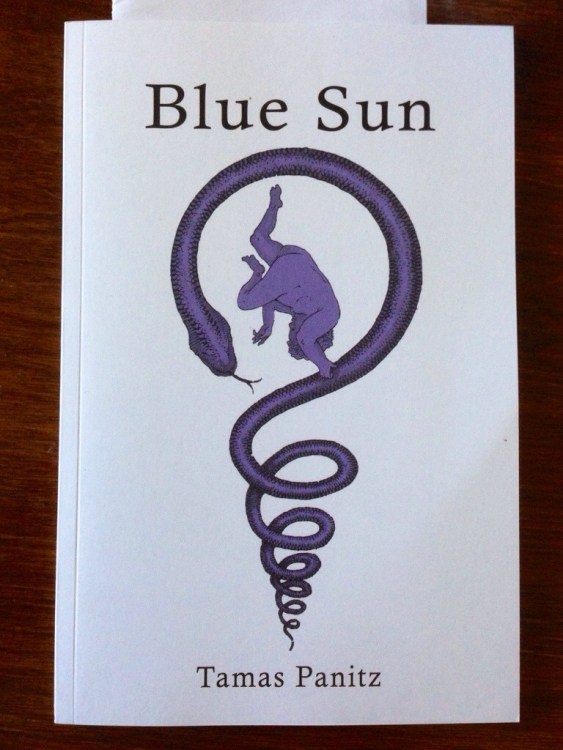
Blue Sun (Book Acquired, Like Maybe Three Weeks Ago)

20140504-091954.jpg

I got Tamas Panitz’s poems Blue Sun a few weeks ago but didn’t get a chance to get into it until last night. Good stuff—I’ll try to write a proper review in the next week, but until then, here’s Charles Stein’s blurb, via publisher Inpatient Press:

The splitting of historiography into a brash imposition of history as ontology, history as willfully configurative, history as but a wistful desideratum — leaves the archetypal self little choice but to hive in the lucubrations of a poetry questing for self and history. Panitz’ book enacts such a questing. Its voice would be master of its walk to the extent that even in addressing another it might be strictly about its own business: a panoply of poetic measures, variable tactics of order, the exploration of ontological imponderables. The smartness of its utterance throughout is instructive and – something not so common these days – provides a species of written speech that will repay proper study.

Happy Birthday Mr. Pynchon

Happy Birthday to Thomas Pynchon, who turns lucky 77 today.

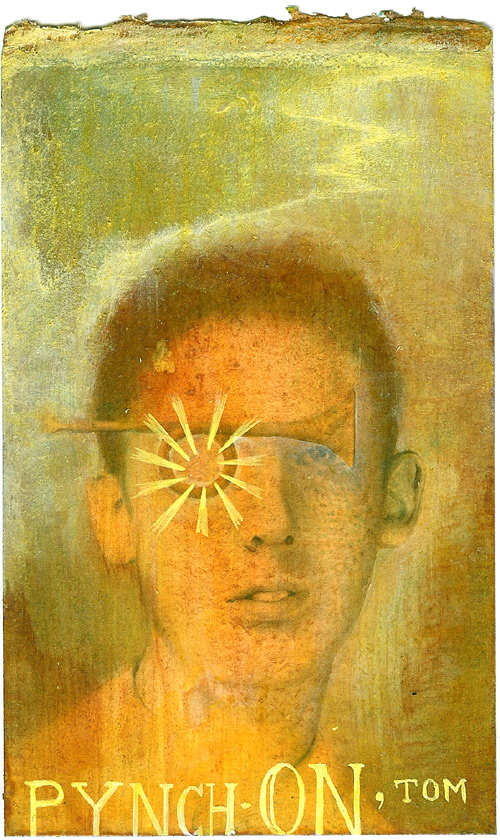
Portrait of Thomas Pynchon, James Jean

“The Whole Sick Crew,” George Plimpton on Pynchon’s V.

Captain Geoffrey “Pirate” Prentice’s bodacious banana breakfast for a bunch of hung over army officers (Gravity’s Rainbow)

Routine: plug in American blending machine won from some Yank last summer, some poker game, table stakes, B.O.Q. somewhere in the north, never remember now….Chop several bananas into pieces. Make coffee in urn. Get can of milk from cooler. Puree ‘nanas in milk. Lovely. I would coat all the booze-corroded stomachs of England. . . . Bit of marge, still smells all right, melt in the skillet. Peel more bananas, slice lengthwise. Marge sizzling, in go long slices. Light oven whoomp blow us all up someday oh, ha, ha, yes. Peeled whole bananas to go on broiler grill soon as it heats. Find marshmallows. . . .

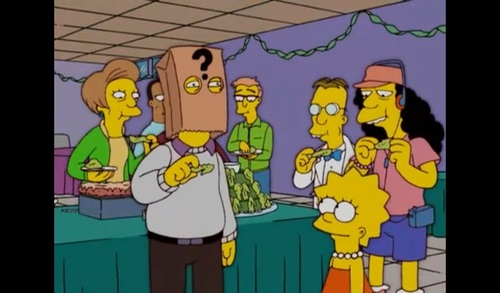
Silly CNN report on Pynchon:

Louis Menand reviews Mason & Dixon

Wingnuts (The Crying of Lot 49):

“You one of those right wing nut outfits?” inquired the diplomatic Metzger.
Fallopian twinkled. “They accuse us of being paranoids.”
“They?” inquired Metzger, twinkling also.
“Us?” asked Oedipa.

List of Possible Descriptors for Against the Day

Pynchon on Barthelme

My review of Inherent Vice

The Crocodile, a traditional anarchist cocktail:

“I’ll be in the bar,” said Reef. Yzles-Bains was in fact one of the few places on the continent of Europe where a sober Anarchist could find a decent Crocodile—equal amounts of rum, absinthe, and the grape spirits known as trois-six—a traditional Anarchist favorite, which Loïc the bartender, a veteran of the Paris Commune, claimed to have been present at the invention of.

tumblr_mdtaejP0E01rjpu6do1_500

Harold Bloom’s disappointment with Vineland:

Our most distinguished living writer of narrative fiction—I don’t think you would quite call him a novelist—is Thomas Pynchon, and yet that recent book Vineland was a total disaster. In fact, I cannot think of a comparable disaster in modern American fiction. To have written the great story of Byron the lightbulb in Gravity’s Rainbow, to have written The Crying of Lot 49 and then to give us this piece of sheer ineptitude, this hopelessly hollow book that I read through in amazement and disbelief, and which has not got in it a redeeming sentence, hardly a redeeming phrase, is immensely disheartening.

Proverbs for Paranoids (from Gravity’s Rainbow):

1. You may never get to touch the Master, but you can tickle his creatures.
2. The innocence of the creatures is in inverse proportion to the immorality of the Master.
3. If they can get you asking the wrong questions, they don’t have to worry about answers.
4. You hide, they seek.
5. Paranoids are not paranoid because they’re paranoid, but because they keep putting themselves, fucking idiots, deliberately into paranoid situations.

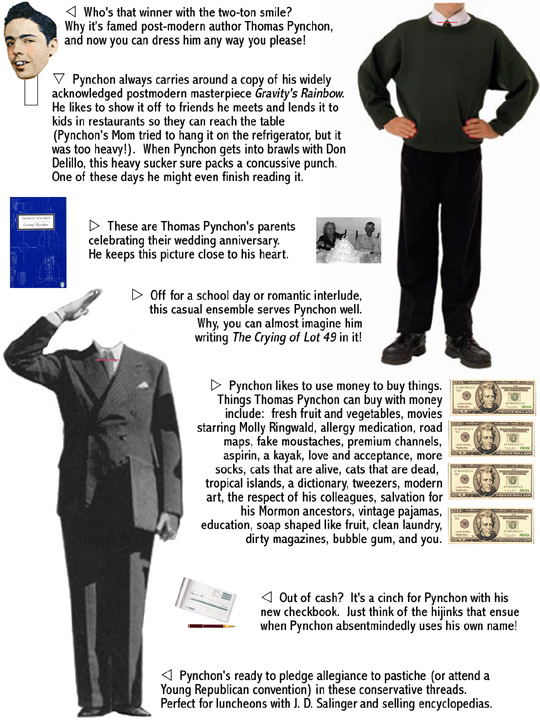
Pynchon Dolls


Pynchon Cover Gallery

Is It O.K. To Be A Luddite?”

 Don DeLillo on Pynchon:

“Somebody quoted Norman Mailer as saying that he wasn’t a better writer because his contemporaries weren’t better…I don’t know whether he really said that or not, but the point I want to make is that no one in Pynchon’s generation can make that statement. If we’re not as good as we should be it’s not because there isn’t a standard. And I think Pynchon, more than any other writer, has set the standard. He’s raised the stakes.”

I read Against the Day last summer and riffed the hell out of it

Pynchon on sloth

Anarchists’ golf (Against the Day):

THE NEXT DAY Reef, Cyprian, and Ratty were out on the Anarchists’ golf course, during a round of Anarchists’ Golf, a craze currently sweeping the civilized world, in which there was no fixed sequence—in fact, no fixed number—of holes, with distances flexible as well, some holes being only putter-distance apart, others uncounted hundreds of yards and requiring a map and compass to locate. Many players had been known to come there at night and dig new ones. Parties were likely to ask, “Do you mind if we don’t play through?” then just go and whack balls at any time and in any direction they liked. Folks were constantly being beaned by approach shots barreling in from unexpected quarters. “This is kind of fun,” Reef said, as an ancient brambled guttie went whizzing by, centimeters from his ear.

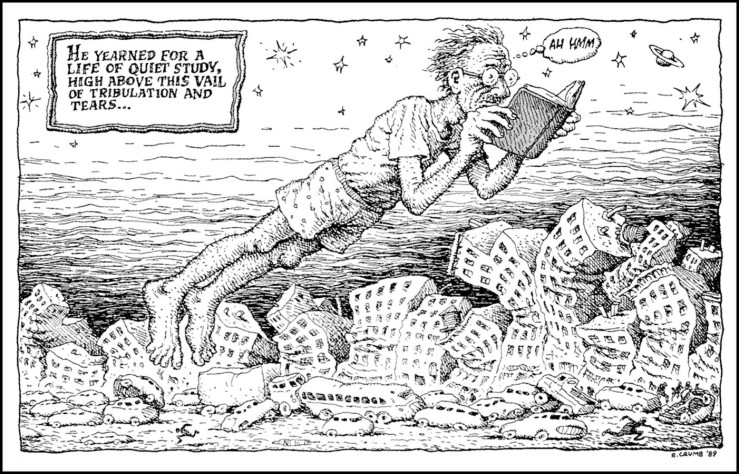
He Yearned for a Life of Quiet Study — Robert Crumb

RobtCrumb_LifeOfQuietStudy_1989_100