
As books multiply to an unmanageable excess, selection becomes more and more a necessity for readers, and the power of selection more and more a desperate problem for the busy part of readers. The possibility of selecting wisely is becoming continually more hopeless as the necessity for selection is becoming continually more pressing. Exactly as the growing weight of books overlays and stifles the power of comparison, pari passu is the call for comparison the more clamorous; and thus arises a duty correspondingly more urgent of searching and revising until everything spurious has been weeded out from amongst the Flora of our highest literature, and until the waste of time for those who have so little at their command is reduced to a minimum. For, where the good cannot be read in its twentieth part, the more requisite it is that no part of the bad should steal an hour of the available time; and it is not to be endured that people without a minute to spare should be obliged first of all to read a book before they can ascertain whether in fact it is worth reading. The public cannot read by proxy as regards the good which it is to appropriate, but it can as regards the poison which it is to escape. And thus, as literature expands, becoming continually more of a household necessity, the duty resting upon critics (who are the vicarious readers for the public) becomes continually more urgent — of reviewing all works that may be supposed to have benefited too much or too indiscriminately by the superstition of a name. The praegustatores should have tasted of every cup, and reported its quality, before the public call for it; and, above all, they should have done this in all cases of the higher literature — that is, of literature properly so called.
Day: May 19, 2014
He’s puffing like a grampus. / I don’t like talking in a vacuum.
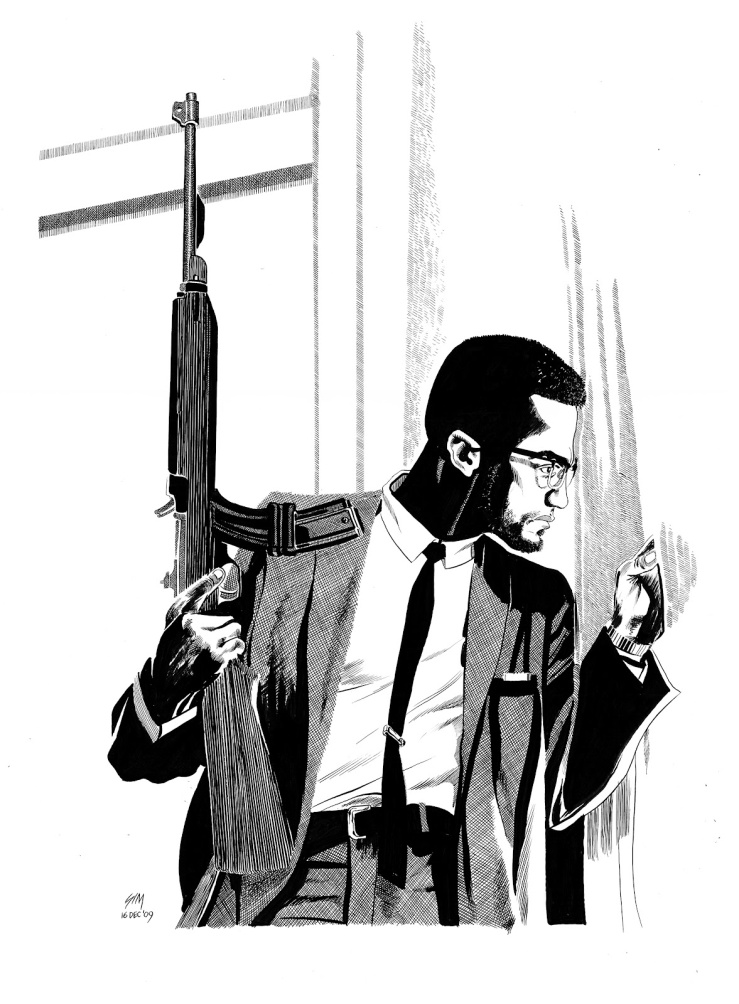
Malcolm X — Dave Sim
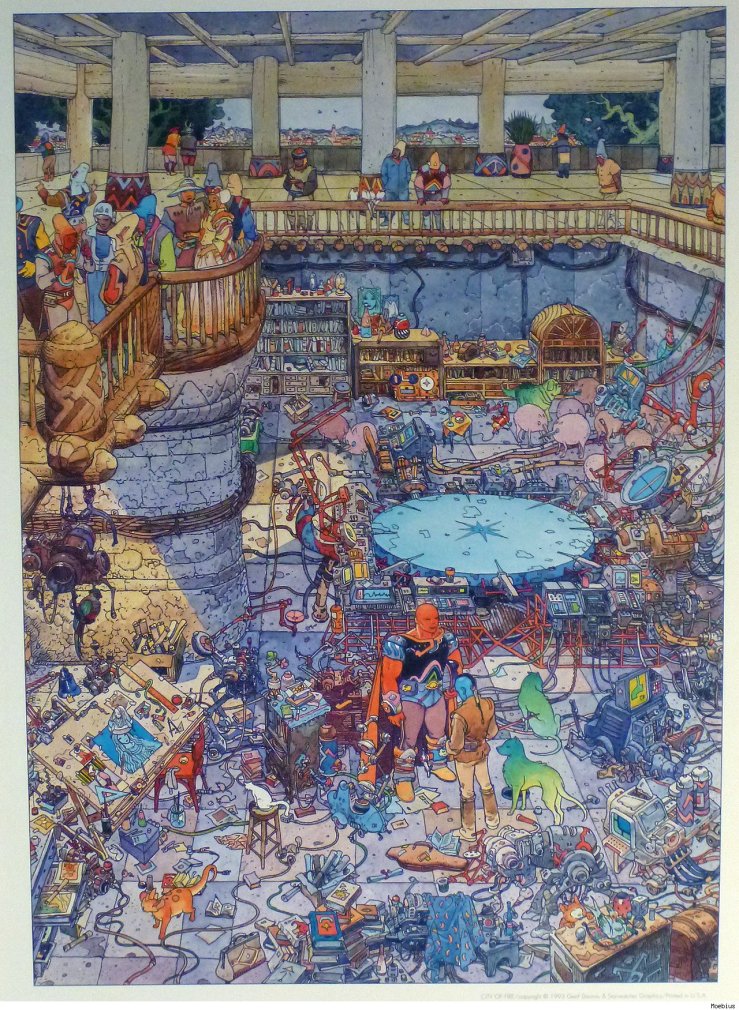
City of Fire — Moebius
“The Voyage” — Katherine Mansfield
“The Voyage”
by
Katherine Mansfield
The Picton boat was due to leave at half-past eleven. It was a beautiful night, mild, starry, only when they got out of the cab and started to walk down the Old Wharf that jutted out into the harbour, a faint wind blowing off the water ruffled under Fenella’s hat, and she put up her hand to keep it on. It was dark on the Old Wharf, very dark; the wool sheds, the cattle trucks, the cranes standing up so high, the little squat railway engine, all seemed carved out of solid darkness. Here and there on a rounded wood-pile, that was like the stalk of a huge black mushroom, there hung a lantern, but it seemed afraid to unfurl its timid, quivering light in all that blackness; it burned softly, as if for itself.
Fenella’s father pushed on with quick, nervous strides. Beside him her grandma bustled along in her crackling black ulster; they went so fast that she had now and again to give an undignified little skip to keep up with them. As well as her luggage strapped into a neat sausage, Fenella carried clasped to her her grandma’s umbrella, and the handle, which was a swan’s head, kept giving her shoulder a sharp little peck as if it too wanted her to hurry… Men, their caps pulled down, their collars turned up, swung by; a few women all muffled scurried along; and one tiny boy, only his little black arms and legs showing out of a white woolly shawl, was jerked along angrily between his father and mother; he looked like a baby fly that had fallen into the cream.
Then suddenly, so suddenly that Fenella and her grandma both leapt, there sounded from behind the largest wool shed, that had a trail of smoke hanging over it, “Mia-oo-oo-O-O!” Continue reading ““The Voyage” — Katherine Mansfield”
RIP Gordon Willis

RIP Gordon Willis, 1931-2014
Swallows — Edouard Manet

 Biblioklept