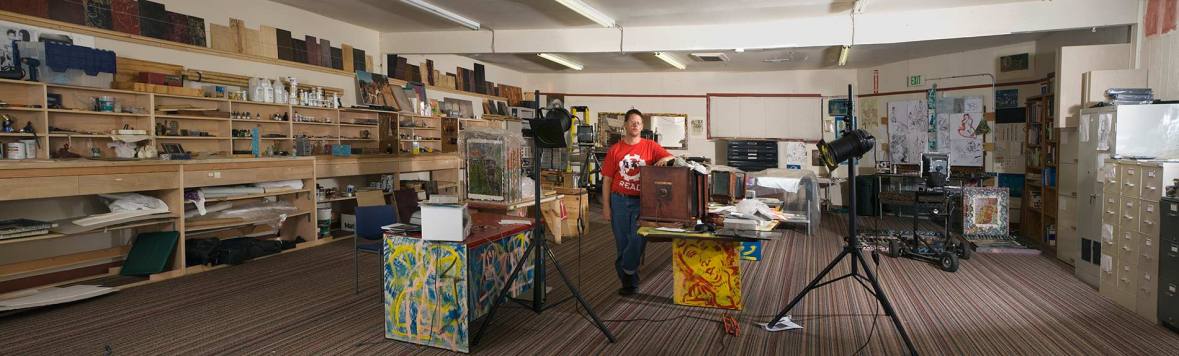
There’s a great big fat long profile of William T. Vollmann by Tom Bissell at The New Republic—it’s one of the better pieces I’ve read on an author who is more widely read about than, you know, read.
From the profile, details of a visit to Vollmann’s studio:
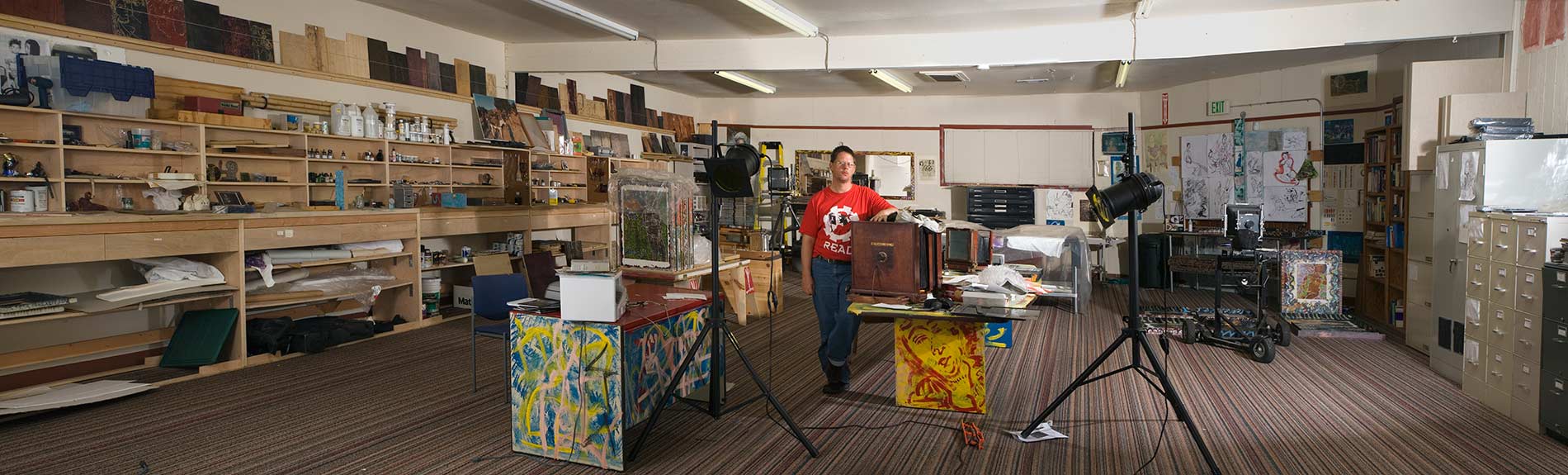
Half of Vollmann’s studio felt like a proper gallery, with finished pieces handsomely framed and displayed. The other half was split into what looked like a used bookstore on one side and a struggling industrial arts business on the other. I imagined Vollmann had a gallery somewhere that showed his stuff, yes? Actually, no. “I’ve had a couple of photographer friends who have shows,” Vollmann said. “Every time, they always end up impoverished.” He employs “a couple dealers” who sell his work to various institutions, but he considers his studio a “perpetual gallery.” Vollmann gets additional income from Ohio State, which has been buying Vollmann’s work and manuscripts for several years. Vollmann has no idea why Ohio State has shown such interest in his work, but he’s grateful to the institution, which has been paying the mortgage on his studio for the last decade.
He began our tour proper while a dinging train from the city’s light-rail line rumbled by, just feet from his curtained windows. Woodcuts, watercolors, ink sketches, silver-gelatin black-and-white photographs, portraits. “Gum-printing is a nineteenth-century technique,” he told me. “It’s the most permanent coloring process. But it’s slow, and toxic. … I also have this device here, which is based in dental technology. … It’s like a non-vibrating, very high-speed Dremel tool. … This was originally drawn with pen and ink, and then I had a magnesium block made with a photo resist.” Some of the pieces he showed me were complete; most were not. He estimated that he has “dozens and dozens” of pieces going at any one time.
Vollmann’s most important artistic influences are Gauguin and what he described as the “power colors” of Native American art. His other inescapable influence is the female body. The majority of Vollmann’s visual art centers upon women generally and geishas, sex workers, and those he calls “goddesses” specifically. Usually they are nude. From where I was standing I counted at least two dozen vaginas, their fleshy machinery painstakingly drawn and then painted over with a delicate red slash. Vollmann uses live models, so every vagina within sight is currently out there right now, wandering the world.



 Biblioklept