Werner Herzog’s Where the Green Ants Dream (Full Film)

https://www.youtube.com/watch?v=aE_LI-v4k58

An adventure in the esthetics (Krazy Kat)

IMG_3346.JPG

Natural Encounters — René Magritte

Microreview of Ben Marcus’s Leaving the Sea (Book Acquired, 9.17.2014)

IMG_3338

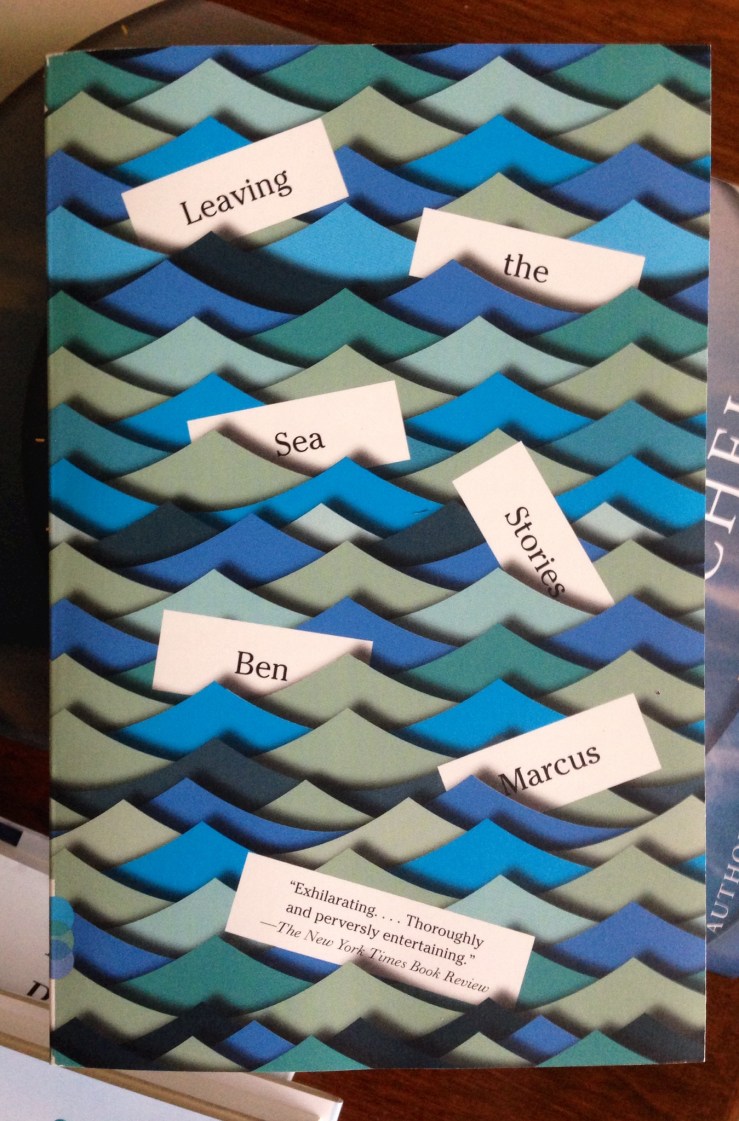
The kind people at Random House sent me a trade paperback of Ben Marcus’s latest collection, Leaving the Sea. The trade paperback comes out in early October.

I actually read the book this summer, and enjoyed it, was frustrated by it, occasionally sickened by it, was enthralled by at least two stories (“The Loyalty Protocol” and “The Moors”), and found one story to be so terribly sad and distressing and horrifying that I hope to never read anything like it again, which is kind of a compliment (“Rollingwood”).

I jammed Leaving the Sea into a riff on stuff I wished I’d written about in the first half of 2014. This is what I wrote:

Leaving the Sea, Ben Marcus: A weird and (thankfully) uneven collection that begins with New Yorkerish stories of a post-Lish stripe (like darker than Lipsyte stuff) and unravels (thankfully) into sketches and thought experiments and outright bizarre blips. Abjection, abjection, abjection. The final story ‘The Moors’ is a minor masterpiece.”

Read “On Not Growing Up” from the collection at Conjunctions. First paragraphs:

—HOW LONG HAVE YOU been a child?

—Seventy-one years.

—Who did you work with?

—Meyerowitz for the first phase: colic, teething, walking, talking. He taught me how to produce false prodigy markers and developmental reversals, to test the power in the room without speaking. I was encouraged to look beyond the tantrum and drastic mood migrations that depended on the environment, and if you know my work you have an idea what resulted. The rest is a hodgepodge, but I don’t advocate linear apprenticeships. A stint in the Bonn Residency. Fellowships at the Cleveland Place, then later a stage at Quebec Center. I entered that Appalachian Trail retreat in 1974, before Krenov revised it, but had to get helicoptered out. Probably my first infant crisis, before I knew to deliberately court interference. The debt to Meyerowitz is huge, obviously, if just for the innocence training. Probably I should have laid off after that, because now it’s all
about unlearning.

—Unlearning as Kugler practices it? That radical?

—I skip the hostility to animals. I skip the forced submersion and the chelation flush. That’s proven to be a dead end. But Kugler is a walking contradiction in that respect, isn’t he? He keeps a horse barn.
He does twilight childishness, and now he’s suddenly opposing the Phoenix baby-talk crowd, who I think are not as threatening as he makes out.

—They’re not registered.

Read “Consequences,” A Short Story by Willa Cather

“Consequences”

by

Willa Cather

Henry Eastman, a lawyer, aged forty, was standing beside the Flatiron building in a driving November rainstorm, signaling frantically for a taxi. It was six-thirty, and everything on wheels was engaged. The streets were in confusion about him, the sky was in turmoil above him, and the Flatiron building, which seemed about to blow down, threw water like a mill-shoot. Suddenly, out of the brutal struggle of men and cars and machines and people tilting at each other with umbrellas, a quiet, well-mannered limousine paused before him, at the curb, and an agreeable, ruddy countenance confronted him through the open window of the car.

“Don’t you want me to pick you up, Mr. Eastman? I’m running directly home now.”

Eastman recognized Kier Cavenaugh, a young man of pleasure, who lived in the house on Central Park South, where he himself had an apartment.

“Don’t I?” he exclaimed, bolting into the car. “I’ll risk getting your cushions wet without compunction. I came up in a taxi, but I didn’t hold it. Bad economy. I thought I saw your car down on Fourteenth Street about half an hour ago.”

The owner of the car smiled. He had a pleasant, round face and round eyes, and a fringe of smooth, yellow hair showed under the rim of his soft felt hat. “With a lot of little broilers fluttering into it? You did. I know some girls who work in the cheap shops down there. I happened to be down-town and I stopped and took a load of them home. I do sometimes. Saves their poor little clothes, you know. Their shoes are never any good.”

Eastman looked at his rescuer. “Aren’t they notoriously afraid of cars and smooth young men?” he inquired. Continue reading “Read “Consequences,” A Short Story by Willa Cather”

Hollander — Yoshitora Utagawa