Mason makes quick Head-Turns, to Left and Right, and lowers his Voice. “Whilst you’ve been out rollicking with your Malays and Pygmies, what have you heard of the various sorts of Magick, that they are said to possess?”
Dixon has in fact heard, from an assortment of Companions native to the Dutch Indies. Tales of Sorcery, invisible Beings, daily efforts to secure Shelter against Demonic Infestation.
“They are not as happy, nor as childlike, as they seem,” he tells Mason. “It may content us, as unhappy grown Englishmen, to think that somewhere in the World, Innocence may yet abide,— yet ’tis not among these people. All is struggle,— and all but occasionally in vain.”
Mason cocks his head, trying to suppress a certain Quiver that also gives him away when at Cards,— a bodily Desire to risk all upon a single Trick. “Would you happen to enjoy Entree to this world of Sorcery? I
am anxious as to Protection.”
“A Spell…?” Dixon suggests.
“Emphatickally not a Love-Potion, you understand, no, no, quite the contrary indeed.”
Dixon, to spare himself what might else prove to be Evenings-ful of Complaint, says, “I’ve met people who are said to possess a special Power,— the Balinese Word is Sakti. It has not, however, always been successful against Dutchmen. Would this be a Hate potion, then, that tha require?”
“Well, certainly not Hate. Inconvenient as Love, in its own way,— no, more of an Indifference-Draught, ‘s more what I had in mind. ‘Twould have to be without odor or Taste, and require but a few Drops,—”
“I could have a look about, tho’ ’tis more common here to accept what they happen to offer…?”
Today is Black Friday in America. I don’t think it’s necessary to remark at length on the bizarre disjunction between this exercise in consumerism-as-culture and the intended spirit of the Thanksgiving holiday that precedes it. Indeed, I think that the cognitive dissonance that underwrites Black Friday—the compulsion to suffer (and cause suffering), both physically and mentally, to “save” money on “consumer goods” (sorry for all the scare quotes, but these terms are euphemisms and must be placed under suspicion)—I think that this cognitive dissonance is nakedly apparent to all who choose to (or are forced to) actively engage in Black Friday. The name itself is dark, ominous, wonderfully satanic.
Rereading “The Subliminal Man,” I was struck by how presciently J.G. Ballard anticipated not only the contours of consumerist culture—urban sprawl, a debt-based economy, the mechanization of leisure, the illusion of freedom of choice—but also how closely he intuited the human, psychological responses to the consumerist society he saw on the horizon. Half a century after its publication, “The Subliminal Man” seems more relevant than ever.
The premise of the tale is fairly straightforward and fits neatly with the schema of many other early Ballard stories: Franklin, an overworked doctor, is approached by Hathaway, a “crazy beatnik,” who refuses to take part in the non-stop consumerism of contemporary society. Hathaway can “see” the subliminal messages sent through advertising. He asks for Franklin’s help in stopping the spread of these messages. Hathaway reasons that the messages are intended to enforce consumerist society:
Ultimately we’ll all be working and spending twenty–four hours a day, seven days a week. No one will dare refuse. Think what a slump would mean – millions of lay–offs, people with time on their hands and nothing to spend it on. Real leisure, not just time spent buying things . . .
The fear of a slump. You know the new economic dogmas. Unless output rises by a steady inflationary five per cent the economy is stagnating. Ten years ago increased efficiency alone would raise output, but the advantages there are minimal now and only one thing is left. More work. Subliminal advertising will provide the spur.
Franklin is unconvinced, even though he is already working Saturdays and Sunday mornings to payoff TVs, radios, and other electronic goods that he and his wife replace every few months. Soon, however, he realizes that something is wrong:
He began his inventory after hearing the newscast, and discovered that in the previous fortnight he and Judith had traded in their Car (previous model 2 months old) 2 TV sets (4 months) Power mower (7 months) Electric cooker (5 months) Hair dryer (4 months) Refrigerator (3 months) 2 radios (7 months) Record player (5 months) Cocktail bar (8 months)
Franklin finally sees the truth, but only after Hathaway takes to blowing up signs’ switch boxes (the word “terrorism” is of course not used in the text, although it surely would be today):
Then the flicker of lights cleared and steadied, blazing out continuously, and together the crowd looked up at the decks of brilliant letters. The phrases, and every combination of them possible, were entirely familiar, and Franklin knew that he had been reading them for weeks as he passed up and down the expressway.
BUY NOW BUY NOW BUY NOW BUY NOW BUY NEW CAR NOW NEW CAR NOW NEW CAR NOW
YES YES YES YES YES YES YES YES YES YES
Like many Ballard stories, “The Subliminal Man” ends on a pessimistic note, with Franklin choosing to ignore his brief enlightenment and give in. Ballard drives his criticism home in the final image of the story, with Franklin and his wife heading out to shop:
They walked out into the trim drive, the shadows of the signs swinging across the quiet neighbourhood as the day progressed, sweeping over the heads of the people on their way to the supermarket like the blades of enormous scythes.
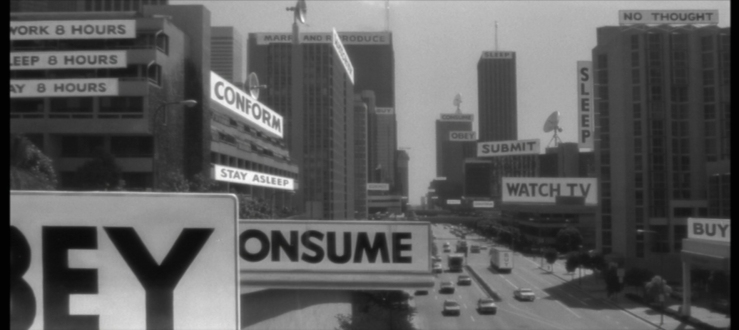
“The Subliminal Man” offers a critique of consumerism that John Carpenter would make with more humor, violence, and force in his 1988 film They Live. In Carpenter’s film, the hero John Nada (played by Roddy Piper) finds a pair of sunglasses that allow him to see through the ads, billboards, and other commercials he’s exposed. What’s underneath? Naked consumerism:
The images here recall the opening lines of “The Subliminal Man”: ‘The signs, Doctor! Have you seen the signs?’ Like Ballard’s story, Carpenter’s film is about waking up, to seeing the controlling messages under the surface.
In his film The Pervert’s Guide to Ideology, Slavoj Žižek offers a compelling critique of just how painfulit is to wake up to these messages:
It’s worth pointing out that Carpenter offers a far more optimistic vision than Ballard. Ballard’s hero gives in—goes back to sleep, shuts his eyes. Carpenter’s hero Nada resists the subliminal messages—he actually takes up arms against them. This active resistance is possible because Carpenter allows his narrative an existential escape hatch: In They Live, there are real, genuine bad guys, body-snatching ugly-assed aliens—others that have imposed consumerism on humanity to enslave them. That’s the big trick to They Live: It’s not us, it’s them.
Ballard understands that there is no them; indeed, even as the story skirts around the idea of a conspiracy to dupe consumers into cycles of nonstop buying, working, and disposing, it never pins that conspiracy on any individual or group. There’s no attack on corporations or government—there’s not even a nebulous “them” or “they” that appears to have controlling agency in “The Subliminal Man.” Rather, Ballard’s story posits ideology as the controlling force, with the only escape a kind of forced suicide.
I don’t think that those who engage in consumerism-as-sport, in shopping-as-a-feeling are as blind as Ballard or Carpenter represent. I think they are aware. Hell, they enjoy it. What I think Ballard and Carpenter (and others, of course) really point to is the deep dissatisfaction that many of us feel with this dominant mode of life. For Ballard, we have resistance in the form of the beatnik Hathaway, an artist, a creator, a person who can perceive what real leisure would mean. For Carpenter, Nada is the resister—an outsider, a loner, a weirdo too. It’s somehow far more satisfying to believe that those who engage in spectacle consumerism are brainwashed by aliens than it is to have to come to terms with the notion that these people are acting through their own agency, of their own will and volition. Happy shopping everyone!
Ed. note: Biblioklept published a version of this post last year. It is offered again now in the spirit of Thanksgiving leftovers.
Mason, having expected some shambling wild Country Fool, remains amiably puzzl’d before the tidied Dixon here presented,— who, for his own part, having despite talk of Oddity expected but another overdress’d London climber, is amus’d at Mason’s nearly invisible Turn-out, all in Snuffs and Buffs and Grays.
Mason is nodding glumly. “I must seem an Ass.”
“If this is as bad as it gets, why I can abide thah’. As long as the Spirits don’t run out.”
“Nor the Wine.”
“Wine.” Dixon is now the one squinting. Mason wonders what he’s done this time. ” ‘Grape or Grain, but ne’er the Twain,’ as me Great- Uncle George observ’d to me more than once,— ‘Vine with Corn, beware the Morn.’ Of the two sorts of drinking Folk this implies, than’ is, Grape People and Grain People, You will now inform rne of Your membership in the Brotherhood of the, eeh, Grape…? and that You seldom, if ever, touch Ale or Spirits, am I correct?”
“Happily so, I should imagine, as, given a finite Supply, there’d be more for each of us, it’s like Jack Sprat, isn’t it.”
“Oh, I’ll drink Wine if I must…?— and now we’re enter’d upon the Topick,— ”
“— and as we are in Portsmouth, after all,— there cannot lie too distant some Room where each of us may consult what former Vegetation pleases him?”
Dixon looks outside at the ebbing wintry sunlight. “Nor too early, I guess…?”
“We’re sailing to the Indies,— Heaven knows what’s available on Board, or out there. It may be our last chance for civiliz’d Drink.”
“Sooner we start, the better, in thah’ case…?”
As the day darkens, and the first Flames appear, sometimes reflected as well in Panes of Glass, the sounds of the Stables and the Alleys grow louder, and chimney-smoke perambulates into the Christmastide air. The Room puts on its Evening-Cloak of shifting amber Light, and sinuous Folds of Shadow. Mason and Dixon become aware of a jostling Murmur of Expectancy.
All at once, out of the Murk, a dozen mirror’d Lanthorns have leapt alight together, as into their Glare now strolls a somewhat dishevel’d Norfolk Terrier, with a raffish Gleam in its eye,— whilst from somewhere less illuminate comes a sprightly Overture upon Horn, Clarinet, and Cello, in time to which the Dog steps back and forth in his bright Ambit.
Ask me anything you please,
The Learned English Dog am I,
well-Up on ev’rything from Fleas Unto the King’s Mon-og-am-eye,
Persian Princes, Polish Blintzes, Chinamen’s Geo-mancy,—
Jump-ing Beans or Flying Machines, Just as it suits your Fan-cy.
I quote enough of the Classickal Stuff To set your Ears a-throb,
Work logarith-mick Versed Sines Withal, within me Nob,
– Only nothing Ministerial, please, Or I’m apt to lose m’ Job,
As, the Learned English Dog, to-ni-ight!
There are the usual Requests. Does the Dog know “Where the Bee Sucks”? What is the Integral of One over (Book) d (Book)? Is he married? Dixon notes how his co-Adjutor-to-be seems fallen into a sort of Magnetickal Stupor, as Mesmerites might term it. More than once, Mason looks ready to leap to his feet and blurt something better kept till later in the Evening. At last the Dog recognizes him, tho’ now he is too key’d up to speak with any Coherence. After allowing him to rattle for a full minute, the Dog sighs deeply. “See me later, out in back.”
“It shouldn’t take but a moment,” Mason tells Dixon. “I’ll be all right by myself, if there’s something you’d rather be doing….”
Once upon a time there lived in Hindustan two kings whose countries bordered upon each other; but, as they were rivals in wealth and power, and one was a Hindu rajah and the other a Mohammedan bâdshah, they were not good friends at all. In order, however, to escape continual quarrels, the rajah and the bâdshah had drawn up an agreement, stamped and signed, declaring that if any of their subjects, from the least to the greatest, crossed the boundary between the two kingdoms, he might be seized and punished.
One morning the bâdshah and his chief wazir, or prime minister, were just about to begin their morning’s work over the affairs of the kingdom, and the bâdshah had taken up a pen and was cutting it to his liking with a sharp knife, when the knife slipped and cut off the tip of his finger.
‘Oh-he, wazir!’ cried the king, ‘I’ve cut the tip of my finger off!’
‘That is good hearing!’ said the wazir in answer.
‘Insolent one,’ exclaimed the king. ‘Do you take pleasure in the misfortunes of others, and in mine also? Take him away, my guards, and put him in the court prison until I have time to punish him as he deserves!’
Instantly the officers in attendance seized upon the luckless wazir, and dragged him out of the king’s presence towards the narrow doorway, through which unhappy criminals were wont to be led to prison or execution. As the door opened to receive him, the wazir muttered something into his great white beard which the soldiers could not hear.



 Biblioklept