
Happiness in this world, when it comes, comes incidentally. Make it the object of pursuit, and it leads us a wild-goose chase, and is never attained. Follow some other object, and very possibly we may find that we have caught happiness without dreaming of it; but likely enough it is gone the moment we say to ourselves, “Here it is!” like the chest of gold that treasure-seekers find.
Month: February 2015
ESL — James Jean
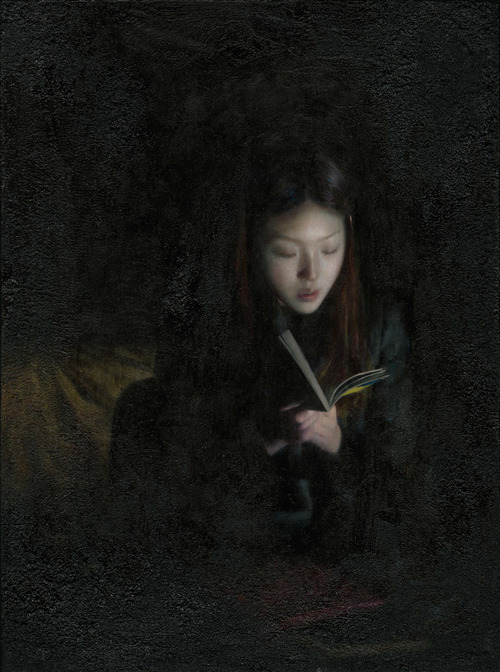
“Fern” — Jean Toomer
“Fern”
from Cane
by Jean Toomer
Face flowed into her eyes. Flowed in soft cream foam and plaintive ripples, in such a way that wherever your glance may momentarily have rested, it immediately thereafter wavered in the direction of her eyes. The soft suggestion of down slightly, like the shadow of a bird’s wing might, the creamy brown color of her upper lip. Why, after noticing it, you sought her eyes, I cannot tell you. Her nose was aquiline, Semitic. If you have heard a Jewish Cantor sing, if he has touched you and made your own sorrow seem trivial when compared with his, you will know my feeling when I follow the curves of her profile, like mobile rivers, to their common delta. They were strange eyes. In this, that they sought nothing—That is, nothing that was obvious and tangible and that one could see, and they gave the impression that nothing was to be denied. When a woman seeks, you will have observed, her eyes deny. Fern’s eyes desired nothing that you could give her; there was no reason why they should withhold. Men saw her eyes and fooled themselves. Fern’s eyes said to them that she was easy. When she was young, a few men took her, but got no joy from it. And then, once done, they felt bound to her (quite unlike their hit and run with other girls), felt as though it would take them a lifetime to fulfill an obligation which they could find no name for. They became attached to her, and hungered after finding the barest trace of what she might desire. As she grew up, new men who came to town felt as almost everyone did who ever saw her: that they would not be denied. Men were everlastingly bringing her their bodies. Something inside of her got tired of them, I guess, for I am certain that for the life of her she could not tell why or how she began to turn them off. A man in fever is no trifling thing to send away. They began to leave her, baffled and ashamed, yet vowing to themselves that some day they would do some fine thing for her: send her candy every week and not let her know whom it came from, watch out for her wedding-day and give her a magnificent something with no name on it, buy a house and deed it to her, rescue her from some unworthy fellow who had tricked her into marrying him. As you know, men are apt to idolize or fear that which they cannot understand, especially if it be a woman. She did not deny them, yet the fact was that they were denied. A sort of superstition crept into their consciousness of her being somehow above them. Being above them meant that she was not to be approached by anyone. She became a virgin. Now a virgin in a small southern town is by no means the usual thing, if you will believe me. That the sexes were made to mate is the practice of the South. Particularly, black folks were made to mate. And it is black folks whom I have been talking about thus far. What white men thought of Fern I can arrive at only by analogy. They let her alone.
Anyone, of course, could see her, could see her eyes. If you waked up the Dixie Pike most any time of day, you’d be most likely to see her resting listless-like on the railing of the porch, back propped against a post, head tilted a little forward because there was a nail in the porch post just where her head came which for some reason or other she never took the trouble to pull out. Her eyes, if it were sunset, rested idly where the sun, molten and glorious, was pouring down between the fringe of pines. Or maybe they gazed at the gray cabin on the knoll from which an evening folk-song was coming. Perhaps they followed a cow that had been turned loose to roam and feed on cotton-stalks and corn leaves. Like as not they’d settle on some vague spot above the horizon, though hardly a trace of wistfulness would come to them. If it were dusk, then they’d wait for the search-light of the evening training which you could see miles up the track before it flared across the Dixie Pike, close to her home. Whereever they looked, you’d follow them and then waver back. Like her face, the whole countryside seemed to flow into her eyes. Flowed into them with the soft listless cadence of Georgia’s South. A young Negro, once, was looking at her, spellbound, from the road. A white man passing in a buggy had to flick him with his whip if he was to get by without running him over. I first saw her on the porch. I was passing with a fellow whose crusty numbness (I was from the North and suspected of being prejudiced and stuck-up) was melting as he found me warm. I asked him who she was. “That’s Fern,” was all that I could get from him. Continue reading ““Fern” — Jean Toomer”
Studio Interior with Casts — Adolph von Menzel

Moondog – Moondog (1969) (Full Album)
Dreams No. 2 — Jacob Lawrence

“The Debt” — Paul Laurence Dunbar

Moby-Dick — Emmanuel Polanco

“Cover” by Emmanuel Polanco. From 50 Watts’ Polish book cover contest.
Signs Preceding the End of the World (Book acquired, 2.13.2015)

Yuri Herrera’s novel Signs Preceding the End of the World is forthcoming from And Other Stories. It looks pretty good. Their blurb:
Signs Preceding the End of the World is one of the most arresting novels to be published in Spanish in the last ten years. Yuri Herrera does not simply write about the border between Mexico and the United States and those who cross it. He explores the crossings and translations people make in their minds and language as they move from one country to another, especially when there’s no going back.
Traversing this lonely territory is Makina, a young woman who knows only too well how to survive in a violent, macho world. Leaving behind her life in Mexico to search for her brother, she is smuggled into the USA carrying a pair of secret messages – one from her mother and one from the Mexican underworld.
Guillermo del Toro on Watership Down
Fishbowl — Jason Chan

The Dewey Awards (Mr. Show)
The Bus — Paul Kirchner

Laughing alone (Schopenhauer)
I am not surprised that people are bored when they are alone; they cannot laugh when they are alone, for such a thing seems foolish to them. Is laughter, then, to be regarded as merely a signal for others, a mere sign, like a word? It is a want of imagination and dullness of mind generally as Theophrastus puts it, that prevents people from laughing when they are alone. The lower animals neither laugh when they are alone nor in company.
Nyson, the misanthropist, was surprised as he was laughing to himself by one of these people, who asked him why he laughed when he was alone. “That is just why I was laughing,” was the answer.
Arthur Schopenhauer. From Dircks’s translation of Essays of Schopenhauer.
Morfinomane — Vittorio Corcos

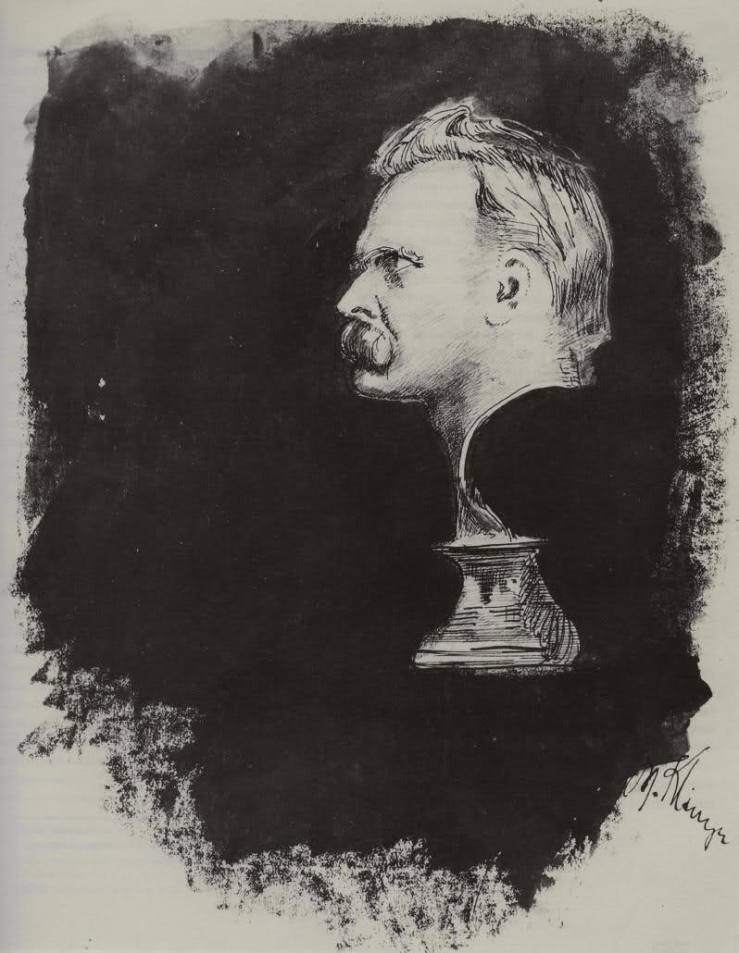
Nietzsche — Max Klinger
Tacere — Dino Valls

 Biblioklept