RIP E.L. Doctorow

1413225265_331013_1413225484_noticia_normal

RIP E.L. Doctorow, 1931-2015

Ragtime–-what a book. Up there with the best of the metafictionists, if also different, to its credit. I dug The March too, even though historical fiction isn’t my bag. Read “Wakefield,” Doctorow’s recasting of Hawthorne’s classic tale. First paragraph:

People will say that I left my wife and I suppose, as a factual matter, I did, but where was the intentionality? I had no thought of deserting her. It was a series of odd circumstances that put me in the garage attic with all the junk furniture and the raccoon droppings—which is how I began to leave her, all unknowing, of course—whereas I could have walked in the door as I had done every evening after work in the fourteen years and two children of our marriage. Diana would think of her last sight of me, that same morning, when she pulled up to the station and slammed on the brakes, and I got out of the car and, before closing the door, leaned in with a cryptic smile to say goodbye—she would think that I had left her from that moment. In fact, I was ready to let bygones be bygones and, in another fact, I came home the very same evening with every expectation of entering the house that I, we, had bought for the raising of our children. And, to be absolutely honest, I remember I was feeling that kind of blood stir you get in anticipation of sex, because marital arguments had that effect on me.

A riff on J.G. Ballard’s superb degenerate satire High-Rise

  1. Ballard-High-RiseWith the bad taste of a recentish YAish post-apocalyptish novel in my brain, I riffled through some old sci-fi titles, hoping to find something to hit “reset.” J.G. Ballard’s 1975 novel High-Rise—which I hadn’t read since I was a teenager—wrapped me up immediately with its opening  sentence:

    Later, as he sat on his balcony eating the dog, Dr Robert Laing reflected on the unusual events that had taken place within this huge apartment building during the previous three months.

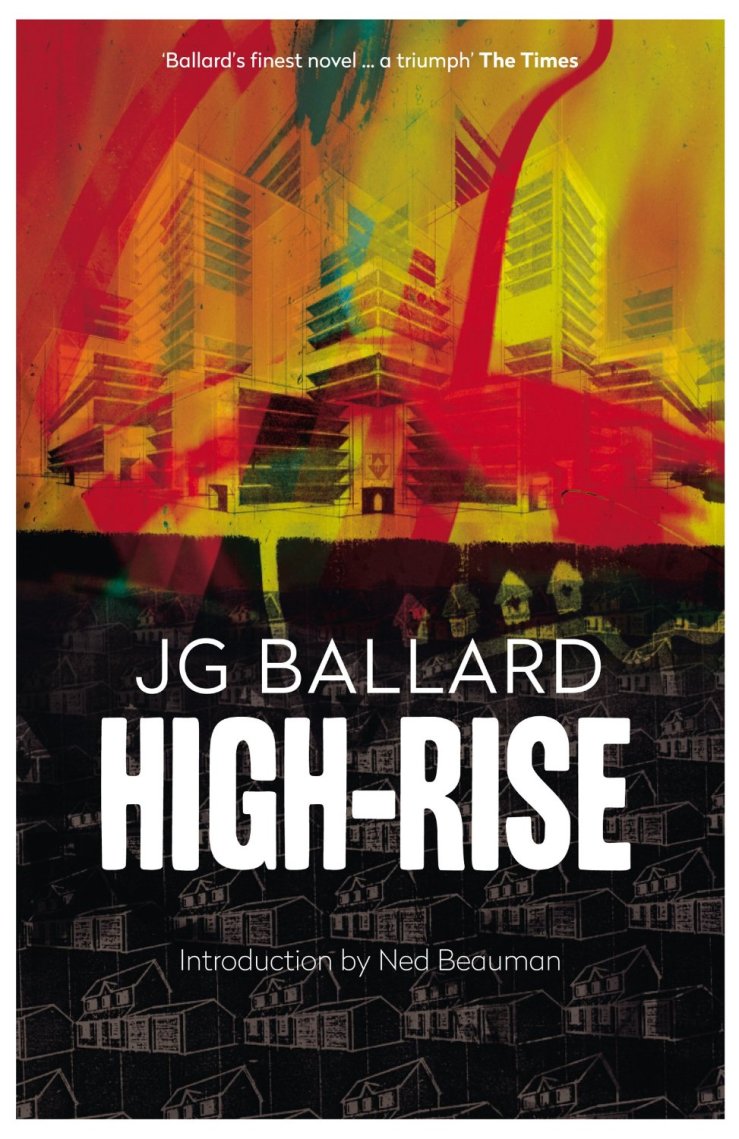
  2. (If the promise of that first line doesn’t intrigue you, High-Rise isn’t for you. Maybe you’ll enjoy all the old High-Rise covers I couldn’t help but to scatter through this riff).
  3. The first chapter of High-Rise is aptly titled “Critical Mass.” This is a book where things, uh, escalate quickly, if you’ll forgive my indulging in the parlance of our times. Ballard dispenses with any simmering in his tale of depraved debauchery (or is that debauched depravity?). He gets that pot boilin’.ballard-high-rise
  4. Depravity. Debauchery. Degeneration. The boiling pot of late-20th century consciousness.
  5. So, what is High-Rise about? Like, the plot, man? Class-war in a high-rise condo: A self-contained society that fails, its id overspilling into sex and violence: The veneer dissolved in piss and spite. And the best part? Ballard dispenses with any sort of explanation whatsoever. We begin at critical mass. He counted on his late-20th-century reader to intuit the whole damn deal (or throw down the book in defensive disgust).
  6. Ballard structures the book around three anti-heroes, who represent, probably, id, ego, and superego—or rather, what I mean to say is ironic send-ups of id, ego, and superego—with the high-rise itself a kind of consciousness in crisis.6001572752_4a601a081e_b
  7. From the middle-class (and perhaps ego)—the 25th floor—there’s Dr. Robert Laing—not really a practicing doctor, no, but he works at a teaching hospital. Ballard tricks us into thinking he’s the protagonist—which I guess he is!—by which I mean audience surrogate, and also typical Ballardian hero (divorced; mama issues; a drinker). His name may recall to you the (anti-)psychiatrist R.D. Laing (as well as, perhaps, Language).
  8. We might find a tidy—as in sanitary–summary of High-Rise in this brief excerpt, where our ego hero Laing packs away his tools and totems of the old world in anticipation of the new one to come:

    In this suitcase-sized cavity he hid away his cheque book and insurance policies, tax returns and share certificates. Lastly, he forced in his medical case with vials of morphine, antibiotics and cardiac stimulants. When he nailed the floorboards back into place he felt that he was sealing away for ever the last residues of his previous life, and preparing himself without reservation for the new one to come.

  9. The phrase “to come” — as in a future to come — repeats throughout High-Rise—a kind of irony, ultimately, that I shouldn’t step all over here. I’ll get back to that momentarily, but—
  10. Ballard soon trips us up by shifting his free-indirect style from Laing to Richard Wilder of the 2nd floor. A bestial brawny brawly dude (and the only father in this trio of anti-heroes) Wilder (c’mon with that name man!) is id id id all the way down (up). Wilder’s also a filmmaker, a camera in his hand, a sensing thing all the way down (up). He causes some problems.
  11. (The idea that a middle-class man like Wilder might represent the proletariat here is addressed in more (although oblique) depth in Ballard’s 2003 novel Millennium People).
  12. And then the super-ego/upper crust: Anthony Royal (O! c’mon with that name dammit!) of the penthouse. He’s the literal architect of the high-rise, which makes him possibly maybe probably responsible for its many, many design flaws, which boil down to intake, outtake, and power, but look like parking, garbage, and electricity.High-Rise
  13. And so Ballard shuttles us between these three consciousnesses, like the elevators that symbolically anchor this novel. (Anchor is a terrible verb for these mobile metaphors. Or maybe it’s the precise verb).
  14. Like I said in point 5, Ballard doesn’t really bother to foreground the causes for the high-rises’s society’s degenerate descent (ascent?)—instead, he offers concrete contours and psychological descriptions. Like this one, when a psychiatrist (yep) offers this analysis to Laing (and the reader, of course):

    I had a bucket of urine thrown over me this afternoon. Much more of that and I may take up a cudgel myself. It’s a mistake to imagine that we’re all moving towards a state of happy primitivism. The model here seems to be less the noble savage than our un-innocent post-Freudian selves, outraged by all that over-indulgent toilet-training, dedicated breast-feeding and parental affection — obviously a more dangerous mix than anything our Victorian forebears had to cope with. Our neighbours had happy childhoods to a man and still feel angry. Perhaps they resent never having had a chance to become perverse . . .

  15. (“Perverse” is a term that repeats throughout High-Rise, and I had to leave in those bucket of urine and cudgel details).
  16. The concrete contours, the description, the late-20th century analysis—that’s the reason to boil along with High-Rise. The book is fucking fun in its thrilling awful decadence—it’s Lord of the Flies for adults, with the spiritual mumbo-jumbo replaced with psychiatric mumbo-jumbo. Or Salò.
  17. Back to that future to come thing, here’s another citation, at some length (enjoy those concrete contours), but with my emphasis in boldface if you’re in some big fucking hurry:

    Still uncertain how long he had been awake, or what he had been doing half an hour earlier, Laing sat down among the empty bottles and refuse on the kitchen floor. He gazed up at the derelict washing-machine and refrigerator, now only used as garbage-bins. He found it hard to remember what their original function had been. To some extent they had taken on a new significance, a role that he had yet to understand. Even the run-down nature of the high-rise was a model of the world into which the future was carrying them, a landscape beyond technology where everything was either derelict or, more ambiguously, recombined in unexpected but more meaningful ways. Laing pondered this — sometimes he found it difficult not to believe that they were living in a future that had already taken place, and was now exhausted.

  18. Ballard’s describing the late 20th century there, but perhaps he intuits the beginning of the 21st as well.91ihsrhnexl-_sl1500_
  19. —Or maybe those are the same thing, I suppose—I mean, High-Rise was published in 1975, four decades ago, but doesn’t feel that old. For some perspective, Karel Capek’s War with the Newts was published in 1936, almost forty years before High-Rise, and that novel doesn’t feel horribly dated either, a tribute to its sharp satire.
  20. —Which is my way of transitioning to the probably completely non-controversial idea that High-Rise is wonderful dark satire. Ballard ushers our consciousness to the high-rise’s summit through surrogate Laing, the limited concrete prose focused on the failed doctor’s misperception of transcendence. Laing perceives himself as the conquering brute, alpha male par excellence, inheritor not only of the falling high-rise, but also its female cohort, his harem in a future to come, his genealogical generativity restored. Laing can’t see that he’s been x’ed out of this equation, the failed phallic figure jutting impotently into mother sky.
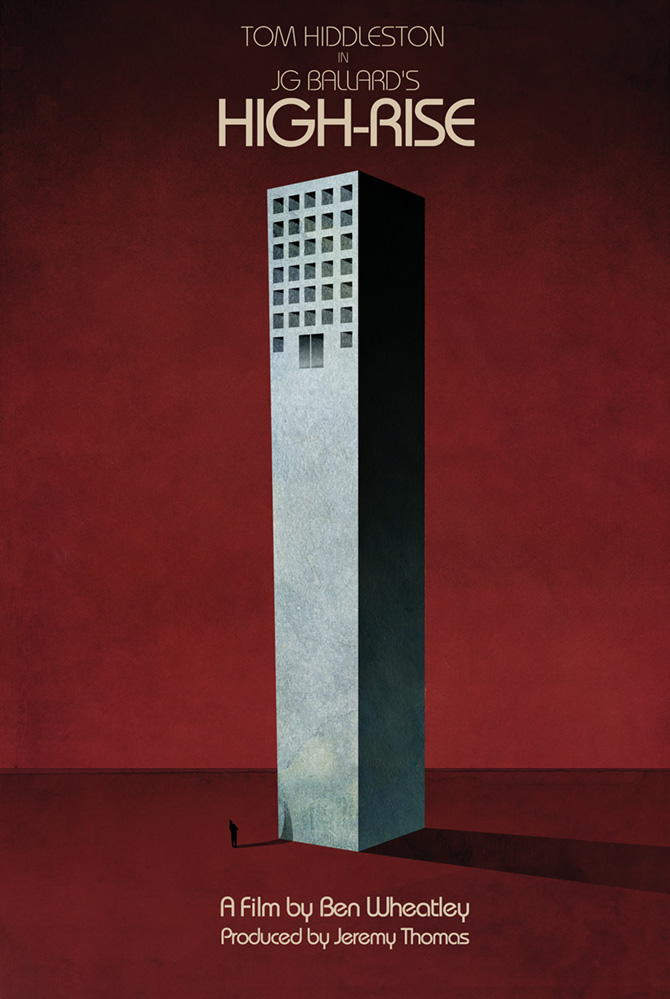
  21. So you know that High-Rise is going to be a movie? A Major Motion Picture? Starring Tom Hiddleston? As cynical as I am, I think the book should make a fine film—it’s adaptable, yes. It could even be a great video game. A video game where you eat a dog. A video game where you think you win, but you don’t.

“Montparnasse” — Ernest Hemingway

Detail from Crivelli’s Annunciation

Screenshot 2015-07-20 at 9.26.10 AM