Artist and Chimera — Jacek Malczewski

A–Z of linguistics in rhyming couplets

Stan Carey's avatarSentence first

Here’s a self-explanatory bit of silliness from Twitter yesterday. There were requests to assemble it somewhere, for convenience and posterity, so I figured I’d reproduce it on Sentence first.

I’ve replaced the quotation marks I used on Twitter with italics; other than that it’s identical. The tweets are all linked, so you can also read them by clicking on the date of this introductory one:

*

*

A is for ARBITRARY: a sound’s tie to meaning.
B is for BACK-FORMED, like dry-clean from dry-cleaning.

View original post 225 more words

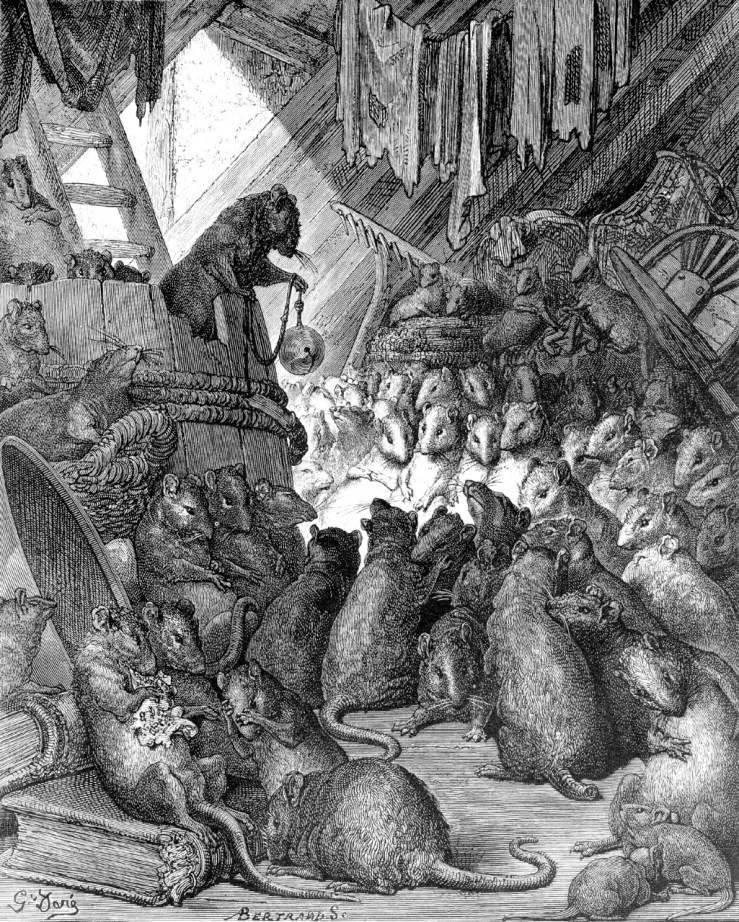
The Council of Rats — Gustave Dore

tumblr_ly1wo5oUy91qb8f0mo1_1280

“Masculine Literature” — Charlotte Perkins Gilman

“Masculine Literature”

by

Charlotte Perkins Gilman

(from Our Androcentric Culutre; or, The Man Made World)


When we are offered a “woman’s” paper, page, or column, we find it filled with matter supposed to appeal to women as a sex or class; the writer mainly dwelling upon the Kaiser’s four K’s—Kuchen, Kinder, Kirche, Kleider. They iterate and reiterate endlessly the discussion of cookery, old and new; of the care of children; of the overwhelming subject of clothing; and of moral instruction. All this is recognized as “feminine” literature, and it must have some appeal else the women would not read it. What parallel have we in “masculine” literature?

“None!” is the proud reply. “Men are people! Women, being ‘the sex,’ have their limited feminine interests, their feminine point of view, which must be provided for. Men, however, are not restricted—to them belongs the world’s literature!”

Yes, it has belonged to them—ever since there was any. They have written it and they have read it. It is only lately that women, generally speaking, have been taught to read; still more lately that they have been allowed to write. It is but a little while since Harriet Martineau concealed her writing beneath her sewing when visitors came in—writing was “masculine”—sewing “feminine.” Continue reading ““Masculine Literature” — Charlotte Perkins Gilman”

Thomas Jefferson Writing the Declaration of Independence — Howard Pyle

Christ Tempted by Satan to Turn the Stones to Bread — William Blake

O Terceiro Polícia — Flann O’Brien

FlannLisbon

From Bertrand Bookstore in Lisbon, the longest continuously operating bookstore in the world (it opened in 1732).

“Men and Art” — Charlotte Perkins Gilman

“Men and Art”

by

Charlotte Perkins Gilman

(from Our Androcentric Culutre; or, The Man Made World)


Among the many counts in which women have been proven inferior to men in human development is the oft-heard charge that there are no great women artists. Where one or two are proudly exhibited in evidence, they are either pooh-poohed as not very great, or held to be the trifling exceptions which do but prove the rule.

Defenders of women generally make the mistake of over-estimating their performances, instead of accepting, and explaining, the visible facts. What are the facts as to the relation of men and women to art? And what, in especial, has been the effect upon art of a solely masculine expression?

When we look for the beginnings of art, we find ourselves in a period of crude decoration of the person and of personal belongings. Tattooing, for instance, is an early form of decorative art, still in practice among certain classes, even in advanced people. Most boys, if they are in contact with this early art, admire it, and wish to adorn themselves therewith; some do so—to later mortification. Early personal decoration consisted largely in direct mutilation of the body, and the hanging upon it, or fastening to it, of decorative objects. This we see among savages still, in its gross and primitive forms monopolized by men, then shared by women, and, in our time, left almost wholly to them. In personal decoration today, women are still near the savage. The “artists” developed in this field of art are the tonsorial, the sartorial, and all those specialized adorners of the body commonly known as “beauty doctors.” Continue reading ““Men and Art” — Charlotte Perkins Gilman”

Operation Wednesday — Leonora Carrington

Battle of the Gods That Have Been Transformed — Ernst Fuchs

Bob Rafelson and Jack Nicholson on the diner scene in Five Easy Pieces

Still Life with a Wine Cooler — Frans Snyders

New Evan Lavender-Smith short story, “For This Relief, Much Thanks”

At The Offing, read “For This Relief, Much Thanks,” a new story by Evan Lavender-Smith. First two paragraphs:

Worried, even certain, will die on upcoming Peru trip — card-carrying hypochondriac — so jotting down some instructions for you. Here goes.

First thing, ms. on ugly brown reclining chair in study, containing, near end, these very instructions — card-carrying metafictionist — requires thorough proofreading before sending out. Aim high initially, as I am of opinion this one may deserve proper publication by proper house, proper distribution to brick-and-mortars, etc., unlike first two. Hopeful royalties, if any, suffice to cover boy’s dental care in upcoming years. Good boy, as you know, deserving of straight teeth. Maybe royalties enough to cover Little League uniforms/dues, though doubtful. Sorry couldn’t afford term life with smoking, unemployment, etc. Baseball equipment stuff way cheaper on Amazon. Try to find ways to make it work. Boy already knows how to be broke. Dentist is one next to Pro’s Ranch, only Spanish spoken there so have him keep moving ahead on his Duolingo app.

Read the rest of Evan Lavender-Smith’s story “For This Relief, Much Thanks.”

If it is not known how and when a man dies, it makes a ghost of him for many years thereafter (Nathaniel Hawthorne)

June 30th.–If it is not known how and when a man dies, it makes a ghost of him for many years thereafter, perhaps for centuries. King Arthur is an example; also the Emperor Frederick, and other famous men, who were thought to be alive ages after their disappearance. So with private individuals. I had an uncle John, who went a voyage to sea about the beginning of the War of 1812, and has never returned to this hour. But as long as his mother lived, as many as twenty years, she never gave up the hope of his return, and was constantly hearing stories of persons whose description answered to his. Some people actually affirmed that they had seen him in various parts of the world. Thus, so far as her belief was concerned, he still walked the earth. And even to this day I never see his name, which is no very uncommon one, without thinking that this may be the lost uncle.

Thus, too, the French Dauphin still exists, or a kind of ghost of him; the three Tells, too, in the cavern of Uri.

—Nathaniel Hawthorne’s journal entry of June 30th, 1854; collected in Passages from the English Note-Books.

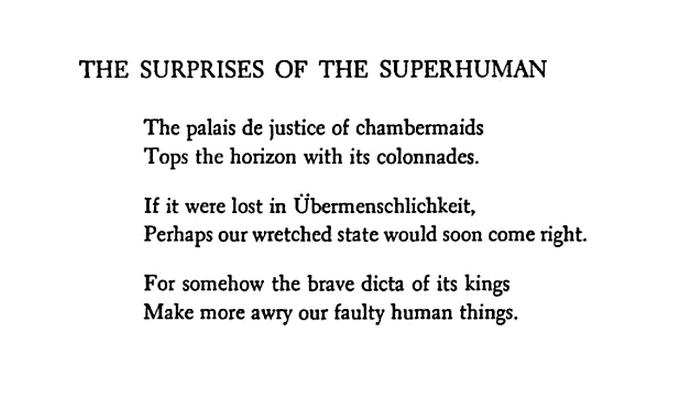
“The Surprises of the Superhuman” — Wallace Stevens

Screenshot 2015-06-29 at 8.49.35 PM

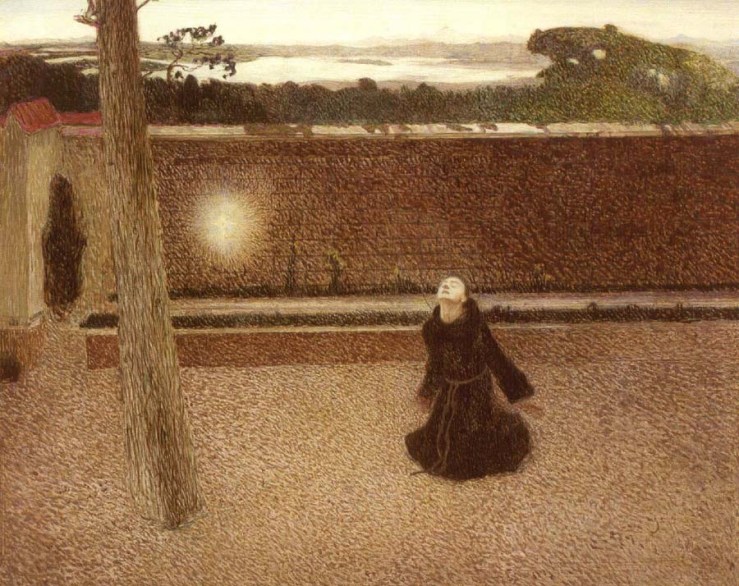
The Vision — Sigmund Walter Hampel

tumblr_kvfhp4rxC81qzw5wjo1_1280

Interior with Girl Reading — Peter Ilsted

c4422_1