“The Girls of Herland” — Charlotte Perkins Gilman

“The Girls of Herland,” below, is Chapter 8 of Charlotte Perkins Gilman’s 1915 novel Herland, a feminist utopian novel that was serialized during its author’s lifetime, but not published in one volume until 1979.  This chapter can, I believe, stand alone or serve even as an introduction even to Herland, depsite coming rather late in the text, but readers who wish more context/want the whole thing can legally download Herland via Project Gutenburg.

***

“The Girls of Herland”

by

Charlotte Perkins Gilman

At last Terry’s ambition was realized. We were invited, always courteously and with free choice on our part, to address general audiences and classes of girls.

I remember the first time—and how careful we were about our clothes, and our amateur barbering. Terry, in particular, was fussy to a degree about the cut of his beard, and so critical of our combined efforts, that we handed him the shears and told him to please himself. We began to rather prize those beards of ours; they were almost our sole distinction among those tall and sturdy women, with their cropped hair and sexless costume. Being offered a wide selection of garments, we had chosen according to our personal taste, and were surprised to find, on meeting large audiences, that we were the most highly decorated, especially Terry.

He was a very impressive figure, his strong features softened by the somewhat longer hair—though he made me trim it as closely as I knew how; and he wore his richly embroidered tunic with its broad, loose girdle with quite a Henry V air. Jeff looked more like—well, like a Huguenot Lover; and I don’t know what I looked like, only that I felt very comfortable. When I got back to our own padded armor and its starched borders I realized with acute regret how comfortable were those Herland clothes.

We scanned that audience, looking for the three bright faces we knew; but they were not to be seen. Just a multitude of girls: quiet, eager, watchful, all eyes and ears to listen and learn.

We had been urged to give, as fully as we cared to, a sort of synopsis of world history, in brief, and to answer questions. Continue reading ““The Girls of Herland” — Charlotte Perkins Gilman”

“One Art” — Elizabeth Bishop

“One Art”

by Elizabeth Bishop

The art of losing isn’t hard to master;
so many things seem filled with the intent
to be lost that their loss is no disaster.

Lose something every day. Accept the fluster
of lost door keys, the hour badly spent.
The art of losing isn’t hard to master.

Then practice losing farther, losing faster:
places, and names, and where it was you meant 
to travel. None of these will bring disaster.

I lost my mother’s watch. And look! my last, or
next-to-last, of three loved houses went.
The art of losing isn’t hard to master.

I lost two cities, lovely ones. And, vaster,
some realms I owned, two rivers, a continent.
I miss them, but it wasn’t a disaster.


—Even losing you (the joking voice, a gesture
I love) I shan’t have lied.  It’s evident
the art of losing’s not too hard to master
though it may look like (Write it!) like disaster.

The Man Who Never Laughed — Kay Nielsen

Cupid, caresses, fire and death (Three notes from Nathaniel Hawthorne’s Note-Books)

Caresses, expressions of one sort or another, are necessary to the life of the affections, as leaves are to the life of a tree. If they are wholly restrained, love will die at the roots.

Cupid in these latter times has probably laid aside his bow and arrows, and uses fire-arms,–a pistol,–perhaps a revolver.

I burned great heaps of old letters, and other papers, a little while ago, preparatory to going to England. Among them were hundreds of letters. The world has no more such, and now they are all dust and ashes. What a trustful guardian of secret matters is fire! What should we do without fire and death?

From Nathaniel Hawthorne’s American Note-Books.


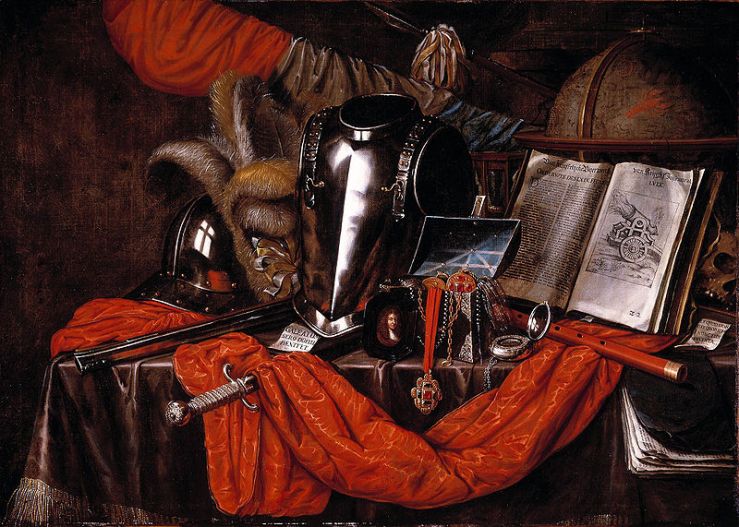
Vanitas — Edward Collier

tumblr_lx8fblsvpT1r5569zo1_1280

Peter Brook’s (Condensed) Hamlet

The Bard and the Bird (Shakespeare Portrait) — Bill Sienkiewicz

A Face from Georgia — Ivan Albright

A good reader can, in a sort, nestle into Plato’s brain, and think from thence; but not into Shakespeare’s (Ralph Waldo Emerson)

Shakspeare is as much out of the category of eminent authors, as he is out of the crowd. He is inconceivably wise; the others, conceivably. A good reader can, in a sort, nestle into Plato’s brain, and think from thence; but not into Shakspeare’s. We are still out of doors. For executive faculty, for creation, Shakspeare is unique. No man can imagine it better. He was the farthest reach of subtlety compatible with an individual self,—the subtilest of authors, and only just within the possibility of authorship. With this wisdom of life, is the equal endowment of imaginative and of lyric power. He clothed the creatures of his legend with form and sentiments, as if they were people who had lived under his roof; and few real men have left such distinct characters as these fictions. And they spoke in language as sweet as it was fit. Yet his talents never seduced him into an ostentation, nor did he harp on one string. An omnipresent humanitycoördinates all his faculties. Give a man of talents a story to tell, and his partiality will presently appear. He has certain observations, opinions, topics, which have some accidental prominence, and which he disposes all to exhibit. He crams this part, and starves that other part, consulting not the fitness of the thing, but his fitness and strength. But Shakspeare has no peculiarity, no importunate topic; but all is duly given; no veins, no curiosities: no cow-painter, no bird-fancier, no mannerist is he: he has no discoverable egotism: the great he tells greatly; the small, subordinately. He is wise without emphasis or assertion; he is strong, as nature is strong, who lifts the land into mountain slopes without effort, and by the same rule as she floats a bubble in the air, and likes as well to do the one as the other. This makes that equality of power in farce, tragedy, narrative, and love-songs; a merit so incessant, that each reader is incredulous of the perception of other readers.

From Ralph Waldo Emerson’s essay “Shakspeare; Or, The Poet.” (And yes, he uses that two-e variant of Shakespeare’s name).

Ballet Class, the Dance Hall — Edgar Degas

I witch to be illone (Krazy Kat)

IMG_5973

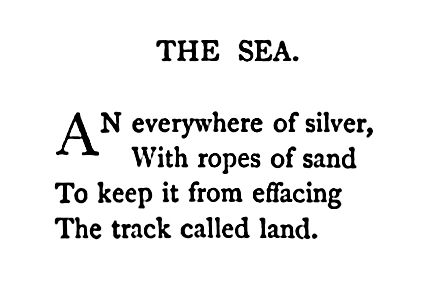
“An everywhere of silver” — Emily Dickinson

Screenshot 2015-04-22 at 1

Earth — Jean-Michel Basquiat

Do I explain myself? | Gerald Murnane interviewed at 3:AM Magazine

At 3:AM Magazine, Tristan Foster has interviewed Gerald Murnane. The interview is wonderfully prickly: “The question arouses a mild resentfulness in me,” Murnane replies at one point, before claiming a few lines later that “My sentences are the best-shaped of any sentences written by any writer of fiction in the English language during my lifetime.” A clip:

3:AM: I hesitate to ask you about your place in Australian literature both because it’s a discussion of categories and because you have directly or indirectly credited your influences as being almost wholly outside of it: Marcel Proust and Emily Brontë and Henry James. That said, I do feel somewhat obliged – you are Australian, you have never lived anywhere else and your writing is published into this country’s book market. Is your place in Australian literature something you think about?

GM: Flemington racecourse has a straight-six track. Certain races are run there over a straight course of twelve hundred metres, or six furlongs as we once called it. Sometimes, if the field is large, a group of horses will follow the inside rail while another group follows the outer rail, perhaps thirty metres away. Each group, of course, has its own leaders and pursuers and tail-enders. Sometimes, the outside group numbers only a few while the inside group comprises most of the field. The watchers in the grandstands, near the winning-post, are often unable to tell which group is in front of the other. The watchers are almost head-on to the field, and only when the leaders reach the last few hundred metres can they, the watchers, line up the two different groups, as the expression has it. If I try to compare myself with my contemporaries, I usually see us all as a field of horses coming down the straight-six course at Flemington. Most of us are over on the rails. I’m on my own coming down the outside fence. At different times, one or another of the bunch on the rails shows out far ahead of the others. Being on my own, I can’t be compared with any nearby rival, but I seem to be going well. Do I explain myself? In thirty years from now, we may know the finishing order. By that time, my archives may have become available to the public – a whole new body of my writing to be taken account of.