
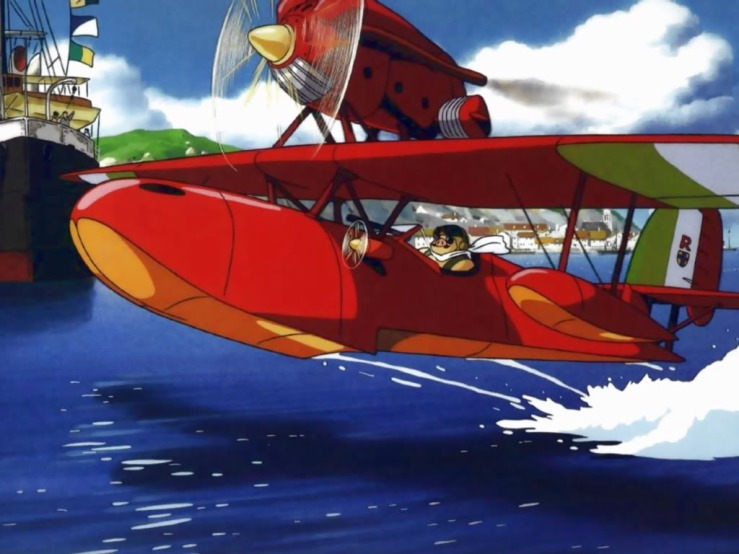
Hayao Miyazaki’s Porco Rosso (1992) is one of my favorite films, and I was able to see it this summer for the first time on the big screen thanks to Studio Ghibli Fest 2018. Although I’ve seen Porco Rosso maybe a dozen times, seeing its rich, deep, bold animation on an enormous screen felt like seeing it for the first time.
Porco Rosso takes place in and around various islands in the Adriatic Sea during the thin slice of years between the First and Second World Wars. Italy, like much of the world, is in the midst of a severe economic depression, and is slowly sliding into fascism. World War II is clearly on the horizon. Miyazaki pushes these problems to the margins of his film, conjuring instead a romanticized Mediterranean. However, this romantic space is always under the pressure of a coming disaster—fascism and a new war.
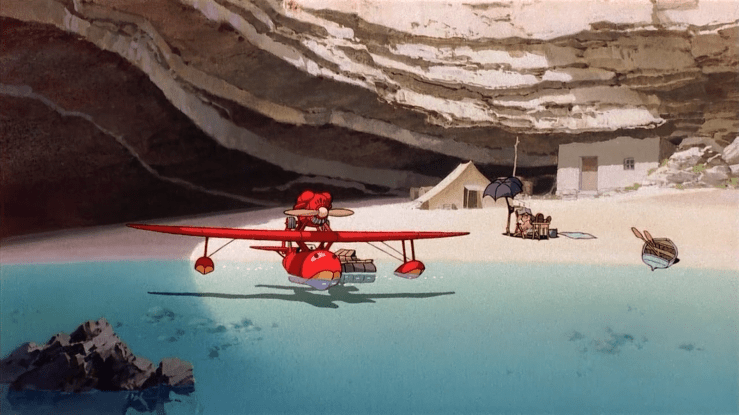
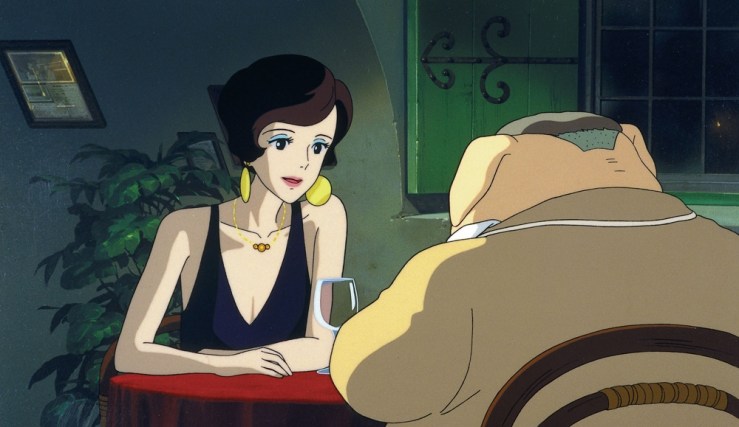
The hero of Porco Rosso is Marco Pagot (called Marco Rossolini in the American dub). Marco is an ex-military pilot, an aviation ace who fought with honor for the Italian air force in the Great War. He now spends his days drinking red wine and smoking cigarettes on a beautiful deserted island, occasionally taking jobs as a bounty hunter, retrieving hostages and other stolen goods from the nefarious and unwashed air pirates who plunder the ships of the Adriatic. Marco makes occasional concessions to civilization by taking a meal at the Hotel Adriano, a charming resort run by his oldest friend Gina. Gina is love with Marco and we come to realize Marco is in love with Gina, but he cannot come out and say this. Marco is a pig.
Marco is literally a pig. He is the victim of a curse that the film never explicitly names or addresses, although a late scene late in which Marco essentially survives an attack that should have killed him—an event that gives him a dramatic glimpse of a heaven of pilots—may be a clue to the origins of Marco’s porcine curse. In any case, Marco’s pigman existence is the film’s only concession to the kind of mythical and magical fantasy that otherwise permeates Miyazaki’s canon (with the notable exception of The Wind Rises (2013), which in some ways is a sequel to Porco Rosso).
This isn’t to say that Porco Rosso isn’t a fantasy though. Miyazaki’s world of air pirates and bounty hunters, attractive hoteliers and hotshot engineers, and seaplanes dueling in a radiant sky, brims with an effervescent energy that counterbalances the grim specter of the Great War that preceded the film’s narrative action and the Second World War—and a Fascist Italy—that the narrative’s “real” time must eventually intersect. Ever the lone pig, Marco seeks to fly away from the social and historical forces that would constrain him.
Unfortunately for Marco, luxurious isolation remains an impossibility. The air pirates hire a hotshot American to take out the damned Crimson Pig once and for all. Donald Curtis (hailing from Alabama in the Japanese version and Texas in the American) exemplifies American cockiness. His enormous jaw precedes the rest of his swaggering body, he falls in love at first sight with any beautiful woman he sees, and he’s brash and impetuous. He wants to transition to Hollywood and eventually become the President of the United States! Curtis shoots up Marco’s plane early in the film, but our porcine hero escapes to Milan, where he rebuilds his plane with the help of a whiskered mechanic named Piccolo and his charming granddaughter Fio. Fio redesigns the plane and eventually becomes Marco’s sidekick, traveling with him back to the Adriatic and helping him face Curtis and the air pirates.
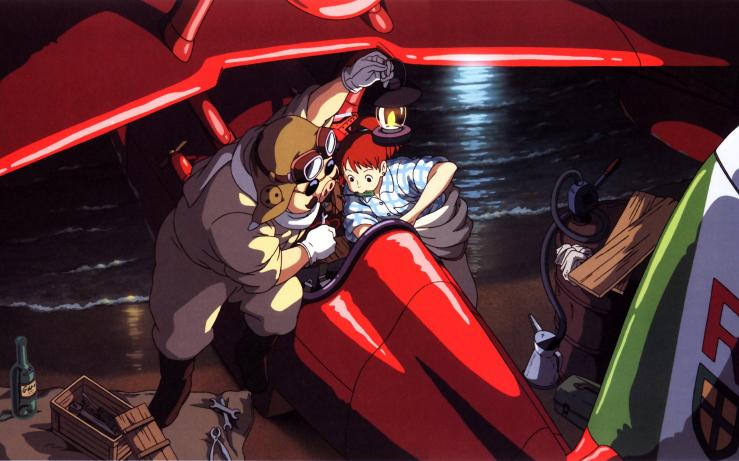
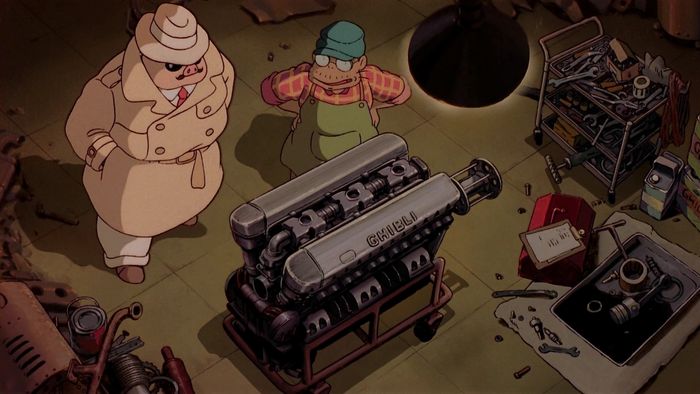
Fio, whose character design recalls Nausicaa of Nausicaä of the Valley of the Wind (1984), is another of Miyazaki’s prominent female protagonists. In some ways she is the secret hero of the film; she takes over the narration at the end, implicitly assuming Porco Rosso’s mantle. Fio has earned Marco’s trust after he is initially dubious of her ability because of her age and his sexism. Fio leads an all-female team of builders and engineers to recreate a superior version of Marco’s plane. This workshop sequence is one of the film’s finest. Miyazaki often foregrounds labor in his films, but Porco Rosso explicitly shows how a complex work—whether it’s a plane, or, y’know, a film—is never the singular work of a gifted genius, but rather the concentrated effort of a team. Miyazaki underscores the connection between the creative process of plane-building and film-making, stamping his studio’s name on Marco’s new engine. (Studio Ghibli was named after an Italian war plane, the Caproni Ca.309, which was nicknamed Ghibli—“Desert Wind”).
While in Milan, Marco realizes that the fascist secret police are after him. The Fascists in Porco Rosso (who want to conscript Marco—or take his plane) are far more ominous than Curtis. Curtis serves as an actual antagonist for Marco to face, and the fight between the two at the end of Porco Rosso, although violent, plays with a light comic touch. Miyazaki references the “gentlemen pilots” of World War I here. The Fascists, in contrast, are a spectral force lurking behind the narrative, threatening Marco’s individuality and autonomy. The film affirms itself as a comedy that resists encroaching fascism in a conclusion that sees Marco, Fio, Gina Curtis, the air pirates, and every other member of this strange Adriatic paradise working together to escape their approaching air force.
The film’s denouement is a retreat into the romantic Adriatic community, a kind of gauzy, rosy vision of an isolated paradise untouched by war or fascism. The fantasy reminds one of an island from some lost book of The Odyssey, a tranquil paradise unbothered by Trojans or Greeks. Marco—Porco—too feels like a figure from the margins of The Odyssey, a hero transfigured into a pig. The end of Porco Rosso refuses to give us a direct answer as to what happens to Porco. Does he regain his human form? Or, perhaps more importantly, is there a happy ending for Porco and Gina? The film offers a number of clues, some explicit and some implicit, but a first viewing may feel ambiguous for many viewers. However, subsequent viewings reveal a clearer picture as to what happens to Gina and Marco. Why the ambiguity then? Porco Rosso is (apart from The Wind Rises) the Miyazaki film with the strongest historicity. The historical reality of a looming World War II threatens to devour the romance of Gina and Porco—so Miyazaki and the inhabitants of his secret Adriatic world conspire to hide it. Lovely stuff.
[Ed. note–Biblioklept ran a version of this review in the summer of 2018].



 Biblioklept