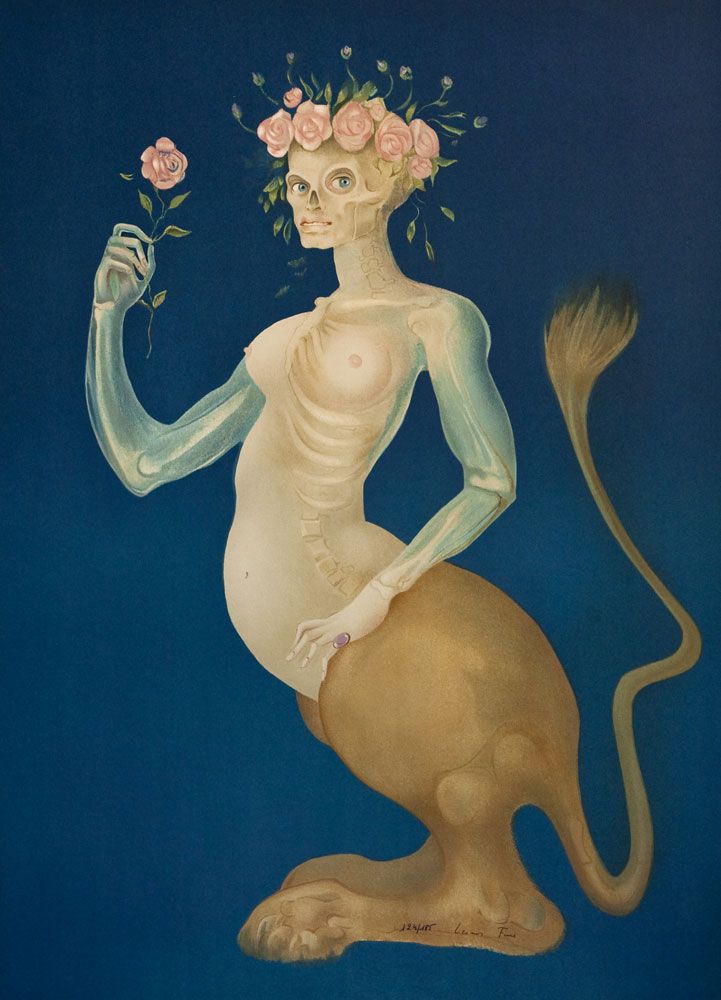
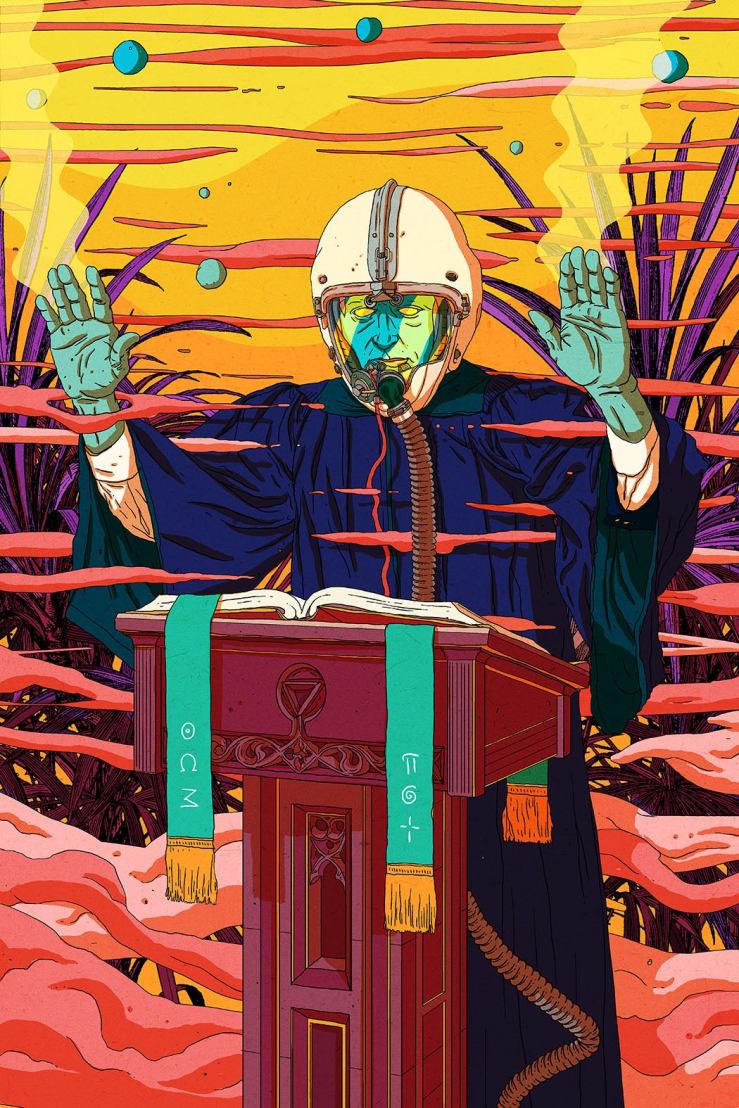
The Blue Bird II — Natalie Frank

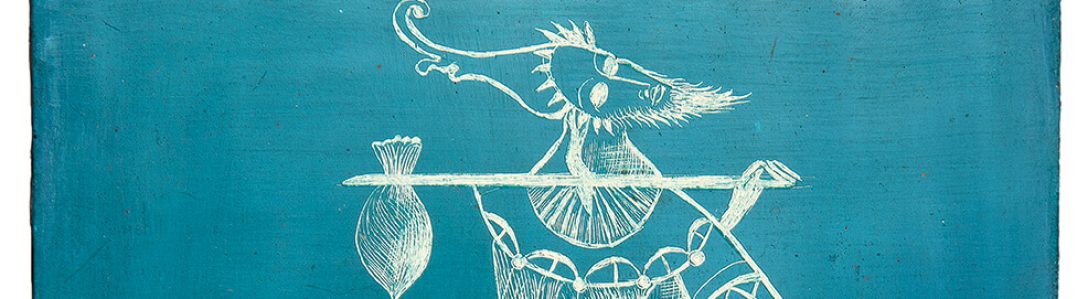
The Blue Bird II, 2019 by Natalie Frank (b. 1980)


“The Blue Bird”

by

Madame d’Aulnoy

Translated from the French by

Andrew Lang


Once upon a time there lived a King who was immensely rich. He had broad lands, and sacks overflowing with gold and silver; but he did not care a bit for all his riches, because the Queen, his wife, was dead. He shut himself up in a little room and knocked his head against the walls for grief, until his courtiers were really afraid that he would hurt himself. So they hung feather-beds between the tapestry and the walls, and then he could go on knocking his head as long as it was any consolation to him without coming to much harm. All his subjects came to see him, and said whatever they thought would comfort him: some were grave, even gloomy with him; and some agreeable, even gay; but not one could make the least impression upon him. Indeed, he hardly seemed to hear what they said. At last came a lady who was wrapped in a black mantle, and seemed to be in the deepest grief. She wept and sobbed until even the King’s attention was attracted; and when she said that, far from coming to try and diminish his grief, she, who had just lost a good husband, was come to add her tears to his, since she knew what he must be feeling, the King redoubled his lamentations. Then he told the sorrowful lady long stories about the good qualities of his departed Queen, and she in her turn recounted all the virtues of her departed husband; and this passed the time so agreeably that the King quite forgot to thump his head against the feather-beds, and the lady did not need to wipe the tears from her great blue eyes as often as before. By degrees they came to talking about other things in which the King took an interest, and in a wonderfully short time the whole kingdom was astonished by the news that the King was married again to the sorrowful lady. Continue reading “The Blue Bird II — Natalie Frank”

Blog about some recent reading (Süskind/Shange/Dara/Walton/Cain)

Last time I did one of these silly blogs about recent reading—

–(a poor substitute for meaningful reviews, blogs about recent reading—but so and in some measure of fairness to myself, the last few weeks were larded with occasions—promotional ceremonies, out-of-town graduations, visits to new schools, and a triumvirate of family birthdays. So…)—

So last time I did one of these silly blogs about recent reading I was about halfway through Patrick Süskind’s Perfume (1985, in translation by John E. Woods). The novel is kinda sorta historical magical realism, if that makes sense, although it’s really straightforward in its telling (the good ole third-person omniscient/free indirect style). It’s pre-Revolutionary France and Jean-Baptiste Grenouille has a magical mystical murderous sense of smell. He’s born a freak and lives a freaky life. We follow Grenouille, a bastard abandoned to a quick near-death in a pile of fish guts, from a group home for orphans to a tanner’s factory to his time as an unrecognized perfume genius, concocting enchanting scents for not just Paris’s wealthiest, but the European elite. He becomes a journeyman, an ascetic hermit, and a serial killer. The novel culminates in twin orgies, ecstatic and then thanatopic. I wonder if Woods’s translation tamed things down a bit, or if Süskind’s original German is so…clinical…there’s something about the prose that elides the lurid abject rot under it all. (Oh, and I rewatched Tom Twyker’s 2006 film adaptation after finishing Süskind’s novel—it’s a fine effort, but simply can’t do what a novel can do—namely, take us convincingly into Grenouille’s estranging consciousness. We’re let with some lovely gross set pieces. Dustin Hoffman and Alan Rickman chew up all the scenery they can fit in their mouths.)

I picked up Ntozake Shange’s novel Sassafrass, Cypress & Indigo (1982) after finishing Perfume. It was Shange’s first novel, unless I’m mistaken, and there’s something wonderfully uneven to it. The titular trio are sisters hailing from Charleston, South Carolina and environs. The sisters (mythical muses, but also concrete people) are the daughters of Hilda Effania, a weaver. Hilda’s children appreciate her craft, but they long for newer, stranger art. Sassafrass seeks to elevate weaving into fine art; Cypress flits from classical ballet to new forms of dance; the youngest, Indigo, is part musician, part magician—her fiddle conjures all kinds of charms. Here, Shange borrows touches of Gullah-Geechee culture, and the novel’s evocations of Charleston and the coastal Sea Islands to its east will resonate with anyone familiar with the terrain. (The novel might be read with/against Padgett Powell’s 1984 debut, Edisto, a coming-of-age story told from the perspective of a white male teenager living in the titular South Carolina Sea Island.) Sassafrass, Cypress & Indigo doesn’t exactly have a plot, per se, which is lovely—the novel seems to sprawl out in different tangles, a kind of diffident rejection of Hilda Effania’s skilled weaving. Each daughter rebels, but returns to the hearth. Shange loads the novel with recipes, letters, journal entries, and magic spells, and if the end result is wildly uneven, it’s also lots of fun and often moving.

I got Evan Dara’s Permanent Earthquake (2021) on my birthday, a few days ago. I read the first 30 or so pages. I will write more later.

The Final Revival of Opal & Nev  (2021) is Dawnie Walton’s debut novel. It deserves its own long review, but the short of it is—good stuff. Opal & Nev takes the form of an oral history of the fictional titular early seventies rock-freak-soul outfit: a bald Afro-punk progenitor (Opal) and a pasty ginger Brit (Nev). The narrator is S. Sunny Shelton; her father, Jimmy Curtis, played drums on the first Opal & Nev record, and “was beaten to death by a racist gang during the riot” at a label showcase, as the novel’s astonishing opening paragraph attests. Nev carries Opal out on his back in the ensuing violent aftermath, and a photographer captures the moment. The photo becomes iconic, symbolic, and the touchstone of the oral history Shelton assembles. And that oral history: Walton adroitly ventriloquizes her cast—the aging British producer, the asshole label owner, the worried Christian sister, the “Hey-I’m-not-racist-but-look-I’m-actually-racist” Southern rocker-turned Trump supporter. Nev and Opal are particularly well-defined; as the novel develops, we start to see their masks crack. The diversity of perspectives on the novel’s central event–the murder of Shelton’s father Jimmy (and the subsequent photograph of Opal on Nev’s back)—leads to a compelling twist in the novel’s climax. The twist plays out in the book’s second half, as Opal & Nev undertake a reunion show at a big festival concert (something like Bonnaroo, I guess). The novel is set right before the 2016 election, leading to a number of ironies, and Shelton—telegraphing Walton, I suspect—is not shy of editorializing (nor should she be). Opal & Nev also contains lots of footnotes. Many of these footnotes flesh out the alternate reality of Walton’s imagined musicsphere, but some offer historical girding to the narrative proper. For example, Walton, through Shelton, lets us know who Josephine Baker was, and that George Wallace was a notorious racist, and that Stephanie St. Clair was an infamous Harlem racketeer. Etc. These footnotes made me feel old in the sense that they seem designed to help a younger audience navigate the mostly-real (and real in the ugliest, realest ways possible) of Opal & Nev, while also absorbing much that American history has sought to whitewash. Ultimately, The Final Revival of Opal & Nev kept me reading because the voices were so compelling. Watson lets her subjects speak, channeling all of their flaws and glories. Recommended.

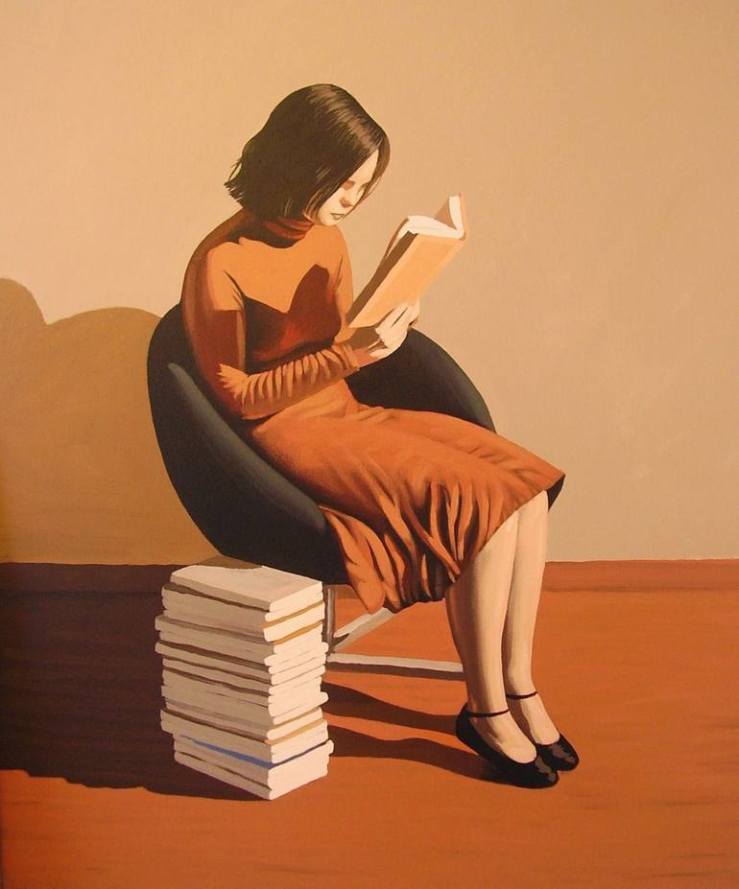
Years ago someone—who was it, was it you?—told me to read James M. Cain’s noir The Postman Always Rings Twice (1934). I got a copy of Three Complete Novels this weekend, and read Postman over two days. Cain’s novel is visceral, gross, violent, and fast fast fast. It’s a basic stranger-comes-to-town plot, only the town is reduced to a young wife dissatisfied with her husband (and the husband in question). It’s also told from the perspective of the stranger, a quippy drifter who reminded me more of Camus’ Mersault than anything else. (I think it would be fascinating to rewrite this novel from another character’s perspective, by the way.) The novel did for me exactly what I needed—sort of zapped me, reset my reading rainbow. Cain’s prose is so economical that I found myself having to go back to previous sentences at times to make sure that I was comprehending his camera-flow. An unhealthy juvenile puma shows up in a late courtroom scene. This novel is wonderfully grotesque. I’m ashamed that I’ve never seen the 1946 film version (starring Lana Turner)—but I have seen the 1945 adaptation of Mildred Pierce with Joan Crawford, so I look forward to reading that (and Double Indemnity). Great stuff, even if the postman never rings, not even once.

A Couple on the Floor of a Forgotten Church — Ilya Milstein

A Couple on the Floor of a Forgotten Church, 2018 by Ilya Milstein

Huddled on the Verge of a Wilderness — Sanam Khatibi 

Huddled on the Verge of a Wilderness, 2018 by Sanam Khatibi (b. 1979)

Roberto Bolaño Bingo

Evan Dara’s Permanent Earthquake (Book acquired, 7 June 2021)

So I got Evan Dara’s fourth novel, Permanent Earthquake. There’s no summary blurb for it, but it seems to concern, like, an earthquake that is ongoing, or, if you will, permanent. The first 25 pages are written in the first-person; the novel then gives way to a third-person “he.” More thoughts to come. More on Dara:

My review of Dara’s last publication, the play Provisional Biography of Mose Eakins.

Daniel Green on Dara’s youngish oeuvre.

Ryan Chang and I riff on Dara’s last novel, Flee.

And I’ll close by saying that Dara’s first novel The Lost Scrapbook is an overlooked classic of late American postmodernism.

“No Complaints” — Nikki Giovanni

“No Complaints”

by

Nikki Giovanni

(For Gwendolyn Brooks, 1917—2001)

maybe there is something about the seventh of June: Gwen,
Prince and me . . . or maybe people just have to be born at some
time . . . and there are only three hundred sixty-five days or three
sixty-six every four years or so . . . meaning that some things
happen at the same time in the same rising sign . . . and the same
houses in Gemini . . . but some of us might also consider the
possibility of reincarnating revolving restructuring that spirit . . .
reshaping that spirit . . . releasing that spirit . . . tucking the use-
less inside and when the useless pushes out again we restructure
again and poetry and song and praisesong go on  . . . because it is
the right thing to do

we always will cry when a great heart . . . a good soul . . . one of
the premier poets of her age restructures . . . reincarnates  . . .
revolves into a resolve that we now carry in our hearts . . . as all
great women and men are alive . . . not by biology but remem-
brance . . . and that’s all right . . . as the old folk say . . . because as
long as they stay on the lips . . . they nestle in our hearts and those
souls which are planted . . . continue growing . . . until generations
not knowing their touch . . . their voice . . . or even the fact
that some Chicago poets are terrible cooks . . . but always fun
to eat with . . . will tell tales of having met someone who knew
someone who once watched a basketball game . . . in which some
Chicago poet cheered for Seattle at the request of some Virginia
poet who wanted more games . . . while Mr. Blakely was amazed
that a Chicago poet was even watching a game . . . and didn’t
we miss him as he slipped away watching baseball . . . and what
a way to go . . . though we then did sort of know . . . that once
gone . . . he would call the woman he loved

and so we come to no more phone calls at six a.m. to chat …
and no more Benihana when we are all in New York . . . and no
more gossiping and questioning and trying to make sense of a
senseless world . . . no more face-to-face . . . only the poetry which
is a great monument from this Topeka daughter to the world . . .
and yet . . . there can be no complaints in this passing . . . no
sorrow songs . . . no if onlys . . . it is all here: the work the love:
the woman: who gave and gave and gave . . . no complaints of too
long or too hard . . . no injustice of accident or misunderstanding
of disease . . . just one great woman moving to the next phase . . .
and us on the ground . . . giving Alleluias

‘Impromptu’ Sinding — Pamela Colman Smith

‘Impromptu’ Sinding, 1907 by Pamela Colman Smith (1878 – 1951)

Lavengro and Isopel in the Dingle — Paul Nash

Lavengro and Isopel in the Dingle, 1912-13 by Paul Nash (1889-1946)

Canto XXII — Tom Phillips

Canto XXII, 1982 by Tom Phillips (b. 1937). From the Dante’s Inferno series.

Seated Woman, Back View — Egon Schiele

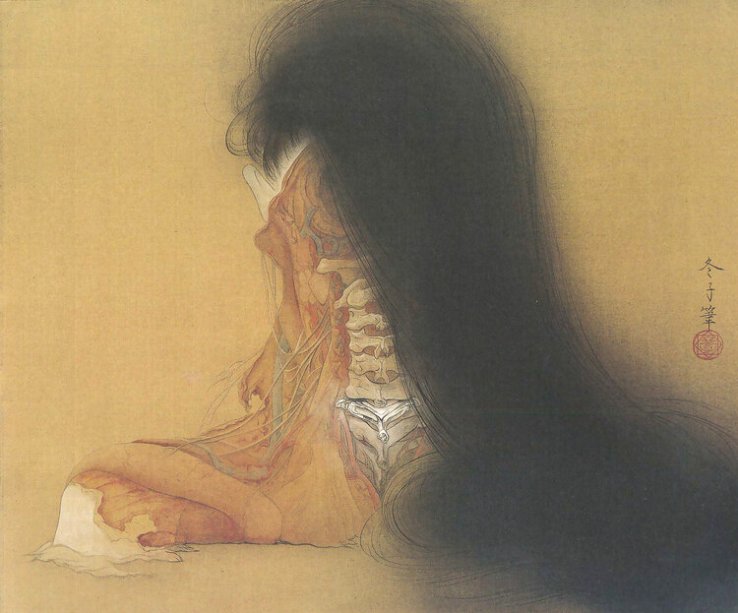
Seated Woman, Back View, 1917 by Egon Schiele (1890–1918)

B.S. Johnson’s The Unfortunates (Book (in a box) acquired 2 June 2021)

I went on a B.S. Johnson tear last month. Ordered his (infamous?) “book in a box,” The Unfortunates (1969). There are 27 unbound (but somewhat bound) sections to the novel; two are labeled FIRST/LAST, but the rest are meant to be read randomly. The New Directions edition I ordered includes some directions:

I never made it through any iteration of Julio Cortázar’s Hopscotch, so we’ll see how I do.

Here’s a sense of what the book looks like (the initial booklet is an introduction by Johnson’s biographer Jonathan Coe):


Private Worlds — Edward Melcarth

Private Worlds, 1961 by Edward Melcarth (1914–1973)

June — Alex Colville

june-1979.jpg!Large

June, 1979 by Alex Colville (1920-2013)

 Merz Picture with Rainbow — Kurt Schwitters

Merz Picture with Rainbow, 1920–39, by Kurt Schwitters (1887–1948)

Six Studies for Gassed — John Singer

Six studies for Gassed, 1919 by John Singer Sargent (1856-1925)

John Barth’s brief description of Donald Barthelme’s so-called postmodernist dinners

1fa8c7cbf8dc977653f7750905725da4
Photograph from “The Postmodernists Dinner,” 1983 by Jill Krementz (b. 1940)

In John Barth’s 1989 New York Times eulogy for Donald Barthelme, Barth gives a brief description of two so-called postmodernist dinners, both of which I’ve written on this blog before.

…though [Barthelme] tsked at the critical tendency to group certain writers against certain others ”as if we were football teams” – praising these as the true ”post-contemporaries” or whatever, and consigning those to some outer darkness of the passe – he freely acknowledged his admiration for such of his ”teammates,” in those critics’ view, as Robert Coover, Stanley Elkin, William Gaddis, William Gass, John Hawkes, Thomas Pynchon and Kurt Vonnegut, among others. A few springs ago, he and his wife, Marion, presided over a memorable Greenwich Village dinner party for most of these and their companions (together with his agent, Lynn Nesbit, whom Donald called ”the mother of postmodernism”). In 1988, on the occasion of John Hawkes’s academic retirement, Robert Coover impresarioed a more formal reunion of that team, complete with readings and symposia, at Brown University. Donald’s throat cancer had by then already announced itself – another, elsewhere, would be the death of him – but he gave one more of his perfectly antitheatrical virtuoso readings.

More on the first dinner here.

More on the second dinner here.