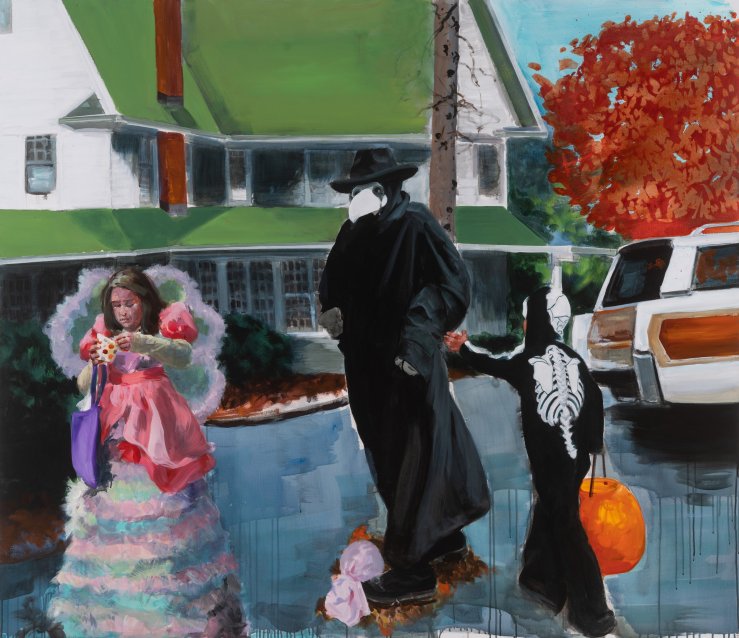
“Pete Resists the Man of His Old Room,” a very short story by Barry Hannah

“Pete Resists the Man of His Old Room”

by

Barry Hannah


Who is that?” hissed the woman at the corner. Pete and Tardy were necking. They could never quit. They hardly ever heard. The porch where their bench was was purple and smelly with creeping pot plants. Their child, who was thirty, rode a giant trike specially made, he being, you know, simple, back and forth on the walk, singing : Awwwww. Ernnnnnn. Oobbbbbbbb.

The man, remarked only by the hissing woman at the corner, who was Tardy’s mother, walked, or rather verged, here and there, undecided, froth running down his chin and a dagger in his hand. He had an address printed on some length of cardboard. His fingernails were black.

“Out! Out of here, you mange!” shouted Tardy’s mother.

“In, in, in!” the hairy man in the street shouted back.

Pete looked up. “It’s my old college roommate.

Lay off, Mamma,” Pete expressed, rising.

The fellow in the street straightaway made for Pete but got caught in the immense rose hedge. “I knew I’d find you! Peace! Joy! Communion at last!” the filthy fellow shouted as he writhed, disabled.

“Son of a gun!” roared Pete. “Look here, Tardy. It’s old Room Man!”’

“Jumping Jesus, do these thorns hurt!” shouted the filthy hairy fellow. He’d lost his dagger in the leaf mold. That hedge really had him.

“What say?” shouted Pete.

“I got no more discretion, Pete boy! I’m just a walking reminiscence ! Here I am ! I remember you when you were skinny and cried about a Longfellow poem! Your rash! Everything! Edna, Nannie, Fran! Puking at the drive-in!”

“I thought so,” said Pete to Tardy, low, his smile dropped aside. “Would you get me my piece, my charm?”

“Your spiritual phase!” the filthy hairy fellow was screaming. “Your Albert Schweitzer dreams! Signing on the dorm wall with your own blood !” shouted the awful man who was clogged in the hedge.

“Yes,” Pete said, lifting the weary corners of his lips.

Tardy lugged out the heavy piece.

Pete took it and jammed home the two big ones.

“Remember Juanita and her neat one? Played the cornet with her thing and you did the fingering?” screamed the wretched fellow all fouled in the hedge.

Yes.

He cut half his hedge away when he fired the double through it. The dagger blew out in the street along with the creep that held it. All the while Tardy’s mother stood with crossed arms.

The son stopped his giant trike. He said, “Ernnnnn,” to his dad on the porch.

“Albert,” said Pete. “Take care of the stuff in the street,” and within minutes the son was back with the wagon attached and the scoop.

“It makes me not hardly want to kiss anymore,” Tardy said, fft

The World had been expected to end in the year one thousand | From T.H. White’s The Ill-Made Knight

The World had been expected to end in the year one thousand, and, in the reaction which followed its reprieve, there had been a burst of lawlessness and brutality which had sickened Europe for centuries. It had been responsible for the doctrine of Might which was the Table’s enemy. The fierce lords of the Strong Arm had hunted the wild woodlands—only, of course, there had always been exceptions like the good Sir Ector of Forest Sauvage—till John of Salisbury had been forced to advise his readers: “If one of these great and merciless hunters shall pass by your habitation, bring forth hastily all the refreshment you have in your house, or that you can readily buy, or borrow from your neighbour: that you may not be involved in ruin, or even accused of treason.” Children, Duruy tells us, had been seen hanging in trees, by the sinews of their thighs. It had been no uncommon sight to see a man-at-arms whistling like a lobster, and looking like porridge, because they had emptied a bucket of boiling bran over his armour during a siege. Other spectacles even more dramatic have been mentioned by Chaucer: the smyler with the knyf under the cloke, the careyne in the bush with throte y-corve, or the colde deeth with mouth gaping upright. Everywhere it had been blood on steel, and smoke on sky, and power unbridled—and, in the general confusion of the times, Gawaine had at last contrived to murder our dear old friend King Pellinore, in revenge for the death of his own father, King Lot.

Such had been the England which Arthur had inherited, such the birthpangs of the civilization which he had sought to invent. Now, after twenty-one years of patient success, the land presented a different picture.

Where the black knights had hoved, all brim and furious by some ford, to take toll of anybody rash enough to pass that way, now any virgin could circumambulate the whole country, even with gold and ornaments upon her person, without the least fear of harm. Where once the horrible lepers—they called them Measles—had been accustomed to ramble through the woods in white cowls, ringing their doleful clappers if they wanted to give warning, or just pouncing on you without ringing them if they did not, now there were proper hospitals, governed by religious orders of knighthood, to look after those who had come back sick with leprosy from the Crusades. All the tyrannous giants were dead, all the dangerous dragons—some of which used to come down with a burrr like the peregrine’s stoop—had been put out of action. Where the raiding parties had once streamed along the highways with fluttering pennoncels, now there were merry bands of pilgrims telling each other dirty stories on the way to Canterbury. Demure clerics, taking a day’s outing to Our Lady of Walsingham, were singing Alleluia Dulce Carmen, while the less demure ones were warbling the great medieval drinking-song of their own composition: Meum est propositum in taberna mori. There were urbane abbots, titupping along on ambling palfreys, in furred hoods which were against the rules of their orders, and yeomen in smart tackle with hawks on their fists, and sturdy peasants quarrelling with their wives about new cloaks, and jolly parties going out to hunt without armour of any sort. Some were riding to fairs as great as that of Troyes, others to universities which rivalled Paris, where there were twenty thousand scholars whose ranks eventually provided seven popes. In the abbeys all the monks were illuminating the initial letters of their manuscripts with such a riot of invention that it was impossible to read the first page at all. Those who were not doing the chi-ro page were carefully copying out the Historia Francorum of Gregory of Tours, or the Legenda Aurea, or the Jeu d’Echecs Moralisé, or a Treatise of Hawkynge—that is, if they were not engaged upon the Ars Magna of the magician Lully, or the Speculum Majus by the greatest of all magicians. In the kitchens the famous cooks were preparing menus which included, for one course alone: ballock broth, caudle ferry, lampreys en galentine, oysters in civey, eels in sorré, baked trout, brawn in mustard, numbles of a hart, pigs farsed, cockintryce, goose in hoggepotte, venison in frumenty, hens in brewet, roast squirrels, haggis, capon-neck pudding, garbage, tripe, blaundesorye, caboges, buttered worts, apple mousse, gingerbread, fruit tart, blancmange, quinces in comfit, stilton cheese, and causs boby. In the dining halls the older gentlemen, who had spoiled their palates with drinking, were relishing those strange delicacies of the Middle Ages—the strong flavours of whale and porpoise. Their dainty ladies were putting roses and violets in their dishes—baked marigolds still make an excellent flavouring for bread-and-butter puddings—while the squires were showing their weakness for sheep’s-milk cheese. In the nurseries all the little boys were moving heaven and earth to persuade their mothers to have hard pears for dinner, which were stewed in honey-syrup and vinegar, and eaten with whipped cream. The manners of the table, too, had reached a pitch of civilization far beyond our own. Now, instead of the plates made of bread, there were covered dishes, scented finger bowls, sumptuous table cloths, a plethora of napkins. The diners themselves were wearing chaplets of flowers and graceful draperies. The pages were serving the food with the formal movements of a ballet. Wine bottles were being placed on the tables, but ale, being less respectable, was being put beneath. The musicians, with strange orchestras of bells, large horns, harps, viols, zithers and organs, were playing as the people ate. Where once, before King Arthur had made his chivalry, the Knight of the Tower Landry had been compelled to warn his daughter against entering her own dining hall in the evening unaccompanied—for fear of what might happen in the dark corners—now there was music and light. In the smoky vaults, where once the grubby barons had gnawed their bones with bloody fingers, now there were people eating with clean fingers, which they had washed with herb-scented toilet soap out of wooden bowls. In the cellars of the monasteries the butlers were tapping new and old ale, mead, port, claree, dry sherry, hock, beer, metheglyn, perry, hippocras, and the best white whisky. In the law courts the judges were dispensing the King’s new law, instead of the fierce law of Fort Mayne. In the cottages the good wives were making hot griddle bread enough to make your mouth water, and putting fine turf on their fires regardless of expense, and herding fat geese on the commons enough to support twenty families for twenty years. The Saxons and Normans of Arthur’s accession had begun to think of themselves as Englishmen.

From The Ill-Made Knight by T.H. White.

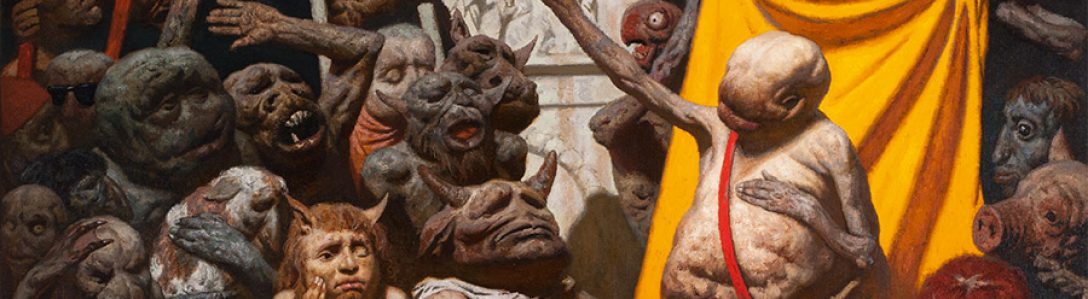
May God Deliver Us from the Venom of the Cobra, Teeth of the Tiger, and Cinema of the Americans — Jean-Pierre Roy

May God Deliver Us from the Venom of the Cobra, Teeth of the Tiger, and Cinema of the Americans, 2023 by Jean-Pierre Roy (b. 1974)

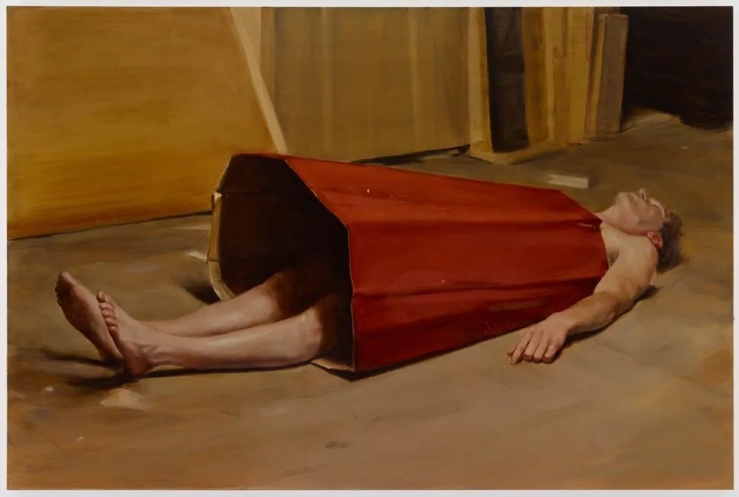
Self-Portrait with Land Skirt — Julie Heffernan

Self-Portrait with Land Skirt, 2022 by Julie Heffernan (b. 1956)

“Edgy Pleasures” — William T. Vollmann

“Edgy Pleasures”

by

William T. Vollmann


The most significant characteristic of the lovely nineteenth-century Indian daggers I collect is their blunt edges. Their purpose, in short, is to symbolize the power and authority of weapons, much like an officer’s pistol or even a policeman’s uniform. They are talismanic, like a crucifix or a Platonic form. Evidently, beauty was an absolute requirement in their crafting, since any such dagger was metonymic with the official function of a maharaja, whose life had to symbolize perfection to the rest of society. What purpose now? The maharajas are impoverished, and even such distant cousins of these daggers as bayonets are frequently used. For acts of war, we have our bombs, flying machines, crawling machines, swimming machines; for acts of legislation, the truncheon and the gun; for acts of atrocity, again the gun. Thus, these daggers are doubly removed from sharpness. It is emblematic that the little store in Udaipur that sold them (lubricated well with coconut oil, wrapped in bundles of old newspaper) was equally forward in displaying jointed silverfish made up of many small pieces more complex than bones. This made the daggers seem even more beautifully useless, metonymic still of the maharaja but only the Maharaja of Astonishment—for instance, Sawai Madho Singh I, who was reputedly seven feet tall and four feet wide.

In Jaipur, I saw his maharani’s eighteen-pound dress. “That must have been heavy,” I said. The guide smiled. “The Indian women don’t feel the weight when it’s real gold,” he said. The real gold of these daggers is, of course, their craftsmanship. The longer I handle the smooth, yellow ivory of that camel’s head or peer into the checkered gape of that flower-inlaid tiger, the more I perceive this and the more fairylike the pieces become. I have seen the maharaja’s sun emblem: It was composed of muskets raying outward from sacredness. Surely these muskets were never fired. How blasphemous it would have been to wrench off a ray from the sun! I went to another palace, whose wooden gates were forty feet high. I saw the high window where the maharani used to welcome her husband with rose flowers. I passed through green-bordered receding arches like the leaves of artichokes. Now: the Hall of Glory. The ceiling was inlaid with silvered glass in tiny, complex pieces to shimmer a million reflected flames of a single candle. Skeletons dazzled me in the perforated marble screens. But the guide said, “Before, the maharaja had elephants. Now, not a single one!” No utility anywhere. Consider the so-called tiger knife, which is shaped like the letter A with two horizontals. The hand grips one of them: The legs of the A curve inward into parallels to enclose the wrist and lock it. The tiger comes; the point of the A stabs him; he falls dead. Functional, no doubt. But many of these tiger knives—old ones gilded, damascened, tawny-striped like tigers— are for sale. A good one goes for $3,000 (less, of course, if you bargain, cash in hand). A maharaja had placed it on consignment. The maharajas sell things incognito, I heard; the maharajas are ashamed. Sometimes, to decrease the likelihood that the knives will be recognized as theirs, they sell to distant provinces, even though there’s less money that way. This is how it must be. Recently, an art connoisseur came to buy Mogul miniatures. He asked a maharaja if anything was for sale. The maharaja said no, but if the man was serious, he knew another noble who might sell. It had to be understood, however, that the connoisseur would never meet him or learn his name. What is a tiger knife without its maharaja? And, indeed, the matter is worse, much worse, for in Udaipur I saw towers alone and incongruous upon the desert hills. Sentries used to watch there for tigers, but that was when there were still forests. The trees are all burned now. What use, then, a tiger knife? No matter whether any blade is sharp.


From a 1996 Esquire feature called “My Favorite Things.” The feature also included Charles M. Schulz, Francis Ford Coppola, David Lee Roth, Wayne Gretzky, Susan Sontag, John Travolta and many other folks on their favorite thing.

Rainer J. Hanshe’s Closing Melodies (Book acquired, 8 Aug. 2023)

Rainer J. Hanshe’s enormous, strange tome Closing Melodies is new from Contra Mundum. Their description:

As the 19th century comes to a close, Friedrich Nietzsche and Vincent van Gogh unknowingly traverse proximate geographical terrain, nearly circling one another like close but distant stars as the philosopher wanders between Nizza, Sils Maria, and Torino, and the painter wanders between Paris, Arles, and Saint-Rémy. In the midst of their philosophical and artistic pursuits, simultaneously, the Eiffel Tower, symbol of artistic progress and industrialization, begins to rise in Paris amidst clamors of protest and praise.

Through intertwining letters written to (& sometimes by) friends, family, and others, the philosopher and painter are brought into ever-greater proximity as we witness their daily personal and artistic struggles. Woven between and interrupting this panoply of voices are a series of intervals, short illuminating blasts, like a camera’s exploding flash powder, of artistic, scientific, political, and other events spanning 1888 to 1890, drawing Nietzsche and Van Gogh in and out of the wider expanses of history.

As construction of the Eiffel Tower comes to completion in Paris and Elisabeth Förster, the sister of the philosopher of the will to power, tries to found a utopic race colony in South America, the lives of Nietzsche and Van Gogh come to their terrible denouements. Her brother now a full-fledged zombie, the former queen of Nueva Germania seizes the reins of his living corpse and rides him into the future.

With no deus ex machina in sight, and none possible, WWI and the terrors and the beauties of the 20th century crack the horizon.

“Awareness is its own action” and other things Harry Dean Stanton learned

That doormat? That doormat? It was a gift. Got that years and years ago. “Welcome UFOs and crews.”

Churches. Catholics. Jews. Christians. Protestants. Mormons. Muslims. Scientologists. They’re all macrocosms of the ego. When man began to think he was a separate person with a separate soul, it created a violent situation.

Everyone wants an answer. I think it was Gertrude Stein who wrote, “There is no answer, there never was an answer, there’ll never be an answer. That’s the answer.” It’s a hard sell, but that’s the ultimate truth.

For Ride in the WhirlwindJack came to me and said, “Harry I’ve got this part for you. His name is Blind Dick Reilly and he’s the head of the gang. He’s got a patch over one eye and a derby hat.” Then he says, “But I don’t want you to do anything. Let the wardrobe play the character.” Which meant, just play yourself. That became my whole approach.

Awareness is its own action.

We had a scene in One from the Heart. Francis Ford Coppola comes up to me and he says, “Harry Dean, why don’t you direct this scene?” Can you imagine that?

Ten seconds from now you don’t know what you’re gonna say or think. So who’s in charge?

I make my living asking questions, too. Acting, you ask questions.

There’s no answer to what made Paul Newman a great actor.

A friend is somebody who doesn’t lie. My friend Logan, great guy, said to me once, “Lie to me once, it’s strike one. Like to me twice, it’s strike three.”

Jack Nicholson could be president, easy.

Marilyn Monroe was used and tossed away. I told Madonna, “You’re not like that. Don’t be.”

I don’t know why I’ve never married. Again, I had nothing to do with it. I just evolved, you know.

No, I’m not curious about anything. I’m just letting it all happen.

There’s no answer to the state of Kentucky. Again, you’re looking for an answer and there is none.

I only eat so I can smoke and stay alive.

The Ten Commandments. What is that? That’s what they do in the army. Give you orders. “Thou shalt not kill?” And we immediately set on killing each other—in spades.

Most people as they get older don’t talk about it. But the sex drive lessens. You’re not driven by it.

I’d love to meet Gandhi. And Christ. I’m sure he’d be interesting. And a lot different than a lot of people would think.

The void, the concept of nothingness, is terrifying to most people on the planet. And I get anxiety attacks myself. I know the fear of that void. You have to learn to die before you die. You give up, surrender to the void, to nothingness.

Oh, yeah, Marlon and I talked about this stuff all the time. On the phone once, he said, “What do you think of me?” And I said, “I think you’re nothing.” And he goes, “Bahahaha!”

Is there an interesting way to go? Who gives a fuck? You’re already gone.

The only fear I have is how long consciousness is gonna hang on after my body goes. I just hope there’s nothing. Like there was before I was born.

Anybody else you’ve interviewed bring these things up?

Hang on, I gotta take this call. “Hey, brother. That’s great, man. Yeah, I’m being interviewed by this Esquire guy. We’re talking about nothing. I’ve got him well-steeped in nothing right now. He’s stopped asking questions.”

From a January 2009 feature on Harry Dean Stanton in Esquire. The interview is by Cal Fussman.

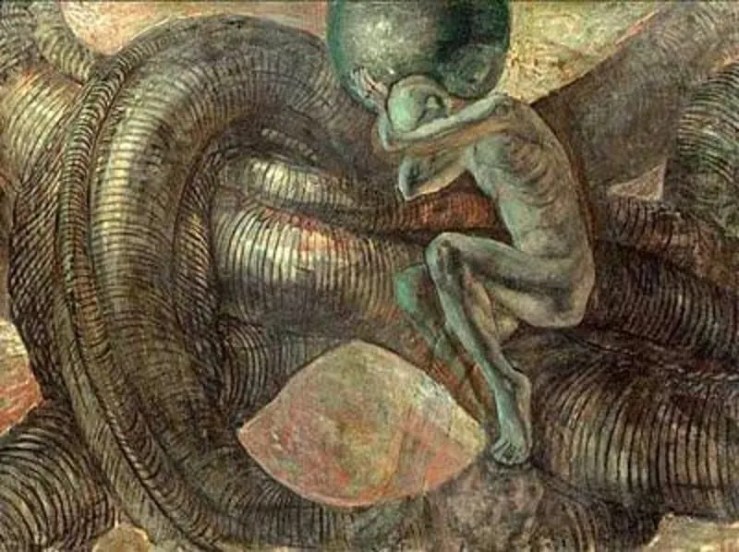
Sphinx II — Ludwig Schwarzer

Sphinx II, 1978 by Ludwig Schwarzer (1912 – 1989)

Steven Moore on William Gaddis and Russian Literature

Photograph of William Gaddis by William H. Gass

The good folks at indie publisher Sublunary have shared on their site the text of Gaddis scholar Steven Moore’s essay “William Gaddis and Russian Literature.” The essay serves as the preface for a forthcoming Russian translation of Moore’s Gaddis study, William Gaddis: Expanded Edition.

From the essay:

By the age of twenty Gaddis had already read Dostoevsky’s Crime and Punishment—he later called it “the first ‘great’ novel I experienced”—and over the next decade he devoured much more Russian literature, as is evident from the letters he wrote while writing his first novel, The Recognitions. He tells his mother about reading Chekhov’s plays and Dostoevsky’s House of the Dead, praises Crime and Punishment and The Idiot to short-story writer Katherine Anne Porter, and informs an ex-girlfriend that he is re-reading Goncharov’s Oblomov, which he continued to praise all his life. When his first novel was published in 1955, many critics mistakenly assumed that it was influenced by James Joyce’s Ulysses; but an informed reader would have noticed the numerous references to books by Dostoevsky (Brothers Karamazov, Crime and Punishment, Demons, The Idiot) and Tolstoy (Kingdom of God, Power of Darkness, Redemption), and would have correctly concluded that Gaddis had adapted the 19th-century Russian novel for 20th-century Americans, one closer to The Idiot than to Ulysses.

Read the essay at Sublunary.

A Portent for All Good Dogs of Tulsa Who Want to Show Their Quality — Peter Ferguson

A Portent for All Good Dogs of Tulsa Who Want to Show Their Quality by Peter Ferguson (b. 1968)

On the Beach — Peter Busch

On the Beach, 2019 by Peter Busch (b. 1971)

“Making Do,” a very short tale by Italo Calvino

“Making Do”

by

Italo Calvino

translated by Tim Parks


There was a town where everything was forbidden.

Now, since the only thing that wasn’t forbidden was the game tip-cat, the town’s subjects used to assemble on meadows behind the town and spend the day there playing tip-cat.

And as the laws forbidding things had been introduced one at a time and always with good reason, no one found any cause for complaint or had any trouble getting used to them.

Years passed. One day the constables saw that there was no longer any reason why everything should be forbidden and they sent messengers to inform their subjects that they could do whatever they wanted.

The messengers went to those places where the subjects were wont to assemble.

‘Hear ye, hear ye,’ they announced, ‘nothing is forbidden any more.’

The people went on playing tip-cat.

‘Understand?’ the messengers insisted. ‘You are free to do what you want.’

‘Good,’ replied the subjects. ‘We’re playing tip-cat.’

The messengers busily reminded them of the many wonderful and useful occupations they had once engaged in and could now engage in once again. But the subjects wouldn’t listen and just went on playing, stroke after stroke, without even stopping for a breather.

Seeing that their efforts were in vain, the messengers went to tell the constables.

‘Easy,’ the constables said. ‘Let’s forbid the game of tip-cat.’

That was when the people rebelled and killed the lot of them.

Then without wasting time, they got back to playing tip-cat.

Conspirators — Aaron Gilbert

Conspirators, 2020 by Aaron Gilbert (b. 1979)

William Friedkin describes creating Sorcerer’s bridge-crossing sequence

The most important scene in the film and the most difficult I’ve ever attempted is the bridge-crossing sequence, wherein the two trucks have to separately cross an old wooden suspension bridge that appears completely unstable. The bridge was anchored by crossbeams at each end, and the ropes suspending it were frayed, the wooden planks rotted and in some places absent. The crossing takes place over a rushing river during a blinding rainstorm. John Box designed the bridge so that it was controlled by a concealed hydraulic system with metallic supports. Each truck, as it crossed, was attached invisibly to the bridge so that it would sway but not capsize. That was the theory. Built at a cost of a million dollars, the bridge took three months to complete and was totally realistic, but it was a mad enterprise and definitely life-threatening.

We found the perfect river over which to build it, with a strong current and a depth of twelve feet. The river was more than two hundred feet wide, so that dictated the length of the bridge. Thick forest flanked it at each end.

As the weeks unfolded, there was little rainfall, and the river was diminishing. How could this be? Local experts and army engineers assured us that the river had never gone down. But slowly, agonizingly, it was doing just that. From twelve feet, the water level dropped down to ten, then eight, then five. By the time the bridge was finished, there was a little over a foot of water; and then the river dried up entirely! We had constructed a bridge over nothing. This was becoming a cursed project. With costs escalating and so many on the crew lost to illness and burnout, the sensible thing to do was to come up with a simpler sequence. That was the advice of all the executives, but I had become like Fitzcarraldo, the man who built an opera house in the Brazilian jungle. When I saw the finished bridge, I believed that if I could film the scene as I conceived it, it would be one of the greatest in film history. My obsession was out of control, and if I hadn’t been so successful over the past few years, I would have been ordered to stop. The two studios bet on me against their better judgment, because they thought I still had the mojo; maybe I was so in tune with audience tastes that costs wouldn’t matter. No one in his right mind would have continued on this course, but no one was in his right mind. I had the confidence, the energy, and the drive of an Olympic downhill skier, and those who stayed with me—the camera crew, the grips, electric, props, John Box, Roy Walker, my assistant director, Newt Arnold, and Bud Smith—all shared my passion. So we dispatched scouts to Mexico, to the Papaloapan River outside the town of Tuxtepec, where we had been told there were rushing waters in similar terrain that had never dropped in level, “the memory of man runneth not to the contrary.” John Box went to Mexico and came back with photos that matched our Dominican location perfectly. We dismantled the bridge and left the Dominican Republic with only two scenes left to shoot. We had to shut down while holding on to our four principal actors and key crew.

We flew to Vera Cruz, a shadowy seaport on Mexico’s Gulf Coast, which would be our base for three days, while John organized the precise location to rebuild the bridge. I discovered a small hotel in Plaza de las Armas, the main square. The tree-lined square was filled with mariachi bands and old men playing dominoes, smoking cigars, and drinking locally grown coffee. We filmed a prologue for Paco Rabal’s character Nilo, who kills a man execution-style in a room at the hotel overlooking the peaceful plaza below.

Our next stop was Tuxtepec in Oaxaca Province, one hundred miles to the south and east of Vera Cruz. From here we pushed farther south into the jungle surrounding the Papaloapan, to what had been an ancient Aztec village, with a small peasant population. The weather was humid, and thick, lush vegetation surrounded the fifteen-foot-deep branch of the swiftly rushing river. The bridge was already designed and built, so now it was a matter of reassembling and anchoring it. The shutdown of production lasted a month while we regrouped, at great expense to management. When we arrived at the Aztec village, I noticed what appeared to be a mass exodus of the local population. One of the authorities told me it was because of word of my arrival. They were a deeply religious people, and the man who made The Exorcist was coming to their village: bad karma. But a few of the locals and people from surrounding villages stayed and worked with us to put up the bridge.

I know this is hard to believe, but again the river level began to drop, at the rate of six inches or more a day. We had been told it rained often in this area, but we weren’t told that rain occurred only in the summer season. It was now the fall. I could see where this was going, but there was no turning back.

I became friendly with the local laborers. I used to share cervezas with them after a day’s work. One evening a man named Luis, who helped to organize the local crew, knocked on the door of my cabin. We all stayed in small wooden cabins in the jungle, the size of prison cells, with only an army cot, a chair, and a single hanging lightbulb. Luis asked if he might have a word with me. I was exhausted, but he was a good man who worked hard with a pick and shovel all day. I invited him in, and he handed me a beer and had one himself. We sat down and exchanged small talk for a few minutes; then he reached into his shirt pocket and pulled out what looked like an identity card but was on closer examination a badge. His look turned serious and sad. “Si, Señor Bill, I am Federales.” He was a federal agent assigned to work undercover on our set. “I have to inform you of an unfortunate situation,” he said. “There are members of your crew who are using drugs. This is a serious problem in my country.”

Was this a shakedown? “In a normal situation,” he continued, “I would be obliged to arrest them, and they would go to prison. Because I like you, I will not arrest them.” I was shocked; I wasn’t aware of who was using, or what. I thanked him and promised to make sure this activity stopped. “But they have to leave the country. Tomorrow,” he added. “Tomorrow?” “Sí.”

He gave me a dozen names, handwritten on a scrap of paper. They included members of the grip crew, some of the stuntmen, and the makeup artist. I told him this would seriously damage my ability to finish the film. “I am sorry,” he said quietly. “I’m sure you don’t want them to go to prison, and it is within my authority to arrest or send you all home, even those who are not using drugs. This is the best I can do; these people have to leave Mexico tomorrow.”

And so they did. It took two weeks to replace key people who had been with the film from the beginning, while the river continued to decline to a height of just under three feet, then became a stagnant pool. I called a meeting of the crew and explained the situation without inquiring who else was using. It was clear that anyone using would be caught and arrested. There were no more “unfortunate situations,” and thankfully the actors weren’t at risk, or we’d have been forced to shut the picture down.

We were able to divert sections of the river to our location using large pipes and pumping equipment, and I decided to shoot the scene in rain, manmade rain, so we brought in half a dozen large sprinklers that drew water from upriver. The sky was cloudy from morning until noon, then bright sun appeared and we had to shut down and go to our cabins until five o’clock, when the clouds rolled in again and we could resume shooting in matching light. The scene runs twelve minutes, roughly 10 percent of the final cut, but it took months to complete and cost more than $3 million, most of it not budgeted. The only thing that could save me was a hit picture. I had no doubt it would be. The performances were terrific, and the action scenes were original and believable.

Though the bridge scene was carefully prepared, the trucks would occasionally fall to one side. No one was hurt or injured, and none of the actors took the fall, only the stuntmen, who were heavily padded with flotation gear. I ran three cameras at different angles, but with the split shooting days it seemed as though we’d never be able to complete the scene. By the time it was over, a month later, I was exhausted and stressed but relieved, proud of the film but anxious to get home.

From William Friedkin’s memoir The Friedkin Connection.

Susie Boyt’s Loved and Missed (Book acquired, 5 Aug. 2023)

Loved and Missed is the seventh novel by British author Susie Boyt, but the first to be published here in the States. Publisher NYRB’s blurb:

Ruth is a woman who believes in and despairs of the curative power of love. Her daughter, Eleanor, who is addicted to drugs, has just had a baby, Lily. Ruth adjusts herself in ways large and small to give to Eleanor what she thinks she may need—nourishment, distance, affection—but all her gifts fall short. After someone dies of an overdoes in Eleanor’s apartment, Ruth hands her daughter an envelope of cash and takes Lily home with her, and Lily, as she grows, proves a compensation for all of Ruth’s past defeats and disappointment. Love without fear is a new feeling for her, almost unrecognizable. Will it last?

48 frames from William Friedkin’s Sorcerer

From Sorcerer, 1977. Directed by William Friedkin. Cinematography by Dick Bush & John M. Stephens. Stills via Film Grab.

RIP William Friedkin, 1935-2023.

“Counterman” — Paul Violi

“Counterman”
by
Paul Violi

What’ll it be?
Roast beef on rye, with tomato and mayo.
Whaddaya want on it?
A swipe of mayo.
Pepper but no salt.
You got it. Roast beef on rye.
You want lettuce on that?
No. Just tomato and mayo.
Tomato and mayo. You got it.
…Salt and pepper?
No salt, just a little pepper.
You got it. No salt.
You want tomato.
Yes. Tomato. No lettuce.
No lettuce. You got it.
…No salt, right?
Right. No salt.
You got it. Pickle?
No, no pickle. Just tomato and mayo.
And pepper.
Pepper.
Yes, a little pepper.
Right. A little pepper.
No pickle.
Right. No pickle.
You got it.
Next!
Roast beef on whole wheat, please,
With lettuce, mayonnaise and a center slice
Of beefsteak tomato.
The lettuce splayed, if you will,
In a Beaux Arts derivative of classical acanthus,
And the roast beef, thinly sliced, folded
In a multi-foil arrangement
That eschews Bragdonian pretensions
Or any idea of divine geometric projection
For that matter, but simply provides
A setting for the tomato
To form a medallion with a dab
Of mayonnaise as a fleuron.
And—as eclectic as this may sound—
If the mayonnaise can also be applied
Along the crust in a Vitruvian scroll
And as a festoon below the medallion,
That would be swell.
You mean like in the Cathedral St. Pierre in Geneva?
Yes, but the swag more like the one below the rosette
At the Royal Palace in Amsterdam.
You got it.
Next!