I have never written a novel (Thomas Bernhard)

JEAN-LOUIS DE RAMBURES: Why since 1975 have you set aside novel-writing in favor of autobiography?

THOMAS BERNHARD: I have never written a novel, but merely prose texts of greater or lesser length, and I’m going to take care not to describe them as novels; I don’t know what the word means.  I haven’t ever wanted to write an autobiographical work either; I have a genuine aversion to all things autobiographical.  The fact is that at a certain moment in my life I got curious about my childhood.  I said to myself, “I haven’t much longer to live.  Why not try to record my life up to the age of nineteen?  Not as it was in reality—there’s no such thing as objectivity—but as I see it today.”

When I was planning the book I envisaged it as a single slim volume.  A second one emerged.  Then yet another one…until the point when I started to get bored.  In the end childhood is always just childhood.  After the fifth volume I decided to call it a day. In the case of each my books I’m always torn this way and that between a passion and a loathing for my chosen subject.

Every time my second thoughts get the upper hand, I resolve to give up intellectual pursuits for good and dedicate myself instead to purely material tasks, for example to chopping wood or plastering a wall, in the hope of recovering my good cheer.  My dream is of a never-ending wall and never-ending good cheer.  But after a stretch of time of greater or lesser length, I once again start to loathe myself for being unproductive, and despair about this drives me to seek refuge in my brain.  Sometimes I tell myself my instability is something I’ve inherited from my ancestors, who were a very heterogeneous bunch.  This bunch included farmers, philosophers, laborers, writers, geniuses, and morons, mediocre petit-bourgeois types, and even criminals.  All these people exist within me, and they never leave off fighting each other.  Sometimes I feel like committing myself into the custody of the goose-keeper, at other times into the custody of the thief or the murderer.  Because you’ve got to make choices, and every choice means precluding other choices; this round-dance ultimately drives me to the brink of madness.  Such that if I make it to the end of my matutinal shaving routine without killing myself in front of the mirror, I have only my cowardice to thank for it.

Cowardice, vanity, and curiosity are the three basic and essential impetuses to life, the things that keep it moving along, even though every conceivable rational argument gainsays this movement.  At any rate, that’s the way it seems to me today.  Because it may very well happen that tomorrow I’ll think something completely different.

From an interview with Thomas Bernhard originally published in Le Monde. The English translation is by Douglas Robertson. You can read the entire translated interview at his blog.

Maiden Meditation — Charles West Cope

Early Autumn Wind, Lingering Memory of Summer — Shuichi Nakano

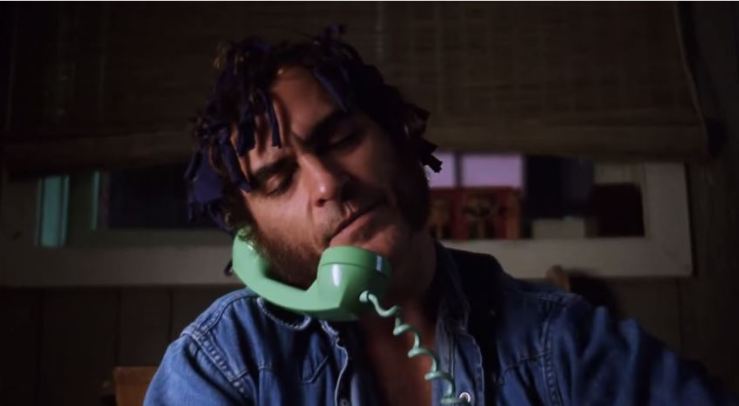
A Short Riff on the Inherent Vice Film Trailer

2

A. It’s likely that if you care about these things you’ve already seen the first full (non-teaser) trailer for Paul Thomas Anderson’s film adaptation of Thomas Pynchon’s novel Inherent Vice.

B. Here is that trailer:


C. What do you think?

D. I think it looks pretty great.

E. Well, I mean, the trailer still has the, I don’t know, rhythms and contours and tropes of, like, quirky indie comedy film trailers—verbal slapstick, slapstick slapstick (I love the bit at 00:27 when the cop knocks Sportello down, but the callback at 1:52 seems like it could squash a punchline), an affected scream, up-tempo soundtrack (although “Don’t Know Much About History” isn’t one of the many, many songs mentioned in the book). But hey, target audience, etc. etc. etc.

F. And I’m sure the target audience here loves to get a taste of Owen Wilson looking vulnerable and sensitive and just very Owen Wilsonish. (I, a target, enjoyed the taste).

G. And apparently Michael K. Williams is in this movie making his Michael K. Williams face.

H. And also: Joanna Newsom is supposedly in the film—both as a character and narrator. She narrates the trailer, but if she’s in it, like, physically, I think I missed that.

I. And we get this:

1

J. And a New Age cult pizza party, staged in a loose approximation of The Last Supper.

K. And Eric Roberts.

L. And Josh Brolin shouting for pancakes in sloppy Japanese.

M. And guns! Yes, guns in the trailer, audience!

N. And some ass shots to boot, including our man Sportello, prostrate, cowering.

O. I like that the trailer—and I’m guessing the film itself (?)—uses the same neon-noir font that the book did; I thought the cover of Inherent Vice was horrendous, but ultimately made sense.

P. But what I find most fascinating here is how neatly Newsom’s narration sums up the novel’s plot in the first 20 seconds of the trailer, highlighting just how irrelevant the plot is in Pynchon’s novel. Inherent Vice: The Novel eschews plotting in favor of verbal style, mood, and imagery—which makes Paul Thomas Anderson an ideal filmmaker to handle the first (and maybe we should hope only) Pynchon adaptation.

Q. I’m usually pretty wary of film adaptations of big-ell Literature, but Inherent Vice is kind of on the bubble there. It’s a shaggy dog tale, just like the Coen brothers’ classic The Big Lebowski, or Tarantino’s best film Jackie Brown. (When I reviewed the book a few years ago, I brought up Elmore Leonard and Lebowski, along with Chinatown).

R. My big concern is that PTA, like his hero Robert Altman, can get a bit too shaggy. When he’s got a clear trajectory to follow (Boogie NightsPunch Drunk Love), PTA offers up a deep comic complex humanism. But then there’s that fine mess Magnolia. 

S. I loved the last film that Joaquin Phoenix and PTA did together though, 2012’s The Master.

T. And what do we think of Joaquin Phoenix as Doc Sportello? Does he look a little bit, I don’t know, too old? I don’t know. He kind of looks a little bit like a stoned Hugh-Jackman-as-Wolverine here.

U. (That’s not necessarily, like, bad).

V. The trailer makes me want to see the film more than I had wanted to see it before, which was its job, so, like, good trailer, I guess.

Never was there more hollowness at heart than at present (Walt Whitman)

I say we had best look our times and lands searchingly in the face, like a physician diagnosing some deep disease. Never was there, perhaps, more hollowness at heart than at present, and here in the United States. Genuine belief seems to have left us. The underlying principles of the States are not honestly believ’d in, (for all this hectic glow, and these melodramatic screamings,) nor is humanity itself believ’d in. What penetrating eye does not everywhere see through the mask? The spectacle is appaling. We live in an atmosphere of hypocrisy throughout. The men believe not in the women, nor the women in the men. A scornful superciliousness rules in literature. The aim of all the littérateurs is to find something to make fun of. A lot of churches, sects, &c., the most dismal phantasms I know, usurp the name of religion. Conversation is a mass of badinage. From deceit in the spirit, the mother of all false deeds, the offspring is already incalculable. An acute and candid person, in the revenue department in Washington, who is led by the course of his employment to regularly visit the cities, north, south and west, to investigate frauds, has talk’d much with me about his discoveries. The depravity of the business classes of our country is not less than has been supposed, but infinitely greater. The official services of America, national, state, and municipal, in all their branches and departments, except the judiciary, are saturated in corruption, bribery, falsehood, mal-administration; and the judiciary is tainted. The great cities reek with respectable as much as non-respectable robbery and scoundrelism. In fashionable life, flippancy, tepid amours, weak infidelism, small aims, or no aims at all, only to kill time. In business, (this all-devouring modern word, business,) the one sole object is, by any means, pecuniary gain. The magician’s serpent in the fable ate up all the other serpents; and money-making is our magician’s serpent, remaining to-day sole master of the field.

From Walt Whitman’s Democratic Vistas (1871).

“October” — Robert Frost

Capture

John Wycliffe Reading His Translation of the Bible to John of Gaunt — Ford Madox Brown

Forbidden Fruit — Leonora Carrington

Forbidden Fruit, 1959, oil on canvas

“Washington Blues” / “I’m Going Away”– Elizabeth Cotten

“Discovery” — Guy de Maupassant

The steamer was crowded with people and the crossing promised to be good. I was going from Havre to Trouville.

The ropes were thrown off, the whistle blew for the last time, the whole boat started to tremble, and the great wheels began to revolve, slowly at first, and then with ever-increasing rapidity.

We were gliding along the pier, black with people. Those on board were waving their handkerchiefs, as though they were leaving for America, and their friends on shore were answering in the same manner.

The big July sun was shining down on the red parasols, the light dresses, the joyous faces and on the ocean, barely stirred by a ripple. When we were out of the harbor, the little vessel swung round the big curve and pointed her nose toward the distant shore which was barely visible through the early morning mist. On our left was the broad estuary of the Seine, her muddy water, which never mingles with that of the ocean, making large yellow streaks clearly outlined against the immense sheet of the pure green sea.

As soon as I am on a boat I feel the need of walking to and fro, like a sailor on watch. Why? I do not know. Therefore I began to thread my way along the deck through the crowd of travellers. Suddenly I heard my name called. I turned around. I beheld one of my old friends, Henri Sidoine, whom I had not seen for ten years. Continue reading ““Discovery” — Guy de Maupassant”

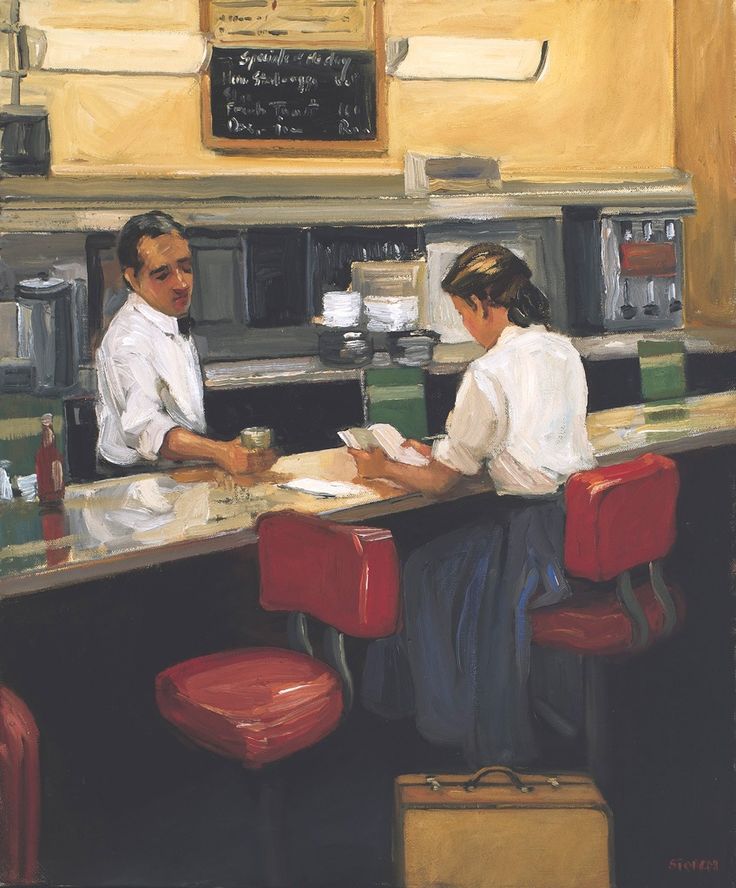
Night Cafe — Sally Storch

06dbbbf1463c62eef9208e4b55d82e65

Coffee Harvest — Candido Portinari

Cousins — Jim Jarmusch

A Coffee Thesaurus

A COFFEE THESAURUS — From William H. Ukers’s All About Coffee (1922)

Encomiums and descriptive phrases applied to the plant, the berry, and the beverage

The Plant

The precious plant
This friendly plant
Mocha’s happy tree
The gift of Heaven
The plant with the jessamine-like flowers
The most exquisite perfume of Araby the blest
Given to the human race by the gift of the Gods

The Berry

The magic bean
The divine fruit
Fragrant berries
Rich, royal berry
Voluptuous berry
The precious berry
The healthful bean
The Heavenly berry
The marvelous berry
This all-healing berry
Yemen’s fragrant berry
The little aromatic berry
Little brown Arabian berry
Thought-inspiring bean of Arabia
The smoking, ardent beans Aleppo sends
That wild fruit which gives so beloved a drink

The Beverage

Nepenthe
Festive cup
Juice divine
Nectar divine
Ruddy mocha
A man’s drink
Lovable liquor
Delicious mocha
The magic drink
This rich cordial
Its stream divine
The family drink
The festive drink
Coffee is our gold
Nectar of all men
The golden mocha
This sweet nectar
Celestial ambrosia
The friendly drink
The cheerful drink
The essential drink
The sweet draught
The divine draught
The grateful liquor
The universal drink
The American drink
The amber beverage
The convivial drink
The universal thrill
King of all perfumes
The cup of happiness
The soothing draught
Ambrosia of the Gods
The intellectual drink
The aromatic draught
The salutary beverage
The good-fellow drink
The drink of democracy
The drink ever glorious
Wakeful and civil drink
The beverage of sobriety
A psychological necessity
The fighting man’s drink
Loved and favored drink
The symbol of hospitality
This rare Arabian cordial
Inspirer of men of letters
The revolutionary beverage
Triumphant stream of sable
Grave and wholesome liquor
The drink of the intellectuals
A restorative of sparkling wit
Its color is the seal of its purity
The sober and wholesome drink
Lovelier than a thousand kisses
This honest and cheering beverage
A wine which no sorrow can resist
The symbol of human brotherhood
At once a pleasure and a medicine
The beverage of the friends of God
The fire which consumes our griefs
Gentle panacea of domestic troubles
The autocrat of the breakfast table
The beverage of the children of God
King of the American breakfast table
Soothes you softly out of dull sobriety
The cup that cheers but not inebriates
Coffee, which makes the politician wise
Its aroma is the pleasantest in all nature
The sovereign drink of pleasure and health
The indispensable beverage of strong nations
The stream in which we wash away our sorrows
The enchanting perfume that a zephyr has brought
Favored liquid which fills all my soul with delight
The delicious libation we pour on the altar of friendship
This invigorating drink which drives sad care from the heart


The Angry One — Ferdinand Hodler

The Land of Miracles — René Magritte