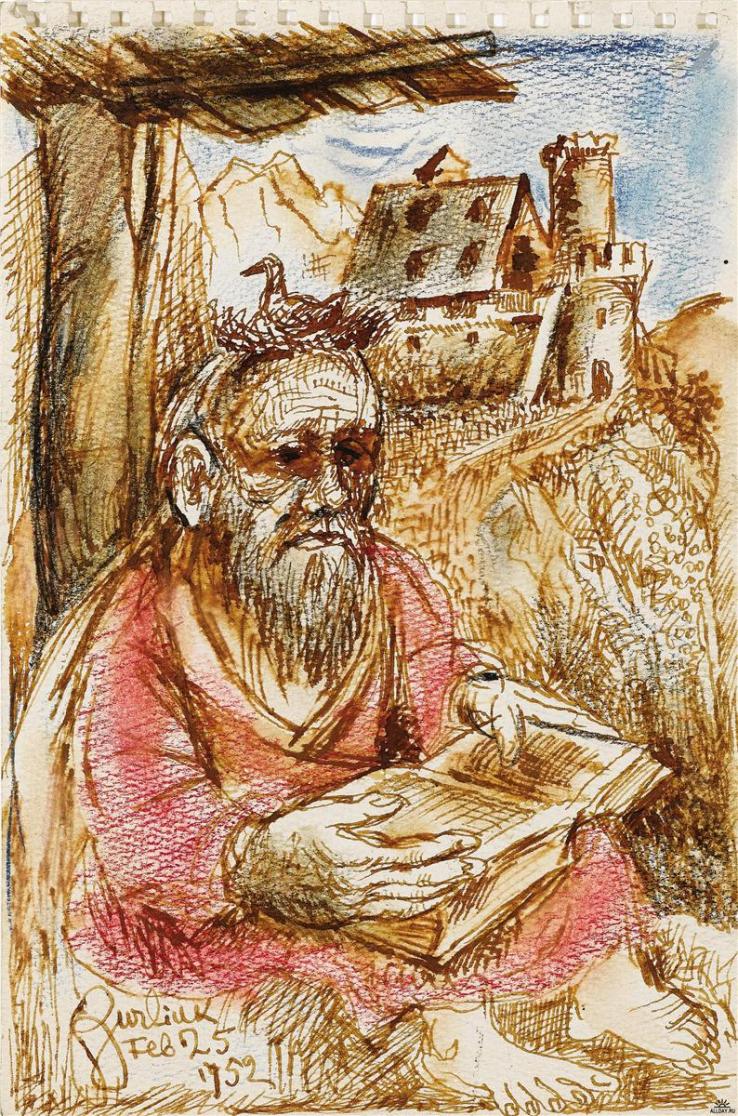
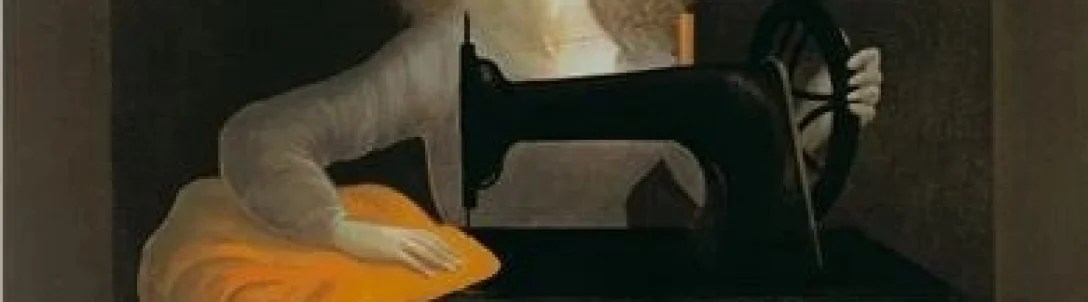
Scientist — David Burliuk

scientist-1952.jpg!HD

Ali: Fear Eats the Soul — Rainer Werner Fassbinder (Full Film)

Love and Death — Francisco Goya

Film Footage of William Faulkner (1952)

“Hollow” — Breece D’J Pancake

“Hollow” by Breece D’J Pancake

Hunched on his knees in front of the three-foot coal seam, Buddy was lost in the back-and-forth rhythm of the truck mine’s relay: the glitter of coal and sandstone in his cap light, the setting and lifting and pouring into the cart that carried the stuff to the mouth of the mine. This was nothing like shaft mining, no deep tunnels or up-and-down man-trips, only the setting, lifting, pouring, only the rumbling of the relay cart and the light-flash from caps in the relay. In the pace of work, he daydreamed his father lowering him into the cistern: many summers ago he touched the cool tile walls, felt the moist air from the water below, heard the pulley squeak in the circle of blue above. The tin of the well-pail buckled under his tiny feet, and he began to cry. His father hauled him up. “That’s the way we do it,” he said, laughing, and carried Buddy to the house.

But that came before everything; before they moved from the ridge, before the big mine closed, before welfare. Now, at the far end of the relay, the men were quiet, and Buddy wondered if they thought of stupid things. From where he squatted he could see the gray grin of light at the mouth of the truck mine, the March wind spraying dust into little clouds. The half-ton relay cart was full now, and the last man in the relay shoved it toward the chute at the mine-mouth on two-by-four tracks.

“Take a break” came from the opening, and as he set his shovel aside to rise from where he knelt at the coal face, Buddy saw his cousin Curtis start through the mine-mouth. Curtis was dragging a poplar post behind him as he crawled past the relay cart toward the face. Buddy watched while Curtis worked the post upright from the floor to catch the weight of the ceiling. It was too short, and Curtis hammered wedges in to tighten the fit.

“Got it?” Buddy asked.

“Hell no, but she looks real pretty.”
Continue reading ““Hollow” — Breece D’J Pancake” →

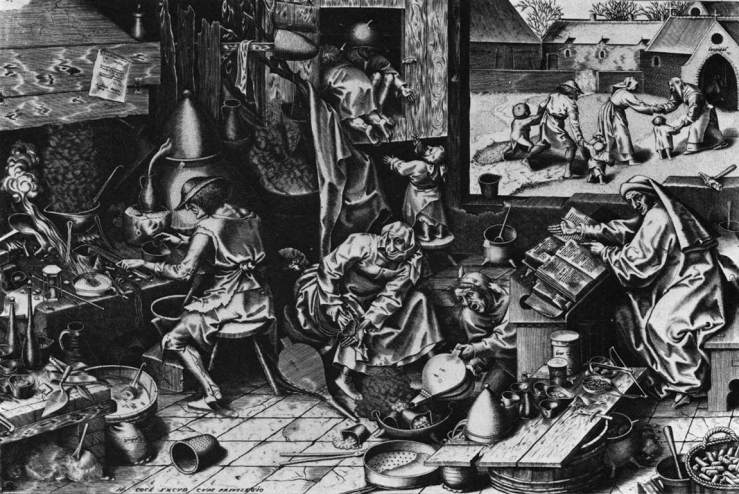
The Alchemist — Pieter Bruegel the Elder

the-alchemist

Gummo — Harmony Korine (Full Film)

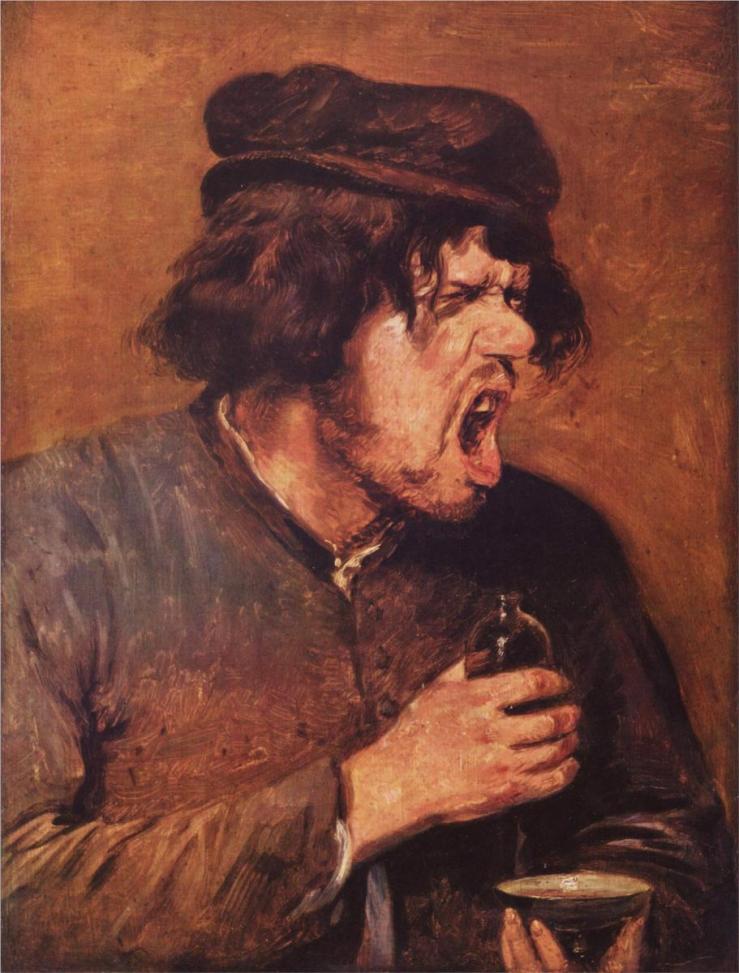
The Bitter Drunk — Adriaen Brouwer

the-bitter-drunk.jpg!HD

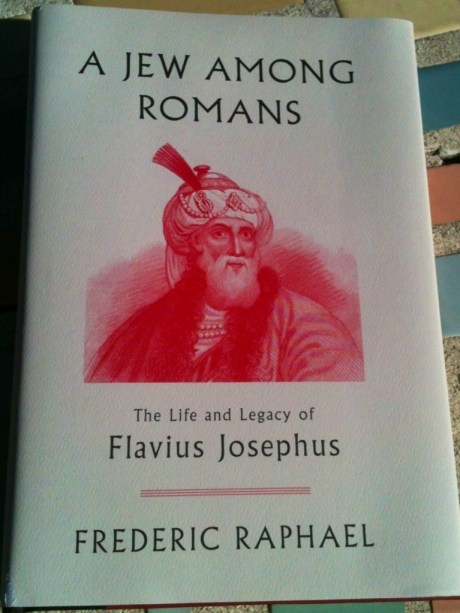
A Jew Among Romans: The Life and Legacy of Flavius Josephus (Book Acquired, 1.14.2013

20130120-174045.jpg

This one looks pretty interesting, and the first chapter was intriguing: A Jew Among the Romans: The Life and Legacy of Flavius Josephus. It’s new in hardback from Random House. Their blurb:

From the acclaimed biographer, screenwriter, and novelist Frederic Raphael, here is an audacious history of Josephus (37–c.100), the Jewish general turned Roman historian, whose emblematic betrayal is a touchstone for the Jew alone in the Gentile world.

Joseph ben Mattathias’s transformation into Titus Flavius Josephus, historian to the Roman emperor Vespasian, is a gripping and dramatic story. His life, in the hands of Frederic Raphael, becomes a point of departure for an appraisal of Diasporan Jews seeking a place in the dominant cultures they inhabit. Raphael brings a scholar’s rigor, a historian’s perspective, and a novelist’s imagination to this project. He goes beyond the fascinating details of Josephus’s life and his singular literary achievements to examine how Josephus has been viewed by posterity, finding in him the prototype for the un-Jewish Jew, the assimilated intellectual, and the abiding apostate: the recurrent figures in the long centuries of the Diaspora. Raphael’s insightful portraits of  Yehuda Halevi, Baruch Spinoza, Karl Kraus, Benjamin Disraeli, Ludwig Wittgenstein, and Hannah Arendt extend and illuminate the Josephean worldview Raphael so eloquently lays out.


“They’re called Hüsker Dü. Why are they on our show?”

“Sweat” — Zora Neale Hurston

“Sweat” by Zora Neale Hurston

It was eleven o’clock of a Spring night in Florida. It was Sunday. Any other night, Delia Jones would have been in bed for two hours by this time. But she was a wash-woman, and Monday morning meant a great deal to her. So she collected the soiled clothes on Saturday when she returned the clean things. Sunday night after church, she sorted them and put the white things to soak. It saved her almost a half day’s start. A great hamper in the bedroom held the clothes that she brought home. It was so much neater than a number of bundles lying around.

She squatted in the kitchen floor beside the great pile of clothes, sorting them into small heaps according to color, and humming a song in a mournful key, but wondering through it all where Sykes, her husband, had gone with her horse and buckboard.

Just then something long, round, limp and black fell upon her shoulders and slithered to the floor beside her. A great terror took hold of her. It softened her knees and dried her mouth so that it was a full minute before she could cry out or move. Then she saw that it was the big bull whip her husband liked to carry when he drove.

She lifted her eyes to the door and saw him standing there bent over with laughter at her fright. She screamed at him.

“Sykes, what you throw dat whip on me like dat? You know it would skeer me–looks just like a snake, an’ you knows how skeered Ah is of snakes.”

“Course Ah knowed it! That’s how come Ah done it.” He slapped his leg with his hand and almost rolled on the ground in his mirth. “If you such a big fool dat you got to have a fit over a earth worm or a string, Ah don’t keer how bad Ah skeer you.”

“You aint got no business doing it. Gawd knows it’s a sin. Some day Ah’m goin’ tuh drop dead from some of yo’ foolishness. ‘Nother thing, where you been wid mah rig? Ah feeds dat pony. He aint fuh you to be drivin’ wid no bull whip.”

“You sho is one aggravatin’ nigger woman!” he declared and stepped into the room. She resumed her work and did not answer him at once. “Ah done tole you time and again to keep them white folks’ clothes outa dis house.”

He picked up the whip and glared down at her. Delia went on with her work. She went out into the yard and returned with a galvanized tub and set it on the washbench. She saw that Sykes had kicked all of the clothes together again, and now stood in her way truculently, his whole manner hoping, praying, for an argument. But she walked calmly around him and commenced to re-sort the things.

“Next time, Ah’m gointer kick ’em outdoors,” he threatened as he struck a match along the leg of his corduroy breeches. Continue reading ““Sweat” — Zora Neale Hurston” →
Reading — Konstantin Makovsky

reading (1)

Taboo — Nagisa Oshima (Full Film with English Subtitles)

“I’m Happy” — Ivor Cutler

“Were this world an endless plain…” (Moby-Dick)

Were this world an endless plain, and by sailing eastward we could for ever reach new distances, and discover sights more sweet and strange than any Cyclades or Islands of King Solomon, then there were promise in the voyage. But in pursuit of those far mysteries we dream of, or in tormented chase of that demon phantom that, some time or other, swims before all human hearts; while chasing such over this round globe, they either lead us on in barren mazes or midway leave us whelmed.

From “The Albatross,” Chapter 52 of Melville’s Moby-Dick.


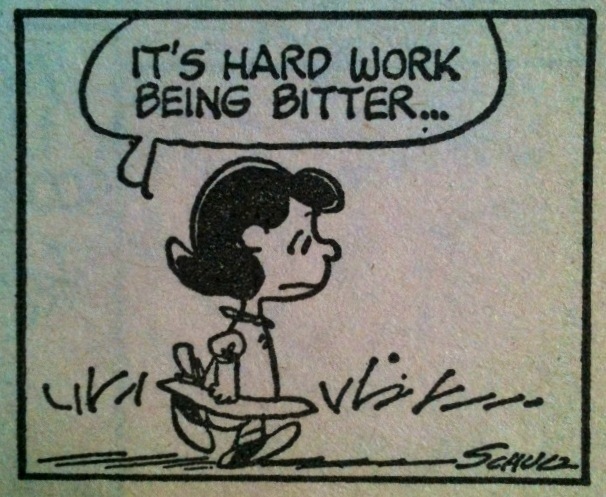
Hard Work (Peanuts)

20130120-101954.jpg

“King for a Day” — Bobby Conn