There’s a nice new big fat interview with Ishmael Reed now up at The Collidescope

2020-01-03_152112_1

There’s a nice new big fat interview with Ishmael Reed now up at The Collidescope. In the interview (conducted by George Salis), Reed discusses lots of stuff, including his love of Nathaniel Hawthorne’s “Young Goodman Brown” (“one of the great short stories [by] the greatest of American white male writers for my money”), his contempt for David Simon’s The Wire, most of his novels, and his new play The Slave Who Loved Caviar. 

Late in the interview, Salis asks Reed to name a novel he thinks deserves more attention. Here’s Reed’s reply:

IR: Let’s see, there’s a novel by Ron Sukenick, one of the experimental writers about the golden calf [Mosaic Man, 1999]. I can’t figure the title right now, but I think it deserves more readers. I think they like Philip Roth and pedestrian writers like him. But Ron Sukenick was an excellent writer and one of those experimental white writers who don’t get enough attention. I like also A Different Drummer by William Melvin Kelley which I have written a review about but it’s not published and there are a lot of excellent writers, excellent novelists, but the Anglo minds of reviewers is just preventing the public from having access to these writers.

Read the interview at The Collidescope.

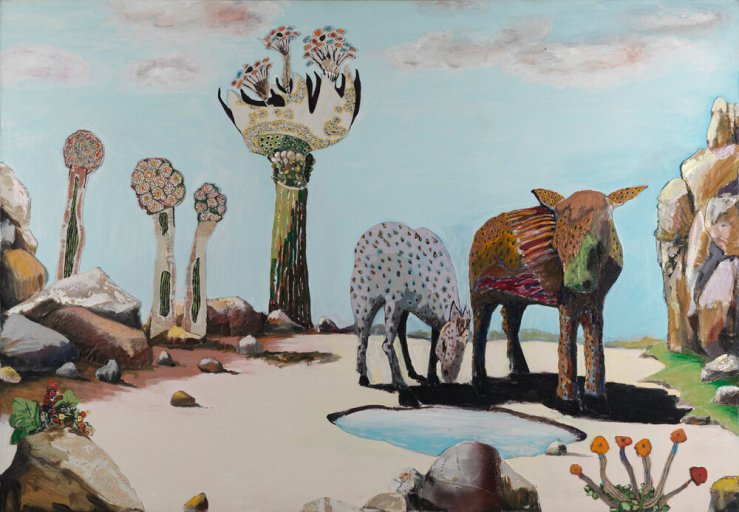
Drivers Notice: Are That Mr. Mushroom and Badger the Mad Warlock — Davor Gromilovic

Drivers Notice: Are That Mr. Mushroom and Badger the Mad Warlock, 2021 by Davor Gromilovic (b. 1985)

“The Terrapin” — Wendell Berry


“The Terrapin”

by

Wendell Berry


The terrapin and his house are one.
Though he may go, he’s never gone.

He’s housed within, from nose to toe:
A door, a floor, and no window.

There’s little room; the light is dim;
His furniture is only him.

He doesn’t speak what he thinks about;
Where no guest comes, a thought’s a shout.

He pokes along; he’s in no haste:
He has no map and no suitcase;

He has no worries and no woes,
For where he is is where he goes.

Ponder this wonder under his dome
Who, wandering, is always home.

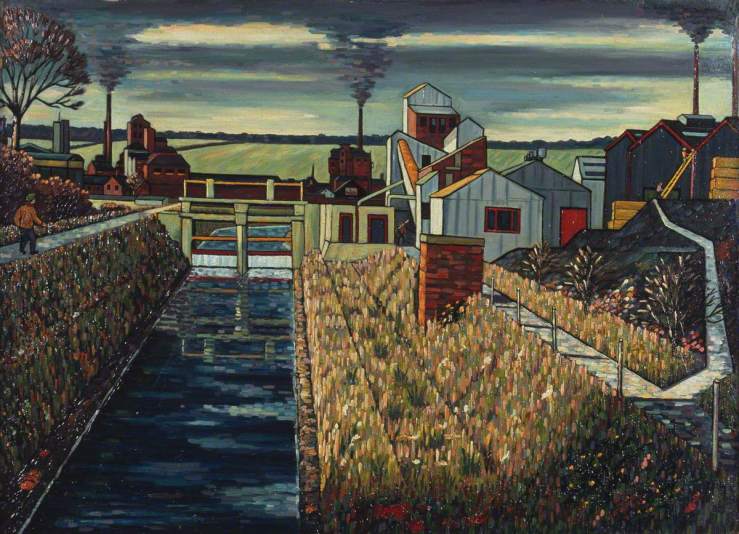
The Brewery and Paper Mill — Ely Charles Byrd

The Brewery and Paper Mill by Ely Charles Byrd (1916–2018)

“The Valley” — William S. Burroughs

“The Valley”

a passage from

The Western Lands

by William S. Burroughs


THE VALLEY

There is no way in or out of the Valley, which is ringed with sheer cliffs with an overhanging ledge. How did the people of the Valley get in there in the first place? No one remembers. They have been there for many years. Children have been born, grown old and died in the Valley, but not many children. Food is scarce. A stream runs through the Valley, and they have dammed up a large pond to raise fish. There is an area along the stream where they grow corn. Sometimes they kill birds, a few lizards and snakes. So most children must be killed at birth. Just an allotted number to continue the line.

Maybe, some say, they will be seen, and people will lower ropes. There is a legend that one man built a flying machine from lizard, snake and fish skins sewn to a frame of light wood. It took him all his life to build it, and he was seventy when the machine was finally finished. It looked like a gigantic dragonfly with sixty-foot wings.
Continue reading ““The Valley” — William S. Burroughs”

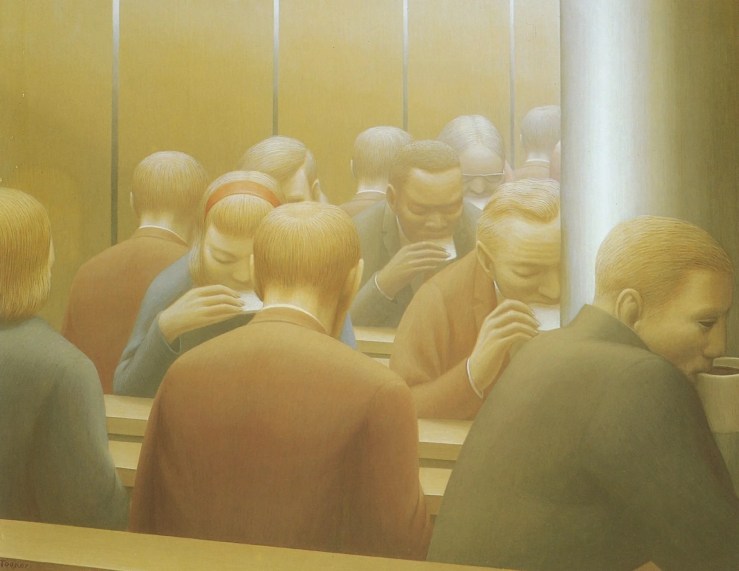
Lunch — George Tooker

Lunch, 1964 by George Tooker (1920-2011)

Posted in Art

“Metals Metals” — Russell Edson

“Metals Metals”

by

Russell Edson


Out of the golden West, out of the leaden East, into the iron South, and to the silver North … Oh metals metals everywhere, forks and knives, belt buckles and hooks … When you are beaten you sing. You do not give anyone a chance …

You come out of the earth and fly with men. You lodge in men. You hurt them terribly. You tear them. You do not care for anyone.

Oh metals metals, why are you always hanging about? Is it not enough that you hold men’s wrists? Is it not enough that we let you in our mouths?

Why is it you will not do anything for yourself? Why is it you always wait for men to show you what to be?

And men love you. Perhaps it is because you soften so often.

You did, it is true, pour into anything men asked you to. It has always proved you to be somewhat softer than you really are.

Oh metals metals, why are you always filling my house?

You are like family, you do not care for anyone.

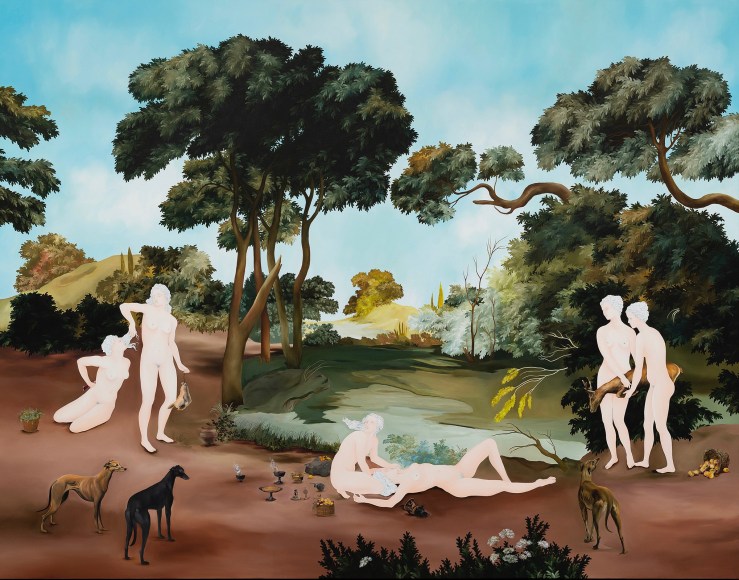
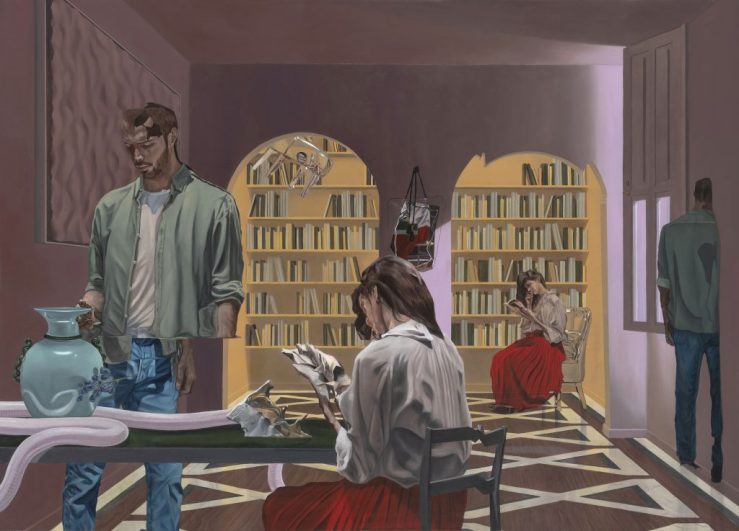
Under the Influence of Poison — Sanam Khatibi 

Under the Influence of Poison, 2018 by Sanam Khatibi (b. 1979)

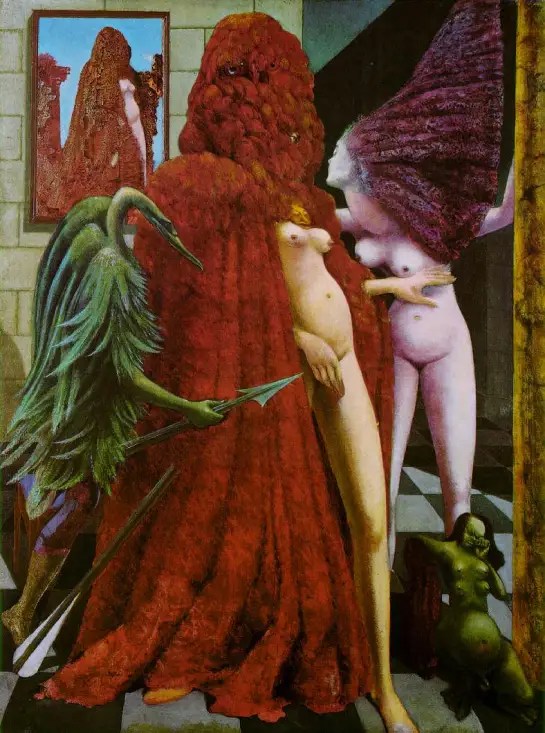
The Robing of the Bride. The title of one of Max Ernst’s most mysterious paintings | J.G. Ballard

The Robing of the Bride.

The title of one of Max Ernst’s most mysterious paintings. An unseen woman is being prepared by two attendants for her marriage, and is dressed in an immense gown of red plumage that transforms her into a beautiful and threatening bird. Behind her, as if in a mirror, is a fossilized version of herself, fashioned from archaic red coral. All my respect and admiration of women is prompted by this painting, which I last saw at Peggy Guggenheim’s museum in Venice, stared at by bored students. Leaving them. I strayed into a private corridor of the palazzo, and a maid emerging through a door with a vacuum cleaner gave me a glimpse into a bedroom overlooking the Grand Canal. Sitting rather sadly on the bed was Miss Guggenheim herself, sometime Alice at the surrealist tea-party, a former wife of Max Ernst and by then an old woman. As she stared at the window I half-expected to see the bird costume on the floor beside her. She was certainly entitled to wear it.

From The Atrocity Exhibition by J.G. Ballard

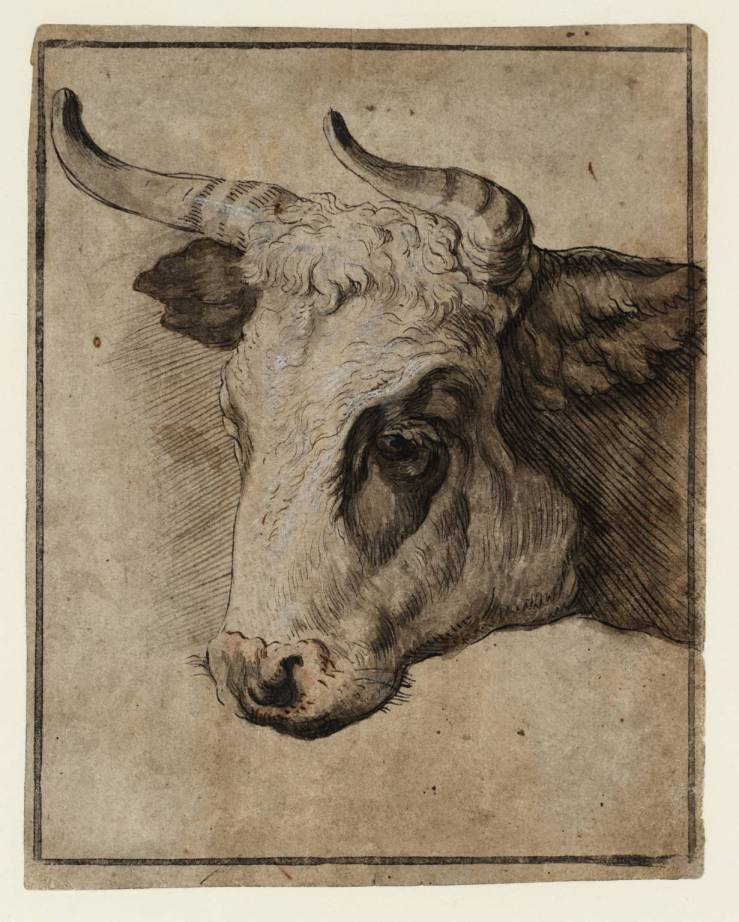
Side View of a Bull’s Head — Joseph Highmore

Side View of a Bull’s Head by Joseph Highmore (1692-1780)

List with no name #66

  1. The Slynx, Tatyana Tolstoya
  2. Nazi Literature in the Americas, Roberto Bolaño
  3. Parable of the Sower, Octavia Butler
  4. Telluria, Vladimir Sorokin
  5. The Road, Cormac McCarthy
  6. The Cities of Red Night, William S. Burroughs
  7. Harrow, Joy Williams
  8. Love in the Ruins, Walker Percy
  9. The Hospital Ship, Martin Bax
  10. Post-Exoticism in Ten Lessons, Lesson Eleven, Antoine Volodine
  11. Carmen Dog, Carol Emshwiller

Reification #80 — Dario Maglionico 

Reification #80, 2021 by Dario Maglionico (b. 1986)

“Silvio Salvático” — Roberto Bolaño

“Silvio Salvático”

by

Roberto Bolaño

translated by Chris Andrews

from Nazi Literature in the Americas


SILVIO SALVÁTICO

Buenos Aires, 1901–Buenos Aires, 1994

As a young man Salvático advocated, among other things, the re-establishment of the Inquisition; corporal punishment in public; a permanent war against the Chileans, the Paraguayans, or the Bolivians as a kind of gymnastics for the nation; polygamy; the extermination of the Indians to prevent further contamination of the Argentinean race; curtailing the rights of any citizen with Jewish blood; a massive influx of migrants from the Scandinavian countries in order to effect a progressive lightening of the national skin color, darkened by years of promiscuity with the indigenous population; life-long writer’s grants; the abolition of tax on artists’ incomes; the creation of the largest air force in South America; the colonization of Antarctica; and the building of new cities in Patagonia.

He was a soccer player and a Futurist.

From 1920 to 1929, in addition to frequenting the literary salons and fashionable cafes, he wrote and published more than twelve collections of poems, some of which won municipal and provincial prizes. From 1930 on, burdened by a disastrous marriage and numerous offspring, he worked as a gossip columnist and copy-editor for various newspapers in the capital, hung out in dives, and practised the art of the novel, which stubbornly declined to yield its secrets to him. Three titles resulted: Fields of Honor (1936), about semi-secret challenges and duels in a spectral Buenos Aires; The French Lady (1949), a story of prostitutes with hearts of gold, tango singers and detectives; and The Eyes of the Assassin (1962), a curious precursor to the psycho-killer movies of the seventies and eighties.

He died in an old-age home in Villa Luro, his worldly possessions consisting of a single suitcase full of books and unpublished manuscripts.

His books were never republished. His manuscripts were probably thrown out with the trash or burned by the orderlies.

You who saw it all, or saw flashes and fragments

Lovers — Ilya Milstein

Lovers, 2019 by Ilya Milstein

Oasis — Benny Andrews

Oasis, 1989 by Benny Andrews (1930-2006)

Posted in Art

Joe the Dead belongs to a select breed of outlaws known as the NOs, natural outlaws dedicated to breaking the so-called natural laws of the universe | William S. Burroughs

  Joe the Dead belongs to a select breed of outlaws known as the NOs, natural outlaws dedicated to breaking the so-called natural laws of the universe foisted upon us by physicists, chemists, mathematicians, biologists and, above all, the monumental fraud of cause and effect, to be replaced by the more pregnant concept of synchronicity.

Ordinary outlaws break man-made laws. Laws against theft and murder are broken every second. You only break a natural law once. To the ordinary criminal, breaking a law is a means to an end: obtaining money, removing a source of danger or annoyance. To the NO, breaking a natural law is an end in itself: the end of that law.

Ordinary outlaws specialize their trades, in accordance with their inclinations and aptitudes—or they did at one time. Many of the old-time criminal types are endangered species now. Consider the Murphy Man. How many even know what a Murphy Man is? Your Murphy Man steers the mark to a nonexistent whore, having located an apartment building without a doorman and with the front door unlocked.

“Looking for some action, friend?”

“Well, uh, yes . . .”

The Murphy Man makes a phone call: it’s all set up. He leads the mark to the apartment building entrance.

“Go up one flight, first door on your left, 1A. Prime grade, friend, and she’s ready and waiting on you. You pay me now, so there won’t be any arguments.”

Only a black man can have the real Murphy Man voice— cool, insinuating, familiar—and the real Murphy Man face— sincere, unflappable, untrustworthy.

And practitioners of the Hype or the Bill, a short-change routine. You start by paying for a two-bit item with a twenty-dollar bill. You get the change on the counter, then you tell the clerk, “I must have been dreaming—I don’t mean to take all your small change. Here, give me ten for this” and count the ones back, minus the five. Or something like that. It’s hard to get a conviction on the Bill, because nobody can explain exactly what happened.

The basic principle can be found in a sketch by Edgar Allan Poe on nineteenth-century hustlers who were known as Diddlers. The diddler walks into a tobacco store and asks for a plug of tobacco. When the plug is on the counter, he changes his mind.

“Give me a cigar instead.” He takes the cigar and starts to walk out.

“Wait a minute. You didn’t pay for the cigar.”

“Of course not. I traded it against the tobacco plug.”

“Don’t recall you paid me for that either.”

“Paid you for it! Why, there it is! None of your tricks on traveling men.”

Unobtrusive and insistent, practitioners of the Bill are often addicts.

I wonder if there are any hype men left? Like Yellow Kid Weil and the Big Store: he would set up a prop brokerage office or bookmaking parlor and fleece his customers for several days before vanishing one night with the boodle. Also noteworthy is the sordid yachting swindle, practiced at one time by a certain well-known cult leader who shall be nameless. They’re going to buy a boat together, sail the South Seas . . . this swindle requires that mark and swindler live in the same trailer, get drunk together every night and lay the same whore. Yellow Kid Weil would have been scandalized. “Never drink with a savage,” was one of his rules.

The old-time bank robbers, the burglars who bought jewelry-store insurance inventories and knew exactly what they were looking for, the pickpockets trained from early childhood—they say the best ones come from Colombia—where are they now? The Murphy Men, the hype artists, the Big Store? Gone, all gone.

From William S. Burroughs’ last novel The Western Lands.