Hurricane Tips for Yankees

You’ll need this—

A bunch of these—

Lots of these—

—and/or these—

Some of this—

And some of this—

Never hurts to have one of these around too—

It’s also a good idea to fill up the tub with water (Galifianakis and ducklings optional)—

In all seriousness though, good luck and stay safe.

“I Scream, You Scream, We All Scream for Ice Cream”

A favorite scene from a favorite film.

“The Monstropolous Beast Had Left His Bed” — Zora Neale Hurston’s Hurricane

In Chapter 18 of her novel Their Eyes Were Watching God, Zora Neale Hurston imagines a hurricane descending on the Everglades as a cosmic monster. Her description comes in part from accounts of the 1928 Great Lake Okeechobee Hurricane—

Ten feet higher and far as they could see the muttering wall advanced before the braced-up waters like a road crusher on a cosmic scale. The monstropolous beast had left his bed. Two hundred miles an hour wind had loosed his chains. He seized hold of his dikes and ran forward until he met the quarters; uprooted them like grass and rushed on after his supposed-to- be conquerors, rolling the dikes, rolling the houses, rolling the people in the houses along with other timbers. The sea was walking the earth with a heavy heel.

“Backwood Names” — F. Scott Fitzgerald

F. Scott Fitzgerald puts his imagination to work. From Notebooks

BACKWOOD NAMES.
Olsie, Hassie, Goba, Bleba, Onza, (Ozma—my own), Retha, Otella, Tatrina, Delphia, Wedda, Zannis, Avaline, Burtryce, Chalme, Glenola, Turla, Verlie, Legitta, Navilla, Oha, Verla, Blooma, Inabeth, Versia, Gomeria, Valaria, Berdine, Olabeth, Adelloyd.

“I’m Not a Good Reader” — Witold Gombrowicz

Book Acquired, 8.25.11

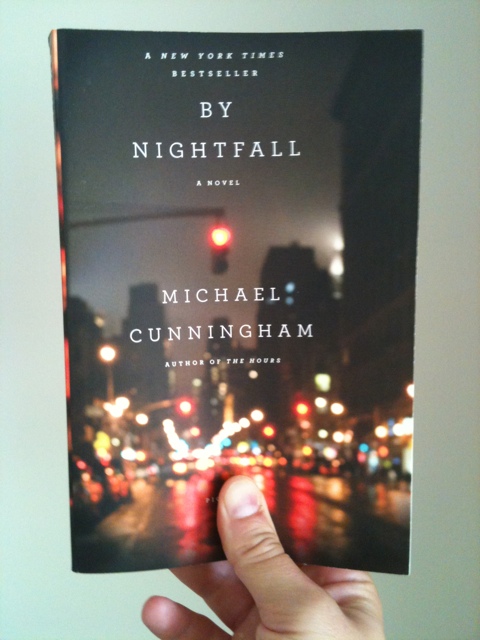
20110825-023856.jpg

In the mail today: Michael Cunningham’s By Nightfall, in trade paperback from the good folks at Picador. From novelist Jeanette Winterson’s review of the hardback edition, printed last year in the NYT

Cunningham has taken on the classic plot of the uninvited or unexpected stranger or guest whose arrival brings chaos, self-knowledge, tragedy, the ruin of one kind of life that may or may not lead to something better. It’s a story we know from variants as classic as Shakespeare’s “Twelfth Night” to Mark Twain’s “Mysterious Stranger” to contemporary versions like “The Accidental” by Ali Smith. Cunningham is drawn to simple, potent plots (think of the triptych in “The Hours”), saving his energy for the hearts and minds, the groins and guts, of his characters. Yet he makes you turn the pages. He tells a story here, but not too much of a story. You aren’t deadened by detail; you’re eager to know what happens next.

Cunningham writes so well, and with such an economy of language, that he can call up the poet’s exact match. His dialogue is deft and fast. The pace of the writing is skilled — stretched or contracted at just the right time. And if some of the interventions on art are too long — well, too long for whom? For what? Good novels are novels that provoke us to argue with the writer, not just novels that make us feel magically, mysteriously at home.A novel in which everything is perfect is a waxwork. A novel that is alive is never perfect.

A List of Things Roberto Bolaño Discussed with His Friend Rodrigo Fresán

From the entry “All Subjects with Fresán,” in Bolaño’s collection Between Parentheses, a list of stuff the late writer talked about with his good friend, which includes (as usual) plenty of references to writers, poets, directors—and some funny jokes as well. Read part of Fresán’s essay “The Savage Detective” — it was the piece that first got me to go pick up a Bolaño. Here’s the list—

1) The Latin American hell that, especially on weekends, is concentrated around some Kentucky Fried Chicken or McDonald’s.

2) The doings of Buenos Aires photographer Alfredo Garofano, childhood friend of Rodrigo and how a friend of mine and of anyone with the least bit of discernment.

3) Bad translations.

4) Serial killers and mass murders.

5) Prospective leisure as the antidote to prospective poetry.

6) The vast number of writers who should retire after writing their first book or their second or their third or their fourth or their fifth.

7) The superiority of the work of Basquiat to that of Haring, or vice versa.

8 ) The works of Borges and the works of Bioy.

9) The advisability of retiring to a ranch in Mexico near a volcano to finish writing The Turkey Buzzard Trilogy.

10) Wrinkles in the space time continuum.

11) The kind of majestic women you’ve never met who come up to you in a bar and whisper in your ear that they have AIDS (or that they don’t).

12) Gombrowicz and his conception of immaturity.

13) Philip K. Dick, whom we both unreservedly admire.

14) The likelihood of a war between Chile and Argentina and its possible and impossible consequences.

15) The life of Proust and the life of Stendhal.

16) The activities of some professors in the United States.

17) The sexual practices of titi monkeys and ants and great cetaceans.

18) Colleagues who must be avoided like limpet mines.

19) Ignacio Echevarria, whom both of us love and admire.

20) Some Mexican writers liked by me and not by him, and some Argentine writers like by me and not by him.

21) Barcelonan manners.

22) David Lynch and the prolixity of David Foster Wallace.

23) Chabon and Palahniuk, whom he likes and I don’t.

24) Wittgenstein and his plumbing and carpentry skills.

25) Some twilit dinners, which actually, to the surprise of the diner, become theater pieces in five acts.

26) Trashy TV game shows.

27) The end of the world.

28) Kubrick’s films, which Fresán loves so much that I’m beginning to hate them.

29) The incredible war between the planet of the novel-creatures and the planet of the story beings.

30) The possibility that when the novel awakes from its iron dreams, the story will be there.

Fierce Monster — Goya

“To a Cat” — Jorge Luis Borges

“To a Cat,” a poem by Jorge Luis Borges—

Mirrors are not more silent
nor the creeping dawn more secretive;
in the moonlight, you are that panther
we catch sight of from afar.
By the inexplicable workings of a divine law,
we look for you in vain;
More remote, even, than the Ganges or the setting sun,
yours is the solitude, yours the secret.
Your haunch allows the lingering
caress of my hand. You have accepted,
since that long forgotten past,
the love of the distrustful hand.
You belong to another time. You are lord
of a place bounded like a dream.

“Sail to Your St. Freak, Cursed by All Nature” — Some Creative Cursing from Witold Gombrowicz’s Novel Trans-Atlantyk

A passage from Witold Gombrowicz’s incomparable (and I use that word in a literal sense here) novel Trans-Atlantyk. Context: Upon learning of the Nazi’s invasion of his native Poland, our hero Gombrowicz has decided not to return to Europe and instead take his chances in Argentina. He watches the ship depart—

Then would I fain have fallen on my knees! Albeit I did not fall at all, just quietly began to Curse, Damn mightily but only to Myself: “Sail, sail, you Compatriots, to your People! Sail to that holy Nation of yours haply Cursed! Sail to that St. Monster Dark, dying for ages yet unable to die! Sail to your St. Freak, cursed by all Nature, ever being born and still Unborn! Sail, sail, so he will not suffer you to Live or Die but keep you for ever between Being and Non-being. Sail to your St. Slug that she may ever the more Enslime you.” The ship turned aslant now and was moving off so this I likewise say: “Sail to that Madman, to that St. Bedlamite of yours—oh, haply Cursed—so that he may Torment, Torture you by those leaps and frenzies of his, drown you in blood, howl at you and by his Howling howl you out, by Torturing torture you, Children of yours, wives, to Death, to Agony—in agony himself, in the agonies of Madness Madden you, O’ermadden you!” With this Curse, turning my back on the ship, I entered the Town.

Book Acquired, 8.23.11

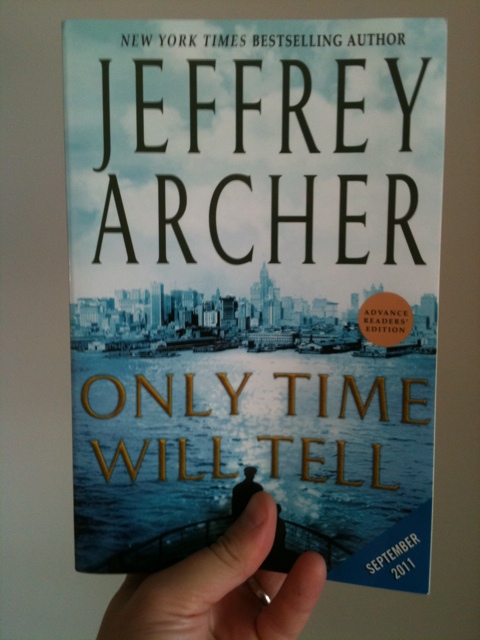
20110823-030250.jpg

In the mail today, an ARC of Jeffrey Archer’s forthcoming novel Only Time Will Tell. Publisher’s description—

From the internationally bestselling author of Kane and Abel and A Prisoner of Birth comes Only Time Will Tell, the first in an ambitious new series that tells the story of one family across generations, across oceans, from heartbreak to triumph.

The epic tale of Harry Clifton’s life begins in 1920, with the words “I was told that my father was killed in the war.” A dock worker in Bristol, Harry never knew his father, but he learns about life on the docks from his uncle, who expects Harry to join him at the shipyard once he’s left school. But then an unexpected gift wins him a scholarship to an exclusive boys’ school, and his life will never be the same again.

As he enters into adulthood, Harry finally learns how his father really died, but the awful truth only leads him to question, was he even his father? Is he the son of Arthur Clifton, a stevedore who spent his whole life on the docks, or the firstborn son of a scion of West Country society, whose family owns a shipping line?

This introductory novel in Archer’s ambitious series The Clifton Chronicles includes a cast of colorful characters and takes us from the ravages of the Great War to the outbreak of the Second World War, when Harry must decide whether to take up a place at Oxford or join the navy and go to war with Hitler’s Germany. From the docks of working-class England to the bustling streets of 1940 New York City, Only Time Will Tell takes readers on a journey through to future volumes, which will bring to life one hundred years of recent history to reveal a family story that neither the reader nor Harry Clifton himself could ever have imagined.

Sunshine through the Rain — A Beautiful Scene from Akira Kurosawa’s Dreams

Beautiful scene from a beautiful film.

Calvin and Hobbes

Calvin and Hobbes -- Nina Matsumoto

Book Acquired, 8.22.11

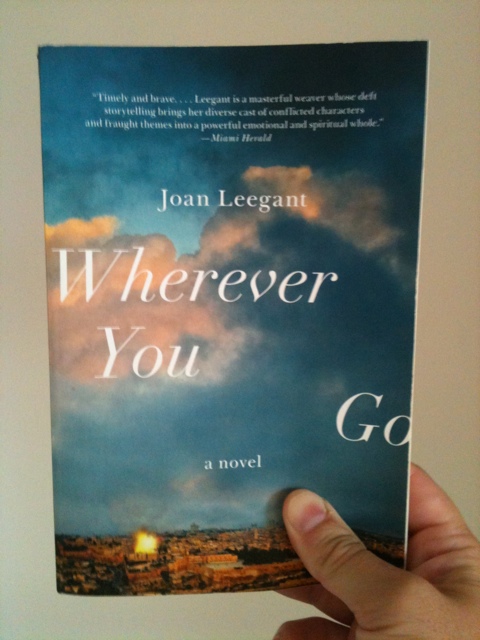
20110822-053907.jpgJoan Leegant’s novel Wherever You Go showed up in today’s mail. Publisher’s description—

“In this sweeping and beautifully written novel, Joan Leegant weaves together three lives caught in the grip of a volatile and uncompromising faith. Yona Stern has traveled to Jerusalem from New York to make amends with her sister, a stoic mother of five dedicated to the hard-line settlement cause. Mark Greenglass, a gifted Talmud teacher and former drug dealer saved by religion, has lost his passion and wonders if he’s done with God. Enter Aaron Blinder, an unstable college dropout with a history of failure who finds a home on the radical fringe of Israeli society. Emotionally gripping and unmistakably timely, Wherever You Go tells the story of three Americans in Israel and the attractions–and dangers– of Jewish extremism, and its threat to the modern democratic state.”

Martin Scorsese on Story Vs. Plot

Aaron Burr’s Death Mask

“The Sport Roadster” — F. Scott Fitzgerald

“The Sport Roadster,” a short short story/scene/memory (?) from F. Scott Fitzgerald’s Notebooks

The Sport Roadster
When I was a boy I dreamed that I sat always at the wheel of a magnificent Stutz—in those days the Stutz was the stamp of the romantic life—a Stutz as low as a snake and as red as an Indiana barn. But in point of fact, the best I could manage was the intermittent use of the family car. If I were willing to endure the most unaristocratic groanings and vibrations I could torture it up to fifty miles an hour.
But no matter how passionately I slouched down in the seat, I couldn’t make it look like a Stutz. One day I lowered the top and opened the windshield, and with the car thus pathetically jazzed up, took my mother and another lady down town shopping.
It was a scorching day. The sun blazed down upon us, the molten air blew like the breath of a furnace into our faces—through the open windshield. I could literally feel the sunburn deepening on me, block by block. It was appalling.
The two ladies fanned themselves uneasily. I don’t believe either of them quite realized what the trouble was. But I, even with the perspiration pouring into my eyes, found sight to envy the owner of a peagreen cut-down flivver which oozed by us through the heat.
My passengers visited a series of stores. I waited in the sun, still slouched down, and with that sort of half-sneer on my face which I had noted was peculiar to drivers of racing cars. The heat continued to be terrific.
Finally my mother’s friend came out of the store and I helped her into the car. She sank down into the seat—then sank quickly up again.
“Ah!” she said wildly.
She had burned herself.
When we reached home I offered—most unusually—to take them both for a long ride—anywhere they wished to go. They said politely that they were going for a little walk to cool off!