From Edith Hamilton’s essay “William Faulkner: Sorcerer or Slave,” collected in The Ever Present Past—
Mr. Faulkner’s novels are about ugly people in an ugly land. There is no beauty anywhere. Whether he deliberately excludes it or does not perceive it, no one can say; but at least he says himself that a blossoming pear tree in the moonlight looks like hair streaming up from the head of a drowned woman, each hair distinct in the water from the others. He describes the scent of a blooming shrub, still wet with dew, as sickening. To walk through the woodlands in summer in “a gloom dimmer than the gray desolation of November” is to feel “malicious little eyes” watching (birds? squirrels?) while under foot the oozing earth crawls with snakes.
But the land is worse, far worse, than all of these unpleasant features put together. It ruins the people it nourishes. A dark curse lies on it. It was “already tainted before any white man owned it . . . from that old world’s corrupt and worthless twilight as though in the sailfulls of the old world’s tainted wind which drove the ships.” Columbus’, presumably. The initial curse, connected with the dispossession of the Indians, appears to be—Mr. Faulkner is not quite clear about it—inherited by the North as well as the South, but its full effect is shown concentrated in the South. “Don’t you see?” young Ike McCaslin cries in “The Bear.” “Don’t you see? This whole land, the whole South, is cursed, and all of us who derive from it, whom it ever suckled, lie under the curse.”
The people, thus doomed, are like the land that dooms them. It is part of the fate that molds them. “Our rivers, our land: opaque, slow, violent, shaping and creating the life of man in its implacable and brooking image.” At this point Poe comes irresistibly to mind. “The dank tarn of Auber—the misty mid region of Weir—the ghoul-haunted woodlands of Weir.” It is the point in the realm of romance where extremes meet, Poe’s lovely and lost Ulalume and Mr. Faulkner’s curse-ridden men
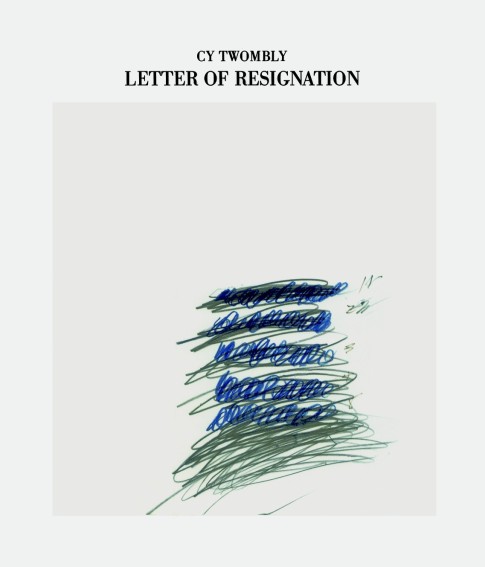
Thanks to Biblioklept reader Jescie for sending in this 2009 piece from Eye Level, which recounts film director John Waters narrating Cy Twombly’s collection Letter of Resignation. From the write-up—-
Baltimore-native Waters, best known for his films Hairspray and Pink Flamingos, spoke, if not performed, at the McEvoy Auditorium, as the inaugural speaker in the second annual American Pictures Distinguished Lecture Series. For one hour on Saturday afternoon, Waters shared his interpretation of Cy Twombly’s Letter of Resignation. From the word go, Waters had the SRO audience captivated as he “narrated” the thirty-eight separate drawings that make up this work. At times, Waters had us in stitches, relating slightly off-color stories, and using words not found in museum labels. Often in strong language, he created a persona, or voice for the letter writer: a disgruntled worker who is drafting (and re-drafting) his letter of resignation. By the thirty-eighth draft, he’s just about there. . . .
Waters, who keeps the Letters of Resignation catalogue by his bed, says that Twombly created “such confident work it makes people mad.” To detractors not fond of the work, Waters offered this retort, “This kind of contemporary art hates you too, and you deserve it.”
“Ode to the Only Girl,” a poem by John Edward Williams—
I’ve seen you many times in many places–
Theater, bus, train, or on the street;
Smiling in spring rain, in winter sleet,
Eyes of any hue in myriad faces;
Midnight black, all shades of brown your hair,
Long, short, bronze or honey-fair.
Instantly have I loved, have never spoken;
Slowly a truck passed, a light changed,
A door closed–all seemingly pre-arranged–
Then you were gone forever, the spell was broken.
Ubiquitios only one, we’ve met before
A hundred times, and we’ll meet again
As many more; in hills or forest glen,
On crowded street or lonely, peaceful shore;
Somewhere, someday–but how will we ever know
True love, how wil we ever know?
As always, the stack overfloweth. Here are a few of the more interesting titles that have landed at Biblioklept International Headquarters recently.
Banana Republican is the first novel by historian Eric Rauchway. The book is a send up of American Imperialism in the 1920s, satirizing the naked greed, corrupt capitalism, and ugly jingoism that infused the rise of the global economy. Fortunately, all of these ills have left American foreign policy forever, right? Satire! Seriously though, Banana Republican looks to the past to reveal that our current foreign debacles are merely an extension of policies that have been around for decades. The protagonist is Tom Buchanan (yes, that Tom Buchanan, the racist football-playing, mistress-slapping lout of The Great Gatsby). Rauchway sends Buchanan into the fiasco of American intervention in Nicaragua in the early 20th century. In an interview with The St. Petersburg Times, Rauchway points out how this scenario allows for an exploration of the American dream from a decidedly different viewpoint than the one we find in Fitzgerald—-
People always see Gatsby as the novel about the American dream. But the character who represents that dream of upward mobility ends up floating facedown in a swimming pool. Tom Buchanan represents the real American dream: having it all and not having to suffer the consequences. I wanted to get away from the somewhat suspect view of the narrator in Gatsby and let Tom speak for himself. . . .
I was interested in writing about the irresponsibility of American foreign policy, so if you take Tom Buchanan in the 1920s, where are we? We’re in Nicaragua. When you look at American foreign policy, in Europe we do pretty well. In South America, not so much. And there’s that tradition in places that are on the edges of empire: Dissolute people get to go there and act badly and no one calls them on it.
Evgenia Citkowitz’s Ethercollects seven short stories and a novella, all united by psychological and emotional complexity. Citkowitz’s characters explore moral dilemmas as they quest for identity, and if that sounds like the stock of contemporary fiction (which it is), the prose, terse, often chilly, and darkly funny, is what set these apart. Here’s Ligaya Mishan, reviewing the hardback edition last year in The New York Times—
Citkowitz’s book is peopled by mothers and fathers who are fumblers at best, unrepentant alcoholics at worst. A few are simply absentees, like the father of Beatty, the British schoolgirl in “Leavers’ Events,” who is omitted from family suppers, “disqualified by his status as a heroin addict.” The girl’s mother, a high-level fashion editor, is hardly more present. The only grown-up in Beatty’s life who actually behaves like one is, oddly enough, the rakish novelist she invites to the opera. After initiating a lazy seduction, he wisely thinks better of it. Again, Citkowitz flouts expectations: her heroine may be momentarily crushed, but soon she has moved to New York, ascended the editorial ladder at a chic magazine, landed her own office and effectively supplanted her mother — a modern-day Electra.
In his promo vid (below) for The Oregon Experiment, author Keith Scribner suggests that, “It’s a novel that explores the ways in which the political, the social, the personal, the domestic are inseparable.” Those are some pretty grand claims, so here are the details: The Oregon Experiment recounts the story of Scanlon and Naomi Pratt, a couple who move from the East Coast to Oregon, where Scanlon begins his first tenure-track job as a professor who studies radical action mass movements. Naomi was once a “genius nose” who worked for perfume companies, but she’s lost her sense of smell; she’s also pregnant with the couple’s first child. Scanlon quickly becomes enamored of Oregon, and becomes particularly intrigued by local separatists and anarchists; Naomi’s nose returns, but she isn’t quite as thrilled as Scanlon about the new scene (particularly Scanlon’s enchantment with Sequoia, leader of the secessionists), although she does connect with Scanlon’s young subject Clay, an anarchist. Scribner propels his novel with ideas rendered in crisp, realistic dialogue. The Oregon Experiment is new from Knopf.



 Thanks to Biblioklept reader Jescie for sending in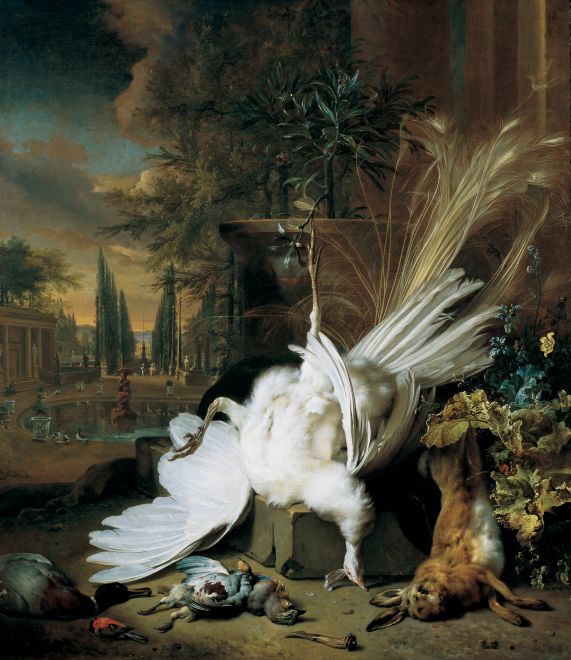

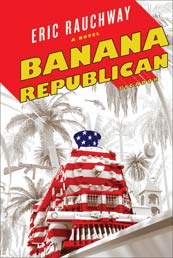 Banana Republican is the first novel by historian Eric Rauchway. The book is a send up of American Imperialism in the 1920s, satirizing the naked greed, corrupt capitalism, and ugly jingoism that infused the rise of the global economy. Fortunately, all of these ills have left American foreign policy forever, right? Satire! Seriously though, Banana Republican looks to the past to reveal that our current foreign debacles are merely an extension of policies that have been around for decades. The protagonist is Tom Buchanan (yes, that Tom Buchanan, the racist football-playing, mistress-slapping lout of The Great Gatsby). Rauchway sends Buchanan into the fiasco of American intervention in Nicaragua in the early 20th century. In an interview with
 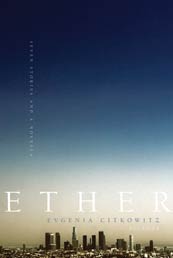 Evgenia Citkowitz’s Ether collects seven short stories and a novella, all united by psychological and emotional complexity. Citkowitz’s characters explore moral dilemmas as they quest for identity, and if that sounds like the stock of contemporary fiction (which it is), the prose, terse, often chilly, and darkly funny, is what set these apart. Here’s Ligaya Mishan, reviewing the hardback edition last year in
  In his promo vid (below) for The Oregon Experiment, author Keith Scribner suggests that, “It’s a novel that explores the ways in which the political, the social, the personal, the domestic are inseparable.” Those are some pretty grand claims, so here are the details: The Oregon Experiment recounts the story of Scanlon and Naomi Pratt, a couple who move from the East Coast to Oregon, where Scanlon begins his first tenure-track job as a professor who studies radical action mass movements. Naomi was once a “genius nose” who worked for perfume companies, but she’s lost her sense of smell; she’s also pregnant with the couple’s first child. Scanlon quickly becomes enamored of Oregon, and becomes particularly intrigued by local separatists and anarchists; Naomi’s nose returns, but she isn’t quite as thrilled as Scanlon about the new scene (particularly Scanlon’s enchantment with Sequoia, leader of the secessionists), although she does connect with Scanlon’s young subject Clay, an anarchist. Scribner propels his novel with ideas rendered in crisp, realistic dialogue. The Oregon Experiment is new from
  Biblioklept