See the Trailer for Arrietty, the New Film from Studio Ghibli

“We Are Challenging Nature Itself . . . And It Hits Back” — Werner Herzog on Nature’s Violent Obscenity

(More).

RIP Cy Twombly

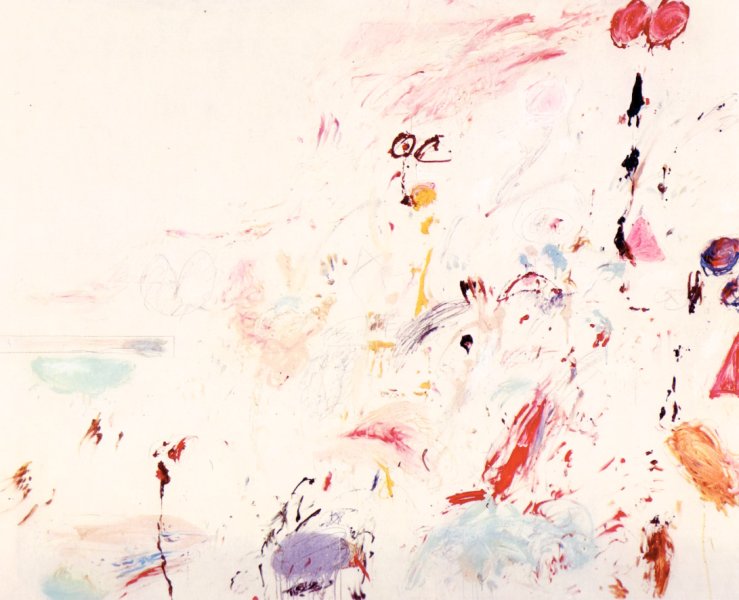
Bay of Naples (1961) -- Cy Twombly

(More, more, and more).

“This Schedule In Effect July 5th, 1922” — The Great Gatsby’s House Guests

In Chapter 4 of F. Scott Fitzgerald’s The Great Gatsby, narrator Nick Carraway recounts the names of the rich, shallow, parasitic guests who attended Gatsby’s parties. Nick tells us the list comes from “an old time-table” of names he originally recorded in July 5th—significantly, the day after Independence Day: the day after the hopes and dreams of a new country. From the chapter—-

Once I wrote down on the empty spaces of a time-table the names of those who came to Gatsby’s house that summer. It is an old time-table now, disintegrating at its folds, and headed “This schedule in effect July 5th, 1922.” But I can still read the gray names, and they will give you a better impression than my generalities of those who accepted Gatsby’s hospitality and paid him the subtle tribute of knowing nothing whatever about him.

From East Egg, then, came the Chester Beckers and the Leeches, and a man named Bunsen, whom I knew at Yale, and Doctor Webster Civet, who was drowned last summer up in Maine. And the Hornbeams and the Willie Voltaires, and a whole clan named Blackbuck, who always gathered in a corner and flipped up their noses like goats at whosoever came near. And the Ismays and the Chrysties (or rather Hubert Auerbach and Mr. Chrystie’s wife), and Edgar Beaver, whose hair, they say, turned cotton-white one winter afternoon for no good reason at all.

Clarence Endive was from East Egg, as I remember. He came only once, in white knickerbockers, and had a fight with a bum named Etty in the garden. From farther out on the Island came the Cheadles and the O. R. P. Schraeders, and the Stonewall Jackson Abrams of Georgia, and the Fishguards and the Ripley Snells. Snell was there three days before he went to the penitentiary, so drunk out on the gravel drive that Mrs. Ulysses Swett’s automobile ran over his right hand. The Dancies came, too, and S. B. Whitebait, who was well over sixty, and Maurice A. Flink, and the Hammerheads, and Beluga the tobacco importer, and Beluga’s girls.

From West Egg came the Poles and the Mulreadys and Cecil Roebuck and Cecil Schoen and Gulick the state senator and Newton Orchid, who controlled Films Par Excellence, and Eckhaust and Clyde Cohen and Don S. Schwartze (the son) and Arthur McCarty, all connected with the movies in one way or another. And the Catlips and the Bembergs and G. Earl Muldoon, brother to that Muldoon who afterward strangled his wife. Da Fontano the promoter came there, and Ed Legros and James B. (“Rot-Gut.”) Ferret and the De Jongs and Ernest Lilly — they came to gamble, and when Ferret wandered into the garden it meant he was cleaned out and Associated Traction would have to fluctuate profitably next day.

A man named Klipspringer was there so often and so long that he became known as “the boarder.”— I doubt if he had any other home. Of theatrical people there were Gus Waize and Horace O’donavan and Lester Meyer and George Duckweed and Francis Bull. Also from New York were the Chromes and the Backhyssons and the Dennickers and Russel Betty and the Corrigans and the Kellehers and the Dewars and the Scullys and S. W. Belcher and the Smirkes and the young Quinns, divorced now, and Henry L. Palmetto, who killed himself by jumping in front of a subway train in Times Square.

Benny McClenahan arrived always with four girls. They were never quite the same ones in physical person, but they were so identical one with another that it inevitably seemed they had been there before. I have forgotten their names — Jaqueline, I think, or else Consuela, or Gloria or Judy or June, and their last names were either the melodious names of flowers and months or the sterner ones of the great American capitalists whose cousins, if pressed, they would confess themselves to be.

In addition to all these I can remember that Faustina O’brien came there at least once and the Baedeker girls and young Brewer, who had his nose shot off in the war, and Mr. Albrucksburger and Miss Haag, his fiancee, and Ardita Fitz-Peters and Mr. P. Jewett, once head of the American Legion, and Miss Claudia Hip, with a man reputed to be her chauffeur, and a prince of something, whom we called Duke, and whose name, if I ever knew it, I have forgotten.

All these people came to Gatsby’s house in the summer.

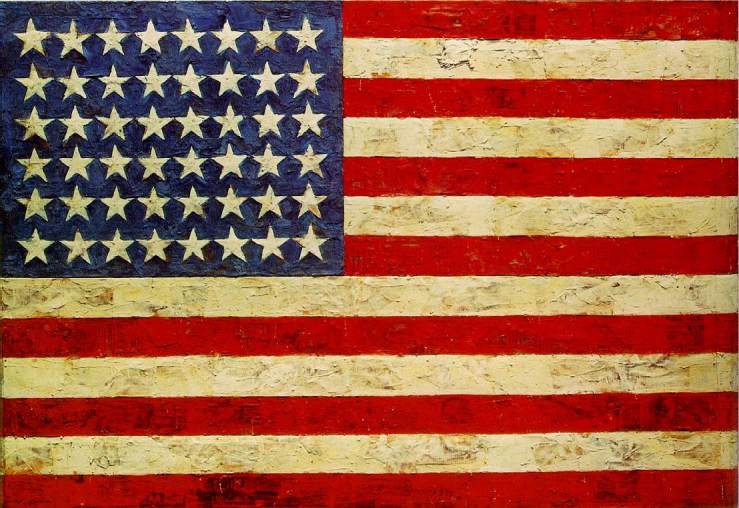
Flag (1957) — Jasper Johns

A Poem for July 4th — Walt Whitman’s “I Hear America Singing”

Walt Whitman’s poem “I Hear America Singing”—

I hear America singing, the varied carols I hear,
Those of mechanics, each one singing his as it should be blithe and strong,
The carpenter singing his as he measures his plank or beam,
The mason singing his as he makes ready for work, or leaves off work,
The boatman singing what belongs to him in his boat, the deckhand singing on the steamboat deck,
The shoemaker singing as he sits on his bench, the hatter singing as he stands,
The wood-cutter’s song, the ploughboy’s on his way in the morning, or at noon intermission or at sundown,
The delicious singing of the mother, or of the young wife at work, or of the girl sewing or washing,
Each singing what belongs to him or her and to none else,
The day what belongs to the day—at night the party of young fellows, robust, friendly,
Singing with open mouths their strong melodious songs.

Mark Twain’s Fourth of July Speech in Keokuk, Iowa July 3, 1886

Mark Twain’s Fourth of July speech, delivered in Keokuk, Iowa, 1886—

Ladies and gentlemen: I little thought that when the boys woke me with their noise this morning that I should be called upon to add to their noise. But I promise not to keep you long. You have heard all there is to hear on the subject, the evidence is all in and all I have to do is to sum up the evidence and deliver the verdict. You have heard the declaration of independence with its majestic ending, which is worthy to live forever, which has been hurled at the bones of a fossilized monarch, old King George the III, who has been dead these many years, and which will continue to be hurled at him annually as long as this republic lives. You have heard the history of the nation from the first to the last–from the beginning of the revolutionary was, past the days of its great general, Grant, told in eloquent language by the orator of the day. All I have to do is to add the verdict, which is all that can be added, and that is, ‘It is a successful day.’ I thank the officers of the day that I am enabled to once more stand face to face with the citizens that I met thirty years ago, when I was a citizen of Iowa, and also those of a later generation. In the address to-day, I have not heard much mention made of the progress of these last few years–of the telegraph, telephone, phonograph, and other great inventions. A poet has said, ‘Better fifty years of England than all the cycles of Cathay,’ but I say ‘Better this decade than the 900 years of Methuselah.’ There is more done in one year now than Methuselah ever saw in all his life. He was probably asleep all those 900 years. When I was here thirty years ago there were 3,000 people here and they drank 3,000 barrels of whisky a day, and they drank it in public then. I know that the man who makes the last speech on an occasion like this has the best of the other speakers, as he has the last word to say, which falls like a balm on the audience–though this audience has not been bored to-day–and though I can’t say that last word, I will do the next best thing I can, and that is to sit down.

(More).

Flag (1954–55) — Jasper Johns

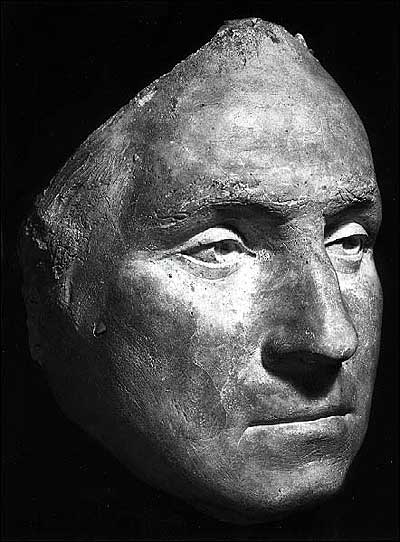
George Washington’s Death Mask

Continue reading “George Washington’s Death Mask”

Ernest Hemingway’s Suicide Gun

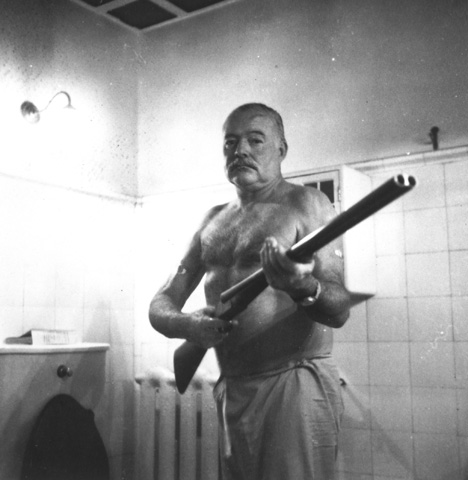
Garden & Gun ran a short piece on Ernest Hemingway’s guns last year, and linked to a slideshow of the famous author (who killed himself 50 years ago today) with his guns. From the article—

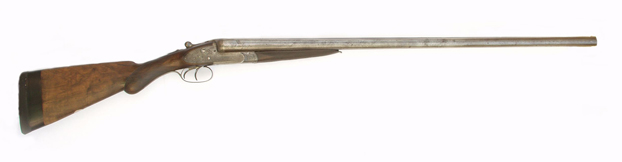
When Ernest Hemingway took his own life on July 2, 1961, it was reported in Life magazine that he had done so with a “double-barreled shotgun.” Further reports specified the gun was a Boss that he had purchased from Abercrombie & Fitch, and for years this has been widely accepted as fact. But a fascinating new book, Hemingway’s Guns, by Silvio Calabi, Steve Helsley, and Roger Sanger (Shooting Sportsman Books), makes the case that Hemingway never owned a Boss, and that the suicide gun was actually made by W. & C. Scott & Son. It was Hemingway’s pigeon gun, a long-barreled side-by-side that traveled with him from shooting competitions in Cuba to duck hunts in Italy to a safari in East Africa. By all accounts it was a favorite.

Not long after that tragic day in Ketchum, Idaho, the gun was given to a local welder to be destroyed. “The stock was smashed and the steel parts cut up with a torch,” the authors write. “The mangled remnants were then buried in a field.” Roger Sanger visited the welding shop, which is still in business and being run by the grandson of the original proprietor. Amazingly, the welder still had a few pieces of the gun in a matchbox, and Sanger’s immediate reaction to the evidence was, “This is no Boss.” After showing pictures to a number of experts and collectors, he confirmed that it was most likely Hemingway’s beloved W. & C. Scott that had been the suicide gun.

A W. & C. Scott & Son Monte Carlo B—Serial No. 60293, c. 1898

White Flag — Jasper Johns

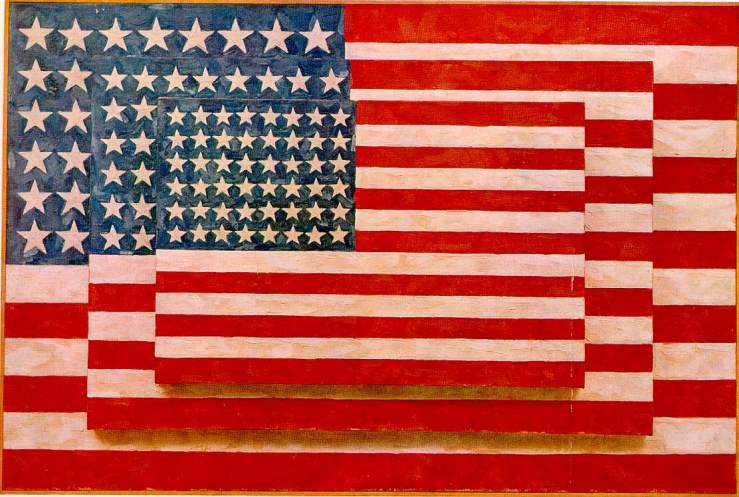
Three Flags — Jasper Johns

The Red Sea — Anselm Kiefer

Eat the Document — Bob Dylan’s Rambling 1966 Tour Film

“The List Is the Origin of Culture” — Umberto Eco

From a 2009 interview with Der Spiegel

Umberto Eco: The list is the origin of culture. It’s part of the history of art and literature. What does culture want? To make infinity comprehensible. It also wants to create order — not always, but often. And how, as a human being, does one face infinity? How does one attempt to grasp the incomprehensible? Through lists, through catalogs, through collections in museums and through encyclopedias and dictionaries. There is an allure to enumerating how many women Don Giovanni slept with: It was 2,063, at least according to Mozart’s librettist, Lorenzo da Ponte. We also have completely practical lists — the shopping list, the will, the menu — that are also cultural achievements in their own right.

SPIEGEL: Should the cultured person be understood as a custodian looking to impose order on places where chaos prevails?

Eco: The list doesn’t destroy culture; it creates it. Wherever you look in cultural history, you will find lists. In fact, there is a dizzying array: lists of saints, armies and medicinal plants, or of treasures and book titles. Think of the nature collections of the 16th century. My novels, by the way, are full of lists.

SPIEGEL: Accountants make lists, but you also find them in the works of Homer, James Joyce and Thomas Mann.

Eco: Yes. But they, of course, aren’t accountants. In “Ulysses,” James Joyce describes how his protagonist, Leopold Bloom, opens his drawers and all the things he finds in them. I see this as a literary list, and it says a lot about Bloom. Or take Homer, for example. In the “Iliad,” he tries to convey an impression of the size of the Greek army. At first he uses similes: “As when some great forest fire is raging upon a mountain top and its light is seen afar, even so, as they marched, the gleam of their armour flashed up into the firmament of heaven.” But he isn’t satisfied. He cannot find the right metaphor, and so he begs the muses to help him. Then he hits upon the idea of naming many, many generals and their ships.

SPIEGEL: But, in doing so, doesn’t he stray from poetry?

Eco: At first, we think that a list is primitive and typical of very early cultures, which had no exact concept of the universe and were therefore limited to listing the characteristics they could name. But, in cultural history, the list has prevailed over and over again. It is by no means merely an expression of primitive cultures. A very clear image of the universe existed in the Middle Ages, and there were lists. A new worldview based on astronomy predominated in the Renaissance and the Baroque era. And there were lists. And the list is certainly prevalent in the postmodern age. It has an irresistible magic.

“I’m a Writer You Monsters!”

John Turturro on Miller’s Crossing and Barton Fink

Great interview with John Turturro at the AV Club today—it’s part of their Random Roles feature, where an actor (usually a character actor) discusses his or her films. Here’s Turturro talking about some of the films he’s made with the Coen brothers

JT: I’ve known [the Coens] a long time. I’ve known them from the mid-’80s, because I’m friends with Fran [McDormand]. That’s how I know them. I’ve worked with them on four movies, and they were my executive producers for and really helped me edit Romance And Cigarettes. They’re really good friends—and so is someone like Spike [Lee]. It’s a pleasure in this business when you work with someone more than once. It’s nice, because everybody knows each other.

The Coens are like a mom-and-pop operation. They write it, they edit it, they do the whole thing. They’re involved in everything. It’s very low stress, working with them. There’s almost no stress. If I could make a movie with them every couple of years I would, just because of the pleasure of it.

AVC: How did you finally come to work with them on Miller’s Crossing?

JT: They’d seen me do a lot of plays, and so they said they were going to write a part for me. Then they wrote two parts for me in a row! [Laughs.] Those are big things. When someone writes something for you, you really want to return the favor. So I put a lot of work into it, and tried to give them a little surprise back. Actually I’m going to be directing these three one-act plays on Broadway soon, and Ethan is one of the writers. Woody Allen is one and Elaine May is one and Ethan is one. So I’m working with him again. This is, I guess, the sixth time we’ve worked together.

AVC: The big “look into your heart” scene in the woods. How many takes was that?

JT: I don’t remember how many takes. I just know it was 13 degrees, that’s all. It was really cold. You know, it was a long time ago. It was a hard scene. Sometimes you think about movies, and you say, “Well, I want to try to do something that’s not exactly in a movie.” If you’ve ever been in a very dangerous situation, you know that people will do all kinds of things to keep themselves alive. It was very well-written, but you want to imagine what it’s really like to be in that kind of situation. It depends on what you’re willing to do, and in real life you would do a lot of different things. I tried to capture a little bit of that. I had a couple close encounters throughout my life before that, and you store that stuff in the back of your mind. It’s how you do it, but it’s what they choose and how they put it together too. But that was my goal when I did that, was to do something that was almost a little difficult to watch, because people aren’t trying to be heroic at those moments.

AVC: When you first came across that scene in the screenplay, was it obvious to you that it would be so central and important to the movie? They even used it for the poster.

JT: I guess maybe, but not completely. I kind of knew it was important, and they kept telling me it was. But you don’t want to put too much pressure on yourself, because then it’s like going to bed with somebody the first time or something. You’re like, “Oh God, I got to be great.” [Laughs.] You just don’t want to put too much pressure on yourself. I just thought about it in the context of the story, that’s it. Because you can overthink something, too. It all felt really good when they did it, but it was hard to do.

Barton Fink (1991)—“Barton Fink”
AVC: Since the Coens were writing Barton Fink while they were still struggling through Miller’s Crossing, were you guys discussing that during the shoot?

JT: No. They said at the end—the guy, [executive producer] Ben Barenholtz, said there was this other movie. The way he talked, it sounded like Bart And Fink. I thought it was Bart And Fink. I was like, Bart And Fink? I don’t know about that.” And I didn’t completely get it when I first read it. Their scripts you have to read a bunch of times. And now I guess people can read them easier—someof their scripts—because they know their sensibility. But their sensibility can be quite different, depending on the movie that they’re linked to.

AVC: Did you really go to secretarial school just to study typing for Barton Fink?

JT: Yeah, I did. It was in Brooklyn Heights. It was with electric typewriters; they didn’t have computers. But then I had to use the old manual typewriter, which I loved. They get stuck, but I really love the sound of it, and the whole visceral experience. I wrote a lot of things on that typewriter during the shoot, a lot of ideas for other things.

AVC: Didn’t you write Romance And Cigarettes on it?

JT: I wrote the title of it and some ideas. A couple of scenes. But then I kind of sat on it. I put it in this box for 10 years. So yeah, it was “A Film by Barton Fink.” [Laughs.]

AVC: Your character talks a lot about creating “a new living theater of, about, and for the common man,” which is relevant to the sort of stories you seem to tell in a lot of your own work. But in the film, it seems like that whole idea is being mocked as pretentious. 

JT: [Laughs.] Yeah. Well, there’s guys who are outside of that and who talk about it, and there are guys who are inside of it. I did Mac right after that, which was really, for me, inside. And Fink is more from the outside. Plenty of writers have taken those stances—especially in the ’30s, because people came out of immigration, and there was a lot of Socialism. People were really liberal. There were anarchists. There was a Communist Party in this country. There was also a Nazi party that people don’t really talk about. So there were a lot of these things going on, and you kind of have to go back years to understand this thing. It was in the Group Theatre, and people like Arthur Miller obviously had that in his plays. Sometimes it could become a little bit pretentious, and other times not. But everything’s connected in different ways.

AVC: My favorite scene—honestly, maybe my favorite scene in a movie ever—is just a simple dialogue between you and Tony Shalhoub.

JT: Which one?

AVC: “Throw it hard.”

JT: “Throw it hard, Fink!” [Laughs.] Yeah, there were some great actors in that movie, and I got to work with all of them. It was just a treat. There was just wonderful writing in it too. Even though it was a strange movie and stuff like that, when I see the movie now, I really appreciate it. I’m like, “Wow, that was really good.” When I first saw it, it’s hard, because you’re in it. But it’s a good movie, so thank you. It’s a really well-crafted film. It was a treat to make that film, and to work with every one of those actors. Judy Davis is just fabulous.