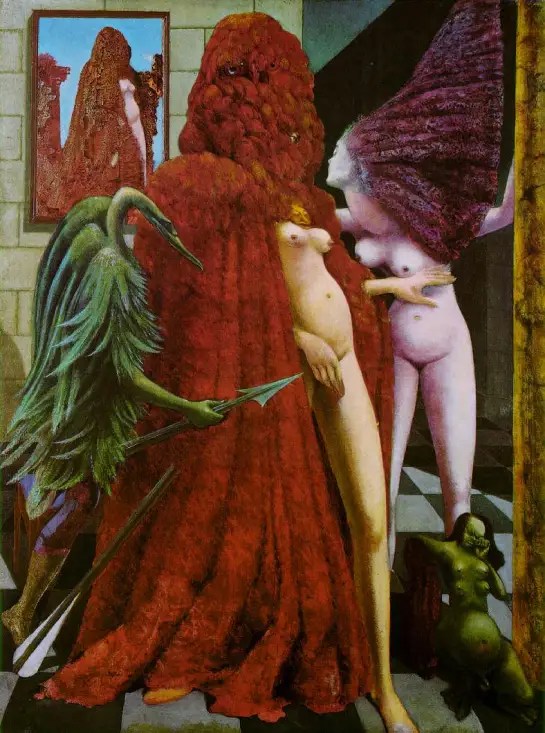
Bathsheba — Artemisia Gentileschi

Bathsheba, c. 1645–1650 by Artemisia Gentileschi (1593-1653)

“Fox” — Rita Dove

“Fox”

by

Rita Dove


She knew what
she was and so
was capable
of anything
anyone
could imagine.
She loved what
she was, there
for the taking,
imagine.

She imagined
nothing.
She loved
nothing more
than what she had,
which was enough
for her,
which was more
than any man
could handle.

Photographic portrait of Donald Barthelme at his drum kit, taken by his father Donald Barthelme, Sr.

db

Donkey — Eckhart Hahn

Donkey, 2019 by Eckhart Hahn (b. 1971)

Hero’s Journey — Susannah Martin

Hero’s Journey, 2021 by Susannah Martin (b. 1964)

Read Edna St. Vincent Millay’s one-act play, Two Slatterns and a King

Two Slatterns and a King

A Moral Interlude

by

Edna St. Vincent Millay


PERSONS

The King
Chance the Vice
Tidy the false Slattern
Slut the true Slattern

The Prologue and the Epilogue Spoken by Chance


Two Slatterns and a King

PROLOGUE

I am that cunning infidel
By men called CHANCE,—you know me well.
It is through me you met your wives;
Through me your harvest blights or thrives;
And one and all, through me, to-day
Hither you came to see the play,
Which if your favor still you lend,
As now, so on until the end,
You shall be taught what way a King
Though a sublime and awful thing
And even wise, may come to be
A laughing-stock,—and all through me!
(Exit)
(enter King)
King:
I am the King of all this land:
I hold a sceptre in my hand;
Upon my head I wear a crown;
Everybody stands when I sit down. (Sits)
Chance (Appearing to audience; he is invisible
throughout the play to the other players in it.
):
Excepting me,—please bear in mind
I sit whenever I feel inclined. (Sits)
King:
Although my lands are wide and long,
My walls right thick, my armies strong,
I am not wholly satisfied.
Chance:
That is because you have no bride.
King:
Who speaks?—Come forth and, if you dare,
Say once again what causes my care!
Why I am discontent with life!
Chance:
It is because you have no wife.
King:
A woman in my royal house!
A woman! A wife! A bride! A spouse!
Bold stranger, this is not the cure,
For a woman I could never endure!
Chance:
Per-CHANCE to-morrow you will find
You have altered your imperial mind.
(Exeunt King and Chance severally)
(Enter Tidy)
Tidy:
I am TIDY, I have been
All my life both neat and clean.
From my outside to my in
Clean am I unto my skin.
Every day into a bucket
My hands I dip, my head I duck it;
And if the water plenty be
I sometimes wet some more of me.
This is my kitchen, where you will find
All things pleasant and to your mind;
Against the wall in orderly pairs—
One, two,—one, two,—observe my chairs
In the middle of the room my table stands:
I would not move it for many lands.
My basins and bowls are all in their places;
The bottoms of my pots are as clean as your faces.
My kettle boils so cheerily,
It is like a friendly voice to me;
About my work I merrily sing,
And I brush my hearth with a white duck’s wing.
Oh, full is every cupboard, sharp is every knife!—
My bright, sunny kitchen is the pride of my life!
(Exit Tidy)
(Enter Slut)
Slut:
I am SLUT; I am a slattern,
You must not take me for your pattern.
I spend my days in slovenly ease;
I sleep when I like and I wake when I please.
My manners, they are indolent;
In clutter and filth I am quite content.
Here is my kitchen, where I stir up my messes,
And wear out my old shoes and soiled silk dresses.
My table sags beneath the weight
Of stale food and unwashed plate;
The cat has tipped the pitcher o’er,—
The greasy stream drips onto the floor;
Under the table is a broken cup—
I am too tired to pick it up.
(Exit Slut)
(Enter King)

Continue reading “Read Edna St. Vincent Millay’s one-act play, Two Slatterns and a King”

Posted in Art

Untitled — Mark Rothko

Untitled [Verso], c. 1940 by Mark Rothko (1903-1970)

“The Unexplorer” — Edna St. Vincent Millay

esvm

Pancake Day — Jozef Israëls

Pancake Day, c. 1885 by Jozef Israëls (1824-1911)

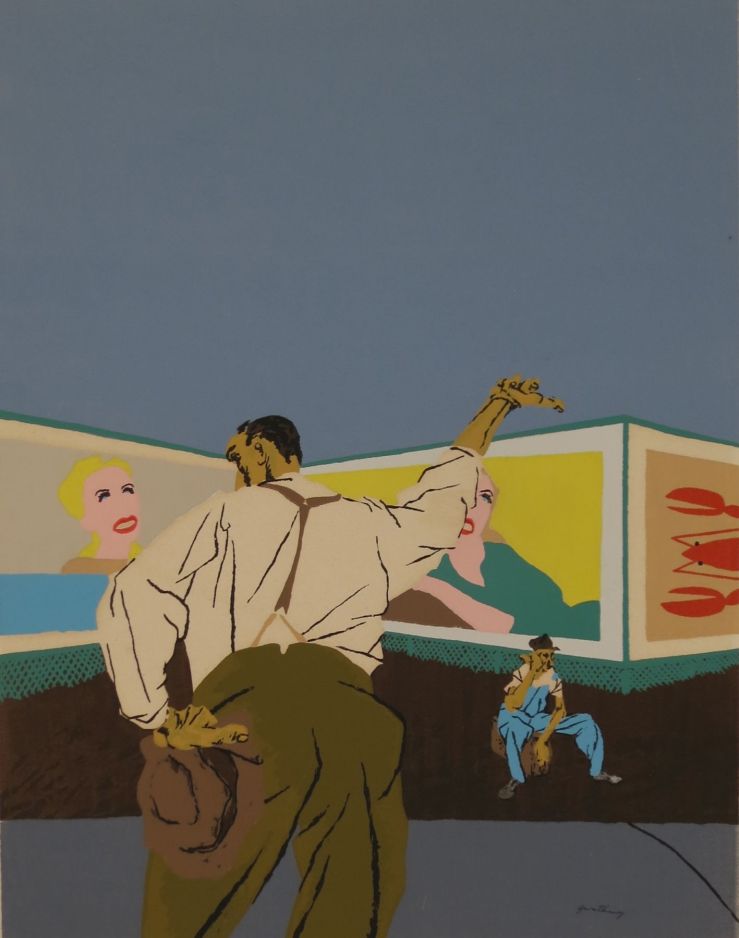
Home in Bed — Shannon Cartier Lucy 

Home in Bed, 2018 by Shannon Cartier Lucy (b. 1977)

Untitled — Kerry James Marshall

Untitled, 2003 by Kerry James Marshall (b. 1955)

Posted in Art

A review of Ishmael Reed’s sharp satire The Last Days of Louisiana Red

img_2323

Ishmael Reed’s 1974 novel The Last Days of Louisiana Red is a sharp, zany satire of US culture at the end of the twentieth century. The novel, Reed’s fourth, is a sequel of sorts to Mumbo Jumbo (1972), and features that earlier novel’s protagonist, the Neo-HooDoo ghost detective Papa LaBas.

In Mumbo Jumbo, Reed gave us the story of an uptight secret society, the Wallflower Order, and their attempt to root out and eradicate “Jes’ Grew,” a psychic virus that spreads freedom and takes its form in arts like jazz and the jitterbug. The Last Days of Louisiana Red also employs a psychic virus to drive its plot, although this transmission is far deadlier. “Louisiana Red” is a poisonous mental disease that afflicts black people in the Americas, causing them to fall into a neo-slave mentality in which they act like “Crabs in the Barrel…Each crab trying to keep the other from reaching the top.”

The Last Days of Louisiana Red begins with Ed Yellings, “an american negro itinerant who popped into Berkeley during the age of Nat King Cole. People looked around one day and there he was.” Yellings is the West Coast counterpart to New-York-based Papa LeBas, a fellow Worker of Neo-HooDoo who fights against the secret forces of psychic slavery.

Sliding into the mythological motif that ripple through Louisiana Red, Reed writes,

When Osiris entered Egypt, cannibalism was in vogue. He stopped men from eating men. Thousands of years later when Ed Yellings entered Berkeley, there was a plague too, but not as savage. After centuries of learning how to be subtle, the scheming beast that is man had acquired the ability to cover up.

Yellings’ mission is to destroy the psychic cannibalism that afflicts his people. He gets to it, and earns “a reputation for being not only a Worker [of the voodoo arts] but a worker too.” Yellings’ working class bona fides helps solidify his sympathies and his mission:

Since he worked with workers, he gained a knowledge of the workers’ lot. He knew that their lives were bitter. He experienced their surliness, their downtroddenness, their spitefulness and the hatred they had for one another and for their wives and their kids. He saw them repeatedly go against their own best interests as they were swayed and bedazzled by modern subliminal techniques, manipulated by politicians and corporate tycoons, who posed as their friends while sapping their energy. Whose political campaigns amounted to: “Get the Nigger.”

As always, Reed’s diagnosis of late 20th-century American culture seems to belong, unfortunately, just as much to our own time, giving his novels a perhaps-unintended sheen of prescience. Reed’s work points to dystopia, even as his heroes work for freedom and justice. And yet Reed gives equal air time to the forces that oppress freedom and justice, forces that find expression in “Louisiana Red”:

Louisiana Red was the way they related to one another, oppressed one another, maimed and murdered one another., carving one another while above their heads, fifty thousand feet, billionaires few in custom-made jet planes equipped with saunas tennis courts swimming pools discotheques and meeting rooms decorated like a Merv Griffin Show set….

The miserable workers were anti-negro, anti-chicano, anti-puerto rican, anti-asian, anti-native american, had forgotten their guild oaths, disrespected craftsmanship; produced badly made cars and appliances and were stimulated by gangster-controlled entertainment; turned out worms in the tuna fish, spiders in the soup, inflamatory toys, tumorous chickens, d.d.t. in fish and the brand new condominium built on quicksand.

As a means to fight the culture of erosion, decay, and entropy, Yellings founds the Solid Gumbo Works. Here, he manufactures a gumbo—a spell, really—to combat “Louisiana Red.” In the process he manages to cure cancer, which pisses off a lot of big corporations, and pretty soon Yellings is murdered. Papa LeBas is sent in from New York to solve the case.

Papa LeBas runs into trouble pretty quickly, mostly by way of Yellings’ adult children: Wolf, Street, Sister, and the provocative and gifted Minnie, who leads a group of militants called the Moochers. Each of the children seem to embody an allegorical parallel to some aspect of the American counterculture of the late sixties and seventies, allowing Reed to mash up genres and skewer ideologies. There are a lot flavors in this gumbo: voodoo lore and California history bubble in the same pot as riffs on astrology and Cab Calloway’s hit “Minnie the Moocher.” Reed frequently compares and contrasts East with West, New York with California, underscoring the latter’s anxieties of influence about being the New World of the New World. Throughout the novel, we get routines on Amos & Andy, slapstick pastiches straight out of George Herriman’s Krazy Kat comix, hysterical nods to Kafka. Reed plays off early blaxploitation films like Sweet Sweetback’s Baadasssss Song and Superfly (not to mention Putney Swope), and synthesizes these tropes with kung fu imagery and neo-Nazi nostalgia garb. He turns Aunt Jemima into a loa at one point.

Reed’s prose ping-pongs between genres, skittering from pulp fiction noir to surrealist frenzies, from bizarre sex to raucous action, from political essaying to postmodernist mythologizing. Through these stylistic shifts, Reed satirizes a host of ideologies that feed into “Louisiana Red.” Aspects of the Berkeley youth movement, radical feminism, free love, and intellectual hucksterism all get skewered, but through an allegorical lens—Reed dares us, often explicitly (by way of a character named Chorus) to read Louisiana Red as an allegorical retelling of Sophocles’ Antigone.

This retelling is both tragic and comic though, premodern and postmodern, a carnival of varied voices. The chapters are short, the sentences sting, and the plot shuttles along, pivoting from episode to episode with manic picaresque glee. Reed’s narrator is always way out there in front of both the reader and the novel’s characters, hollering at us to keep up.

Ultimately, The Last Days of Louisiana Red is a bit of a shaggy dog. It’s not that it doesn’t have a climax—it does, it has lots of climaxes, some quite literal. And it’s not that the novel doesn’t have a point—it very much does. Rather, it’s that Reed employs his detective story as a frame for the larger argument he wants to make about American culture. Sure, Papa LaBas gets to the bottom of Yellings’ murder, but that’s not ultimately what the narrative is about.

When we get to the final chapter, we find LaBas, sitting alone “on a plain box” in the empty offices of the Solid Gumbo Works reflecting on the case in a way that, in short, sums up what The Last Days of Louisiana Red is about:

He thought of the eaters and the eaten of this parable on Gumbo…all ‘oppressed people’ who often, like Tod Browning ‘Freaks,’ have their own boot on their own neck. They exist to give the LaBases, Wolfs and Sisters of these groups the business, so as to prevent them from taking care of Business, Occupation, Work. They are the moochers who cooperate with their ‘oppression,’ for they have the mentality of the prey who thinks his destruction at the fangs of the killer is the natural order of things and colludes with his own death. The Workers exist to tell the ‘prey’ that they were meant to bring down killers three times their size, using the old morality as their guide: Voodoo, Confucianism, the ancient Egyptian inner duties, using the technique of camouflage, independent camouflages like the leopard shark, ruler of the seas for five million years. Doc John, ‘the black Cagliostro,’ rises again over the American scene. The Workers conjure and command the spirit of Doc John to walk the land.

So here, near the end of The Last Days of Louisiana Red, Papa LeBas—and Ishmael Reed, of course—conjures up the spirit of Doctor John, the voodoo healer who escaped slavery and brought knowledge of the hoodoo arts to his people. There’s a promise of hope and optimism here at the novel’s end, despite its many bitter flavors. But the passage cited above is not the final moments of Louisiana Red—no, the novel, ends, despite what I wrote about its being a shaggy dog story, with a marvelous punchline.

Ishmael Reed remains an underappreciated novelist whose early work seems as vital as ever. The Last Days of Louisiana Red is probably not the best starting place for him, but it’s a great novel to read right after Mumbo Jumbo, which is a great starting place to read Reed. In any case: Read Reed. Highly recommended.

[Ed. note–Biblioklept first published this review in March, 2019.]

Self-Portrait — Tetyana Yablonska

Self-Portrait, 1945 by Tetyana Yablonska (1917-2005)

Grandfather — Michael S. Harper

“Grandfather”

by

Michael S. Harper


In 1915 my grandfather’s
neighbors surrounded his house
near the dayline he ran
on the Hudson
in Catskill, NY
and thought they’d burn
his family out
in a movie they’d just seen
and be rid of his kind:
the death of a lone black
family is the Birth
of a Nation,
or so they thought.
His 5’4” waiter gait
quenched the white jacket smile
he’d brought back from watered
polish of my father
on the turning seats,
and he asked his neighbors
up on his thatched porch
for the first blossom of fire
that would bring him down.
They went away, his nation,
spittooning their torched necks
in the shadows of the riverboat
they’d seen, posse decomposing;
and I see him on Sutter
with white bag from your
restaurant, challenged by his first
grandson to a foot-race
he will win in white clothes.

I see him as he buys galoshes
for his railed yard near Mineo’s
metal shop, where roses jump
as the el circles his house
toward Brooklyn, where his rain fell;
and I see cigar smoke in his eyes,
chocolate Madison Square Garden chews
he breaks on his set teeth,
stitched up after cancer,
the great white nation immovable
as his weight wilts
and he is on a porch
that won’t hold my arms,
or the legs of the race run
forwards, or the film
played backwards on his grandson’s eyes.

Ballard/Burroughs/James | Hello/Night/Witch (Books acquired 25 Feb. 2022)

Dropped by my beloved sprawling used bookstore yesterday to pick up a new copy of Marlon James’s Moon Witch, Spider King. It’s not exactly the sequel to 2019’s Black Leopard, Red Wolf as much as it is a kind of parallel story to that novel. From the publisher’s description:

In Black Leopard, Red Wolf, Sogolon the Moon Witch proved a worthy adversary to Tracker as they clashed across a mythical African landscape in search of a mysterious boy who disappeared. In Moon Witch, Spider King, Sogolon takes center stage and gives her own account of what happened to the boy, and how she plotted and fought, triumphed and failed as she looked for him. It’s also the story of a century-long feud—seen through the eyes of a 177-year-old witch—that Sogolon had with the Aesi, chancellor to the king. It is said that Aesi works so closely with the king that together they are like the eight limbs of one spider. Aesi’s power is considerable—and deadly. It takes brains and courage to challenge him, which Sogolon does for reasons of her own.

I also couldn’t pass up a first-edition hardback of William S. Burroughs’s late novel Cities of the Red Night. I haven’t read it in at least twenty years, but I remember it as my favorite Burroughs novel. An excerpt, via The Floating Library–

The Cities of the Red Night were six in number: Tamaghis, Ba’dan, Yass-Waddah, Waghdas, Naufana, and Ghadis. These cities were located in an area roughly corresponding to the Gobi Desert, a hundred thousand years ago. At that time the desert was dotted with large oases and traversed by a river which emptied into the Caspian Sea….

…The towns of Ba’dan and Yass-Waddah were opposite each other on the river. Tamaghis, located in a desolate area to the north on a small oasis, could properly be called a desert town. Naufana and Ghadis were situated in mountainous areas to the west and south beyond the perimeter of usual trade routes between the other cities…

….The inhabitants were divided into an elite minority known as the Transmigrants and a majority known as the Receptacles. Within these categories were a number of occupational and specialized strata and the two classes were not in practice separate: Transmigrants acted as Receptacles and Receptacles became Transmigrants.

To show the system in operation: Here is an old Transmigrant on his deathbed. He has selected his future Receptacle parents, who are summoned to the death chamber. The parents then copulate, achieving orgasm just as the old Transmigrant dies so that his spirit enters the womb to be reborn. Every Transmigrant carries with him at all times a list of alternative parents, and in case of accident, violence, or sudden illness, the nearest parents are rushed to the scene. However, there was at first little chance of random or unexpected deaths since the Council of Transmigrants in Waghdas had attained such skill in the art of prophecy that they were able to chart a life from birth to death and determine in most cases the exact time and manner of death.

Many Transmigrants preferred not to wait for the infirmities of age and the ravages of illness, lest their spirit be so weakened so to be overwhelmed and absorbed by the Receptacle child. These hardy Transmigrants, in the full vigor of maturity, after rigorous training in concentration and astral projection, would select two death guides to kill them in front of the copulating parents. The methods of death most commonly employed were hanging and strangulation, the Transmigrant dying in orgasm, which was considered the most reliable method of ensuring a successful transfer. Drugs were also developed, large doses of which occasioned death in erotic convulsions, smaller doses being used to enhance sexual pleasure. And these drugs were often used in conjunction with other forms of death.

I also couldn’t pass up a mass market edition of J.G. Ballard’s 1981 novel Hello America (with a nice cover by Tim White). I have not read Hello America. Yet.

Malice — Benny Andrews

Malice, 1978 by Benny Andrews (1930-2006)