

Issue 6 of the online literary journal Wag’s Revue is out now, and features interviews with Stephen Colbert and Reality Hunger author David Shields. They’re calling it the “Truthiness” issue, which I guess is appropriate. Here’s Colbert actually talking about Shields:
WG: Despite your professed aversion to books, you often have guests on the show from the world of literature. In fact, David Shields, who we recently interviewed, was on your show shortly after we spoke with him.
SC: Yeah, you guys should get a nice Colbert bump out of that.
WG: How do you reconcile that, though?
SC: Reconcile what? Having Shields on the show? I nailed Shields. You can go to the tape and see that. I mean, the guy’s book is the equivalent of you guys putting clips from my show on your website and calling it “The Wag-bert Report.” It’s—basically, it’s Wikipedia. A bunch of unattributed, slapped-together quotes. Mostly taken from Britannica.
“A bunch of unattributed, slapped-together quotes”–that’s about right, although it’s always a precarious position to agree with Colbert’s persona. As for the Shield’s interview, well, he manages to say a number of embarrassing things. Here he is explaining why he’s too busy to actually read the novels he’d love to see extinct:
What I find tedious are works that genuflect at the altar of narrative. What happens with so many books by supposedly intelligent writers is that the intelligence gets tamped down: ‘I’ll tell this story and the meaning will crawl through the cracks of the narrative at six crucial points.’ That’s not worth it. Part of my conversion, you could say, resulted of becoming aware of mortality. This is what I focused on in my previous book [The Thing About Life is One Day You’ll Be Dead]. This is it. This is my entire life. We are mortal beings watching the earth for a short time. I don’t have time for a 600-page novel that tells me that crime doesn’t pay.
Interviewer Sandra Allen has the intelligence to call Shields out on this. Observe:
SA: But doesn’t this dismissal also potentially dismiss art? Dismiss a reader experiencing the glorious immersion in the art that is Crime and Punishment, or for that matter Swann’s Way or Ulysses or 2666?
DS: First of all, most of the books that you mentioned were written a long time ago. I love Proust above all else pretty much. Of course if you want to read Crime and Punishment, Swann’s Way, these glacially-paced novels that have no place in a 21st century universe, you can. Even the Bolaño was written ten or so years ago. I’m trying to figure out how we’re going to write now.
Shields then blathers about how Reality Hunger, like Monet or Ulysses or Beethoven’s 5th (!) is really renewing art, claims that all of the critics who hated on Reality Hunger merely proved his point (Shields offers no support for this argument), and generally poses as a would-be revolutionary/college sophomore who just read half of Roland Barthes’s Mythologies. The interview is basically great ammunition for anyone who saw through Reality Hunger.

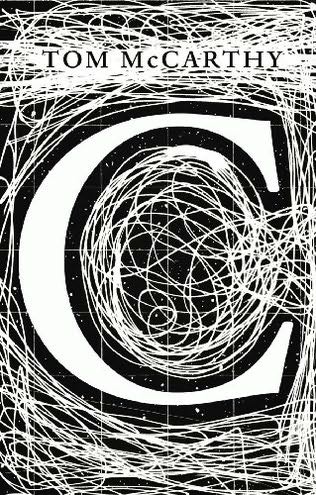

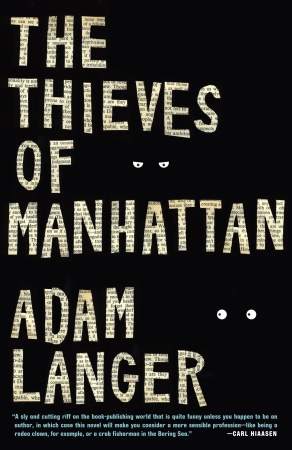 First up: Adam Langer’s new novel, The Thieves of Manhattan, a send-up of the publishing industry that sets its targets directly on the current swath of (faked) memoirs that have done gangbusters for publishers in the past few years. Ian Minot is a broke-assed barista one fuck-up away from an overdue firing, who moves from the Midwest to make it as a writer in the big city. Only he’s not doing so well–in contrast to his gorgeous Romanian girlfriend Anya whose literary star is on the rise. For Minot though, this isn’t the worst–that would be the rampant success of über-poseur Blade Markham, a wanna-be gangsta whose memoir Blade on Blade is a blatant fabrication (albeit a fabrication that no one but savvy schlemiel Minot seems to notice (or, at the least, be bothered by)). I read the first fifty-odd pages of the Thieves in one sitting–a good sign to be sure. Langer’s Minot’s voice is familiar territory, the boy who loves to mock the literati he would love to be a part of. In one of the signal moves of his patois, the names of famous authors (and characters) regularly replace common nouns–a bed becomes a proust, a full head of hair is a chabon, sex is chinaski and so on. Minot seems to be headed to running his own grift soon with the help of a man he appropriately calls the Confident Man–should be good stuff. Full review forthcoming. The Thieves of Manhattan is available July 13, 2010 from
 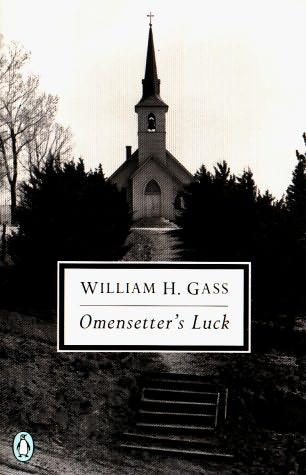 I’ve also been reading William H. Gass’s first novel, Omensetter’s Luck. It’s weird, wonderful, Faulknerish in its loose (but somehow layered and constructed) stream of consciousness. Omensetter’s Luck comprises three sections, each progressively longer; I finished the second one today, and so far the novel seems to dance around a description or accounting of its namesake, Brackett Omensetter who carts his family into the small sleepy town of Gilean, Ohio, and immediately perplexes the townsfolk with his amazing luck. As Frederic Morton put it in his contemporary
 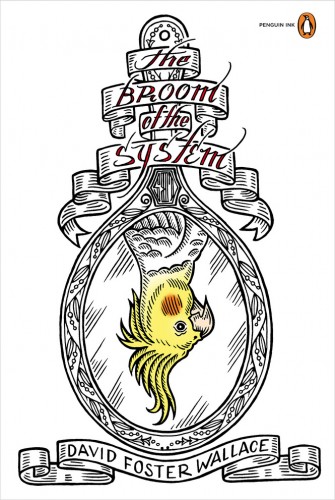 Speaking of Wallace and début novels,
  And, speaking of Wallace (again), or at least using him as a crutch–I’ve almost finished Autobiography of a Recovering Skinhead by Frank Meeink (“as told to” Jody M. Roy; they’ve sort of got the whole Malcolm X/Alex Haley thing going on there). So, yeah, why the Wallace segue? How to justify it? Well, reading Meeink’s story, the true story of an abused, battered Philadelphia kid who falls into the American neo-Nazi movement and its attendant violent crime and terrorism, who goes to prison and finds redemption and human connection and a new purpose for the nihilistic void of his life, who falls into alcoholism and drug addiction only to be redeemed again–reading Meeink’s story, even knowing its veracity (demonstrable to a point that would satisfy even Langer’s Ian Minot)–I couldn’t help but read his strong, immediate, gritty, and utterly real voice as something not unlike one of the creations in David Foster Wallace’s Brief Interviews with Hideous Men. It’s not just Meeink’s hideousness, his violence, or the grace that he works toward–all constituents of DFW’s collection–it’s that voice, the realness of the volume, surely the book’s greatest asset. Recovering Skinhead is an engrossing read, fascinating in the same way that an infected wound prompts our attention, our paradoxical compulsion and repulsion, but most of all it’s an exhilarating and exhausting performance of voice, of Meeink’s unrelenting, authentic telling of a tale, a telling that any novelist would thrill to channel. Only Meeink’s voice isn’t a novel creation: it’s real. Autobiography of a Recovering Skinhead is available now from









 Biblioklept