…a mishmash of metaphysical mumbo jumbo, filtered through touches of space opera and good old fashioned haunted housery. A Maze of Death is a messy space horror that threatens to leave its readers unsatisfied right up until the final moments wherein it rings its sad coda, a reverberation that nullifies all its previous twists and turns in a soothing wash of emptiness. Not the best starting place for PKD, but I’m very glad I read it.
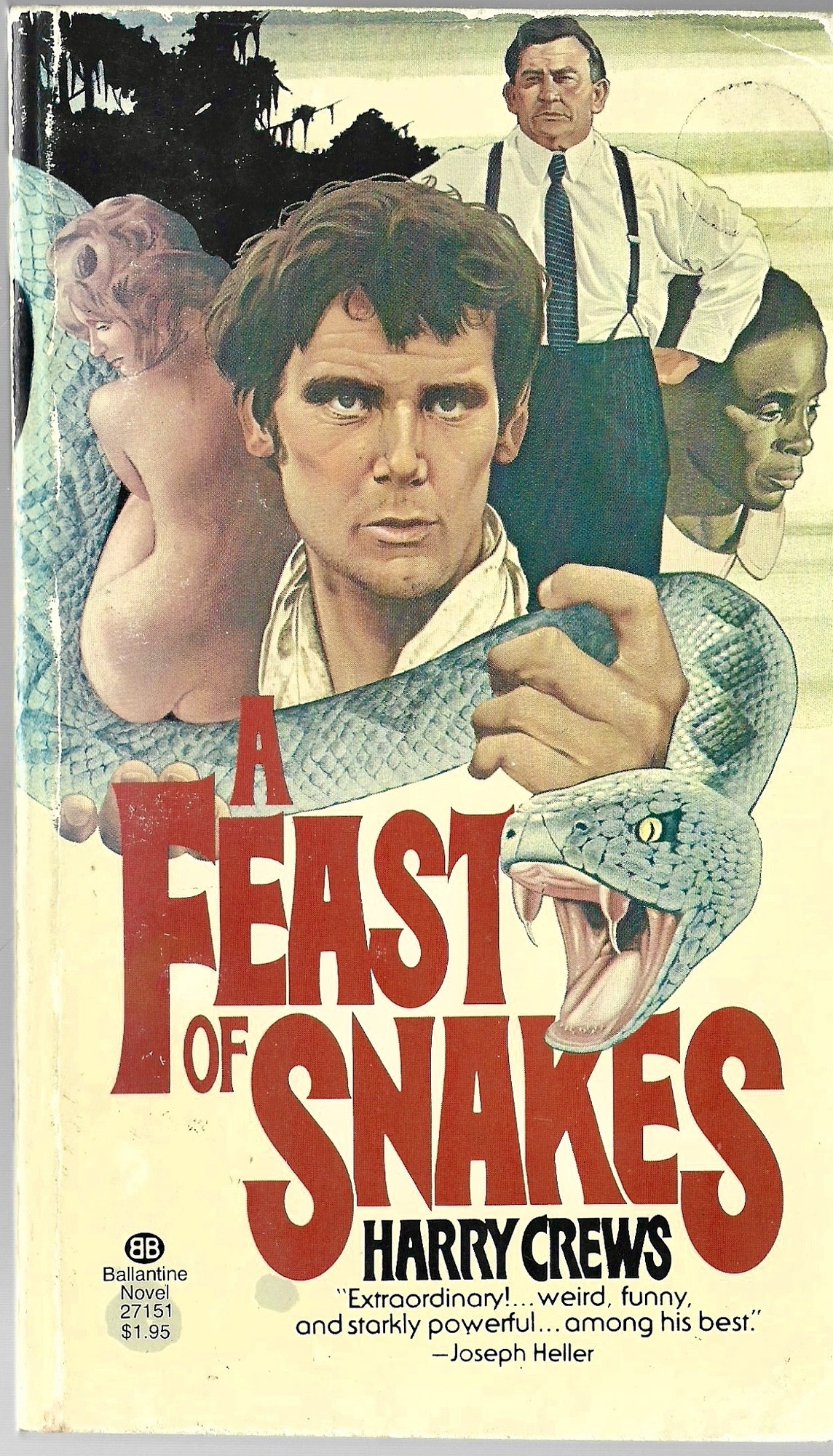
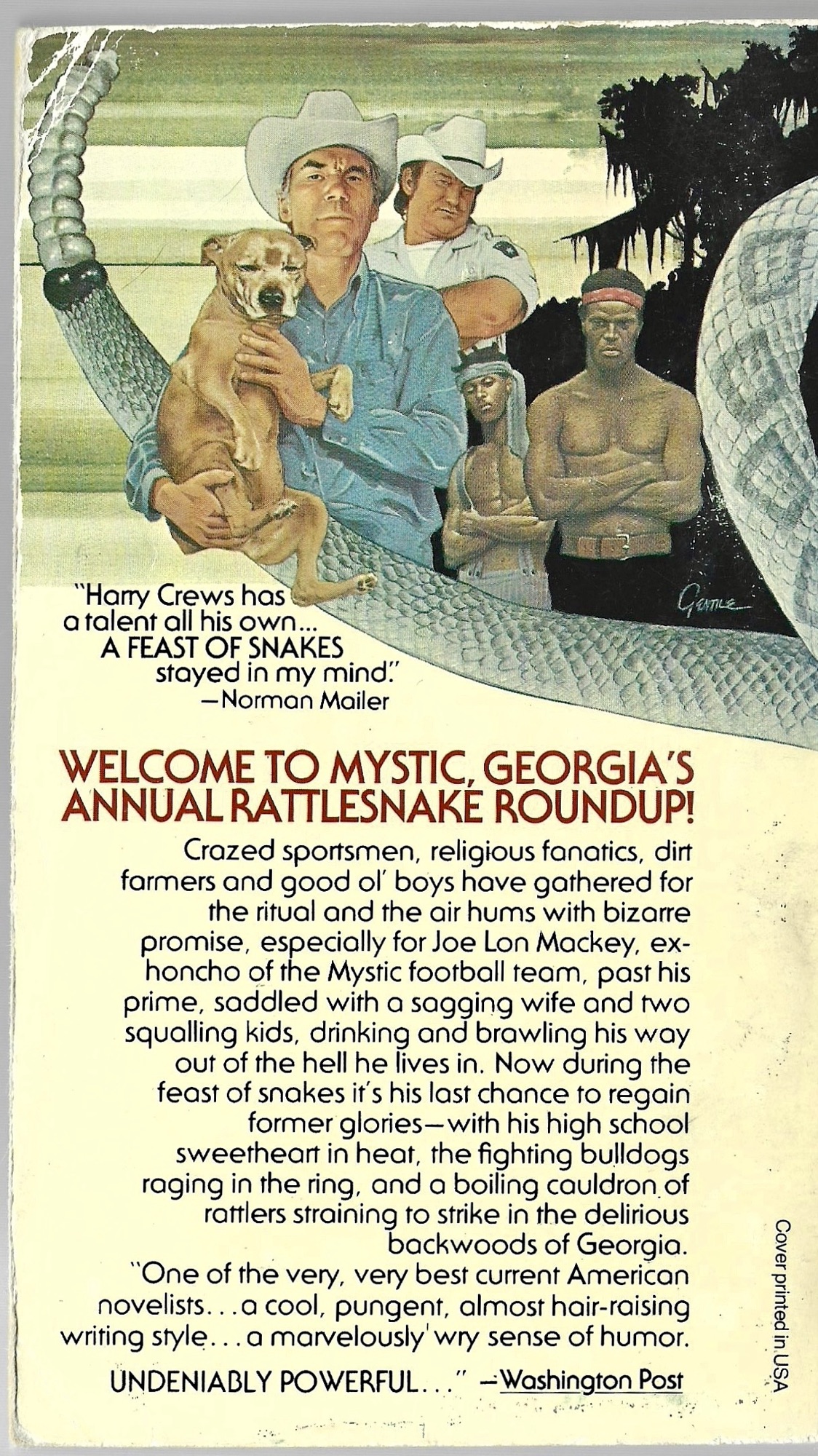
A Feast of Snakes, Harry Crews. Ballantine Books, first edition, first printing (1978). No cover artist credited. 165 pages.
While the cover designer and artist aren’t credited, there is a signature on the back which I believe is “Gentile.” If anyone has a guess as to the artist’s full name I’d be happy to hear it.
From the novel: not quite a recipe for snakes:
When they got to his purple double-wide, Joe Lon skinned snakes in a frenzy. He picked up the snakes by the tails as he dipped them out of the metal drums and swung them around and around his head and then popped them like a cowwhip, which caused their heads to explode. Then he nailed them up on a board in the pen and skinned them out with a pair of wire pliers. Elfie was standing in the door of the trailer behind them with a baby on her hip. Full of beer and fascinated with what Joe Lon could feel—or thought he could—the weight of her gaze on his back while he popped and skinned the snakes. He finally turned and looked at her, pulling his lips back from his teeth in a smile that only shamed him.
He called across the yard to her. “Thought we’d cook up some snake and stuff, darlin, have ourselves a feast.”
Her face brightened in the door and she said: “Course we can, Joe Lon, honey.”
Elfie brought him a pan and Joe Lon cut the snakes into half-inch steaks. Duffy turned to Elfie and said: “My name is Duffy Deeter and this is something fine. Want to tell me how you cook up snakes?”
Elfie smiled, trying not to show her teeth. “It’s lots of ways. Way I do mostly is I soak’m in vinegar about ten minutes, drain’m off good, and sprinkle me a little Looseanner redhot on’m, roll’m in flour, and fry’m is the way I mostly do.”
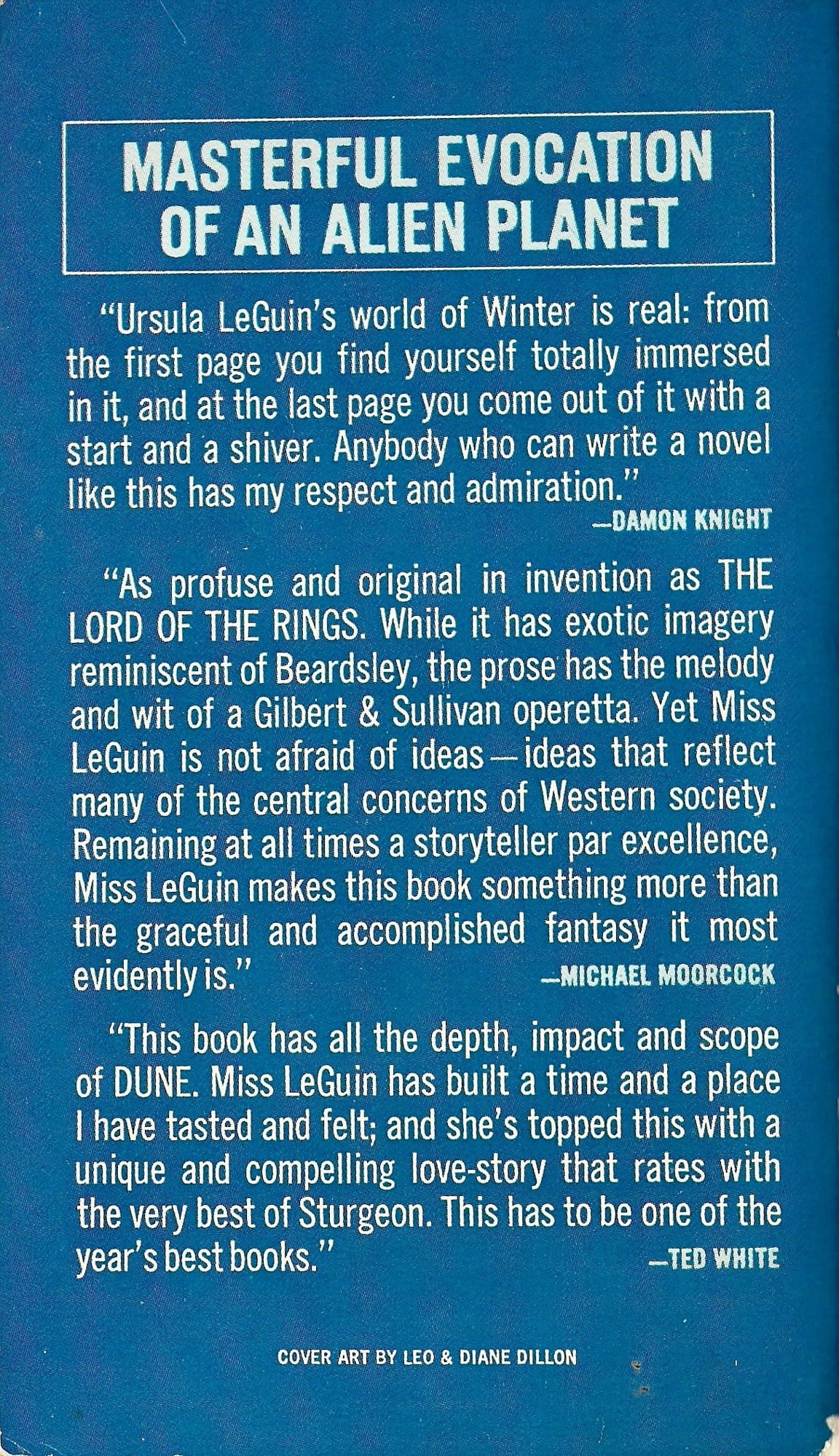
—The Left Hand of Darkness is amazing. Perfect in its strange imperfections and crammed with fables and myths and misunderstandings, it is the apotheosis of Le Guin’s synthesis of adventure with philosophy. Darkness is about shadows and weight. About pulling weight—literally, figuratively. It’s also the story of an ice planet. (A stranger comes to the ice planet!). It’s a political thriller. It’s a sexual thriller. But the impression that lingers strongest: The Left Hand of Darkness is one of the better literary evocations of friendship (its precarious awful strange wonderful tenuous strength) that I’ve ever read.
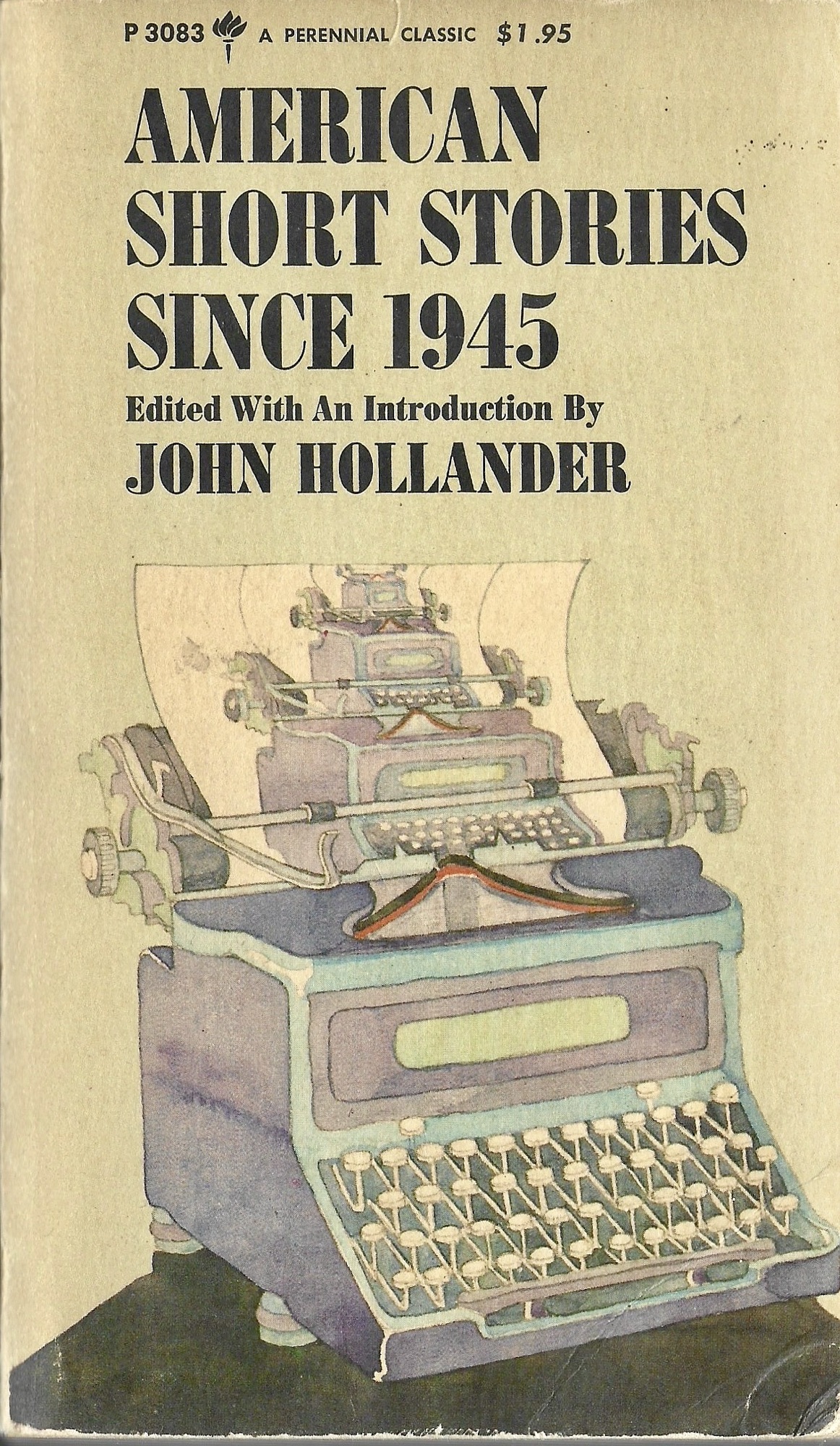
American Short Stories since 1945, edited by John Hollander. Perennial Classics, first edition, 1968. Cover design by Emanuel Schongut. 525 pages.
I think it was the title and the spine that first intrigued me when I pulled American Short Stories since 1945 from the shelf of a used book store: What would the selections be? How many years does the collection span? If Emanuel Schongut’s exquisite cover didn’t sell me on the book (which it did, all two dollars of it!), then the track list on the back certainly would have. And not so much for the authors I’d already read–Gass, Pynchon, Barthelme, O’Connor, Baldwin, and so on—but for the ones I hadn’t heard of, or at least didn’t think I’d heard of. Paul Goodman? Gilbert Rogin? Jeremy Larner? George P. Elliott? The poet who compiled the collection, John Hollander, writes in his introduction that it “aims to show the major shapes taken by shorter fiction in America since the end of World War II.” It’s the sort of book I wish I’d found when I was much, much younger, the kind of mixtape that would have sent me a lot of strange, wonderful directions.
Five years ago, I was fortunate enough to interview Margaret Carson about her translation of a collection of the artist Remedios Varo’s written work. Margaret has since expanded on that collection, adding new material from her dive into Varo’s archives, resulting in On Homo rodans and Other Writings, new this summer from Wakefield Press.On Homo rodans and Other Writings offers readers a fascinating trip through Varo’s imagination. Brimming with impossible images, surreal jokes, and dreamy fragments, the work is more than just an addendum to Varo’s career as an artist. I highly recommend it to those interested in surrealist writing in general. Margaret was kind (and patient!) enough to talk with me again over the course of a few weeks via email. I am grateful for her generosity and for her work in bringing Varo’s words to monoglots such as myself.
In addition to her Varo books, Margaret Carson’s translations include Sergio Chejfec’s Baroni, A Journeyand My Two Worlds. She is Associate Professor in the Modern Languages Department at Borough of Manhattan Community College, The City University of New York.
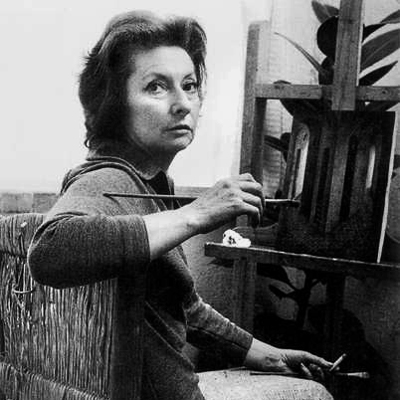
Photograph of Margaret Carson by Beowulf Sheehan.
Biblioklept: Margaret, congratulations on the publication of On Homo rodans and Other Writings, the expanded edition of your English translation of Remedios Varo’s writings! Many of our readers might be familiar with Varo’s wonderful paintings but not know about her writing. How would you characterize the prose collected in On Homo rodans and Other Writings?
Margaret Carson: Thanks, it’s great to have the translation back in print! It’s mainly writings found after Remedios Varo’s death in notebooks and on loose pages. The writings are quite varied: several odd and delightful stories (three of them new to this edition), a fairy tale, letters to friends and strangers, her famous recipe “To Provoke Erotic Dreams,” a poem that invokes the moon, dream narratives, and a few other gems, such as the title piece, “On Homo rodans,” a faux anthropological treatise that accompanied her sculpture of a human-like torso on a giant wheel, made out of chicken, turkey and fish bones.
Homo rodans sculpture in its glass case. Photograph by Margaret Carson.
Varo’s extraordinary creativity and weird sense of humor come across just as much in her writings as in her paintings. I think readers fascinated by Varo, the artist, will also be won over by her gifts as a writer. Simply put, she’s as clever a writer as she is a painter.
Biblioklept: So, let’s get into the stories and other material new to this edition and how you came to translate it into English. Some of this material hasn’t been published before, even in Spanish. If my understanding is correct, Walter Gruen, Varo’s last life partner, donated a significant collection of her works to the Museo de Arte Moderno in Mexico City in 2000. In 2018—after the publication of your translated collection Letters, Dreams & Other Writings—the Varo estate bequeathed more of Varo’s writings to the Museo de Arte Moderno. Is that right?
MC: Yes. In the early 2000s Walter Gruen and his wife Anna Alexandra Varsoviano (a friend of Varo’s who he married after the artist’s death) donated about thirty-eight of her works to the Museo de Arte Moderno (MAM), making it the largest repository of paintings by Varo in the world. Walter Gruen died in 2008, and Anna Alexandra Varsoviano in 2015. (I was lucky enough to meet them both in person: Walter Gruen in 2000 and Anna Alexandra Varsoviano some years later.) In her will, Anna Alexandra bequeathed a trove of Varo’s notebooks, letters, preparatory drawings, photos, and other items to MAM, many of which were displayed in 2018 in an exhibition celebrating the donation: Adictos A Remedios Varo: Nuevo Legado 2018. It was at that exhibition that I first saw Varo’s notebooks, open to pages containing narratives, letters and other pieces, in Varo’s own handwriting. I could instantly recognize them because I’d translated the same texts for Letters, Dreams and Other Writings, except for that book I used a collection of Varo’s writings published in Mexico in the 1990s, Cartas, sueños y otros textos, edited by the Spanish scholar Isabel Castells.
Because the new Wakefield edition mostly uses archival materials as its source, and isn’t a direct translation of texts from an existing book, the estate requested that we give it a new title. So, thinking about Varo’s tour-de-force anthropological spoof, we renamed it On Homo rodans and Other Writings.
A page from the Homo rodans manuscript. Photograph by Margaret Carson.
Biblioklept: What kind of access did the museum give you to the manuscript materials?
MC: When I requested an appointment to consult the archive at MAM, I indicated my area of interest: Varo’s notebooks and any stray papers relating to her writings. So when I visited for a few days in July 2022, an archivist assisted me by bringing out her notebooks one at a time as well as folders containing loose papers. You can’t imagine how excited I was not only to see but to touch these old, faded composition books and to turn their pages to discover what Varo had written or drawn on them. There are about a dozen notebooks in all, mostly school composition books for children. I was snapping photos right and left! I’m very grateful to the Museo and to their archivists for guiding me through the notebooks and for their interest in the project.
Cover of one of Varo’s notebooks. Photograph by Margaret Carson.
Biblioklept: Varo was born in Spain, and her painting career sparked in earnest in France, but she really flourished as a painter in Mexico. Her work seems to find a growing audience in the USA; do you have a sense of her reputation in Mexico?
MC: Remedios Varo came into her own as an artist in Mexico City; when she began to exhibit, she was an immediate success. Her first solo show, in 1956 at the Galería Diana, was a sell-out, as was a subsequent solo show in 1961. Sadly, Varo suddenly died in 1963. Her posthumous reputation is in large part due to Walter Gruen and his efforts to keep her in the public eye. The first catalog of her work, whose publication was overseen by Gruen and funded by Varo’s friend and patron Eva Sulzer, came out just three years after her death, in 1966, with contributions by some heavy hitters: the poet Octavio Paz, the French intellectual Roger Caillois, and the Mexican philosopher Juliana González, a personal friend of Varo’s. Since then, four editions of Varo’s catalogue raisonné have been published in Mexico, the last in 2008. (Alas, all are now out of print but available in many research libraries.) People are deeply fascinated by Varo’s paintings. Special exhibitions of her work at the Museo de Arte Moderno always draw record crowds (as they do in other cities as well, for example, the recent Remedios Varo: Science Fictions exhibition in Chicago, which was one of their best attended shows ever).
Biblioklept: Gruen seems to have led a fascinating life.
MC: Yes, but not without its tragedies. The little I know comes from Janet Kaplan’s biography of Varo, his obituary in the Mexican daily La Jornada, and from the Adictos a Remedios Varo catalog. Like Varo, he was fortunate to get out of war-torn Europe, but only after he experienced the worst. He was born in Austria, started medical school in the 1930s, got kicked out because he was Jewish, was arrested by the Gestapo and sent to Dachau and then Buchenwald. After liberation, he made his way to Mexico City with his wife Klari Willner and it was there that he met Varo and others in the European refugee community. His wife died in Mexico in a drowning accident in the late 1940s, while Varo was living in Venezuela. It was some time after Varo’s return to Mexico that she and Gruen got together. Gruen had established his record store by then, the Sala Margolín, which for decades was the essential go-to place for classical music fans in Mexico City.
A year after Varo’s death, in 1964, Gruen organized an exhibition of her work at the Palacio de Bellas Artes, and it’s at that show that Thomas Pynchon, on a trip to Mexico City, saw Embroidering the Earth’s Mantle /Bordando el manto terrestre, which was immortalized in the novel The Crying of Lot 49. Together with Anna Alexandra Varsoviano, Gruen worked to secure Varo’s legacy as an artist and to safeguard what she left behind. From the perspective of Varo’s writings, it was crucial that her notebooks and papers remain as a single cache of documents and not dispersed. After Varsoviano’s death, the entire archive including this collection of writings passed to the Museo de Arte Moderno.
Embroidering the Earth’s Mantle, 1961, Remedios Varo
Biblioklept: This new edition of Varo’s writings includes three stories that were previously unpublished, even in Spanish. Do you know why they weren’t published before now?
MC: No, I don’t know why. The stories are unquestionably in Varo’s handwriting, and they’re marvelous. It would be a good question to ask Walter Gruen or Anna Alexandra.
Biblioklept: Speaking of her handwriting—did you revise any of the material you’d already translated after seeing it in her manuscript?
MC: To some extent, yes. As I mentioned before, for Letters, Dreams …. (2018), I used as my source text a collection that had already been published in Mexico. As I was translating, I’d occasionally come across bracketed ellipses [. . .], and I wasn’t sure what was being signaled. Had a word or sentence in the original been cut, or was it illegible at that point? I found no editorial explanation, so I simply carried over the bracketed ellipses into the English.
In preparing this new edition, I made sure to look for those same bracketed passages in the manuscripts to see if I could discover what Varo had actually written. I found some wonderful things. All the ellipses in the Mistress Thrompston story, for example, were places where Varo had drawn weird mathematical formulas meant to be read as proper names. So now, instead of “[. . .] Magazine,” you’ll see that its name is “WTrons – X√yl Magazine.” The Marquis of Ornitobello’s daughter, whose name had been dropped completely, returns to the story: she’s called √Ax8. These are the little touches where you see Varo being Varo. She loved playing with math. In Disobedient Plant/Planta insumisashe even painted mathematical formulas into the hair of the scientist and into the tendrils of the plants. Happily, Wakefield Press was able to incorporate Varo’s mathematical doodles and other hand-drawn whimsies into the published book.
Disobedient Plant, 1958, Remedios Varo
Another kind of revision I made after seeing the manuscripts may seem trivial, but in all instances Varo wrote “etc.” not “et cetera,” so I restored “etc.” And in “On Homo rodans” she used the ligature “æ” in her invented Latin, so I restored that as well.
Something that surprised me on reading the original manuscripts was that Varo often wrote super-long sentences—what writing instructors would call “comma splices” or “run-ons.” I initially wanted to restore these sentences to their original length because in their raw state there’s a kind of fast-forward momentum. You get pulled along as she adds one thing after another to her narratives, almost breathlessly. But in the end, for the sake of readability, I normalized the punctuation a bit by breaking up some of the enormously long sentences.
There were maybe only one or two times when I changed the translation of a word after seeing that Varo had written something different from what the editor of the previous volume had transcribed. Nothing major. Of course, like all translators, I’m an obsessive reviser, so in preparing this new edition I couldn’t help but look over the previous translation to polish and tweak. I didn’t need the manuscripts for that. As they say, a translation is never finished….
Biblioklept: I’m curious if your “editor’s voice” clashed at all with your “translator’s voice” when it came to revising Varo’s comma splices and fused sentences. And were there clashes elsewhere, when it came to, say, new word choices?
MC: Hmm, I haven’t thought of the two roles clashing before. I think we worked pretty harmoniously together. The editor would have probably liked more time to revise the introduction and endnotes, and to think about the best way to order the texts within the book, while the translator, eager to get the translation back into print, was more like, “Let’s wrap up!”
Biblioklept: One section new to this edition are a handful of brief poemish texts collected as “Images in Words.” A few of these word-image-poem-texts (?!) contain strikethroughs and doodles, as you mentioned before. Many of these pieces feature phrases that correspond to motifs we see in Varo’s visual art (trees, pulleys, stars, knitters, etc.). To your knowledge, do these image fragments correspond to any of Varo’s paintings? Do you have a sense that these were “plans” for paintings–pieces of visual art that started in language first?
MC: It’s difficult to know with any certainty, but they do seem like plans for paintings that started off in language first. They could be Varo’s earliest ideas: flashes of images, possibly from dreams, that she developed as preliminary drawings and eventually, fully fleshed out in paintings.
When Varo was once asked if she was a writer as well as a painter, she replied, “I sometimes write as if I were making a sketch” (“A veces escribo como si trazase un boceto”).A lot has been made of that one sentence because it’s the only time we know of that Varo speaks of her writing. I used to think she was very modestly describing her writing as a whole, including her creative writing, but now I believe she was referring specifically to these poem-like fragments, these sketches in words. When an idea came to her, I imagine her grabbing her notebook and opening it to a blank page, sometimes to make a quick sketch, other times to jot down a few words. Sometimes she did both on the same page.
Do the fragments correspond to any paintings? Yes, if you’re familiar with her work, you can immediately make connections. For example, from the bottom of p. 131:
character from peeling wall participating in something with another character who is real
Metamorphosis
Mimicry
The abandoned room, someone inside the table, inside the armchair
as well, perhaps inside the wall — — — —
The first two lines seem to describe the painting Harmony / Armonía, in which there’s an ethereal figure emerging from a peeled-back wall to play with an object on a musical staff (a snail?). The other “real” character sits at a table across from the apparition and plays with a polyhedron-like object on the staff. Why did Varo cross the lines out? Walter Gruen speculated that it was because she had finished the painting.
Harmony, 1956, Remedios Varo
The next two lines refer to the well-known painting Mimesis / Mimetismo, in which she depicts a woman undergoing a metamorphosis – she’s taking on the characteristics of the chair she’s sitting in. (Side note: Varo’s catalogue raisonné translates the title of this painting as Mimesis, which isn’t wrong, but it makes me think more of the Erich Auerbach book and literary mimesis. I believe a better English translation would be “Mimicry,” as in insect mimicry, a phenomenon of particular interest to the surrealists. See Roger Caillois’s 1935 essay “Mimétisme et psychasthénie légendaire,” in the surrealist journal Minotaure).
They represent just one moment in the evolution of an artist’s idea. It’s said that Varo was very private in her studio practice. No one knows for sure, but it’s likely she used her notebooks (which also doubled as sketchbooks) at the earliest stages of a painting, when her ideas were hatching.
Biblioklept: Can you expand on how Varo was private in the studio?
MC: I can only talk about her studio in a limited way, from clues provided in photos and in a few accounts. I also talked a bit about Varo’s apartment-studio with Xabier Lizarraga Cruchaga, her godson, who as a boy used to visit Varo in her studio quite often (so she didn’t completely exclude visitors). Her studio was a room on the top floor of the building she lived in, accessible by a private flight of stairs. A wide doorway in the studio opened to a small, north-facing terrace where she kept plenty of plants. You can see the studio in a series of photos Kati Horna took of Varo for a magazine article that appeared in 1960. In the article, two photos show Varo at work, one at a drafting table and the other at her easel. The painting on the easel is Farewell /La despedida, with only the architectural elements of the painting in place (she would later add the departing lovers, their shadows, and the cat that looks on). Observe the white lump on the left side of the easel. That’s a piece of quartz. She apparently used quartz to incise fine lines into her paintings to expose the gesso underneath. Quartz comes up a few times in her writings as well. Let’s say she had an affinity for quartz and its mysterious qualities.
She also mentions her studio in one of her dream narratives, which begins like this:
“I dreamed I was asleep in my bedroom and a loud noise woke me up. The noise came from upstairs, from the studio, and it was as if someone were dragging a chair. I thought that this meant someone was trying to get in from the terrace and was pushing the armchair that was against the door.” (p. 100)
She goes on to narrate a terrifying dream, but note that she’s indirectly giving the basic layout of her apartment-studio.
As to her practices while at work in her studio, more and more is being written in English. In fact, for the first time ever, an in-depth investigation of her paintings by art conservators was done in connection with the recent Remedios Varo: Science Fictionsexhibition at the Art institute of Chicago. For an excellent overview of Varo’s approaches as an artist, and for descriptions of some of her techniques, check out this blog post by members of the AIC curatorial team.
Biblioklept: Varo didn’t strongly pursue exhibiting her art, and she didn’t publish any of her writing in her lifetime, right? Why do you think that was?
MC About her artwork, that’s not true. Varo was totally out there as an artist and very much interested throughout her career in exhibiting her work. As an emerging artist in the 1930s, she didn’t sit back and wait for things to happen. In the 1930s she moves to Barcelona, the home of the avant-garde in Spain, and joins artists who were radically breaking with whatever the conventions were back then. She’s on the map as an artist of note as early as 1936, when her paintings are included in the landmark Exposició Logicofobista in Barcelona. Later, after the Spanish Civil War breaks out and she moves to Paris, she’s in the 1938 Exposition Internationale du Surréalisme and images of her work are published in important Surrealist journals such as Minotaure and Trajectoire du rêve. After the Nazi invasion of France, she flees Europe for Mexico City in 1941 and there’s a pause in her exhibitions (she turned to commercial art to make a living) until 1955, when she exhibits new paintings in a group show of women artists that includes Leonora Carrington and Alice Rahon.
Announcement for “Seis pintoras.” Photograph by Margaret Carson.
This is Varo’s breakthrough show in Mexico City. The following year she is offered her first solo show, which is a great success, leading to new commissions and to (among other things) the magazine article I mentioned above with photos by Kati Horna. In no way did she have a secret life as a painter.
Remedios Varo Wearing a Mask by Leonora Carrington, 1957. Photograph by Kati Horna.
We don’t know as much about her ambitions as a writer, but she wasn’t secretive about that, either. She definitely collaborated with Leonora Carrington on some writings—for example, they have a collaborative play, El santo cuerpo grasoso, not translated yet into English. In this new edition there’s Varo’s part of what I believe was an exquisite corpse novel written with Carrington. Another “public” writing is the title piece of the collection, On Homo rodans. It’s a handwritten manuscript that was never published in the marketplace sense of the word. But Varo certainly intended for others to read it, if only a small audience of friends. (After her death On Homo rodans would be published in a small facsimile edition of 250 copies, put out by a small press in Mexico City in 1970.)
The surprise is that Varo’s excellence as a writer and storyteller still goes unmentioned. It’s a small body of writings, but some of these stories are remarkable. For example, the first three: “In a field in the state of Morelos…,” “Dear friend, I believe it’s necessary to tell you…” “One day when Maria was coming back from school…” (They have no titles, so they’re identified by their opening lines.) I was astounded, amused, captivated when I first read them….talk about the pleasures of the text! Who knew she was such a talented writer? I’m hoping that people who are passionate about Varo, the artist, will be curious about her writings and will find some powerful connections there to her art—and that they’ll also stay with her for her writing alone.
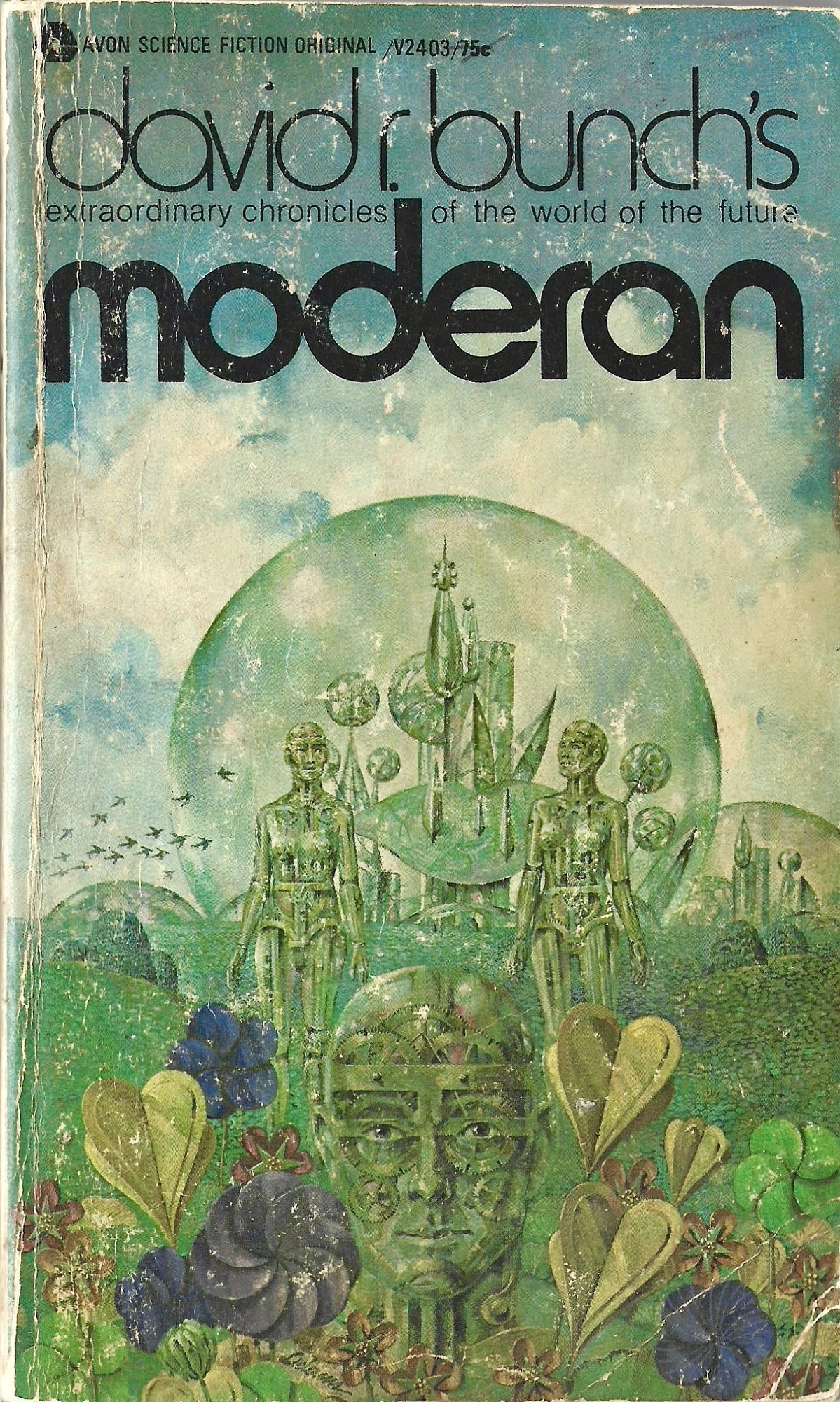
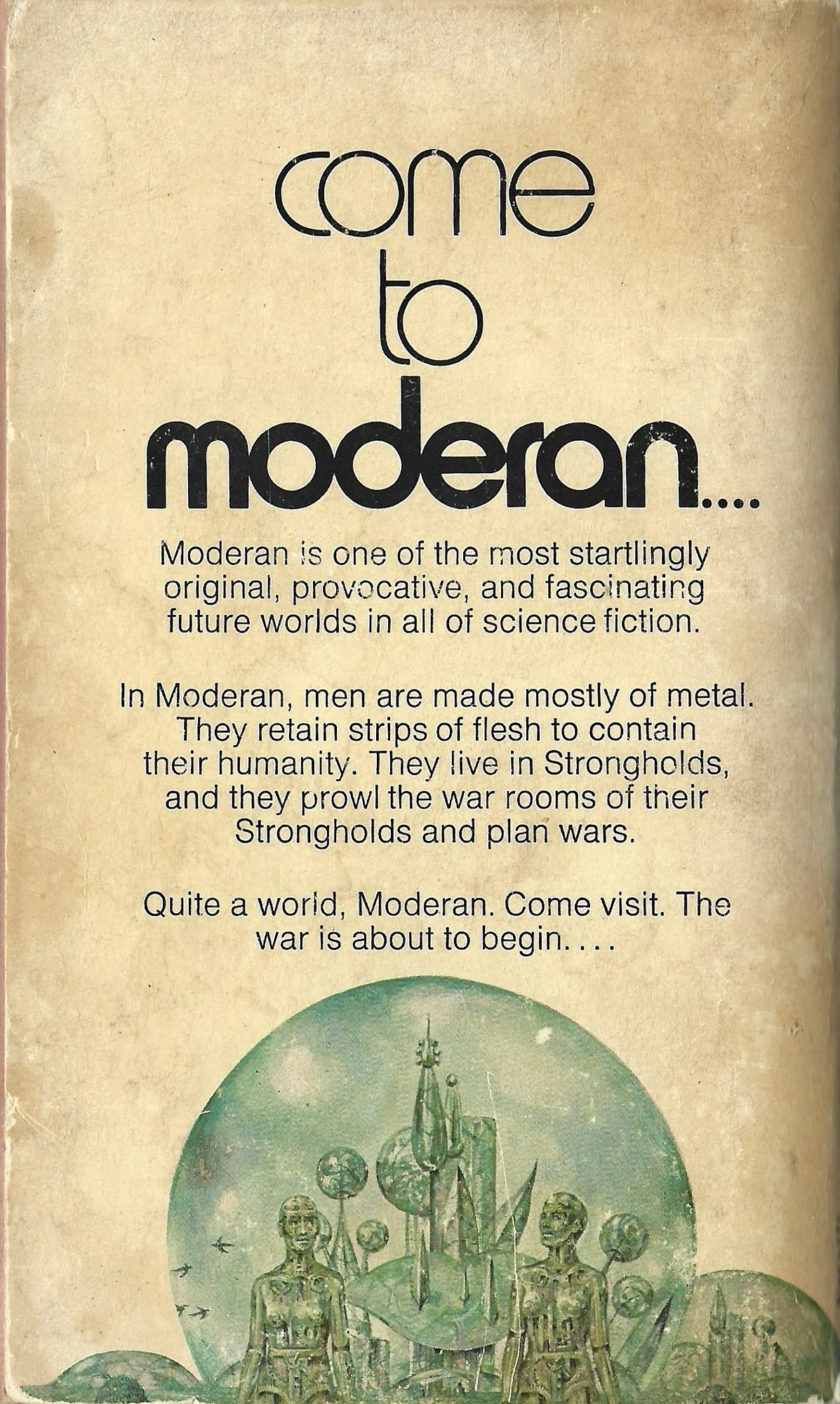
Moderan, David R. Bunch. Avon Books, first edition (1971). No cover artist credited. 240 pages.
The uncredited Boschian cover for this 1971 mass-market paperback edition of Moderan is by Norman Adams. (Adams did a similar cover in 1972 for Jack Williamson’s novel The Humanoids.)
I think copies of this volume were expensive and hard to find previous to NYRB’s 2018 release of a new edition of Moderan (which included eleven new tales). That’s the version I read—although I was happy to snap this old paperback up for three bucks at a used bookstore. I wrote of the novel in my 2018 reading round-up:
Moderan works as a post-nuke dystopian satire on toxic masculinity. The tropes here might seem familiar—cyborgs and dome homes, caste systems and ultraviolence, a world of made and not born ruled by manunkind (to steal from E.E. Cummings)—it’s the way that Bunch conveys this world that is so astounding. Moderan is told in its own idiom; the voice of our narrator Stronghold-10 booms with a bravado that’s ultimately undercut by the authorial irony that lurks under its surface. The book seems equal to the task of satirizing the trajectory of our zeitgeist in a way that some contemporary satirists have failed to.











 Biblioklept