I went to my favorite local bookstore today to pick up my daughter’s sixth-grade required reading list and to offload some books I’ll never read again. I have far too many tasteful trade paperbacks that I don’t need. I try to bring three or four in on each trip and only come out with one for me (books for the kids don’t count). I picked up a copy of Stanley Elkin’s Criers and Kibitzers, Kibitzers and Criers (1966) entirely accidentally. The book was misshelved, stacked somehow on a pile of “Miscellaneous MU-” titles (I was looking for any book by Gerald Murnane, knowing that there were none there). I couldn’t pass it up—the cover, I guess, the cheap Pop appeal of its massmarketishness, and also the fact that I’m imbibing short stories like wine lately. (Murnane, Coover, Volodine).
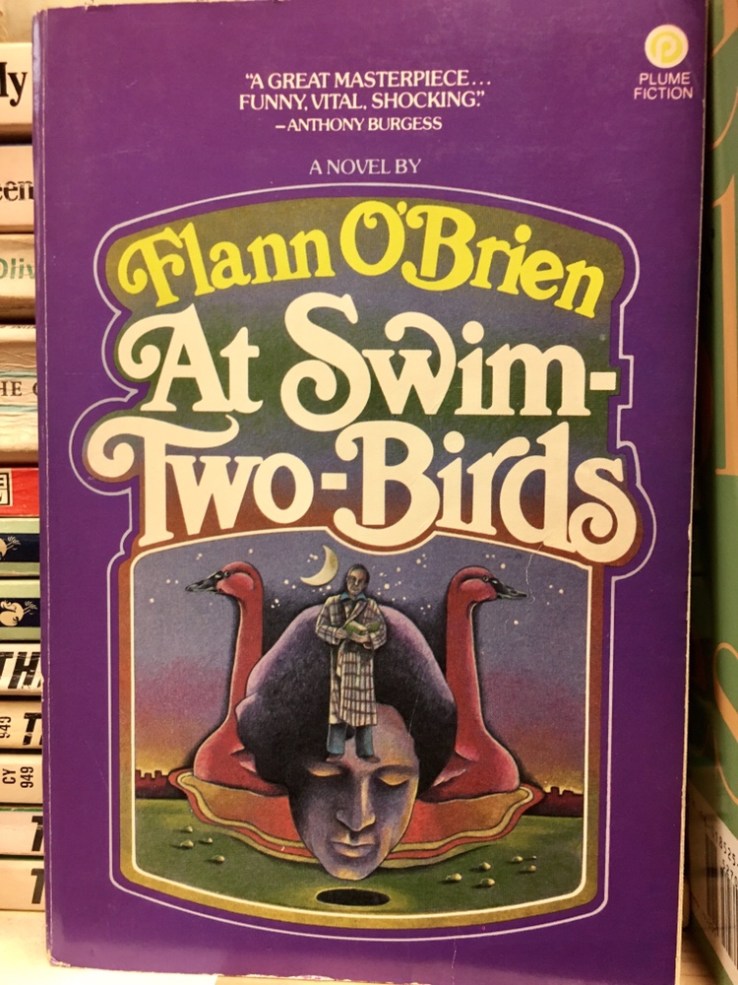
I also came across this lovely edition of Flann O’Brien’s At Swim-Two-Birds, but did not buy it, because I already own it. I love the book. The copy I have has an ugly-assed cover, unlike this beauty, which I hope some kid picks up and loses her mind over—-
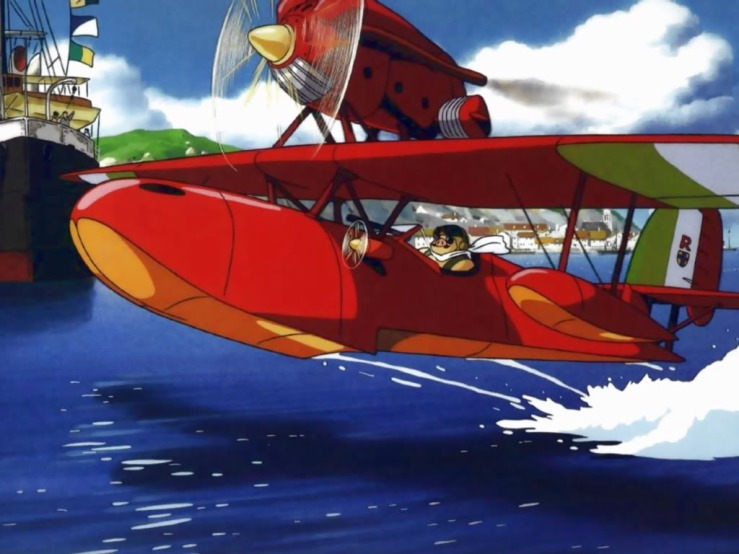
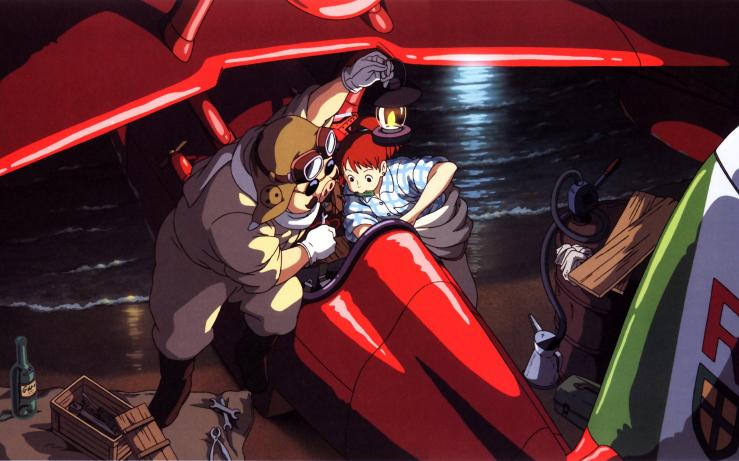
Hayao Miyazaki’s Porco Rosso (1992) is one of my favorite films, and I was able to see it last night for the first time on the big screen thanks to Studio Ghibli Fest 2018. Although I’ve seen Porco Rosso maybe a dozen times, seeing its rich, deep, bold animation on an enormous screen felt like seeing it for the first time (I also hadn’t watched the subtitled version in a while).
Porco Rosso takes place in and around various islands in the Adriatic Sea during the thin slice of years between the First and Second World Wars. Italy, like much of the world, is in the midst of a severe economic depression, and is slowly sliding into fascism. World War II is clearly on the horizon. Miyazaki pushes these problems to the margins of his film, conjuring instead a romanticized Mediterranean. However, this romantic space is always under the pressure of a coming disaster—fascism and a new war.
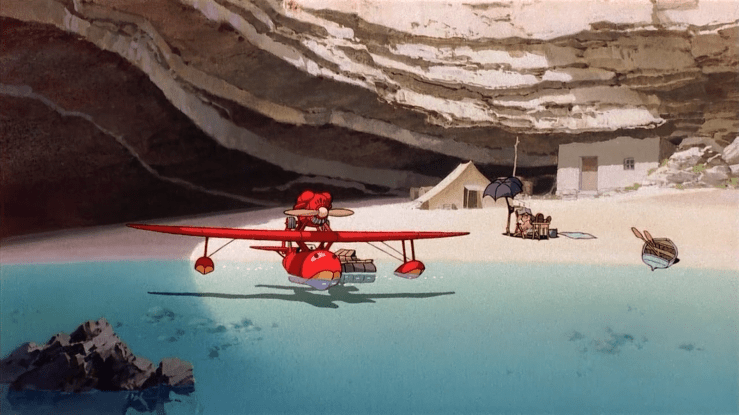
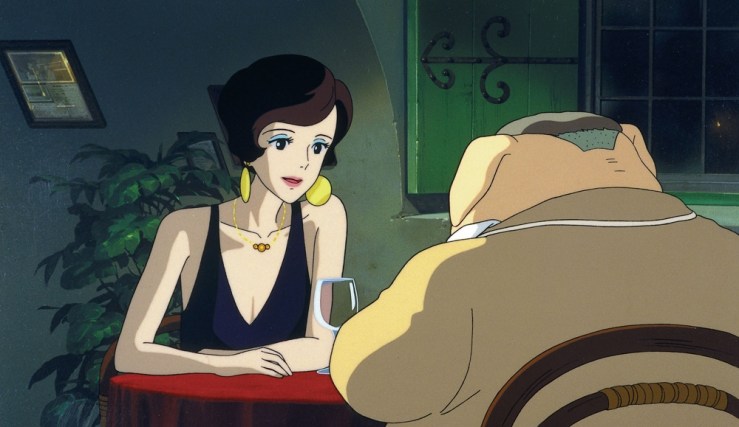
The hero of Porco Rosso is Marco Pagot (called Marco Rossolini in the American dub). Marco is an ex-military pilot, an aviation ace who fought with honor for the Italian air force in the Great War. He now spends his days drinking red wine and smoking cigarettes on a beautiful deserted island, occasionally taking jobs as a bounty hunter, retrieving hostages and other stolen goods from the nefarious and unwashed air pirates who plunder the ships of the Adriatic. Marco makes occasional concessions to civilization by taking a meal at the Hotel Adriano, a charming resort run by his oldest friend Gina. Gina is love with Marco and we come to realize Marco is in love with Gina, but he cannot come out and say this. Marco is a pig.
Marco is, literally, a pig. He is the victim of a curse that the film never explicitly names or addresses, although a scene late in the film in which Marco essentially survives an attack that should have killed him—an event that gives him a dramatic glimpse of a heaven of pilots—may be a clue to the origins of Marco’s porcine curse. In any case, Marco’s pigman existence is the film’s only concession to the kind of mythical and magical fantasy that otherwise permeates Miyazaki’s canon (with the notable exception of The Wind Rises (2013), which in some ways is a sequel to Porco Rosso).
This isn’t to say that Porco Rosso isn’t a fantasy though. Miyazaki’s world of air pirates and bounty hunters, attractive hoteliers and hotshot engineers, and seaplanes dueling in a radiant sky, brims with an effervescent energy that counterbalances the grim specter of the Great War that preceded the film’s narrative action and the Second World War—and a Fascist Italy—that the narrative’s “real” time must eventually intersect. Ever the lone pig, Marco seeks to fly away from the social and historical forces that would constrain him.
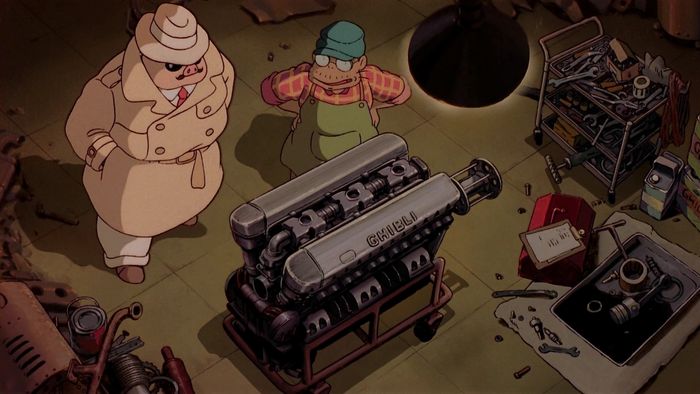
Unfortunately for Marco, luxurious isolation remains an impossibility. The air pirates hire a hotshot American to take out the damned Crimson Pig once and for all. Donald Curtis (hailing from Alabama in the Japanese version and Texas in the American) exemplifies American cockiness. His enormous jaw precedes the rest of his swaggering body, he falls in love at first sight with any beautiful woman he sees, and he’s brash and impetuous. He wants to transition to Hollywood and eventually become the President of the United States! Curtis shoots up Marco’s plane early in the film, but our porcine hero escapes to Milan, where he rebuilds his plane with the help of a whiskered mechanic named Piccolo and his charming granddaughter Fio. Fio redesigns the plane and eventually becomes Marco’s sidekick, traveling with him back to the Adriatic and helping him face Curtis and the air pirates.
Fio, whose character design recalls Nausicaa of Nausicaäof the Valley of the Wind (1984), is another of Miyazaki’s prominent female protagonists. In some ways she is the secret hero of the film; she takes over the narration at the end, implicitly assuming Porco Rosso’s mantle. Fio has earned Marco’s trust after he is initially dubious of her ability because of her age and his sexism. Fio leads an all-female team of builders and engineers to recreate a superior version of Marco’s plane. This workshop sequence is one of the film’s finest. Miyazaki often foregrounds labor in his films, but Porco Rosso explicitly shows how a complex work—whether it’s a plane, or, y’know, a film—is never the singular work of a gifted genius, but rather the concentrated effort of a team. Miyazaki underscores the connection between the creative process of plane-building and film-making, stamping his studio’s name on Marco’s new engine. (Studio Ghibli was named after an Italian war plane, the Caproni Ca.309, which was nicknamed Ghibli—“Desert Wind”).
While in Milan, Marco realizes that the fascist secret police are after him. The Fascists in Porco Rosso (who want to conscript Marco—or take his plane) are far more ominous than Curtis. Curtis serves as an actual antagonist for Marco to face, and the fight between the two at the end of Porco Rosso, although violent, plays with a light comic touch. Miyazaki references the “gentlemen pilots” of World War I here. The Fascists, in contrast, are a spectral force lurking behind the narrative, threatening Marco’s individuality and autonomy. The film affirms itself as a comedy that resists encroaching fascism in a conclusion that sees Marco, Fio, Gina Curtis, the air pirates, and every other member of this strange Adriatic paradise working together to escape their approaching air force.
The film’s denouement is a retreat into the romantic Adriatic community, a kind of gauzy, rosy vision of an isolated paradise untouched by war or fascism. The fantasy reminds one of an island from some lost book of The Odyssey, a tranquil paradise unbothered by Trojans or Greeks. Marco—Porco—too feels like a figure from the margins of The Odyssey, a hero transfigured into a pig. The end of Porco Rosso refuses to give us a direct answer as to what happens to Porco. Does he regain his human form? Or, perhaps more importantly, is there a happy ending for Porco and Gina? The film offers a number of clues, some explicit and some implicit, but a first viewing may feel ambiguous for many viewers. However, subsequent viewings reveal a clearer picture as to what happens to Gina and Marco. Why the ambiguity then? Porco Rosso is (apart from The Wind Rises) the Miyazaki film with the strongest historicity. The historical reality of a looming World War II threatens to devour the romance of Gina and Porco—so Miyazaki and the inhabitants of his secret Adriatic world conspire to hide it. Lovely stuff.
How I watched it: Last night with subtitles at my local indie cinema with full attention—and then again this afternoon, dubbed, on a large TV (via a USB drive with an .mkv file), with minor attention (I wrote this as I watched) with my daughter, who is home from school (poor dear has strep throat), and who was upset because we (that is, my family of four) were unable to watch the film as a family on Sunday afternoon, as it had sold out, and thus requested we watch it together, just now, which we did. Porco Rosso plays in select theaters one more time, by the way–on May 23rd, 2018.
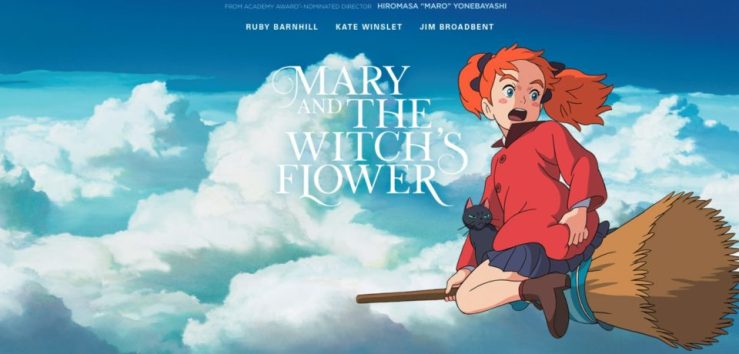
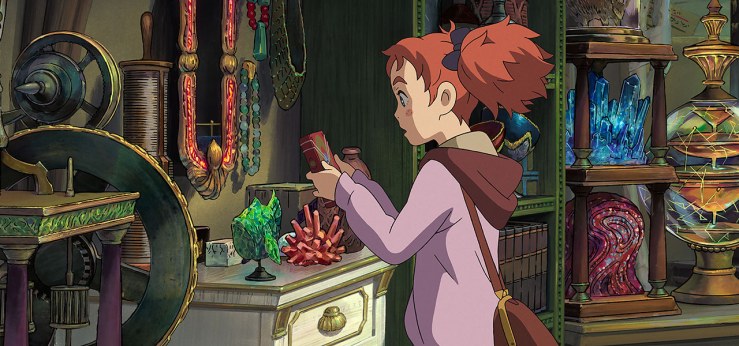
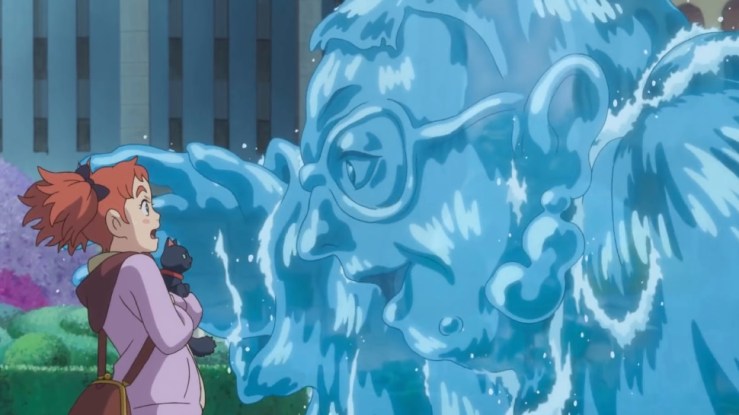
Mary and the Witch’s Flower (2017) tells the story of Mary Smith, a little girl whiling away her time in the English countryside home of her great aunt before school starts. Poor Mary is awfully bored—until she finds a rare flower called the “fly-by-night.” The fly-by-nights, which only bloom once every seven years, bestow magical properties on their user. Mary’s boredom is quickly cured when a flying broomstick whisks her away (black cat in tow) to a magical world above the clouds. She finds herself at the Endor College of Witches, where she’s taken on as a star pupil by the ominous headmistress Miss Mumblechook and her strange partner in scientific magic, Dr. Dee. They take Mary on a tour of Endor College, a visual highlight of a gorgeous film. The tour culminates in Miss Mumblechook’s office, which doubles as a museum of magical artifacts. Here, Mary—somewhat accidentally, but hey—becomes a biblioklept, stealing the headmistress’s book of master spells. Mary then reveals that her power comes from the fly-by-night flower. The film’s plot kicks into a higher gear here, as it becomes clear that Mumblechook and Dee will stop at nothing to get their clutches on the magical flowers.
Mary and the Witch’s Flower is the first film from Studio Ponoc, a production company founded by Yoshiaki Nishimura, who previously worked as a producer for Studio Ghibli. Mary and the Witch’s Flower’s director Hiromasa Yonebayashi is another Studio Ghibli alum; he worked as a key animator on films like Spirited Away (2001), Howl’s Moving Castle (2004), and Ponyo (2008), before directing his own films for the studio—Arrietty (2010) and When Marnie Was There (2014).
Arrietty, while charming, felt like Miyazaki-lite—a small-scale exercise pulled off with aesthetic precision that ultimately lacked the grand emotion that underwrites all the master’s greatest films. In contrast, Mary and the Witch’s Flower isn’t so much Miyazaki-lite as Miyazaki-mega, a love letter composed under heavy anxiety of influence. The film teems with references to Miyazaki’s oeuvre, and Yonebayashi’s visual style is an homage on par with (if not surpassing) the master.
The most immediate comparison viewers might make here is to Miyazaki’s Kiki’s Delivery Service (1989), which Yonebayashi’s film clearly echoes visually with its flying broomsticks and its prominent black cat. However, Mary and the Witch’s Flower has more in common (both in its plot, themes, tone, and visuals) with later Miyazaki films like Ponyo, Howl’s Moving Castle, and Spirited Away. I’m tempted to produce a laundry list here of specific comparisons, but there are simply too many—Yonebayashi delights in larding his film with characters and images that visually resemble Ghibli characters and images, painted in the bright shimmering colors of Miyazaki’s late period. There isn’t a shot in the film that doesn’t crib, even obliquely, from an earlier Ghibli film. (Hell, even composer Takatsugu Muramatsu’s soundtrack sounds like an homage to Joe Hisaishi’s work for Studio Ghibli).
These Easter eggs are most fun to find when Yonebayashi goes beyond the core films that his pastiche derives from, like when we get a shot of a city in the clouds that echoes Castle in the Sky (1986), or when a gray cat is transmuted into a creature resembling something like the gentle creatures from Totoro (1988), or when Yonebayashi’s frame lingers just a second too-long on a pigman chef who bears more than a passing resemblance to the titular hero of Porco Rosso (1992).
Yonebayashi’s melange of Miyazaki is hardly a patchwork of references though. Mary and the Witch’s Flower is rather a loving synthesis of the master’s greatest tendencies. Calling Yonebayashi a copycat simply will not do—he was a key artisan in Miyazaki’s workshop after all, and we see here the same level of technical craftsmanship that made the Ghibli films so special.
What’s missing from the film though is something harder to define. An auteur relies on a company, a workshop, a cohort of skilled artisans to help the auteur realize his or her vision. All auteurs borrow or outright steal from the artists that come before them, but the great artists conjure those ingredients into something new. They overcome their anxiety of influence and synthesize the masterworks that preceded them with their own visions, inspiriting the material with their own sense of soul. Yonebayashi’s film, as I wrote above, is a loving synthesis of Miyazaki’s most magical moments, but what’s missing is Yonebayashi’s own magic, his own vision.
And yet there’s so much promise in the young artist. Yonebayashi is only 44; Miyazaki was around the same age when he made Castle in the Sky, the first Ghibli film, and frankly one of his weakest. Castle in the Sky is best enjoyed now as a work in retrospect, after having traced the auteur’s major themes in grander works like Spirited Away or The Wind Rises (2013). With Mary and the Witch’s Flower, Yonebayashi composed a love letter to the workshop where he honed his craft, and the film will probably be most remembered (and enjoyed) as an homage to all things Ghibli. Let’s hope that Yonebayashi’s next effort sees the young director break free from the anxiety of influence to offer us his own original vision.
How I watched it: On a big TV, rented from iTunes, with full attention, with my family. My daughter gave it a B+; my son gave it a B-.








 Biblioklept