The Wedding — Francisco Goya

Haunted City — Michael Sowa

Short Leash — Kelly Reemsten

kelly-reemtsen-short-leash

Leonora Carrington in the LRB

 spaw01_3708_04

The Temptation of St. Antony, Leonora Carrington

Nice piece by Alice Sprawls on Leonora Carrington (whose work is now on display in the Tate) in The London Review of Books today. Excerpt:

Domesticity in Carrington’s paintings and stories is the scene of Ovidian and spiritual transformations; cooking was a sort of alchemy, like painting, and she began increasingly to use egg tempera – influenced by paintings she had seen in Siena but also by its almost culinary processes (separating the egg yolk, adding wine or vinegar then water and pigment). She refused to explain her personal symbolism, but called reading The White Goddess ‘the greatest revelation of my life’. The figure of the muse, Robert Graves’s ‘Mother of all Living, the ancient power of fright and lust’, became less burdensome as manifested in The Giantess (c.1950), whose colossal central figure towers over the scene like a Madonna della Misericordia. She cradles an egg; geese fly out from beneath her pallium; her golden hair is a field of wheat. Around her feet a hunt is taking place – Uccello’s Hunt in the Forest but with a sylph instead of a stag – while the sea behind is teeming with boats, whales, crabs and bizarre creatures like monsters on a medieval map.

From 1950 the paintings become even more fantastical. Many are dominated by bald, spectral white figures: the Sidhe of Irish legends her grandmother told her. In Darvault(1950), Carrington’s two sons by Weisz, Pablo and Gabriel, stand in a de Chirico-esque courtyard, pale and cloaked with small plants growing from their heads. Is Carrington the feline figure in the apron with the elaborate white headdress and whiskers? InDown Below Carrington had described the worldview of her madness – ‘the father was the planet Cosmos, represented by the planet Saturn: the son was the Sun and I the Moon, an essential element of the Trinity, with a microscopic knowledge of the earth’ – and in Mexico she incorporated more and more elements of myth and occultism into her works; not just the Catholicism and Celtic stories of her childhood but astrological and Egyptian imagery, cabbala, Tibetan Buddhism, tarot.

Water. The Bather. — Frantisek Kupka

Temple of the World — Leonora Carrington

leonora-carrington_2

Uncle Piacsek in Front of the Black Sideboard — Jozsef Rippl-Ronai

Jiří Karásek ze Lvovic’s A Gothic Soul (Book acquired, 3.30.2015)

image

Another beautiful volume from Twisted SpoonA Gothic Soul by Jiří Karásek ze Lvovic, translated from the Czech by Kirsten Lodge, featuring prints by Sascha Schneider.

I dipped my toe in this weekend—strange, brooding stuff. More to come.

image

Twisted Spoon’s blurb:

A Gothic Soul is the most acclaimed work of Czech Decadent prose. Expressing concerns that are unique to the Czech movement while alluding creatively and ironically to Joris-Karl Huysman’s Against Nature, the novella is set in Prague, which is portrayed as a dead city, a city peopled by shades, who, like the protagonist — a nihilist and the “last scion of a noble line” — are only a dim reflection of the city’s medieval splendor. The man lives in a dreamworld, the labyrinth of his soul giving rise to visions. In his quest for meaning, he walks the city, often hallucinating, while pondering questions of religious fervor and loss of faith, the vanity of life, his own sense of social alienation, human identity and its relationship to a “nation,” the miserable situation of the Czechs under Habsburg rule, and Prague’s loss of its soul on the cusp of modernity as old sections, such as much of the squalid Jewish Quarter, are demolished to make way for gaudy new buildings and streets. With a history of madness running in the family and afraid the same fate awaits him, he ultimately retreats into seclusion, preferring the monastic way of life as the epitome of unity and wholeness and a tonic to present-day fragmentation. Yet Karásek eschews the mawkish, opting instead for darker tones that play with the tropes and motifs of Decadence while conflating the same-sex desires of his protagonist, the fatalism and futility of such an existence within the social construct of the day, with concerns for the dual fates of his nation and city.

Given his importance for Czech literature and for European Decadence, very little of Karásek’s work has been translated into English. Kirsten Lodge included translations of his poetry in Solitude, Vanity, Night: An Anthology of Czech Decadent Poetry, and we have made available her translations of some of his shorter prose here and here. This is the first time A Gothic Soul, or any full-length work of Karásek’s prose, has been translated into English.

Pair of Pheasants — Maruyama Okyo

Spring at Barbizon — Jean-Francois Millet

No Way Jose — Alan Macdonald

p_nowayjose

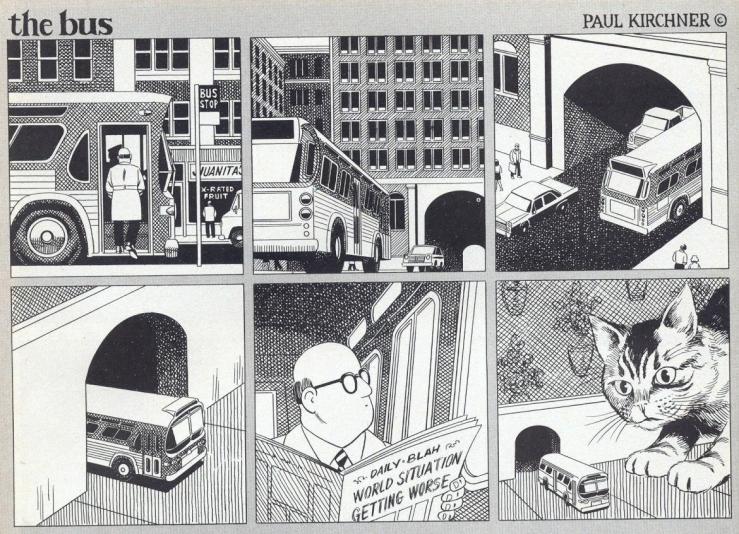
The Bus — Paul Kirchner

U6iKNJX - Imgur