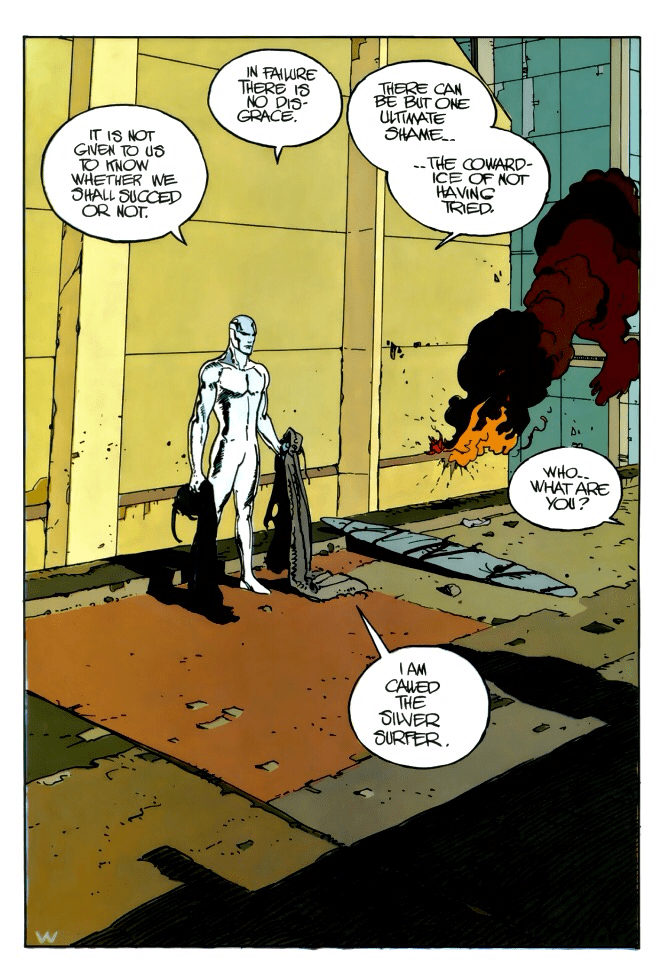
That which is entirely devoid of light is all darkness; as the night is like this and you wish to represent a night subject, represent a great fire, so that the object which is nearest to the fire may be tinged with its colour, since the object which is nearest the fire will participate most in its nature. And as you will make the fire red, all the objects which it illumines must be red also, and those which are farther off from the fire will be dyed to a greater extent by the dark colour of night. The figures which are between you and the fire appear dark from the obscurity of the night, not from the glow of the firelight, and those which are at the side are half dark and half ruddy, and those which are visible beyond the edge of the flames will be altogether lighted up by the red glow against a black background. As to their action, make those which are near shield themselves with their hands and cloaks against the intense heat with averted faces as though about to flee; with regard to those who are farther off, represent them chiefly in the act of raising their hands to their eyes, dazzled by the intense glare.
Category: Art
Wunderkammer — Santiago Caruso
Eva Cristina — Ernst Fuchs

Dream — Claude Verlinde

Salome — Gustav-Adolf Mossa

The Star — Alasdair Gray
The Star is one of several pieces of art by Alasdair Gray that accompany Rodge Glass’s review of the Scottish novelist’s collection of non-fiction pieces, Of Me & Others. The first paragraph of Glass’s piece:
At the time I finished my biography of the polymath Alasdair Gray, in 2008, my subject was at a curious juncture. Though an artist for six decades, he remained a footnote in his country’s art world. Though the author of the most celebrated Scottish novel in the last hundred years, Lanark, and several others which altered the literary landscape of his home city, Glasgow, beyond recognition (Poor Things, 1982, Janine, Unlikely Stories, Mostly) he was dependent on a small Royal Literary Fund grant and regular scraps from various overdue projects for his living. (Gray is, was, and always will be a Republican. He once turned down a knighthood.) 2007 saw the publication of what he called “my final novel,” labeled as such because he’d quite simply run out of old unpublished manuscripts to pilfer ideas from. The spares drawer was now empty. Meanwhile, no matter how many times he reminded folks that he had stolen it from the Canadian poet Dennis Lee, he was still always credited with the only quote outside the still-new Scottish Parliament building: Work as if you live in the early days of a better nation. In his old age, there was talk of him becoming that most disgraceful of things—an uncontroversial “national treasure,” awaiting death, then platitudes from the great and the good, and then probably—the horror!—a statue. All this was an ominous sign for an artist who had always defined himself in opposition to political power.
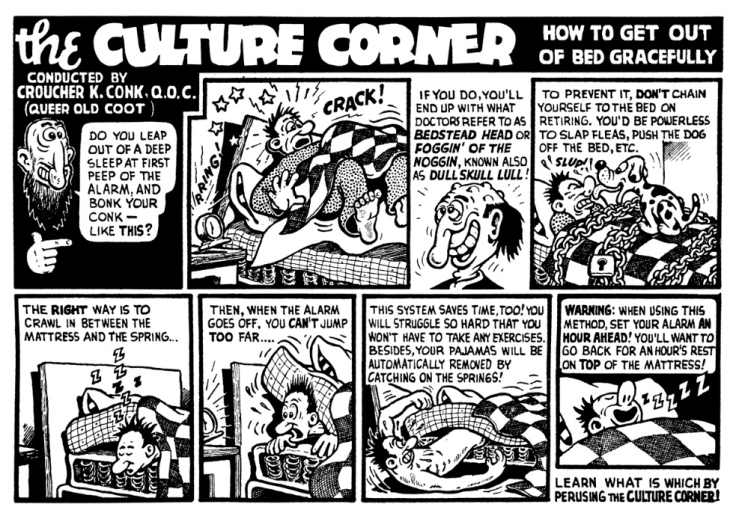
How to Kick a Person in the Teeth — Basil Wolverton

The Milkmaid — Johannes Vermeer

Della — James Jean
Pool Side — Tomer Hanuka
Queequeg in His Coffin — Bill Sienkiewicz
The Pancake Woman — Rembrandt

Vanitas Vanitatum — Agostino Arrivabene

Commuter Doodle (Reader) — Roman Muradov
Sweat of the Brow — Hans-Georg Rauch

I’ve Had Enough of the Futility of Your Struggle! — Yongbo Zhao
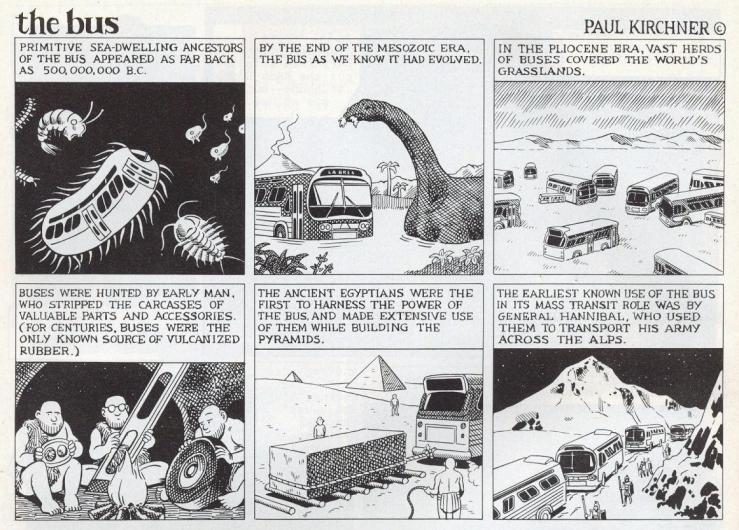
The Bus — Paul Kirchner