Black Moon — Louis Malle (Full Film)

Pôster

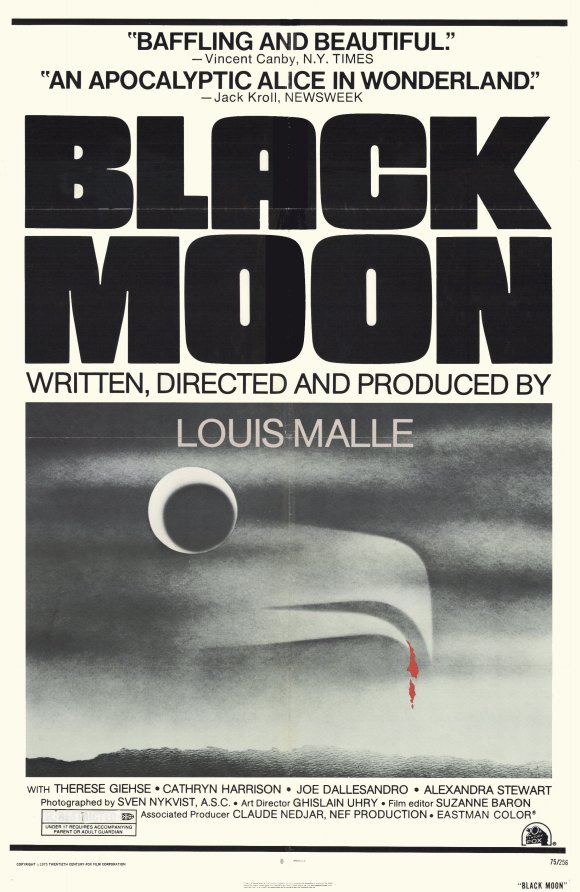
Black Moon may well deserve the title of Louis Malle’s film maudit. The release in September 1975 of what he called his “mythological fairy tale taking place in the near future” disconcerted many, especially as people had expected him to follow up on his previous work, the groundbreaking German-occupation drama Lacombe, Lucien (1974). As a result, the film was his least successful at the box office, and despite receiving two Césars in 1976, it remained until recently one of his most difficult to see.

Black Moon opens as quasi science fiction—there seems to be some kind of nuclear war going on, with soldiers wearing gas masks—but immediately evolves into an elaborate surrealist fantasy. In a deserted countryside, a fair young woman (Cathryn Harrison) fleeing the armed conflict stumbles upon a series of animals, ranging from the rural—a badger, pigs, sheep, snakes, and a horse—to a mythical unicorn. Narrowly escaping being shot, she ends up in a beautiful mansion that is itself overrun by animals, those she has seen outside now joined by a tame rat and an eagle, among others. The human inhabitants of the house are an androgynous and incestuous brother and sister couple, possibly twins (played by Alexandra Stewart and Joe Dallesandro), who, like the heroine, are both called Lily, and their bedridden elderly mother (Thérèse Giehse, who had played the grandmother in Lacombe, Lucien and whom Malle credited with indirectly generating Black Moon by suggesting that he make a film without dialogue; he dedicated the film to her, as she died before it was released). Although Black Moon was produced in an English and a French version—and Malle stated that he preferred the English one—language is reduced to a few grunts, a minute amount of intelligible dialogue, and animal noises. The film is instead replete with surrealist images, such as a talking piglet in a child’s high chair, decapitated animals, feral naked children driving pigs or sheep, and both the female twin and the heroine at one point breast-feeding the old woman.

From Ginette Vincendeau’s essay “Black Moon: Louis in Wonderland.

The Pancake Baker — Adriaen Brouwer

RIP Robert Ashley

ashleybysavio2

RIP Robert Ashley, 1930-2014

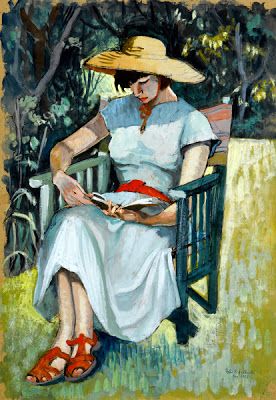
The Artist’s Wife Reading — Fyffe Christie

15e4ee3675c7fb1ea51457d4963e1cc3

Excavation at Night — George Bellows

The Battle of Alexander at Issus — Albrecht Altdorfer

An Old Man Holding a Pipe and Tankard — Gabriel Metsu

Dig — Sadie Wendell Mitchell

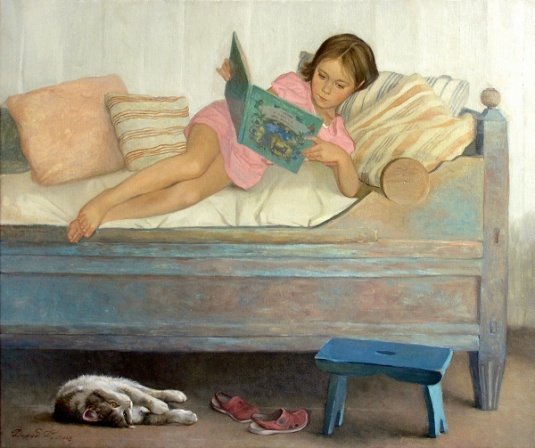
readinglady

White House at Night — Vincent van Gogh

The Stone Bench in the Garden at Saint-Paul Hospital — Vincent van Gogh

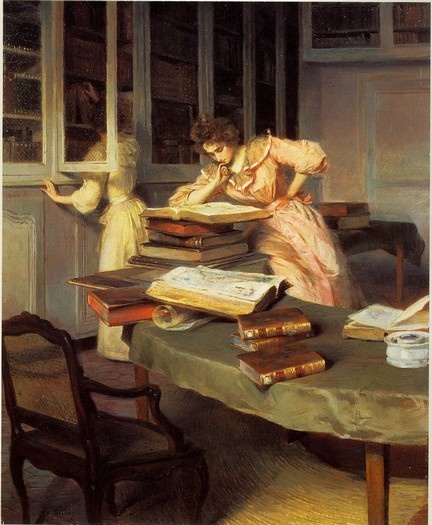
Elegant Woman in Library — Edouard Gelhay

9b59115eab0cb7f2b248b0568d77a948

March — Grant Wood

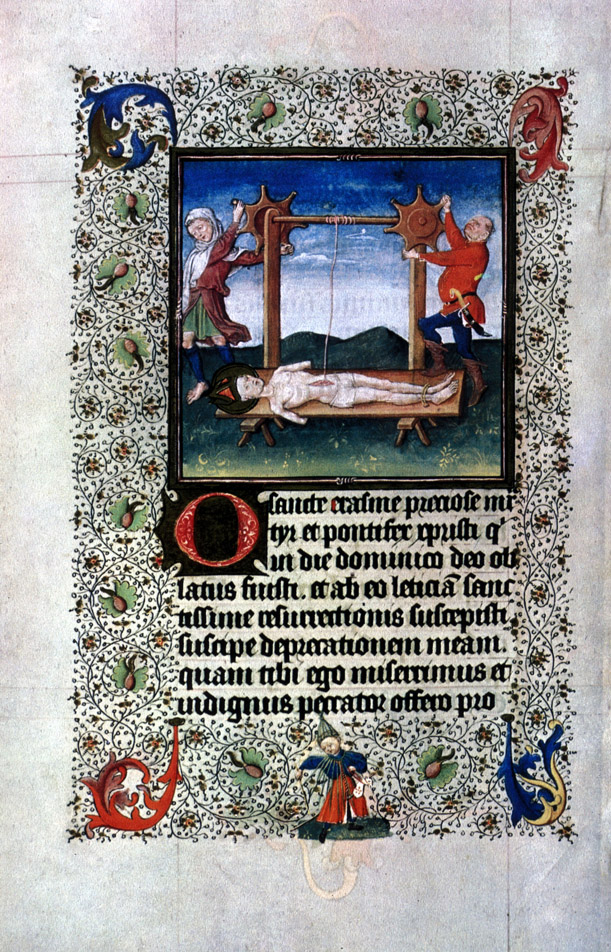
“Martyrdom of Saint Erasmus” (William H. Gass)

week11-0064

There were images that had nowhere to hang but in his head, images he remembered from books but of which he had no other copy; particularly one, from a strangely beautiful illuminated manuscript called The Hours of Catherine of Cleves, that depicted the martyrdom of Saint Erasmus. The presumptive saint lies on a raised plank, naked except for a loincloth. His abdomen has been opened and his intestines attached to a windlass erected above him. Thereupon, like a length of sausage or a length of rope, his innards are being wound by two figures, one male, one possibly female, each working hard to turn the spokes, their faces, however, averted from the scene. The saint does not appear to have wrists or hands. Eight turns have already been taken. The sky is empty except for a few clouds; the earth is empty except for two hills and some small yellow flowers. Around this painting, framed like a picture, is a delicate thin line made of curlicues and a field of tiny petals stalked by imaginary butterflies. At the bottom a small boy wearing a collar of thin sticks is riding a hobbyhorse.

His curiosity aroused by this calamitous vision, Skizzen sought more bio concerning Saint Erasmus. One source simply said that “although he existed, almost nothing is known about him.” This sentence stayed with Skizzen as stubbornly as the piteous illumination. What a blessed condition Erasmus must have enjoyed! Although he existed, almost nothing was known of him. Although nothing was known of him, as a saint, he existed. He existed, yet he had lived such a saintly life there was nothing of him to be known. Still another authority was not as sanguine. It claimed that the cult of Erasmus spread with such success that twelve hundred years later the martyr was invoked as one of the Fourteen Holy Helpers, whoever they were, and had become patron saint of sailors as well as kids who had colic. What was known, during those hundreds of years, was not known of the saint but of some figure he had thrown about himself as you would a ghostly garment or a costume for the dance. Proudly, Professor Skizzen pasted Erasmus in his memory book. A.d. 300. He was sprayed with tar and set alight. He was jailed, rescued by an angel, disemboweled. On a day in a.d. He died for me.

From William H. Gass’s novel  Middle C.

Rat Evolution — Alexis Rockman

Silence — Tantiana Deiry

631e6a6db45c6b3232f1561d55cb4258

Nostalgia — Luke Pearson

“All art constantly aspires towards the condition of music”