Portrait of Laura Battiferri — Bronzino

Grasshopper — Peter Doig

Immaterials, August Cross’s Contemporary Take on Goya’s Caprichos

20140216-114744.jpg

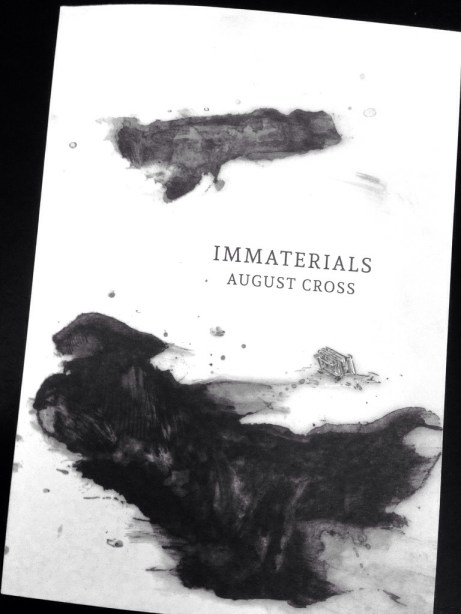
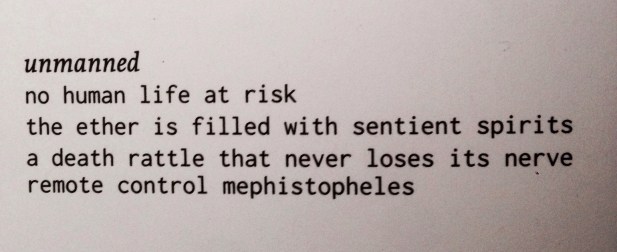
August Cross’s Immaterials—new from indie Inpatient Press—is a dark, strange hybrid of art and poetry. Cross offers 32 chapters here, each combining a stark, rough black and white and gray watercolor with a spare (not-quite) haiku. Cross takes his lead from Francisco Goya here—specifically Goya’s black and white aquatint series, Los Caprichos, and the later etching series The Disasters of War. Cross’s contemporary riff on Goya is apparent in the opener “unmanned,” where Goya’s witches turn into drones:
20140216-114755.jpg

The text accompanying the image introduces the biting, cruel irony that courses throughout Immaterials:
20140216-115320.jpg

While the phrase “unmanned” refers overtly to the drones themselves, it also reflects back on the attempt to completely depersonalize modern warfare—to unman, unperson both the remote pilot and the target, who becomes “no human life.” That spirit of irony and criticism, often oblique, informs all of Immaterials.

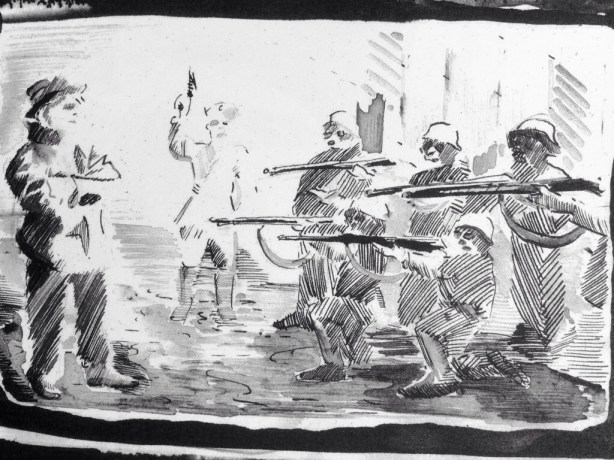
In “monolith,” Cross updates Goya’s The Third of May, 1808, ending the accompanying poem with the line: “a warning to whistleblowers”:
20140216-114810.jpg

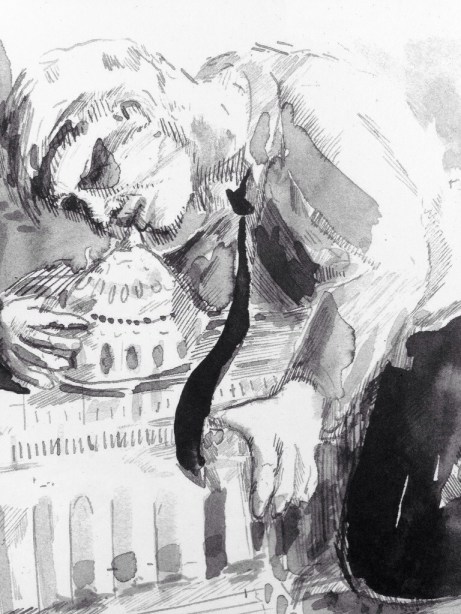
In “dat capitol,” Cross transmutes Goya’s Colossus into a bizarre, dark-eyed lover, a politician gripping the capitol sensually, violently, sucking from its teat. The tone is simultaneously playful and ominous (just like Goya’s work):
20140216-114827.jpg

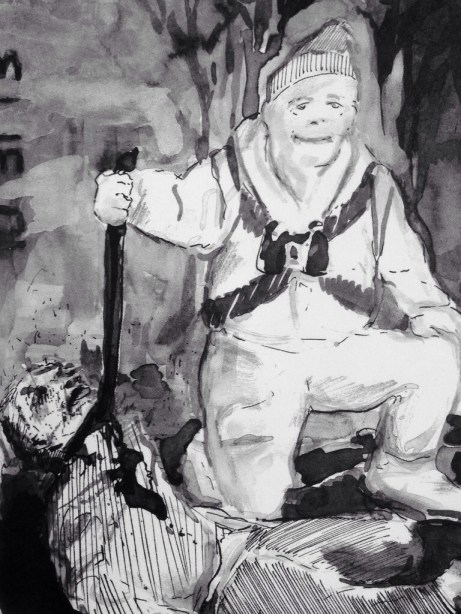
That same dark, violent humor is readily apparent in many of the pieces, like “selfie,” where a grinning cop  takes a selfie with his miserable captive, or “big game,” where “the tie is a leash / the boot is a lack / uniforms trick young men into shocked shells”:
20140216-114847.jpg

There’s a roughness, a rudeness to Cross’s work—a splattering of ink, a muddiness to the grays, a blurriness of line that causes the viewer to have to intensify his gaze in an attempt to resolve the picture (or perhaps look away). The poems too at first appear simple, rude, rough—Cross opts for the monosyllable, the German root. But again, an intensified gaze—a review, a reread—reveals the second and third meanings of each phrase, where the inelegant alliteration of “shocked shells” hides the vacant human subject—the shell, its immaterial essence choked out.

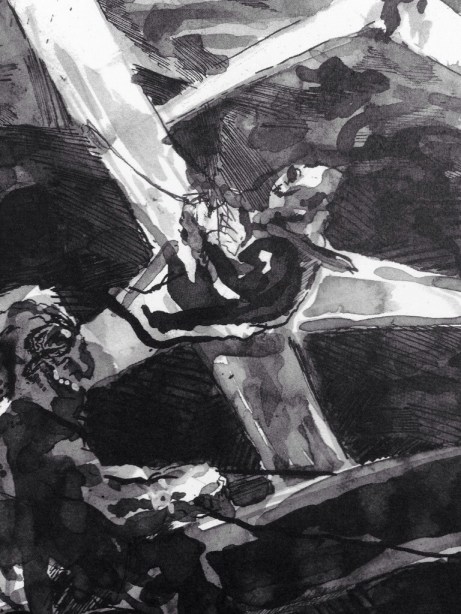
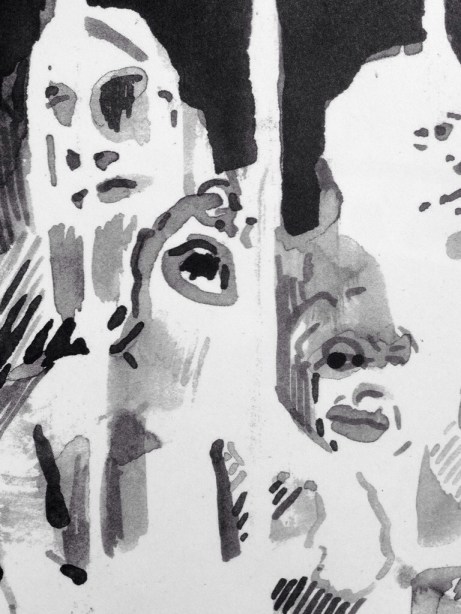
Immaterials presents a sharp if oblique critique of contemporary American society, perhaps summed up best in the two faces in the center of this detail from “gaol over-crowded:
20140216-114837.jpg

Might the howl of the center left figure turn into a laugh? A bark? Either way, it’s tempered by the grimace of the man center right, who focuses intently away from the gaze of the viewer, aiming sights on something the viewer cannot see, can never see.
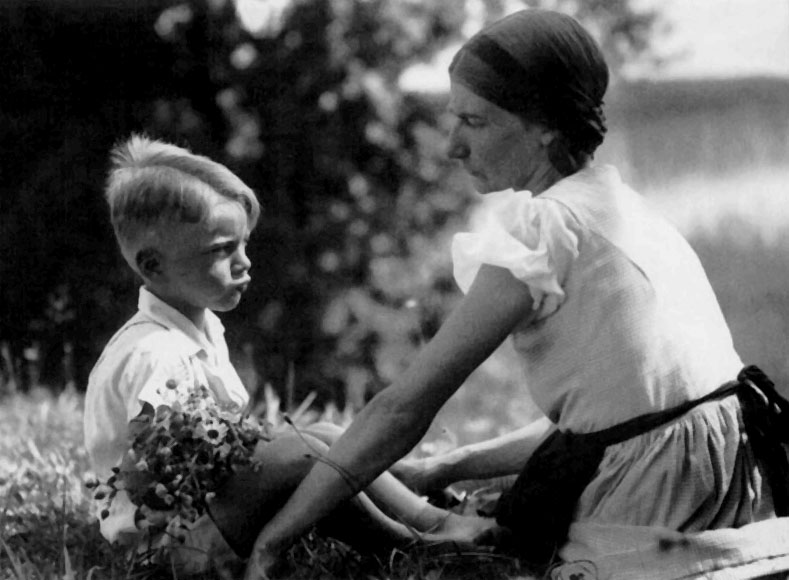
Sunday, Women Drying Their Hair — John French Sloan

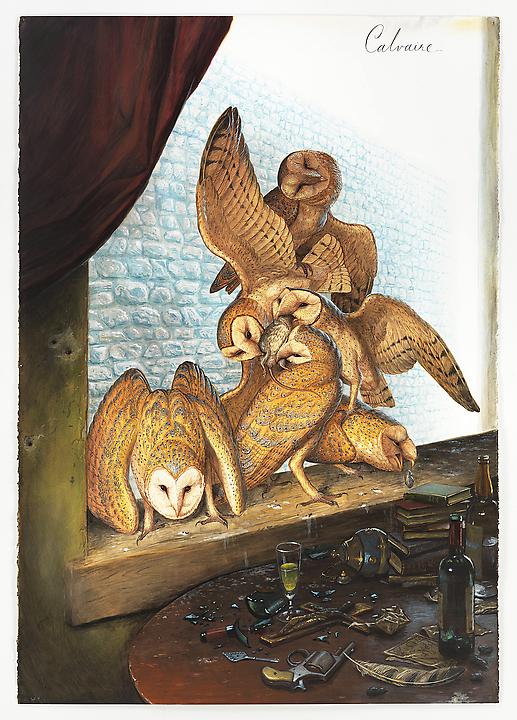
Calvaire — Walton Ford

Calvaire0

Gigantic Roverine — Henry Darger

Goodbye World (The Far Side)

thefarside

Some content on this page was disabled on May 26, 2021 as a result of a DMCA takedown notice from Gary Larson. You can learn more about the DMCA here:

https://wordpress.com/support/copyright-and-the-dmca/

Skeletons Trying to Warm Themselves — James Ensor

Portrait of Lucrezia Panciatichi — Bronzino

The Kiss — Felix Vallotton

Roses in a Glass — Camille Corot

The Love Letter — Auguste Toulmouche

The Glass of Wine — Johannes Vermeer

How to Get the Love You Deserve (Life in Hell)

Hell

Alphabet — Jules Lemaître

N O P Q R S T U V X Y Z

The Love Letter — Nicolae Vermont

“Actually I’m shocked by everything I’ve just written” (Correction, Thomas Bernhard).

Thomas Bernhard died today in 1989. He was buried on the 16th. Three people were present.

tumblr_lyadkzGNjj1qcl8ymo1_1280

I’m getting closer to Altensam, but I’m not getting closer to Altensam in order to solve its mystery; for others to explain it to myself is why I am getting closer to Altensam, to my Altensam, the one that I see. While she lived I never asked my mother, never asked her all these unanswered questions, never once asked her a single crucial question, because I never could formulate such a question, I was afraid I might put such a question wrong somehow, and so I never posed it, and so I got no answer. Now the Eferding woman is dead, I can’t ask her, she can’t answer. But would it be any different now, if I could ask her, and she could answer? We don’t ask those we love, just as we don’t ask those we hate, so Roithamer. Actually I’m shocked by everything I’ve just written, what if it was all quite different, I wonder, but I will not correct now what I’ve written, I’ll correct it all when the time for such correction has come and then I’ll correct the corrections and correct again the resulting corrections andsoforth, so Roithamer. We’re constantly correcting, and correcting ourselves, most rigorously, because we recognize at every moment that we did it all wrong (wrote it, thought it, made it all wrong), acted all wrong, how we acted all wrong, that everything to this point in time is a falsification, so we correct this falsification, and then we again correct the correction of this falsification and we correct the result of the correction of a correction andsoforth, so Roithamer. But the ultimate correction is one we keep delaying, the kind others have made without ado from one minute to the next, I think, so Roithamer, the kind they could make, by the time they no longer thought about it, because they were afraid even to think about it, but then they did correct themselves, like my cousin, like his father, my uncle, like all the others whom we knew, as we thought, whom we knew so thoroughly, yet we didn’t really know all these peoples’ characters, because their self-correction took us by surprise, otherwise we wouldn’t have been surprised by their ultimate existential correction, their suicide.