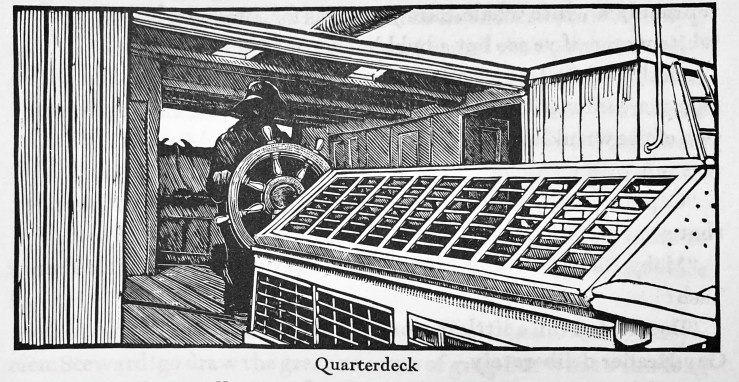
I. In this riff: Just one goddamn chapter, Ch. 36, “The Quarter-Deck.”
II. There’s too much in “The Quarter-Deck” — too many savory lines, too much foreshadowing, too much language language language — and by too much I mean Too much for me to parse here.
III. (I never intended for these riffs to provide insight into Moby-Dick, but I also was hoping that they wouldn’t just be a collection of greatest hits. Most of “The Quarter-Deck” is greatest hits material.)
IV. “The Quarter-Deck” begins in Melville’s Shakespearean mode:
“(Enter Ahab: Then, all.)”
Ahab takes the quarter-deck, the stage, the novel—his voice overwhelms.
V. The plot of this chapter is fairly simple: Ahab reveals to his crew that the true mission of The Pequod is not to hunt whales and harvest their oil, but rather to exact revenge on the great white whale Moby Dick, who took Ahab’s leg.
VI. Starbuck, first mate and second conscience (to Ishmael’s Captain Conscience—or maybe I mean Captain Consciousness)—Starbuck, the first mate of The Pequod is horrified:
“Vengeance on a dumb brute!” cried Starbuck, “that simply smote thee from blindest instinct! Madness! To be enraged with a dumb thing, Captain Ahab, seems blasphemous.”
VII. Ahab replies with some of the book’s greatest lines:
Hark ye yet again—the little lower layer. All visible objects, man, are but as pasteboard masks. But in each event—in the living act, the undoubted deed—there, some unknown but still reasoning thing puts forth the mouldings of its features from behind the unreasoning mask. If man will strike, strike through the mask!
Our half-mad captain wants pure contact with the ineffable, even if it means death.
He continues, delivering another classic zinger:
That inscrutable thing is chiefly what I hate; and be the white whale agent, or be the white whale principal, I will wreak that hate upon him. Talk not to me of blasphemy, man; I’d strike the sun if it insulted me.
And:
Who’s over me? Truth hath no confines.
VIII. Ahab worries that Starbuck’s conscience might override the crew. He calls for “the measure” of spirits to be poured, and passes a pewter chalice of alcohol around several times, having the steward refill it. He then supplies his own rhetorical intoxication, a performance that drives the crew into a frenzy that finds its dizzying fruition in Ch. 40, “Midnight, Forecastle.”
Ahab calls his three mates to him and they quail “before his strong, sustained, and mystic aspect.” He calls then his three harpooneers (twinning triplets) whom he commands to “draw the poles” — their lances, their phallic harpoons. He fills the “goblet end” of the harpoons with “the fiery waters from the pewter,” and has toasts the end of his Great Enemy—
Now, three to three, ye stand. Commend the murderous chalices! Bestow them, ye who are now made parties to this indissoluble league. Ha! Starbuck! but the deed is done! Yon ratifying sun now waits to sit upon it. Drink, ye harpooneers! drink and swear, ye men that man the deathful whaleboat’s bow—Death to Moby Dick! God hunt us all, if we do not hunt Moby Dick to his death!
II. (Re: Above—I just finished Ch. 36 of Moby-Dick, “The Quarter-Deck,” which is like, too good. Too loaded. Ahab erupts. Up until now I’d just been riffing on what I’d read, trying to keep it simple, but “The Quarter-Deck” needs its own riff.)
III. Ch. 33, “The Specksnyder.”
Specksnyder is a strange word. Ishmael tells us that, “Literally this word means Fat-Cutter; usage, however, in time made it equivalent to Chief Harpooneer.” Its provenance is anglicized Dutch—another splicing in a novel of splices.
IV. Ch. 33 follows a pattern (initiates a pattern?) common to Moby-Dick: Ishmael begins his chapter with some facts and descriptions specific to whaling (in this case, the business of the Specksnyder), only to zoom out (or is it zoom in?) to larger philosophical matters.
V. In this case, those larger philosophical matters concern the psychological temperament of those who would assume the mantle of leadership. Ishmael notes that moody Ahab eschews the “shallowest assumption” of “elated grandeur.” Our captain is no faker, fraud, humbug, or poseur — “the only homage he ever exacted, was implicit, instantaneous obedience.”
VI. But Ishmael, ever the hedger of bets, ever the ghost who trades in double negatives, warns us that despite his leadership qualities, “even Captain Ahab was by no means unobservant of the paramount forms and usages of the sea…that behind those forms and usages, as it were, he sometimes masked himself; incidentally making use of them for other and more private ends than they were legitimately intended to subserve.” Foreshadowing!
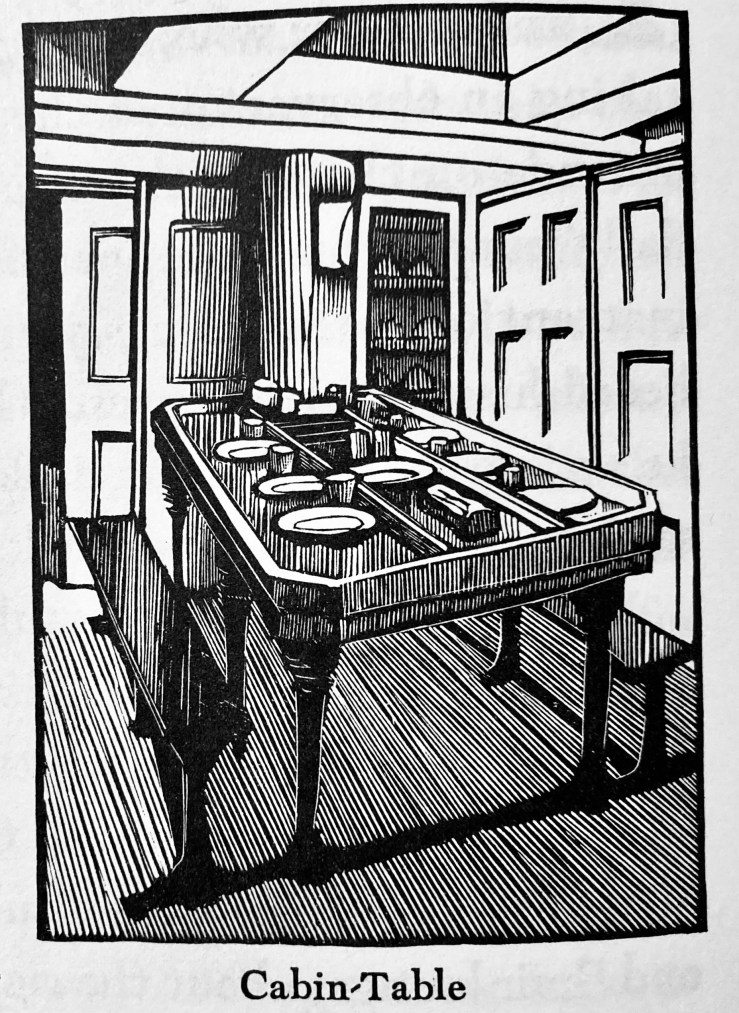
VII. Ch. 34, “The Cabin-Table.”
Another chapter that begins with ship’s business but expands toward grander abstractions. Those abstractions help to shade and characterize Ahab, who has yet to give his first grand speech (that’s in Ch. 36, “The Quarter-Deck”). The ship’s business also points again to obeisance and command. We learn who descends to eat first, a kind of alpha dog Darwinism reconfigured as sea law. Ahab and his three mates go to table in silence. Starbuck is next to go to dinner after his captain. Flask is last: “hilarious little Flask enters King Ahab’s presence, in the character of Abjectus, or the Slave.” Then the three harpooneers eat, noisy, ravenous.
The two most interesting things about this chapter for me on this reread:
a. It is composed in the present tense, beginning: “It is noon.” While Ishmael has shifted into the present tense many times before, unless I am mistaken, this particular whole-chapter shift is a first. And—
b. We have another moment in the narrative where Ishmael witnesses behaviors, viewpoints, events that he should not be able to see.In other words, Ishmael, a lowly seaman has no business at the cabin table.
“The Cabin-Table” is another early moment in M-D that calls into question Ishmael’s witnessing—is he a ghost survivor, a kind of time traveler of consciousnesses? A spy or voyeur, peeking through holes? Or is it just a book, and this is how books work?
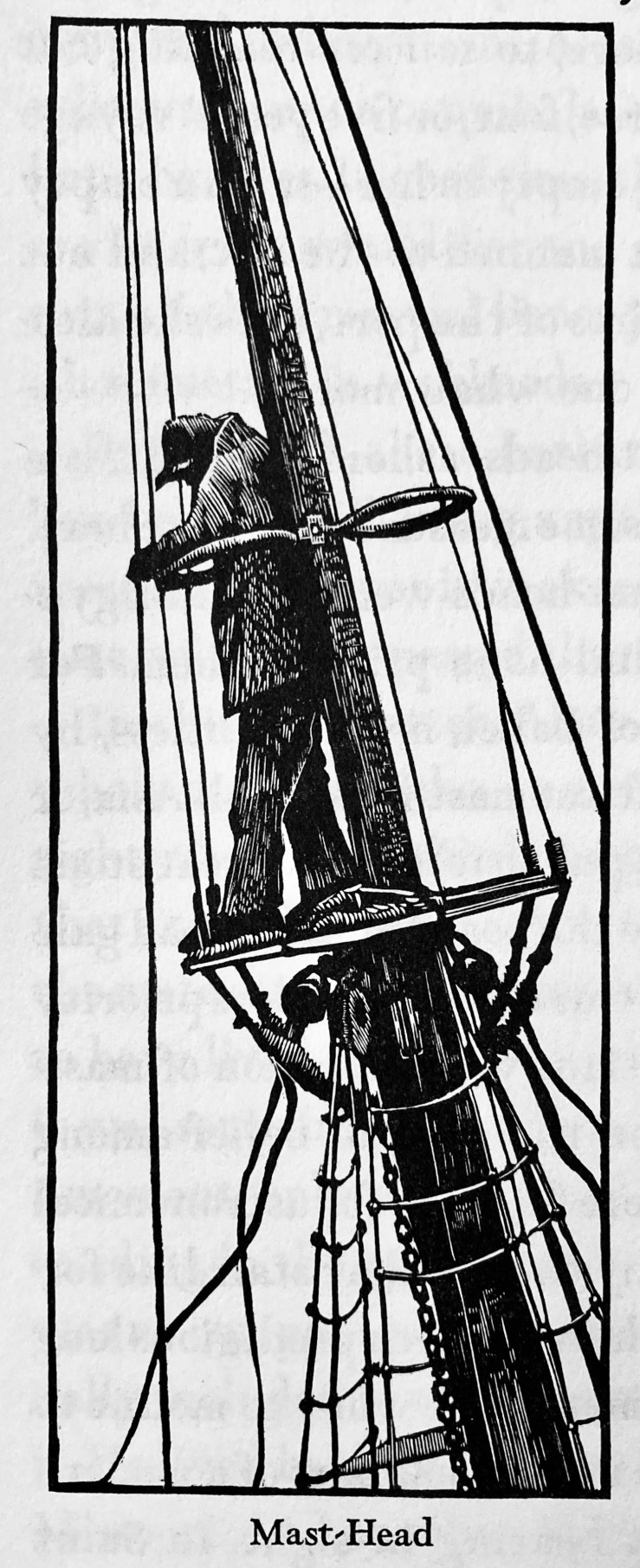
IX. Again we have a chapter that starts with some description and history of whaling and ship business. Ishmael waxes at length about assuming watch at the top of the mast-head, making sure to bring up ancient Egypt (always!), the Tower of Babel, Louis Bonaparte, Childe Harold, George Washington (et al.).
X. But again, Ish moves from particulars to abstraction. “The Mast-Head” reads as both an endorsement of and a warning against romantic transcendentalism. (This is a tale of ambiguities, hedging, and double double double negatives.)
XI. Ish relates the reveries to be had atop the mast-head. A watcher on the watery world will quickly lose a sense of self. His ego will fold into something grander, yet grander without clear object. In short, transcendentally-overwhelmed by horizonless horizons, he will forget to sight the whales he hunts.
In such cases, a watcher might be remonstrated:
‘Why, thou monkey,’ said a harpooneer to one of these lads, ‘we’ve been cruising now hard upon three years, and thou hast not raised a whale yet. Whales are scarce as hen’s teeth whenever thou art up here.’
But we sense that Ishmael was the dreaming lad
Perhaps they were; or perhaps there might have been shoals of them in the far horizon; but lulled into such an opium-like listlessness of vacant, unconscious reverie is this absent-minded youth by the blending cadence of waves with thoughts, that at last he loses his identity; takes the mystic ocean at his feet for the visible image of that deep, blue, bottomless soul, pervading mankind and nature; and every strange, half-seen, gliding, beautiful thing that eludes him; every dimly-discovered, uprising fin of some undiscernible form, seems to him the embodiment of those elusive thoughts that only people the soul by continually flitting through it. In this enchanted mood, thy spirit ebbs away to whence it came; becomes diffused through time and space; like Wickliff’s sprinkled Pantheistic ashes, forming at last a part of every shore the round globe over.
What a sentence! I thought about getting in there for a minute, but hell…what a sentence.
XII. (The word “vacant” above points towards Moby-Dick’s devastating “Epilogue,” where survivor (?) Ishmael assumes the “vacant post” of bowsman.)
XIII. But back to the marvelous conclusion of Ch. 35. Ishmael describes a moment of transcendence, of ego-loss, even ego-death. And then what happens:
There is no life in thee, now, except that rocking life imparted by a gently rolling ship; by her, borrowed from the sea; by the sea, from the inscrutable tides of God. But while this sleep, this dream is on ye, move your foot or hand an inch; slip your hold at all; and your identity comes back in horror. Over Descartian vortices you hover. And perhaps, at mid-day, in the fairest weather, with one half-throttled shriek you drop through that transparent air into the summer sea, no more to rise for ever. Heed it well, ye Pantheists!
II. I just finished Ch. 32, “Cetology,” which ends with this marvelous sentiment:
God keep me from ever completing anything. This whole book is but a draught—nay, but the draught of a draught.
III. (Ishmael makes good here on one a sentiment he expresses at the chapter’s outset: “any human thing supposed to be complete, must for that very reason infallibly be fault.”)
IV. The notion of a “draught of a draught” again points to Moby-Dick’s emerging metatextuality, a conceit Ishmael (and, of course, Melville) initiates in Chs. 23 and 24.
V. “Cetology” is Ish’s attempt to “grope down into the bottom of the sea after them; to have one’s hands among the unspeakable foundations, ribs, and very pelvis of the world; this is a fearful thing” While the likely antecedent of the pronoun “them” in the above sentence is whales, one has to search the paragraph above to find it. I think Melville here opens his metaphor. To go a’whaling is to plumb depths.
VI. (“Cetology” is likely one of the chapters that turn a lot of readers off. It appears to be mostly whale facts, although it is not. It is Ishmael riffing on what he has seen of whales, porpoises, dolphins—which is really Melville riffing on what he has seen of these creatures.)
VII. (Parenthetically: Ishmael takes “the good old fashioned ground that the whale is a fish, and call[s] upon holy Jonah to back me.”)
VIII. But back to metatextuality—in “Cetology,’ Ish organizes his descriptions of whales in bookish terms:
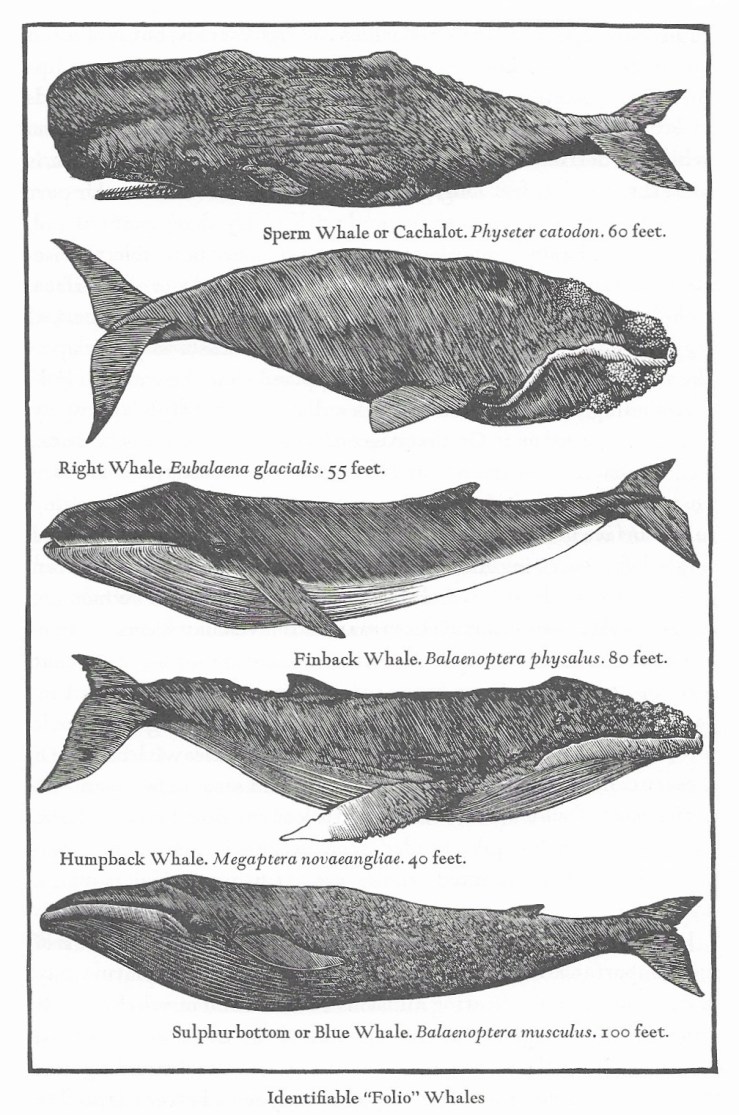
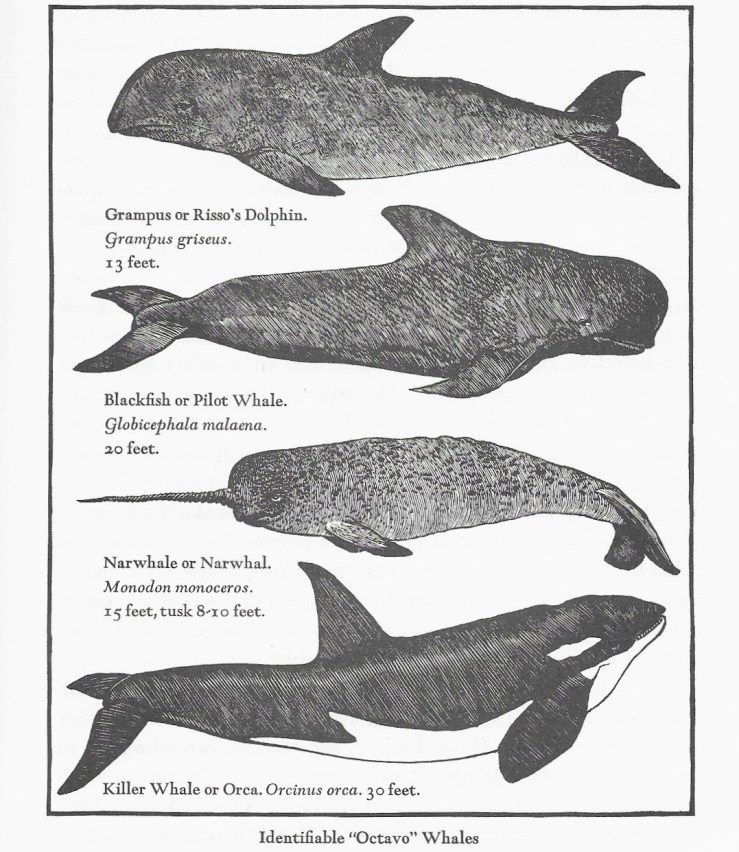
I divide the whales into three primary BOOKS (subdivisible into CHAPTERS), and these shall comprehend them all, both small and large.
I. THE FOLIO WHALE; II. the OCTAVO WHALE; III. the DUODECIMO WHALE.
Ishmael seeks to read the natural world, but also to name and comprehend it in his own terms. He’s radically open to to encountering the deepest divers, but he’s beholden to romantically translating them into a literature of his own making.
IX. Ch. 28, “Ahab.”
Ahab, who has hitherto haunted Ishmael’s consciousness, finally appears. Rather than attempting to summarize, I’ll simply cite:
He looked like a man cut away from the stake, when the fire has overrunningly wasted all the limbs without consuming them, or taking away one particle from their compacted aged robustness. His whole high, broad form, seemed made of solid bronze, and shaped in an unalterable mould, like Cellini’s cast Perseus. Threading its way out from among his grey hairs, and continuing right down one side of his tawny scorched face and neck, till it disappeared in his clothing, you saw a slender rod-like mark, lividly whitish. It resembled that perpendicular seam sometimes made in the straight, lofty trunk of a great tree, when the upper lightning tearingly darts down it, and without wrenching a single twig, peels and grooves out the bark from top to bottom, ere running off into the soil, leaving the tree still greenly alive, but branded. Whether that mark was born with him, or whether it was the scar left by some desperate wound, no one could certainly say.
Ahab’s physical manifestation points toward the ambiguity at the heart of Moby-Dick: Is he hero or villain; is he marked by divine intervention or scarred by his own chosen battles?
X. (Either way, our boy Ishmael is smitten.)
XI. “Ahab” is, despite its reveal of a major character, a transitional chapter. The Pequod moves from the cold waters off New England into more tropical climes and “the warbling persuasiveness of the pleasant, holiday weather.”
How is dour Ahab affected?
More than once did he put forth the faint blossom of a look, which, in any other man, would have soon flowered out in a smile.
XII. (The would have there is everything. This is a novel of hints, double negatives, ambiguities.)
XIII. Ch. 29, “Enter Ahab; to Him, Stubb.”
Ch. 29 initiates Melville’s Shakespearean mode; Moby-Dick seems to turn into a stage drama, players staged in Ishmael’s consciousness. We learn of Ahab’s foul moods, and his tendency to clunk around with his ivory pegleg late at night above decks while his hardworking crew sleep below:
Old age is always wakeful; as if, the longer linked with life, the less man has to do with aught that looks like death. Among sea-commanders, the old greybeards will oftenest leave their berths to visit the night-cloaked deck.
Stubb makes the mistake of confronting Ahab and suggesting he apply “a globe of tow…to the ivory heel” to mute its cacophony. But Ahab will not be silenced. He rebukes Stubb in violent language: “…be called ten times a donkey, and a mule, and an ass, and begone, or I’ll clear the world of thee!”
XIV. The long final paragraph of Ch. 29, although set off in quotation marks, nevertheless reads like Stubb’s internal monologue. Other voices have taken over the narrative before now, most notably Father Mapple in Ch. 4—but Stubb’s aside marks a rhetorical move whereby Ish somehow witnesses voices that seem impossible to access—private thoughts, whispered asides.
XV. Ishmael’s ghostly powers present again in Ch. 30, “The Pipe.” He focuses in on Ahab enthroned:
In old Norse times, the thrones of the sea-loving Danish kings were fabricated, saith tradition, of the tusks of the narwhale. How could one look at Ahab then, seated on that tripod of bones, without bethinking him of the royalty it symbolized? For a Khan of the plank, and a king of the sea, and a great lord of Leviathans was Ahab.
Ishmael then somehow dips into Ahab’s soliloquy. Pipe smoke no longer soothes the tortured captain. He tosses his still-lit pipe into the ocean, a symbol of…something?
XVI. In Ch. 31, “Queen Mab,” Ishmael again breeches an impossible private space. This time it’s a conversation between Stubb and Flask. Conversation isn’t the right term, really — “Queen Mab” is essentially Stubb’s complaint about being slighted by Ahab, delivered in a monologue to Flask. He relates a dream, all about being kicked by the captain. The kick recalls a remembered moment earlier in the novel when Peter Coffin, proprietor of the Spouter-Inn, relates unwittingly kicking his young child Sam from the bed while the family sleeps together. The symbolic orphaning-expulsion repeats in Ch. 22, “Merry Christmas,” when Captain Peleg kicks Ishmael in the ass.
XVII. I started with Ch. 32, “Cetology.” Here are Barry Moser’s illustrations:
II. I’ve read chunks and excerpts of it over the intermittent seven years though—there’s always some bit in it that calls to me, prompted by events personal, political, cultural. I read Melville’s 1846 novel Typee during the beginning of 2020’s quarantine, and knew I’d need to reread M-D in full sooner than later.
III. (Why later, why now? I guess I made this kinda sorta tacit promise to myself not to reread in 2020—to expand my palate, to go past all the Dead White Guys.)
IV. I started Moby-Dick this afternoon. I read the two opening salvos, “Etymology” and “Extracts,” and then the first chapter, “Loomings.”
V. (I have read that some folks skip the “Extracts”: No.)
VI. I started Moby-Dick in an edition that I bought years ago but haven’t actually read: the California UP/Arion Press edition with Barry Moser illustrations. It’s lovely—grand, generous, rich on the page.
VII. So I’ve probably read “Etymology” more than any other section of M-D. It was certainly the section I messed around with for years before reading the actual novel in full. The etymology has supposedly been given to the author of M-D — HM? Ishmael? Some other ghost — by a “pale Usher” (not Poe’s), “threadbare in coat, heart, body, and brain…” The poor fellow “loved to dust his old grammars; it somehow mildly reminded him of his mortality.”
VIII. I don’t dwell on the pale Usher, but I’ve long found the next line of “Etymology” fascinating. It’s a quote attributed to the sixteenth-century English author Richard Hakluyt:
While you take in hand to school others, and to teach them by what name a whale-fish is to be called in our tongue, leaving out, through ignorance, the letter H, which almost alone maketh up the signification of the word, you deliver that which is not true.
A former teacher of mine, A. Samuel Kimball (who I am forever indebted to for teaching me to read again) made much of this citation. For Kimball, the foregrounding of the “H” calls attention to one of Melville’s central themes: whaling as wailing—Moby-Dick as a wail, a grief, maybe a resistance to the infanticidal, genocidal scope of American culture. Ishmael, an orphan, goes to sea to resist his suicide-impulse on a ship named after a near-extinct tribe of American Indians. Ishmael, whose very name is marks him, at least in the KJV context Melville was working within, as the rejected son of the patriarch Abraham. In the novel’s last moments, Ishmael is saved (is he though?) by the ship the Rachel, which, “in her retracing search after her missing children, only found another orphan.”
IX. (Whale-wail / whiteness-witness. Etc. etc.)
X. And those “Extracts,” supplied by a “burrower and grub-worm of a poor devil of a Sub-Sub” — who’s the dom?
XI. I remembered the “Extracts” more fondly than I experienced them.
I just really wanted to get into Ishmael’s head (voice). (And then get out of it, into the drama of Ahab and His Whale.)
XII. And so I got into Ishmael’s head (voice).
XIII. “Loomings” is such a great, great, perfect chapter, and the joy in re-reading Melville is having already worked out most of the plot kinks. Instead of dwelling on What is happening? you can experience What is.
XIV. (I always forget how terribly sad poor Ish is at the outset of M-D. He’s depressed, suffering from hypos, the spleen. He’s not just suicidal, he’s homicidal, wanting to step in the street and knock people’s hats off.)
XV. One of the fascinating things about Moby-Dick, at least in my memory of it, which maybe I’ll expand upon in riffs on this reread, is how little we get to know Ishmael. Like his wanderer namesake, he’s an outsider who, despite taking us in to his tale, nevertheless keeps us out: We know very little about his past or his future, and his present (by which I mean Moby-Dick) is mediated in voyeurism, questioning, and philosophy.
XVI. And “Loomings” — well, what a great title, maybe obvious, but great — the indistinct coming into view, but also the mount of the warp, the initial move in a great tapestry: Moby-Dick.
XVII. I’ll close on the closing line of “Loomings,” which point to the great wonder-world to come, and the grand hooded phantom at the end of Ishmael’s journey:
By reason of these things, then, the whaling voyage was welcome; the great flood-gates of the wonder-world swung open, and in the wild conceits that swayed me to my purpose, two and two there floated into my inmost soul, endless processions of the whale, and, mid most of them all, one grand hooded phantom, like a snow hill in the air.








 Biblioklept