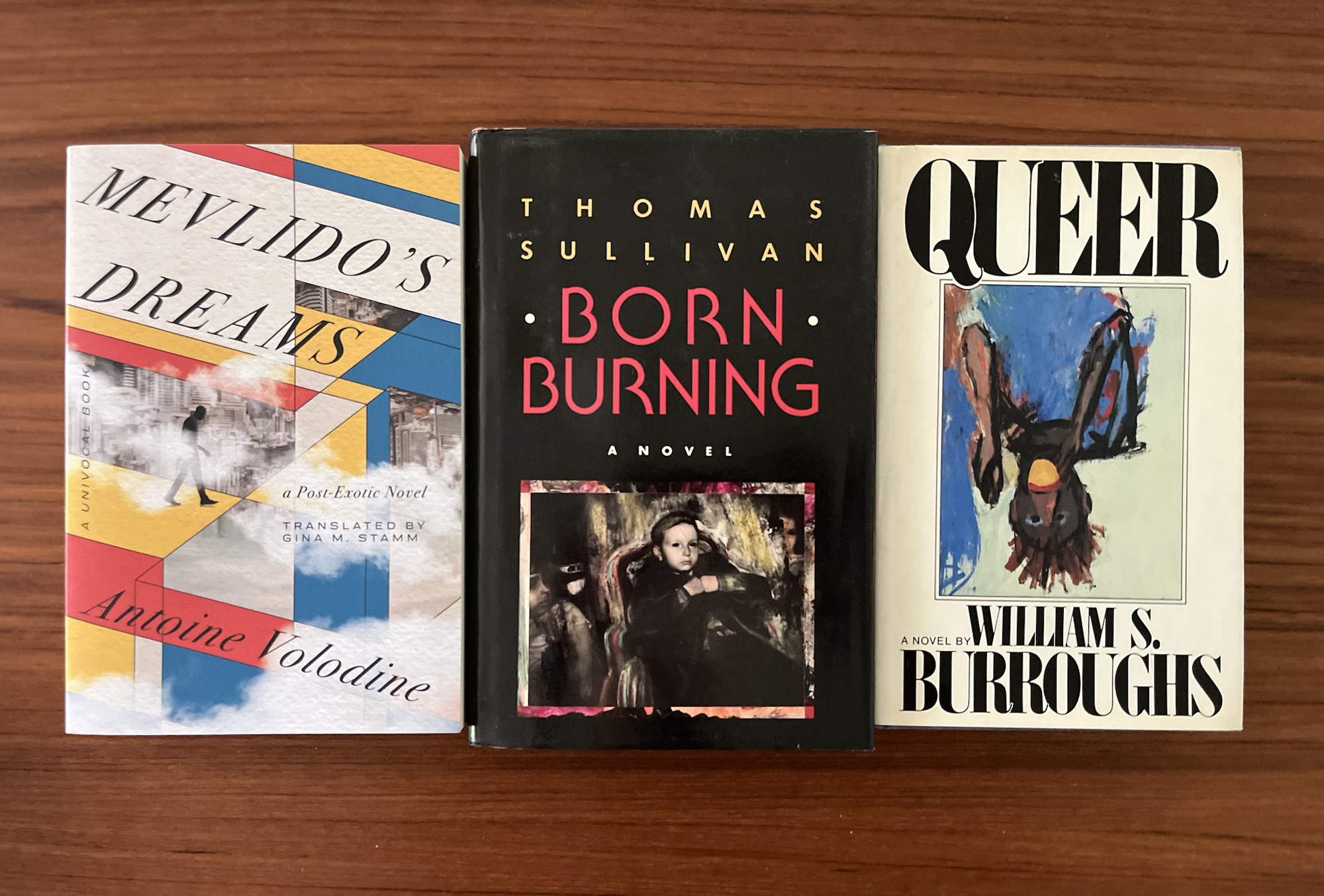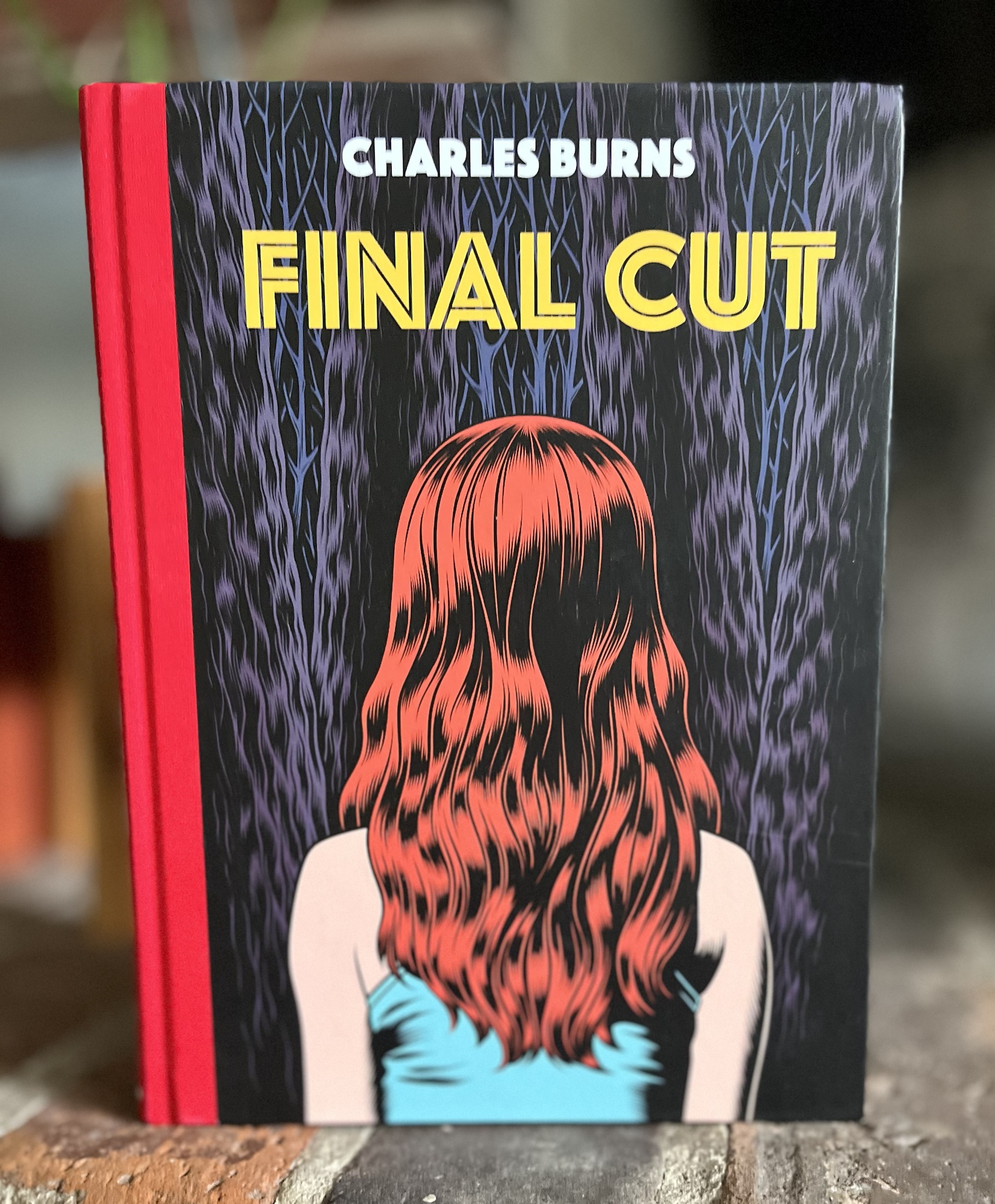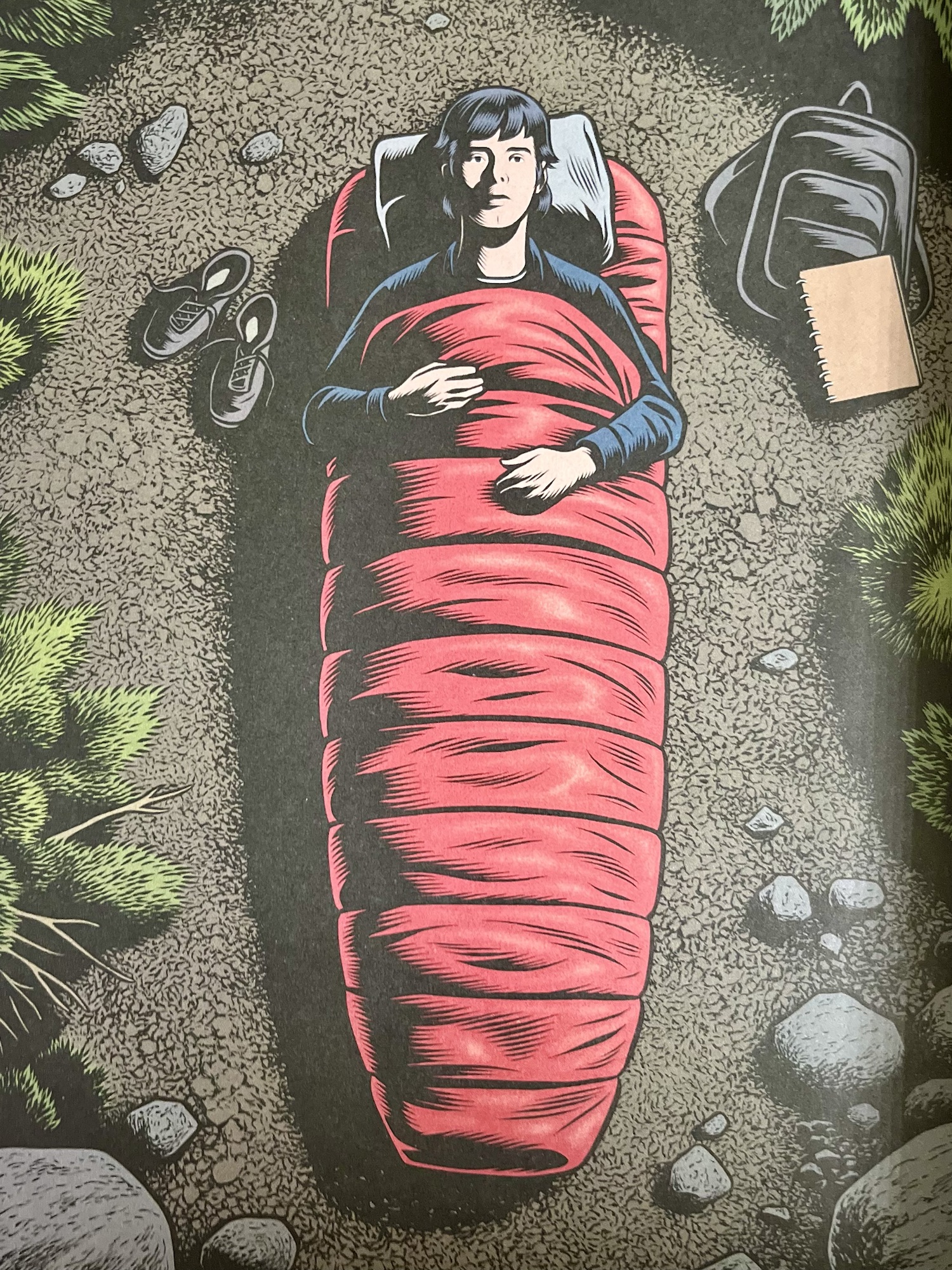
Ariane Koch’s Overstaying (Book acquired, 13 June 2024)

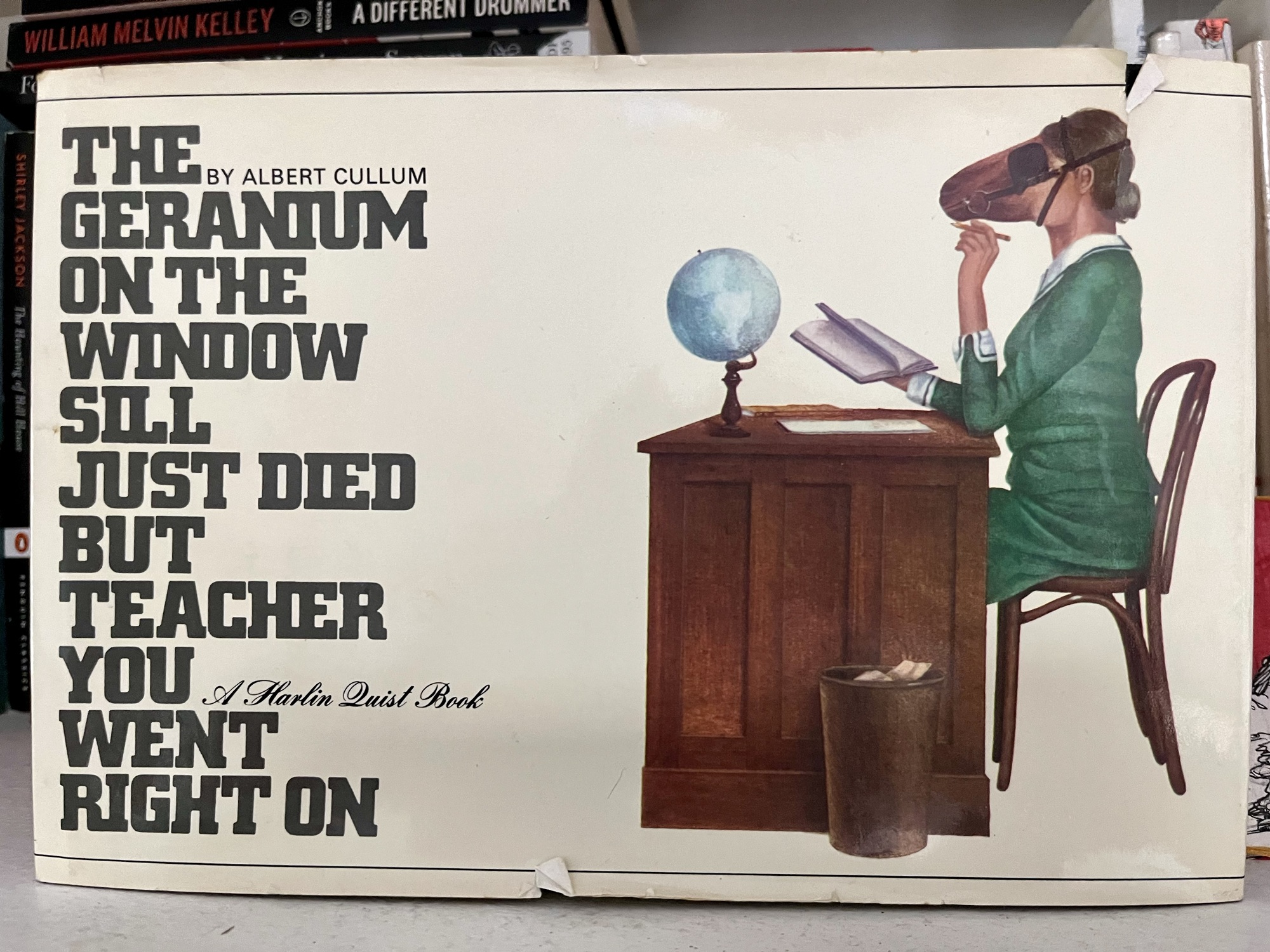
Ariane Koch’s Overstaying is forthcoming this fall from Dorothy, in translation by Damion Searls. Dorothy’s blurb:

Winner of the aspekte Prize, the most prestigious German prize for debut fiction, Swiss playwright and visual artist Ariane Koch’s Overstaying is an absurdist tour de force.

“I don’t see my writing as chronological or classically narrative, but as spatial—a kind of architecture. I keep adding rooms, and readers can take different paths through the rooms,” writes Ariane Koch of Overstaying, her anarchically comic debut. Koch’s narrator is an impudent young woman, a contemporary Bartleby living alone in her parents’ old house in the small hometown she hates but can’t bring herself to leave. When a visitor turns up, promisingly new, she takes him in, and instantly her life revolves around him. Yet it is hard to tell what, exactly, this visitor is. A mooch, a lover, an absence, a presence—possibly a pet? Mostly, he is a set of contradictions, an occasion for Koch’s wild imagination to take readers in brilliant and unexpected directions.

Jean-Baptise Del Amo’s The Son of Man (Book acquired, 8 June 2024)

The day after my birthday, I got the review copy I’d requested of Jean-Baptiste Del Amo’s novel The Son of Man. It was a nice late gift, hungover as I was from a surprise party for my sister-in-law’s 40th, a surprise party which usurped a rare Friday birthday of my own (meet me in 2030 on a Friday (or don’t)). I loved Frank Wynne’s translation of Del Amo’s previous novel, Animalia, suggesting in a 2020 reading round up that the novel “is a visceral, naturalistic, and very precise rendering of humans as animals. . . . Animalia made me physically ill at times. It’s an excellent novel.”

I read the first forty pages of The Son of Man this afternoon; the opening fifteen pages in particular foreground the humans-as-animals dynamic that Animalia worked through. These pages seem like an overture for the novel. They focus on a prehistoric troop of hunter-gatherers, like, hunting and gathering. It’s marvelous. The novel then pivots, I dunno, a couple of thousand years or so to a contemporary scene. We’re somewhere in France; a man and a woman and a boy leave a city in a car and go into the mountains, eventually pressing towards a ruined estate. A dread starts to thicken. The anxiety congeals more from the gaps in the standard cerebral cause-and-effect that we might expect from a novel which isn’t so much replaced as supplanted by precise, lucid detailing of the physical world. Consider this description of the mother:

She lights a cigarette, exhales a first plume of smoke — she holds the filter between the distal phalanges of her index and middle fingers, close to the nails — walks down the central reservation of yellowed grass, then retraces her steps. She brings the cigarette to her lips, darting brief glances that linger on the shadows nesting in the branches of trees and in privet hedges.

Del Amo’s prose, via Wynne’s limpid translation, works like a camera. More thoughts to come. Publisher’s blurb here if you like.

Biblioklept Does Atlanta (Books acquired, some time last week)

Last week, the wife and I drove five hours north to Atlanta, Georgia where we stayed five days in the Cabbagetown neighborhood. Our ostensible purpose was an anniversary trip focused around a Slowdive concert last Friday, but I think we really went to just hang out and eat and drink away from our kids for a few nights. It was famous times.

The Slowdive concert itself was excellent, despite the best efforts of the awful opening band, a dubious and I must assume ironic project called Drab Majesty, and the sound system at the The Eastern. The venue seemed ill-equipped to handle the tonality of either band. I don’t want to sound like a very old man but it was Too Fucking Loud. Opener Drab Majesty, whose sound came from a single guitar, a single synth, and, I’m guessing, a few loop pedals, seemed to have plugged directly into the PA system. It was the absolute worst sound I’ve ever heard. (Earlier that day, driving in awful Atlanta traffic, we listened to a seventeen-minute Merzbow song on the alternate band of Georgia Tech’s WREK radio station; although Merzbow is “noise” music, that song had more musicality, tonality, and depth of rhythm than Drab Majesty.)

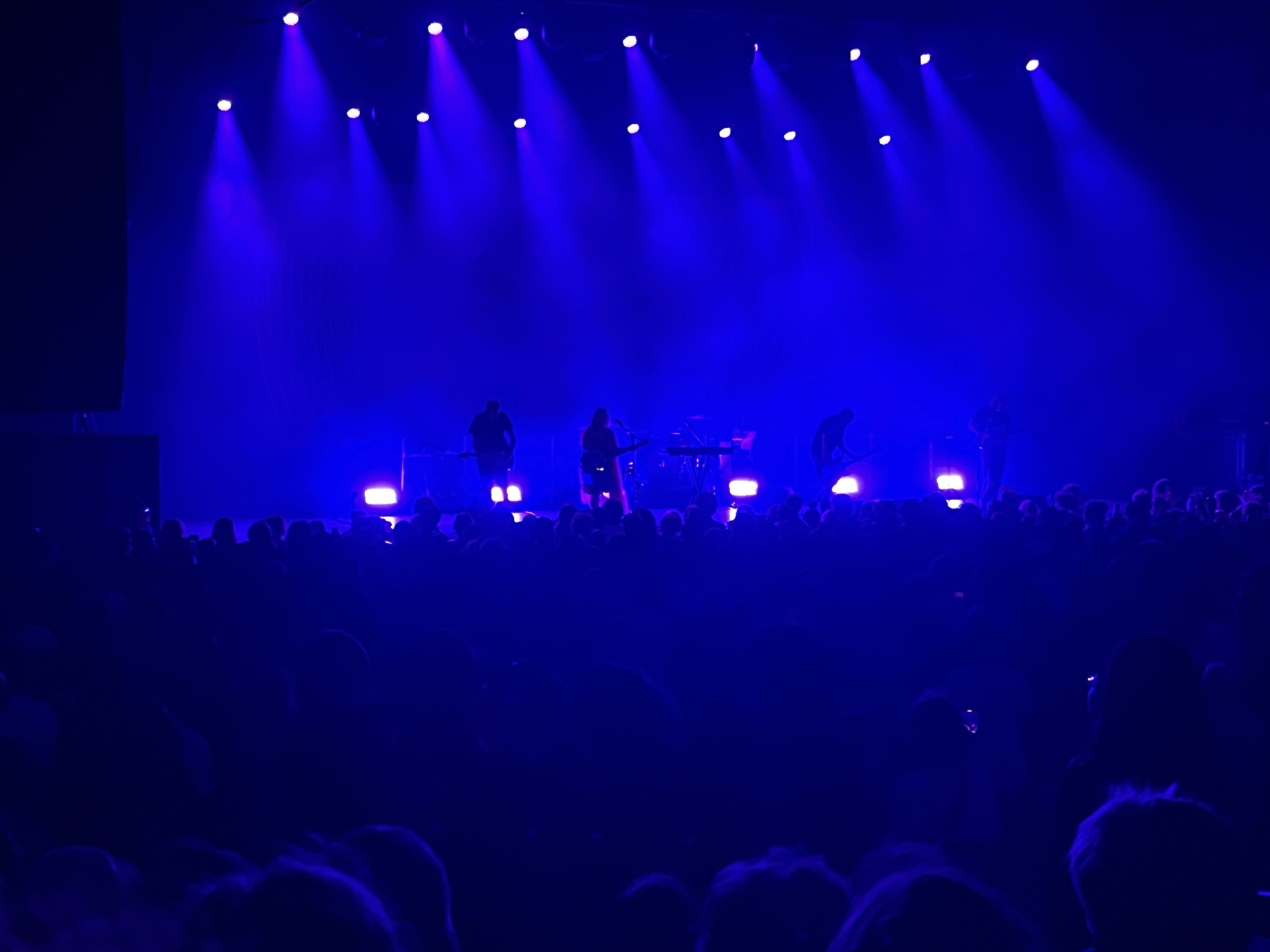
Slowdive was excellent live–much more of a rock sound than I’d expected; I’ve really enjoyed their two newer records, particularly the self-titled one from a few years back, but the songs from Souvlaki sounded particularly fierce live. The setlist was great, and they closed with a cover of Syd Barrett’s “Golden Hair” that might have gone on for 10 or 12 minutes; it was hypnotic. Here is the single picture I took during the show:

But books—

Without children about and with my wife having to work half days from the rented garage apartment, I had enough time to indulge going to pretty much any bookstore I wanted to in Atlanta. I ended up sticking mostly to East Atlanta where we were staying though.

I had been to A Capella Books a few years ago and had somehow entirely missed their used book annex, which had some really great stuff in it, including a first edition of Blood Meridian and Joseph McElroy’s Women and Men. I ended up chatting with the owner Frank for a bit; a very nice guy, he showed me his personal collection of Vintage Contemporaries and we talked in general about our shared sickness of book collecting. I left with Mauro Javier Cárdenas’s new novel American Abductions and a first-edition hardback of McCarthy’s Cities of the Plain. This second purchase seems to have initiated the trip’s theme of buying editions of books I already own—but now I have all three Knopf editions of The Border Trilogy, so everyone can sleep easier.

I stopped by Criminal Records in Little Five Points and didn’t pick anything up, although I’m happy to see that CDs have made such a comeback. (I almost certainly would have bought the new Gastr del Sol box set if it was out yet.) I then made my way to Bibliotech Books in Candler Park. The proprietor assured me that he was in the process of reorganizing, but the store was frankly a mess. One bookcase was organized by the color of the book’s spines. The inventory seemed to be someone’s childhood and adolescent books.

I headed to Virginia Highland Books, a perfectly-respectable book shop in the perfectly-respectable Virginia Highland neighborhood. The perfectly-respectable inventory was not particularly interesting, although I imagine it perfectly suits the perfectly-respectable clientele. On the way to Virginia Highland Books, at a red light, I found myself stopped next to something called Videodrome, so of course I pulled in. I got dizzy in Videodrome a DVD-rental shop stuffed with thousands and thousands of cult films, non-English language films, art films, concert films…amazing stuff. The only thing I could compare it to were some of the rental shops I’d gone to decades ago when I lived in Tokyo. I mean, this place had the Cannibal Ferox soundtrack on vinyl. I spoke to the proprietor for a while. He gave me a sticker. I saw him at the Slowdive show the next night but left him alone.

My last bookshop visit that day was to Bookish, a small indie spot specializing in books by women. I liked the store but was honestly too tired to look around much after two tallboys at a PBR-themed bar in Virginia Highland.

Over the next few days, I visited three more bookshops, all more or less by chance. We went to Decatur, simply to check it out, and parked in Decatur Square right in front of Little Shop of Stories. Framed original artwork by visiting authors adorns the walls of this children’s bookshop, and there’s a life-sized reproduction of the room from Margaret Wise Brown’s classic Good Night Moon that one can hang out in. I felt a little melancholy that our children have outgrown children’s books.

On the way back to Atlanta, we swung by Eagle Eye Books, a Decatur spot specializing in used books (with a large collection of vintage sci-fi hardbacks in a back room). They have several carts of dollar books that are supposedly accessible 24/7—there are lock boxes to slide your dollars into. I ended up picking up different editions of two books I already own: Wells Tower’s Everything Ravaged, Everything Burned in hardback and the 1985 Elisabeth Sifton Books/Penguin Books printing of William Gaddis’s J R. The J R is basically falling apart and is crammed with annotations; I love it. I gave three crumpled dollars over for these two books and then drove back to our garage apartment so we could walk to tacos and then the concert.

The mid-morning after the Slowdive concert we hung out for a while at the Virginia Highland Porchfest. We parked at the Ponce City Market to walk to Porchfest and on the way back stopped at Posman Books. I’d been there before, and while it’s basically a gift shop, its literature section is surprisingly robust, and it even offers a decent number of Spanish-language novels. The vibe at Porchfest was more frat-boys-drinking-sixers and sunburned golf dads than it was hippies and freaks. The neighborhood is Nice, with plenty of In This House signs declaring Attested Beliefs. We felt more at home in Cabbagetown, with its murals and ambivalence, even if our own presence as fucking tourists made us balk at times. But in a plant shop in Virginia Highland, we did meet an interesting clerk who let me take a photograph of their Pynchon tattoo. So that was pretty cool.

Atlanta I heart you.


Oğuz Atay’s Waiting for the Fear (Book acquired, 7 May 2024)

A new translation of Oğuz Atay’s story collection Waiting for the Fear by Ralph Hubbell is forthcoming later this year from NYRB. Their blurb:

Adored in Turkey for his post-modern fiction and regarded internationally as one of Turkey’s greatest writers, Oğuz Atay remains largely untranslated into English. First published in 1975, Waiting for the Fear is Atay’s only collection of short stories, a book that is routinely praised in Turkey, by, among others, the Nobel Prize winner Orhan Pamuk, for having transformed the art of short fiction.

The eight stories that the book contains, all of them focused on characters living on the margins of society, are dramatic and even tragic, while also being shot through with irony and a humor. In the title story, a nameless young man, of a thoughtful and misanthropic turn of mind, returns to his home on the outskirts of an enormous nameless city to find waiting for him a letter in a foreign language of which he has no knowledge at all, and from this anomalous, if seemingly trivial, turn of events, one thing after another unfolds with stark inevitablity. Another story nods to Gogol’s “The Overcoat”: its hero is a speechless beggar wandering around the back streets of Istanbul dressed in a woman’s fur coat who will end up stuck in a shop window like a manikin. Elsewhere, a professional story peddler lives in a hut beside a train station in a country that is at war—unless it isn’t. He can’t remember. What do such life and death realities matter, however, so long as there are stories to tell? Atay’s stories are full of a vivid sense of life’s absurdities while also being psychologically true to life; his characters, oddballs and losers all, are also utterly individual with distinctive voices of their own, now plainspoken, wistful, womanly, now sophisticated and acerbic, with a dangerous swagger. And if Atay is a brilliant examiner of the inner life, he is no less aware of the flawed social world in which his people struggle to make their way.

Waiting for the Fear is a book that, page by beguiling page, holds the reader’s attention from beginning to end, the rare collection of short stories that not only reflects a unique authorial vision but reads like a page-turner. Ralph Hubbell’s new translation will introduce readers of English to a still insufficiently known giant of modern Turkish and world literature.

More Remedios Varo in English translation via Margaret Carson (Book acquired, 7 May 2024)

I’m very happy to have a copy of On Homo rodans and Other Writings, a collection of Remedios Varo’s writings translated and edited by Margaret Carson. This collection expands on the 2018 compendium Letters, Dreams and Other Writings.

Margaret told me via email that On Homo rodans and Other Writings “includes a few new stories and other interesting things that [she] found in the archive in Mexico City in 2022, and also has a rearranged presentation of everything (as requested by the estate).” I hope to have a second interview with Margaret on this new collection soon; in the meantime, check out our conversation from 2019.

(Some) books acquired, April 2024

April is always a weird month for me, the last few weeks of the spring semester when I try to corral my students (and myself) toward our Grand Project of Just Damn Finishing (while also Learning and Growing as Humans), when the magic of spring break has burned off to memories, scents, traces, when the Florida weather is glorious and perfect, but for only just long enough to get out in the garden before Summer Hell commences.

It’s been a lot of cleaning and clearing out and reorganizing for me, along with meetings with students—and not as much reading as I’d like. I devoured Percival Everett’s novel James early in the month, reading it in just a few days and loved it, but failed to write The Thing I Wanted to Write about it—about Twain’s Huckleberry Finn, about lighting out for the Territory, about Leslie Fiedler, about Robert Coover’s Huck Out West. I did manage to shoehorn bits of it into meetings with an American lit class I particularly liked this semester (we’d read Huckleberry Finn back in January). I also read/am reading Max Lawton’s novel-in-progress, The Abode, and reread Max’s translation of Vladimir Sorokin’s novel Blue Lard. I’ve actually done a lot of re-rereading of Blue Lard, as my project of posting about it seems to get delayed by, like, time constraints and/or exhaustion–

–is this the part where I also rant about my eyes going to seed, my eyes of forty-five years, stalwart fellows for most of those years, but now fading? eyes now needing nose-bridge-irritating lenses to be able to read finer print at first and now not-so-fine print? eyes that will need a new set of so-called readers with a higher rate of magnification simply to comprehend the little marks on the huge copy of RSS’s A Bended Circuity I obtained way back in November of last year? my eyes that are also having a hard time with Dalkey’s reissue of Marguerite Young’s Miss Macintosh, My Darling, not included in this riff and pic of books acquired in April because it is new, a new printing? I guess that was the eye rant, so—

Oh and so anyway to the used books I picked up this month, mostly over a series of Friday-afternoon-special-treat browsings, their purchase entirely subsidized by trade credit from so, so many books I read my children when they were little and cute, books that they no longer wish to place on their shelves (ever the sentimentalist, I found space in my tiny Florida attic for a box or two for the future—and made an agreement with my son to shelve the Maurice Sendak titles in his room for at least the next few years). Those books–

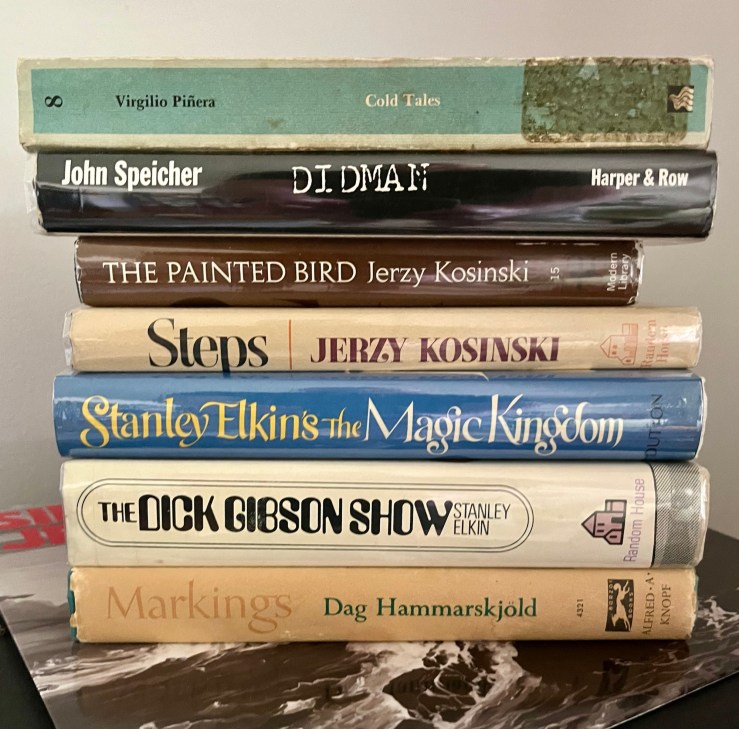
A collection of Virgilio Piñera short stories translated by Mark Schaffer. I admit I was unaware of the Cuban author’s existence until I came across this edition of Cold Tales (once property of the University of Washington Libraries). The spine attracted me, the cover, bearing a reproduction of Goya’s Saturn Snacking enticed me, and I opened, reading a few of the very short stories within, knowing it’d leave with me.

I picked up John Speicher’s 1971 novel Didman because Thomas Pynchon blurbed it; haven’t opened it since.

I picked up first-edition hardbacks of books I already own and have read, books by Stanley Elkin and Jerzy Kosinski—books I already own, in a few cases, in beautiful trade paperback editions (a Vintage Contemporaries edition of Steps; Elkin novels with covers by my favorite, Janet Halverson)—do I need them? Of course not. But I have so few hobbies, reader; my herbs are in good order; my guitars hold their tunings—and I have more regrets about the first editions I let go by years ago.

Perhaps the oddest one stacked here is a first edition of Dag Hammarskjöld’s posthumous 1963 Markings (translated by Leif Sjöberg and W. H. Auden), which collects the Swedish diplomat’s diary entries from 1925 up through his death in 1961. I found it very much at random (in the literary criticism section, where I don’t think it belongs), picked it up, and kept reading. A brief excerpt:

To be “sociable” —to talk merely because convention forbids silence, to rub against one another in order to create the illusion of intimacy and contact: what an example of la condition humaine. Exhausting, naturally, like any improper use of our spiritual resources. In miniature, one of the many ways in which mankind successfully acts as its own scourge-in the hell of spiritual death.

Rainer J. Hanshe’s Dionysos Speed (Book acquired, 4 March 2024)

Rainer J. Hanshe’s Dionysos Speed is out next month from Contra Mundum. Their description:

As the digitization of every aspect of existence grows more pervasive and absolute, from the monitoring of thought to the tracking even of genitals, the central nervous system of the human body has been completely rewired. In the mapping of space-time, the species has moved into a state of total possession, of the enslavement of its drives, imagination, and will. Through this virtualization of life, the society of the spectacle has reached a point of unparalleled monstrosity, with the simulacrum usurping reality itself. The species is divided between the digitalists who see the technologization of the human as its natural evolutionary development, and those who stand against them.

At this epochal crux, an enigmatic faction of anonymous figures engages in coordinated global poetic acts of destruction and creation, ludic and radical capers, dismantling machines of control and surveillance. The society of the spectacle is thereby short-circuited, scrambled, cut-up via skirmishes, détournements, and other subversive acts of havoc wreaking, interruption, and sabotage. Can these dice throws overturn all the mediums of control and enslavement? As time grows more and more constricted, the serendipities and transfigurations of human life suffer swift evisceration. In the midst of this, the anonymous clowns of revolt seek to resurrect the moments and marvels when great forces open up the boundless and the limitless, creating combustion engines of play so as to generate new hemispheres of possibility.

Written as a burst of epigrammatic sequences, like Molotov cocktails arriving from elsewhere, Dionysos Speed is a series of erupting geysers, comets flashing thru space and dispersing new forces. Akin to a Heraclitean fire machine, this book is an act meant to give birth once again to dissonant desire through the powers of the dice throw, a machine forged to release by way of its ludic freedom the vital forces of the cosmos.

Christine Brooke-Rose/Miguel de Unamuno (Books acquired, 23 Feb. 2024)

Picked up Christine Brooke-Rose’s 1984 postmodern novel Amalgamemnon and the Grove Press collection of Three Exemplary Novels by Miguel de Unamuno the other day. Those three exemplary novels are Marquis of Lubria; Two Mothers; and Nothing Less Than a Man, in translation by Angel Flores. It’s an older edition; Grove Press’s contemporary copy offers the following:

In Two Mothers, the demonic will of a woman runs amok in a whirlwind of maternal power, and in The Marquis of Lumbria, another unforgettable heroine steers a violent course through the dense sea of tradition. By contrast, Nothing Less Than a Man, Unamuno’s most forceful piece of writing, focuses on a truly Nietzchean hero, a man who embodies human will deprived of spiritual strength.

And here’s a bit on Brooke-Rose’s Amalgamemnon from Susie E. Hawkins’ essay “Innovation/History/Politics: Reading Christine Brooke-Rose’s Amalgamemnon” from the Spring 1991 issue of Contemporary Literature:

While the title signals possible mythic revisions of Aeschylus’s play Agamemnon, such anticipations on the reader’s part prove to be utterly unfounded. To begin with, there is no “story” as such, there are no “characters,” no “plot,” no “conflict,” and certainly no “climax.” In addition, the fiction is cast entirely in the future and conditional tenses with a few imperatives and subjunctives thrown in. Although Amalgamemnon exhibits few remnants of a traditional narrative desire for unity, presence, psychological accuracy, closure, and so forth, it does do what most innovative writing should do: it challenges the audience in terms of accustomed modes of perception, interpretation, and reading strategies – in short, challenges readerly ideology. In part, this text enacts such a challenge by performing itself, by “being about” language, by being a performance. The text becomes a space in which a cacophony of voices, or discursive amplifications, or babble, or little stories – whichever term best suits — enact their own sounding.

Tomoé Hill’s Songs for Olympia (Book acquired, 16 Feb. 2024)

So I started in on Tomoé Hill’s Songs for Olympia last night—poetic, critical, personal, strange in the right ways. Here’s publisher Sagging Meniscus’ blurb:

In the twilight of life, a black ribbon emerges from a frame and coils itself inside the mind of one of the great French chroniclers of the internal. Across the world, a young girl stares at an image in a book: a woman, naked but for slippers, jewels, and the same ribbon which so captivates the writer. At opposite poles of experience, one follows the ribbon as it winds its way round longings, regrets, and contemplations; the other, at the beginning of development and yet to discover the world, traces the ribbon with a finger, not realising how it will imprint itself upon her.

Years later, the girl—now woman—encounters the ribbon face to face and on the page. Manet’s Olympia and the words of Michel Leiris come together, and an imaginary conversation ensues. It will be a collision and collaboration of sensorial memories and observations on everything from desire and illness to writing and grief. These frames are used to examine both interlocutors; simultaneously, a frame of another sort is removed from Olympia and her artistic kin. Everything from her flowers, Louise Bourgeois’s Sainte Sébastienne, and Francis Bacon’s Henrietta Moraes are reimagined and given new regard.

Songs for Olympia, written in the form of a response to Michel Leiris’s The Ribbon at Olympia’s Throat, itself a highly personal response to Manet’s painting, is an ode to the both the ribbon and the memory: what leads us to constantly rediscover ourselves and a world so easily assumed as viewed through a single frame.

Patrick Langley’s The Variations (Book acquired, early Feb. 2024)

Patrick Langley’s novel The Variations is new from NYRB. Their blurb:

Selda Heddle, a famously reclusive composer, is found dead in a snowy field near her Cornish home. She was educated at Agnes’s Hospice for Acoustically Gifted Children, which for centuries has offered its young wards a grounding in the gift—an inherited ability to tune into the voices and sounds of the past.

When she dies, Selda’s gift passes down to her grandson Wolf, who must make sense of her legacy, and learn to live with the newly unleashed voices in his head. Ambitious and exhilarating, The Variations is a novel of startling originality about music and the difficulty—or impossibility—of living with the past.

Red Pyramid, Blue Lard | Two from Vladimir Sorokin (Books acquired 5 Feb. 2024)

Last week I got physical copies of two forthcoming Vladimir Sorokin books, both translated by Max Lawton and both published by NYRB.

Sorokin’s 1999 novel Blue Lard is one of the strangest and most daring books I’ve ever read—simultaneously compelling and repulsive, confounding and rewarding, a novel that twists from scenario to scenario, occasionally looking back at its reader to holler, Hey, catch up! Its English-language translator Max Lawton was kind enough to share his manuscript for Blue Lard with me during a long and enjoyable interview we undertook in the summer of 2022 (around the time of the publication of his translation of Sorokin’s 2014 novel Telluria). While Max was, on one hand, trying to help me better understand Sorokin in context by sharing Blue Lard with me, on the other, I think he was mostly trying to share a really fucking great book with someone who might like it—which is the kind of love one could only hope for from a translator. From our first interview:

BIBLIOKLEPT: Blue Lard might benefit from a brief introduction, so I’ll offer my unasked-for services: “This shit is wild. Just go for it. Don’t try to make it do what you think a novel should be doing. Just go with it.”

ML: BLUE LARD is about that state of confusion—ontological and linguistic—as it unfurls. To introduce the text beyond something like your pithy statement above might be a disservice to the book. The reader should be confused and it should hurt—then feel fucking good ….when reading Sorokin, we’re fucking nostrils with forked dicks (or—getting our nostrils fucked by the same).

The book’s real introduction is the Nietzsche quote at the beginning.

Does FINNEGANS WAKE need an introduction? Is one even possible?

I loved BLUE LARD when I first read it precisely because I had no point of reference for understanding it

Hey but so well guess what! I have another interview with Max on deck! Here’s a bit of a teaser from that interview, again on Blue Lard:

Like TELLURIA, BLUE LARD is all about textures: literary, historical, ideological… However, unlike TELLURIA, BLUE LARD has a telos to it—an endpoint. I am firmly of the belief that BLUE LARD is Vladimir’s best novel. He had taken a long break from prose (about 7 years) before writing it, so this text simply burst forth from him and ended up as a neat showcase of all of his aesthetic preoccupations, but lorded over by an edifice that has proportions none too short of classically harmonious. What should readers expect… hmm.. the first section is rather challenging. One needs to surf its wave and not expect full comprehension. There is a glossary of Chinese words and neologisms at the back of the book, but I’m not sure it’s worth consulting in the expectation of further understanding. The middle section of the book—characterized by a faux-archaic language—is also terribly strange, but with fewer neologisms. The last section of the book—an alternate iteration of Post-WWII Europe—is formally very smooth, but insanely transgressive in terms of content. And I haven’t even mentioned the rather unorthodox parodies of Russian classics in the novel’s first section! What should readers expect? In short: to have their minds blown!

Red Pyramid offers an overview of Sorokin’s development as a writer, collecting stories composed between 1981 and 2018. From Will Self’s introduction:

Fundamental to the fiction of Vladimir Sorokin is not the pornography his detractors accuse him of producing but the paradoxical topologies his carefully spun tales evoke. Each of his stories is a sort of mutant Möbius strip, in which to follow the narrative is to experience the real and the fantastic as simultaneously opposed and coextensive. There comes a point—it may be early on; it may be comparatively late-when the strictures of orthodox plotting seem to overwhelm its author, such that idiom and plain speech converge even as events spiral ineluctably out of human control.

And here’s Joy Williams’ blurb:

Extravagant, remarkable, politically and socially devastating, the tone and style without precedent, the parables merciless, the nightmares beyond outrance, the violence unparalleled, these stories, translated with fearless agility by Max Lawton, showcase the great novelist Vladimir Sorokin at his divinely disturbing best.

(Williams deploys the word outrance here, which was new to me, and I think it fits.)

Elberto Muller’s Graffiti on Low or No Dollars (Book subtitled “An alternative guide to aesthetics and grifting throughout the United States and Canada,” Feb. 2024)

Digging Elberto Muller’s Graffiti on Low or No Dollars. Mast Books’ blurb

Muller cut his teeth riding freights across America, doing graffiti, creating zines, molding three-dimensional graffiti mosaics and has recently finished his novel: Graffiti on Low or No Dollars. His Huck Finn approach and penchant for freedom from an ordinary life is translated through his art. The work is incredibly honest and reminiscent of Daniel Johnston at times with some of the subjects being tackled a painful reflection of our society today. In the same breath his art can make you smile with all of its crassness and glory.

Blog about some recent books acquired, other stuff

I read Will Oldham’s book On Bonnie ‘Prince’ Billy almost a decade and it therefore doesn’t belong in a stack of recent acquisitions, but it’s there—I pulled it off the shelf last week and thumbed through it in anticipation of seeing Oldham play this past Thursday. I even brought the book to the venue, thinking maybe I’d ask him to sign it. But I left it in the car and simply enjoyed Oldham and his pal run through a set of covers and originals. His voice is more resonant, richer, bolder than the last time I saw him live, and even if I didn’t know half of the songs, I enjoyed the gentle chill music on a cold Florida Thursday night. (I suspect Oldham’s short “tour” of Florida is an excuse to get out of the midwestern cold—although he complained it was “fuckin’ cold” here.)

Other books in the stack above are a composite of three or maybe four book store visits. The most memorable visit was to Aeon Bookstore in the Lower East Side of NYC.

Aeon is a small, cozy shop, well-curated with art, philosophy, anthropology, and literature books, as well as an excellent selection of jazz records. The clerk let me handle some first editions of Williams Burroughs and Gaddis, as well as Ishmael Reed and others.

I resisted The Recognitions and The Hearing Trumpet and picked up first editions of Donald Barthelme’s City Life and Don DeLillo’s Ratner’s Star.

Over two or possibly three visits to my local bookshop over the last month, I picked up copies of Stanley Elkin’s A Bad Man, Denis Johnson’s Resuscitation of a Hanged Man, and Carole Maso’s Ava. I also picked up Anthony Kerrigan’s translation of Miguel de Unamuno stories, Abel Sanchez and Other Stories.

I also snagged an advance copy of Percival Everett’s James. Blurb:

When the enslaved Jim overhears that he is about to be sold to a man in New Orleans, separated from his wife and daughter forever, he decides to hide on nearby Jackson Island until he can formulate a plan. Meanwhile, Huck Finn has faked his own death to escape his violent father, recently returned to town. As all readers of American literature know, thus begins the dangerous and transcendent journey by raft down the Mississippi River toward the elusive and too-often-unreliable promise of the Free States and beyond.

While many narrative set pieces of Adventures of Huckleberry Finn remain in place (floods and storms, stumbling across both unexpected death and unexpected treasure in the myriad stopping points along the river’s banks, encountering the scam artists posing as the Duke and Dauphin…), Jim’s agency, intelligence and compassion are shown in a radically new light.


Debbie Urbanski’s After World (Book acquired, Dec. 2023)

I plan to start into Debbie Urbanski’s debut After World this weekend. Here’s publisher Simon & Schuster’s blurb:

Sen Anon is assigned to be a witness for the Department of Transition, recording the changes in the environment as the world begins to rewild. Abandoned by her mother in a cabin somewhere in Upstate New York, Sen will observe the monumental ecological shift known as the Great Transition, the final step in Project Afterworld. Around her drones buzz, cameras watch, microphones listen, digitizing her every move. Privately she keeps a journal of her observations, which are then uploaded and saved, joining the rest of humanity on Maia, a new virtual home. Sen was seventeen years old when the Digital Human Archive Project (DHAP) was initiated. 12,000,203,891 humans have been archived so far. Only Sen remains.

[storyworker] ad39-393a-7fbc’s assignment is to capture Sen’s life, and they set about doing this using the novels of the 21st century as a roadmap. Their source files: 3.72TB of personal data, including images, archival records, log files, security reports, location tracking, purchase histories, biometrics, geo-facial analysis, and feeds. Potential fatal errors: underlying hardware failure, unexpected data inconsistencies, inability to follow DHAP procedures, empathy, insubordination, hallucinations. Keywords: mothers, filter, woods, road, morning, wind, bridge, cabin, bucket, trying, creek, notebook, hold, future, after, last, light, silence, matches, shattered, kitchen, body, bodies, rope, garage, abandoned, trees, never, broken, simulation, gone, run, don’t, love, dark, scream, starve, if, after, scavenge, pieces, protect.

As Sen struggles to persist in the face of impending death, [storyworker] ad39-393a-7fbc works to unfurl the tale of Sen’s whole life, offering up an increasingly intimate narrative, until they are confronted with a very human problem of their own.

Gerhard Rühm’s Cake & Prostheses/Max Blecher’s Transparent Body (Books acquired 11 Jan. 2024)

I was quite excited earlier this week to get a pair of books in new English translations from the Czech publisher Twisted Spoon Press.

I started in on Gerhard Rühm’s Cake & Prostheses (translated from the German by Alexander Booth) late last night and kept reading and reading, greedily consuming the surreal, poetic “mini dramas” as thought experiments played out in my head. Here’s an early example of one:

practiced biblical saying

catechist : love thy neighbor as thyself.

exegete: i hate myself! (gives the former a hard hook to the chin tho crumples him to the floor).

I’ll admit I didn’t know of Gerhard Rühm, but I’m enjoying Cake & Prostheses and hope to muster a review in the next week or so. Here’s Twisted Spoon’s blurb:

An inveterate experimenter with image and text and music, Gerhard Rühm is truly one of the major figures of the postwar European avant-garde. Yet reprehensibly little of his work has appeared in English. This edition brings together a selection of his work spanning the past seven decades, displaying a wide thematic range (as he has remarked, “there is nothing that cannot become part of one’s poetic universe”) and ingenious combinations of music, pornography, banality, humor, and mythology. The first section comprises “mini dramas,” the text often combined with images and musical notation to create sensorial episodes, the expression of a singular aesthetic perception. The second section is a wry deconstruction of Grillparzer’s play Hero and Leander that juxtaposes original passages with images from a swimming manual and with a more contemporary erotic retelling of the mythological tale. The final section presents 24 short prose pieces: 12 from the early 1950s and 12 from the past few years.

had heard of the surrealist Romanian poet Max Blecher, but am still largely unfamiliar with his work. Twisted Spoon is publishing his 1934 collection Transparent Body along with some, uh, other texts, in a translation by Gabi Reigh. Blurb:

Blecher’s very first book, the poetry collection Transparent Body, appeared in 1934, in a limited edition for bibliophiles. Yet general recognition as one of the most inventive European writers of his day came only with the publication of two of his three “novels” a few years later. And then he died, at the age of twenty-eight. But since 1930 Blecher had been publishing his poetry, short prose, essays, critiques, and other texts in the leading Romanian periodicals, some even appearing in important French publications, such as Le Surréalisme au service de la révolution. In addition, the past half century has seen the posthumous first publication of many texts in a variety of Romanian editions.

Transparent Body & Other Texts brings together Blecher’s entire output of poetry and short prose, from the earliest texts published during his lifetime to those appearing for the first time only recently. They range from stories in the vein of his fantastical, hallucinatory longer work to aphorisms, reportage, and notebook fragments. The volume also includes a selection of his correspondence with such major figures of Romanian interwar modernism as Geo Bogza, Ilarie Voronca, and Saşa Pană to give a fuller picture of Blecher’s engagement with the avant-garde and literary life even as his health was progressively deteriorating over the course of the 1930s.

Have a weird Xmas (Blog about books acquired in Dec. 2023)

Maybe an hour ago, browsing in a used bookstore, I opened a worn and some might say dirty copy of Iain Banks’s 1985 novel Walking on Glass. The very first page of this old book was inscribed with the following:

Have a weird Xmas ’90

                 John

This copy of Iain Banks’s 1985 novel Walking on Glass—a 1990 Abacus trade paperback printed in London, the embossing on its cover yellowed by wear on its cover and back near its spine—this particular copy was addressed to no named person, its inscription signed by a name so anonymous we apply it to unidentified cadavers and prostitute clients.

I take myself to be the unidentified person being addressed by the identified generic John, wishing me weird wellness, a ghost of Xmas past.

Earlier this year I made the tragic mistake of not pulling the trigger on first-edition hardbacks of Banks’s first two novels, The Wasp Factory and Walking on Glass. I hadn’t read Banks at that point, and my familiarity with his work came almost entirely of his proximity to the J.G. Ballard titles I routinely perused. I ended up reading and loving The Wasp Factory this summer (reviewed it here), and the blurb on the back of Walking on Glass promising further perversions intrigues me too, of course.

Today, I also came across a first-edition, first-U.S.-printing of Roberto Bolaño’s opus 2666It was marked at a third of the original cover price and has never been read. I could not leave it behind.

I actually traded some books in today, including my trade paperback of Alasdair Gray’s Poor Things. I had recently reread the novel in anticipation of Yorgos Lanthimos’ film adaptation, and, during that reread, oddly came across an inexpensive pristine first edition of the novel while browsing for something else. Maybe a week or two after finding that hardback of Poor Things, I found a hardback first edition of Gray’s 1990 novel Something Leather. Unlike Poor Things, which features lots of art and typographic adventures, Something Leather is pretty standard (apart from a few chapter heading illustrations)—but it does have a lovely cover under its cover:

Maybe a week after that, I was browsing with my son, who wanted a collection of Harlan Ellison short stories. I was shocked that we couldn’t find any—I had given away two mass market collections to some students maybe seven or eight years ago in a purge. Apparently a lot of it is out of print, but a “greatest hits” collection is coming out this spring. Anyway, I ended up finding hardback editions of Robert Coover’s Whatever Happened to Gloomy Gus of the Chicago Bears? Denis Johnson’s novel Fiskadaro. 

The Johnson is a British edition, Chatto & Windus, and while it’s hardly my favorite novel by him, I found its form too attractive to pass (and it was, like, cheaper than a beer in the same bookstore). I also picked up a book by Lewis Nordan, a slim collection of short stories called Welcome to the Arrow-Catcher Fair. I picked it up because I love those horrid lovely wonderful gross stylish Vintage Contemporaries editions, and then acquired it based on the blurb, which compared it to Flannery O’Connor, Ellen Gilchrist, and Harry Crews. Here it is next to my Vintage Contemporaries copy of Denis Johnson’ Fiskadaro:

I hope you have a weird Xmas. And I hope that John, wherever they are, has a weird Xmas too.

Robert S. Stickley’s A Bended Circuity (Book acquired, 27 Nov. 2023)


After hearing some positive murmurs praising its erudite maximalism and general zaniness, I caved and bought a copy of Robert S. Stickley’s 2020 novel A Bended Circuity. My copy arrived with a ballpoint flower and the front page signed with a scrawled “R S S.” I can’t really find anything about Big Box Publishing, the purported publisher of this edition, but I do know that the copies of the European reprint at Corona Samizdat sold out pretty quickly. (They have a second printing under way).

Here is the copy from the back of my edition:

There are screams in the night. Interlopers are afoot, have taken hold. Wildfires are burning the countryside and the gentry are running for cover. Fortunes are at stake. The South will not sleep.

A Bended Circuity opens on a midsummer’s afternoon with preparations being made for a soirée at the glamorous Hobcaw Barony. But not all goes according to plan. We soon find Charleston abruptly aroused from her slumber by the playful first smites of an unknown enemy waging a heinous prank war.

Calling his confederates to arms, one Bradley Pinçnit — heir to Marigold Manor and writer for revived southern mouthpiece, The Mercury — afternoon with preparations being made for a soirée at the glamorous Hobcaw Barony. But not all goes according to plan. We soon find Charleston abruptly aroused from her slumber by the playful first smites of an unknown enemy waging a heinous prank war.

Calling his confederates to arms, one Bradley Pinçnit — heir to Marigold Manor and writer for revived southern mouthpiece, The Mercury – organizes and helms a “Junto of Condign Men” then drives them to action. Offsetting her husband’s violent movement is Gabuirdine Lee, a housewife struggling to find her voice as the din of war encompasses her.

Ciphered into everything — the new roadways, the scars of the people, the tracts torn through ravaged plantations — there emerges one clear symbol: The Red Radical. Following the hints offered up by this cryptic motif, an army is mustered and pointed toward north so as to seek justice for the pernicious acts being committed upon an old way of life. But the army will first have to get out of its own way if it is to stand a chance of making it out of the South.

Read the W.A.S.T.E. Mailing List review of A Bended Circuity if you like.