Untitled List from the Fall of 1949 — Susan Sontag


From Susan Sontag’s notebooks, collected in Reborn

effete

noctambulus

perfervid

detumescence

disheveled

so alluring, so cerebral

sodden

intriguing

corrupt dignity

lotophagous

elegiac

Meleager

disponibility

pardine

demotic

Harriette Wilson

garbure

satura

succulent

competent intellectual vulgarity of Aldous Huxley

Yellow Book preciousness

secretive

sturdy

pedantry + lechery

spleen

ribaldry

ilex

Klaxon


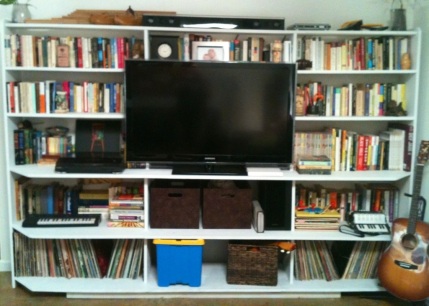
Book Shelves #39, 9.23.2012

20120923-130233.jpg

Book shelves series #39, thirty-ninth Sunday of 2012

Too many beers yesterday. Can’t write anything good.

Can’t even take a decent pic.

Ten of these shelves hold books; hence books shelves #40-49.

And then there’s another bookcase in this weird workshop space, so that’ll be #50.

And then I’ll revisit the thing that I keep review copies in. And then my nightstand, which was #1.

So that’ll be like, #s 51 and 52.

And since there are 53 Sundays in 2012 I’ll do some kind of summary post.

And then I’ll be done thank God.

St. Antony of Padua – El Greco

Fable of the Fox and the Heron — Frans Snyders

Iceberg Slim Talks About His Novel Trick Baby

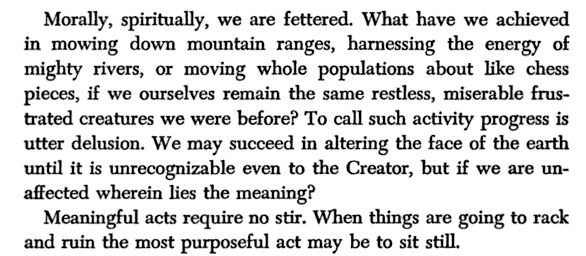
Henry Miller: “Meaningful Acts Require No Stir”

Autumn — Giuseppe Arcimboldo

The Garden Reading – Mary Cassatt

“I don’t believe in a future life,” said Raskolnikov

“I don’t believe in a future life,” said Raskolnikov.

Svidrigaïlov sat lost in thought.

“And what if there are only spiders there, or something of that sort,” he said suddenly.

“He is a madman,” thought Raskolnikov.

“We always imagine eternity as something beyond our conception, something vast, vast! But why must it be vast? Instead of all that, what if it’s one little room, like a bath house in the country, black and grimy and spiders in every corner, and that’s all eternity is? I sometimes fancy it like that.”

“Can it be you can imagine nothing juster and more comforting than that?” Raskolnikov cried, with a feeling of anguish.

“Juster? And how can we tell, perhaps that is just, and do you know it’s what I would certainly have made it,” answered Svidrigaïlov, with a vague smile.

This horrible answer sent a cold chill through Raskolnikov.

From Chapter I of Part IV of Dostoevsky’s Crime and Punishment.

David Markson Describes the Physical Limitations of Three Philosophers

Virgin and Child (The Tallard Madonna) – Giorgione

William Gass: “Ways of Reading Are Adversaries”

William Gass, in his 1977 Paris Review interview

INTERVIEWER

Is the reader an adversary for you?

GASS

No. I don’t think much about the reader. Ways of reading are adversaries—those theoretical ways. As far as writing something is concerned, the reader really doesn’t exist. The writer’s business is somehow to create in the work something which will stand on its own and make its own demands; and if the writer is good, he discovers what those demands are, and he meets them, and creates this thing which readers can then do what they like with. Gertrude Stein said, “I write for myself and strangers,” and then eventually she said that she wrote only for herself. I think she should have taken one further step. You don’t write for anybody. People who send you bills do that. People who want to sell you things so they can send you bills do that. People who want to tell you things so they can sell you things so they can send you bills do that. You are advancing an art—the art. That is what you are trying to do.

Robert Louis Stevenson and His Wife — John Singer Sargent

“The modern novel should be largely a work of reference” (Flann O’Brien)


In reply to an inquiry, it was explained that a satisfactory novel should be a self-evident sham to which the reader could regulate at will the degree of his credulity. It was undemocratic to compel characters to be uniformly good or bad or poor or rich. Each should be allowed a private life, self-determination and a decent standard of living. This would make for self-respect, contentment and better service. It would be incorrect to say that it would lead to chaos. Characters should be interchangeable as between one book and another. The entire corpus of existing literature should be regarded as a limbo from which discerning authors could draw their characters as required, creating only when they failed to find a suitable existing puppet. The modern novel should be largely a work of reference. Most authors spend their time saying what has been said before – usually said much better. A wealth of references to existing works would acquaint the reader instantaneously with the nature of each character, would obviate tiresome explanations and would effectively preclude mountebanks, upstarts, thimble-riggers and persons of inferior education from an understanding of contemporary literature. Conclusion of explanation.

—From Flann O’Brien’s novel At Swim-Two-Birds (1939).


Monk in White, Seated, Reading — Camille Corot

Definition of Politics (Ambrose Bierce)

Compositions II — Roy Lichtenstein