Category: Books
“God Makes Mistakes” — J.R.R. Tolkien Rambles About Elves
Nathaniel Hawthorne’s Book Burning
In his strange story “Earth’s Holocaust,” Nathaniel Hawthorne describes how “this wide world had become so overburdened with an accumulation of worn-out trumpery, that the inhabitants determined to rid themselves of it by a general bonfire.” What ensues is a horrific satire that seems more relevant than ever; the people burn liquor, money, guns, laws, and other sundry items before eventually turning on books—
The truth was, that the human race had now reached a stage of progress so far beyond what the wisest and wittiest men of former ages had ever dreamed of, that it would have been a manifest absurdity to allow the earth to be any longer encumbered with their poor achievements in the literary line. Accordingly a thorough and searching investigation had swept the booksellers’ shops, hawkers’ stands, public and private libraries, and even the little book-shelf by the country fireside, and had brought the world’s entire mass of printed paper, bound or in sheets, to swell the already mountain bulk of our illustrious bonfire. Thick, heavy folios, containing the labors of lexicographers, commentators, and encyclopedists, were flung in, and, falling among the embers with a leaden thump, smouldered away to ashes like rotten wood. The small, richly gilt French tomes of the last age, with the hundred volumes of Voltaire among them, went off in a brilliant shower of sparkles and little jets of flame; while the current literature of the same nation burned red and blue, and threw an infernal light over the visages of the spectators, converting them all to the aspect of party-colored fiends. A collection of German stories emitted a scent of brimstone. The English standard authors made excellent fuel, generally exhibiting the properties of sound oak logs. Milton’s works, in particular, sent up a powerful blaze, gradually reddening into a coal, which promised to endure longer than almost any other material of the pile. From Shakespeare there gushed a flame of such marvellous splendor that men shaded their eyes as against the sun’s meridian glory; nor even when the works of his own elucidators were flung upon him did he cease to flash forth a dazzling radiance from beneath the ponderous heap. It is my belief that he is still blazing as fervidly as ever.
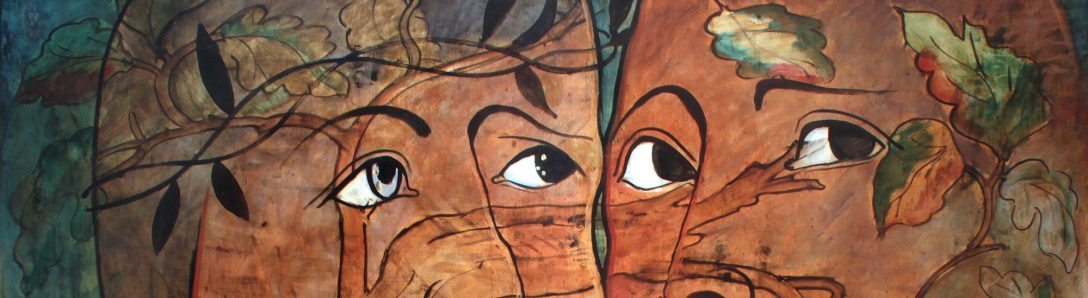
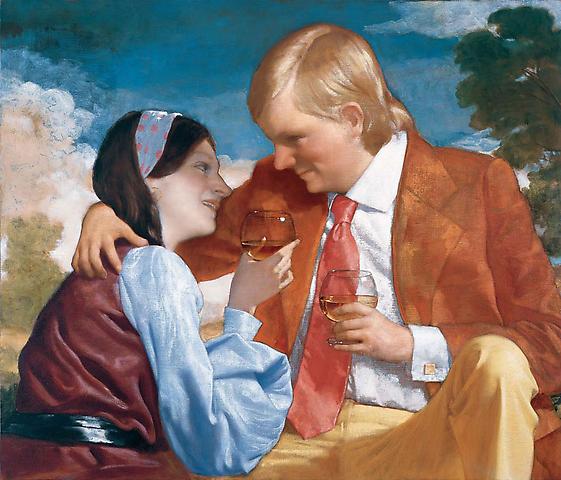
Rippowam — John Currin
Melville House Wants to Duel with You

The good folks at Melville House want to duel with you. They’re publishing five novellas, all called The Duel, and they want you to make a trailer for the books. You can win books and “underground fame,” which I’m sure won’t be fleeting (in any case, winning all 42 titles in their Art of the Novella series is nothing to sneeze at). Full details at Moby Lives.
Some other duels we like:
A duel from Barry Lyndon—
Jean-Léon Gérôme’s Duel After the Masked Ball—
 “Duel” by Swervedriver—
I Have Writer’s Block (but I’ll Share a Vomit Story Anyway)
I have the writer’s block somethin’ terrible.
Everything was going so well, too—I seemed able to blather and drivel at will for a few weeks, dribbling out my noisome little posts on books or films or TV shows or what have you.
But now, nothing, which is terrible, because I have been reading up a storm—putting away half a Hemingway in a day (The Garden of Eden), flying through Donald Harrington’s epic comic masterpiece Architecture of the Arkansas Ozarks (still not finished), trudging through Breece D’J Pancake’s stories when I think I can take the sadness, and polishing off Wayne Koestenbaum’s Humiliation in three short sessions.
I kind of blame Koestenbaum’s book for the writer’s block. It’s always hard to write about a book that you love, that you think others should read too, but even harder when the book is about subjects and figures that most people would rather not think about, like abjection or vomit or gloryholes or the terrible pain of Liza Minelli or Antonin Artaud’s electroshock therapy or Jean Genet’s prison sex or lynching photographs or Michael Jackson’s penis. Plus, Koestenbaum repeatedly points out that the act of writing itself, particularly writing for publication, writing for others to read is an abject, humiliating process. Here’s Koestenbaum—
Writing is a process of turning myself inside out: a regurgitation. I extrude my vulnerable inner lining. I purge. And then I examine the contents—my expulsed interior—and begin the bloody interrogation. I ask whether it is filthy or clean, valuable or deplorable.
Koestenbaum goes beyond metaphorical vomiting to consider the literal act of regurgitation in his book. There’s a lot of vomit in Humiliation—other bodily expulsions too, but Koestenbaum singles vomiting as a primary site of abjection (this seems a little less intense or mordant than theorist Julia Kristeva—whose work Koestenbaum is surely working from—who finds the corpse the ultimate abject object).
Maybe I’ll try to work through my writer’s block by telling a vomit story. The story is made more germane (to what, though?), perhaps, in light of the fact that I had just read some of Koestenbaum’s vomit theory (or vomit prose, if you prefer) the night previous.
Here is the setting: it is a pediatrician’s waiting room. I am waiting with my son, who is 13 months old, who is to receive shots on this visit to protect him from disease. The waiting room is packed and the progress is unusually slow. The woman across from me makes idle chit chat with me and with her own son who is maybe 13 or 14 years old; he’s in marching band; he needs new shoes for marching band; jazz band will be discontinued due to budget cuts, but the teacher (a man who shares my last name, I hear by eavesdropping although how can it be eavesdropping when their conversation is so public and the room so small) will teach jazz band after school. These details are unimportant to the vomiting story, although they perhaps signal the teenager’s mother’s caring, involved nature in her son’s life.
Here is the climax of the story: to my right, another man is at the doctor’s with his son, waiting; the son is perhaps 3 or 4 years old. He doesn’t look well—he looks queasy. In fact, when I look at him (not directly of course, but glancingly, the way that people might in a waiting room or other such place where direct eye contact is unspokenly shunned), when I look at him, I internally remark his queasiness, his ill gills, his distraught angle; I also internally remark his father’s concern, the way his father slowly strokes the son’s back in impotent consolation. And at the same moment I remark on these details, it occurs to me that this queasy looking boy is in the wrong section, that there is a clearly marked, smaller room (not so much a room but an alcove or adjoined large cubby—no door separates the two) for “sick” patients, for patients who are not attending a regular “well” visit (like my own son). My reaction though was not fear or disgust or anger, but more mild annoyance that the father was either flouting a convention of the office (one that I didn’t really care about, knowing that, hey, really, is that smaller room really going to protect my health or my child’s? Because, no it’s not), or that the father simply failed to read a clear sign (I feel a similar annoyance when people at the grocery store where I shop treat the clearly-marked entrance as an exit and vice-versa).
Anyway, I promised a climax, and failed to deliver. How humiliating. So here is the climax: the man’s son up and vomited all over the floor, all over the man’s leg. It was not the tidy vomit that we might sometimes manage—the short, projectile aimed mass that usually conforms to a strict element, mostly solid or mostly liquid. No, this was a messy, mucusy, ill affair, the kind of vomit that hangs from the vomiter’s mouth and sticks to the floor (for me, the most abject, threatening detail). It was foul. And yet I felt no abject horror or humiliation for the man or his child—in short, none of the vomit-horror that Koestenbaum describes in his book (a description I know I have not described for you, dear reader). Instead, I felt immediate empathy and compassion for the man. The mother of the teenager responded even more demonstrably. She immediately located a garbage bin for the boy to continue vomiting in, alerted the staff, went to the bathroom for paper towels, and helped the man while speaking consolingly to the son. She did what I wished that I had did. She behaved like a good human.
The point of this vomit story is to try to address what Koestenbaum does not address in his fantastic book. This is not meant to be a slight or an attack or even a criticism. A book should never be attacked for what it doesn’t aim to do. But what Koestenbaum, in his wonderful analyses of vomit, of expulsion, of all the ways our bodies, the material facts of our bodies humiliate us, make us abject, what Koestenbaum doesn’t consider is that the loving parent’s relation to a helpless child’s body’s expulsions bears the possibility (the strong possibility) of not being abject, but instead a site of abjection’s flipside: grace, love, empathy and all that jazz. In short, no one in the waiting room where the child vomited shrank in disgust or showed any visible sign of shared humiliation—quite the opposite. The child’s demonstrable illness became a moment not of horror but of empathy, of understanding the child’s illness and the father’s worry and care and love for his ill child, a love that transcends humiliation’s gaze.
So there’s my vomit story, or one of my vomit stories. But I still don’t know how to review the book right now.
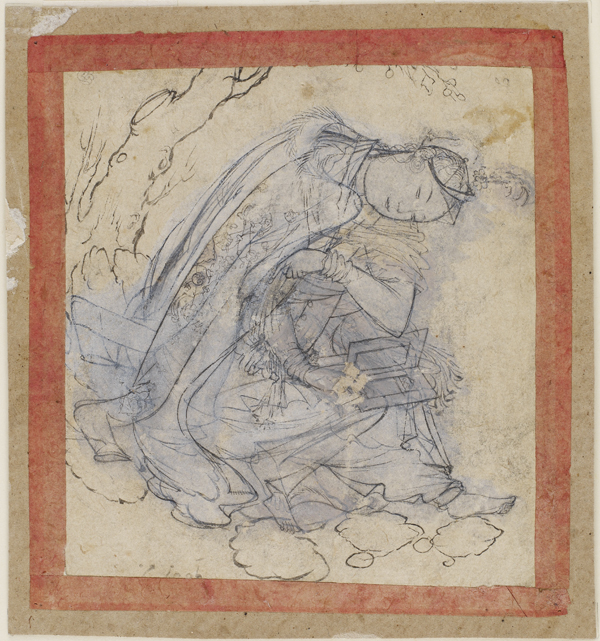
Youth Reading — Riza Abassi
Virginia Woolf’s Bust (and Other Author Gravesites)
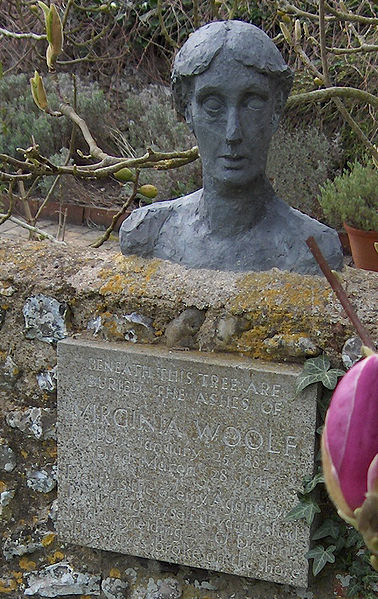
Great post today at Page Pulp featuring author gravesites. Check it out — Edmund Spenser, Shakespeare, Keats, Woolf (above), and more.
Private Moment, YouTube Star
Wayne Koestenbaum’s new book Humiliation is great stuff—tender, thoughtful, maddening, very funny, and possibly wise; I’ll have a proper review (whatever that means) up soon, but, in the meantime check out his book trailers, which are probably the best I’ve seen.
“I am like one of those seeds taken out of the Egyptian Pyramids” — Herman Melville Writes to Nathaniel Hawthorne
From Herman Melville’s June 1851 letter to Nathaniel Hawthorne (read the whole letter here)—
But I was talking about the “Whale” [“Moby-Dick”]. As the fishermen say, “he’s in his flurry” when I left him some three weeks ago. I’m going to take him by his jaw, however, before long, and finish him up in some fashion or other. What’s the use of elaborating what, in its very essence, is so short-lived as a modern book? Though I wrote the Gospels in this century, I should die in the gutter. — I talk all about myself, and this is selfishness and egotism. Granted. But how help it? I am writing to you; I know little about you, but something about myself so I write about myself, — at least, to you. Don’t trouble yourself, though, about writing; and don’t trouble yourself about visiting; and when you do visit, don’t trouble yourself about talking. I will do all the writing and visiting and talking myself — By the way, in the last “Dollar Magazine” I read “The Unpardonable Sin.” He was a sad fellow, that Ethan Brand. I have no doubt you are by this time responsible for many a shake and tremor of the tribe of “general readers.” It is a frightful poetical creed that the cultivation of the brain eats out the heart. But it’s myprose opinion that in most cases, in those men who have fine brains and work them well, the heart extends down to hams. And though you smoke them with the fire of tribulation, yet, like veritable hams, the head only gives the richer and the better flavor. I stand for the heart. To the dogs with the head! I had rather be a fool with a heart, than Jupiter Olympus with his head. The reason the mass of men fear God, and at bottom dislike Him, is because they rather distrust His heart, and fancy Him all brain like a watch. (You perceive I employ a capital initial in the pronoun referring to the Deity; don’t you think there is a slight dash of flunkeyism in that usage?) Another thing. I was in New York for four-and-twenty hours the other day, and saw a portrait of N.H. And I have seen and heard many flattering (in a publisher’s point of view) allusions to the “Seven Gables.” And I have seen “Tales,” and “A New Volume” announced, by N.H. So upon the whole, I say to myself, this N.H. is in the ascendant. My dear Sir, they begin to patronize. All Fame is patronage. Let me be infamous: there is no patronage in that. What “reputation” H.M. has is horrible. Think of it ! To go down to posterity is bad enough, any way; but to go down as a “man who lived among the cannibals”! When I speak of posterity, in reference to myself, I only mean the babies who will probably be born in the moment immediately ensuing upon my giving up the ghost. I shall go down to some of them, in all likelihood. Typee will be given to them, perhaps, with their gingerbread. I have come to regard this matter of Fame as the most transparent of all vanities. I read Solomon more and more, and every time see deeper and deeper and unspeakable meanings in him. I did not think of Fame, a year ago, as I do now. My development has been all within a few years past. I am like one of those seeds taken out of the Egyptian Pyramids, which, after being three thousand years a seed and nothing but a seed, being planted in English soil, it developed itself, grew to greenness, and then fell to mould. So I. Until I was twenty-five, I had no development at all. From my twenty-fifth year I date my life. Three weeks have scarcely passed, at any time between then and now, that I have not unfolded within myself. But I feel that I am now come to the inmost leaf of the bulb, and that shortly the flower must fall to the mould. It seems to be now that Solomon was the truest man who ever spoke, and yet that he a little managed the truth with a view to popular conservatism; or else there have been many corruptions and interpolations of the text. — In reading some of Goethe’s sayings, so worshipped by his votaries, I came across this, “Live in the all.” That is to say, your separate identity is but a wretched one, — good; but get out of yourself, spread and expand yourself, and bring to yourself the tinglings of life that are felt in the flowers and the woods, that are felt in the planets Saturn and Venus, and the Fixed Stars. What nonsense! Here is a fellow with a raging toothache. “My dear boy,” Goethe says to him, “you are sorely afflicted with that tooth; but you must live in the all, and then you will be happy!” As with all great genius, there is an immense deal of flummery in Goethe, and in proportion to my own contact with him, a monstrous deal of it in me.
H. Melville.
P.S. “Amen!” saith Hawthorne.
N.B. This “all” feeling, though, there is some truth in. You must often have felt it, lying on the grass on a warm summer’s day. Your legs seem to send out shoots into the earth. Your hair feels like leaves upon your head. This is the all feeling. But what plays the mischief with the truth is that men will insist upon the universal application of a temporary feeling or opinion.
P.S. You must not fail to admire my discretion in paying the postage on this letter.
“Shakespeare Humiliates the Prior Body of Language” — Wayne Koestenbaum
A passage from Wayne Koestenbaum’s new book, Humiliation—
Shakespeare humiliates the prior body of language—the poor body of English, lackluster before he came along and renovated it. Shakespeare ennobled English, and so it may seem odd to say that he also humiliated it; but in his semantic magnanimity, his aural cornucopia, I detect the presence of lacerations. When Shakespeare commits lexical excess (by coining new words, by larding a simple thought with plump, dense sounds and metaphors, by hyper-enlivening every sentiment with figurative language), English becomes a body punctured by his violent actions. Example: “The murmuring surge / That on th’ unnumb’red idle pebble chafes / Cannot be heard so high.” “Murmuring” and “surge” and “unnumb’red” present the ear with a glut of “u” and “m” and “r” sounds. And “idle” and “pebble,” next to each other, create a pebble effect. With purple ripeness, low-pitched vowels (“murmuring surge”) ascend to high-pitched vowels (“high”). This apex virtuosity—language creaming, ascending, and thickening—this process (I’m straining my point) alerts me to a violence committed, symbolically, against English’s body. Poetic intensity—linguistic bravado, musical compression—hurts the mother tongue. “Good” language is hurt language. Bare, desiccated language—Samuel Beckett’s—is also humiliated: shorn, Samson-like. If you don’t understand what I’m saying, I will feel humiliated. If I fail to communicate my meaning, and if you tell me I’ve failed, then you will have humiliated me.
RIP Lucian Freud

Mad Meg — David Teniers the Younger

Mad Meg — Pieter Brueghel the Elder

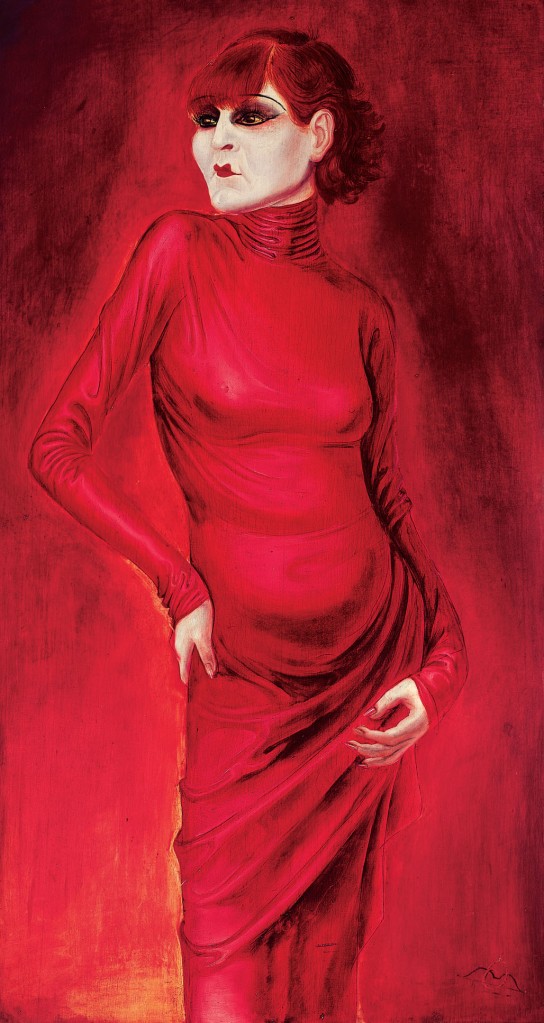
Portrait of Dancer Anita Berber — Otto Dix
Shy Coworker, Dirty Movies
Started Wayne Koestenbaum’s Humiliation (forthcoming from Picador) last night, and it’s excellent—one of the best cultural commentaries I’ve read in years. Abjection, King Lear, Julia Kristeva, Michael Jackson, Liza Minelli, A Star Is Born, fear of writing—great stuff. Full review soon.
“I Have a Very Vivid Child’s View” — A 1967 Interview with J.R.R. Tolkien
Read this marvelous 1967 profile of J.R.R. Tolkien by Philip Norman, in The New York Times. The piece focuses on Tolkien’s impact in America, particularly in the universities and the counterculture. From the piece—
Tolkien wasn’t a hearty child. At the age of 3 he was brought home from Bloemfontein, South Africa, his birthplace, and brought up at Sarehole, near Birmingham. Until he won a scholarship to grammar school his mother taught him. He is particularly attached to the powder horn; it reminds him of being “borrowed” by an African named Isaac, who wanted to show a white baby off in his kraal. “It was typical native psychology but it upset everyone very much, of course. I know he called his son Isaac after himself, Mister Tolkien after my father and Victor-ha! ha!-after Queen Victoria.
“I was nearly bitten by a snake and I was stung by a tarantula, I believe. In my garden. All I can remember is a very hot day, long, dead grass and running. I don’t even remember screaming. I remember being rather horrified at seeing the Archdeacon eat mealies [Indian corn] in the proper fashion.” …Tolkien stuck his fingers in his mouth.
“Quite by accident, I have a very vivid child’s view, which was the result of being taken away from one country and put in another hemisphere-the place where I belonged but which was totally novel and strange. After the barren, arid heat a Christmas tree. But no, it was not an unhappy childhood. It was full of tragedies but it didn’t tot up to an unhappy childhood.”
 Biblioklept