Note: This chart does not represent Melville’s entire literary production. It does not list earnings for the magazine articles or for Israel Potter, The Piazza Tales, and The Confidence-Man, for which surviving records are incomplete; nor does it give figures for the volumes of poetry that were published at private expense.
		    UNITED STATES	       UNITED KINGDOM		      TOTALS

		Copies       	            Copies       	        Total       Total
Title		Sold	     Earnings	    Sold	 Earnings (a)   Sales       Earnings
--------------------------------------------------------------------------------------------
Typee		9,598	     1,138.61	    6,722	   708.40	16,320	    1,847.01

Omoo		7,403	     1,719.78	    5,932	   644.00	13,335	    2,363.78

Mardi		2,900	       740.88	    1,000	   970.65	 3,900      1,711.53

Redburn		4,718	       683.57	      750	   484.00	 5,468	    1,167.57

White-Jacket	4,922	       969.44	    1,000	   968.00	 5,922	    1,937.44

Moby-Dick	3,215	       556.37	      500	   703.08	 3,715	    1,259.45

Pierre		1,821	       157.75	      --	      --	 1,821	      157.75
Battle-Pieces	  471	     - 229.71 (b)     --	      --	   471	    - 229.71
	       ------	     --------	   ------	 --------	------	   ---------
TOTALS	       35,048	     5,736.69 	   15,905	 4,478.13       50,953	   10,214.82
Edgar Allan Poe reviews Nathaniel Hawthorne’s Twice-Told Tales. Originally published in Graham’s Magazine, April, 1842—
We have always regarded the Tale (using this word in its popular acceptation) as affording the best prose opportunity for display of the highest talent. It has peculiar advantages which the novel does not admit. It is, of course, a far finer field than the essay. It has even points of superiority over the poem. An accident has deprived us, this month, of our customary space for review; and thus nipped in the bud a design long cherished of treating this subject in detail; taking Mr. Hawthorne’s volumes as a text. In May we shall endeavor to carry out our intention. At present we are forced to be brief.
With rare exception–in the case of Mr. Irving’s “Tales of a Traveller” and a few other works of a like cast–we have had no American tales of high merit. We have had no skilful compositions–nothing which could bear examination as works of art. Of twattle called tale-writing we have had, perhaps, more than enough. We have had a superabundance of the Rosa-Matilda effusions–gilt-edged paper all couleur de rose: a full allowance of cut-and-thrust blue-blazing melodramaticisms; a nauseating surfeit of low miniature copying of low life, much in the manner, and with about half the merit, of the Dutch herrings and decayed cheeses of Van Tuyssel–of all this,eheu jam satis!
Mr. Hawthorne’s volumes appear to us misnamed in two respects. In the first place they should not have been called “Twice-Told Tales”–for this is a title which will not bear repetition. If in the first collected edition they were twice-told, of course now they are thrice-told.–May we live to hear them told a hundred times! In the second place, these compositions are by no means all “Tales.” The most of them are essays properly so called. It would have been wise in their author to have modified his title, so as to have had reference to all included. This point could have been easily arranged.
But under whatever titular blunders we receive this book, it is most cordially welcome. We have seen no prose composition by any American which can compare with some of these articles in the higher merits, or indeed in the lower; while there is not a single piece which would do dishonor to the best of the British essayists.
“The Rill from the Town Pump” which, through the ad captandum nature of its title, has attracted more of public notice than any one other of Mr. Hawthorne’s compositions, is perhaps, the least meritorious. Among his best, we may briefly mention “The Hollow of the Three Hills;” “The Minister’s Black Veil;” “Wakefield;” “Mr. Higginbotham’s Catastrophe,” “Fancy’s Show-Box;” “Dr. Heidegger’s Experiment;” “David Swan;” “The Wedding Knell;” and “The White Old Maid.” It is remarkable that all these, with one exception, are from the first volume.
The style of Mr. Hawthorne is purity itself. His tone is singularly effective–wild, plaintive, thoughtful, and in full accordance with his themes. We have only to object that there is insufficient diversity in these themes themselves, or rather in their character. His originality both of incident and of reflection is very remarkable; and this trait alone would ensure him at least our warmest regard and commendation. We speak here chiefly of the tales; the essays are not so markedly novel. Upon the whole we look upon him as one of the few men of indisputable genius to whom our country has as yet given birth. As such, it will be our delight to do him honor; and lest,
Lars Iyer’s first novel Spurious (Melville House) is by turns, witty, sad, and profound, and garnered serious acclaim on its release earlier this year. Spurious originated in a blog of the same name. There are two sequels on the way—Dogma should be on shelves in early 2012, and Exodus the year after. Lars teaches philosophy at Newcastle University (so it’s no wonder that Spurious reads like a discursive philosophy course by way of the Marx brothers). Lars was kind enough to talk to Biblioklept in depth about his work and writing. In addition to his teaching, writing, and blogging, you will also find Lars on Twitter.
Biblioklept: Your novel Spurious began as a blog and then was published by Melville House, a thriving indie publisher that also began life as a blog. At a recent talk you gave at the HowTheLightGetsIn philosophy and music festival, you discuss the freedom blogging allows for writers to develop their “legitimate strangeness.” Why is “legitimate strangeness” important for writers, and how does blogging help facilitate it?
Lars Iyer: Sometimes it is necessary to depart. Sometimes it is necessary to leave it all behind. That’s how I understood the act of blogging, back when I started Spurious, the blog which shares thesame name as the novel.
As someone who had made some progress as an academic – a journey which implies valuable training as well as compromise and despair – I thought a kind of exodus was necessary, from existing forms of published writing. Leave it all behind!, I told myself. Leave the Egypt of introductory books and academic journals and edited collections behind. Leave the slave-drivers behind, and the sense you have of being a slave. Leave capitalism and capitalist relations behind. Leave behind any sense of the importance of career and advancement. Leave behind those relationships that are modelled on investment and return.
Sometimes a kind of solitude is necessary. You need to be alone, to regather your forces, to marshall your strength. But what is really necessary is a solitude in community. You’re on your own, depending on your own resources. But your solitude is lightened: because you know that there are others like you, who have likewise expelled themselves from captivity; because you know that others share your sense of disgust and self-disgust, that they too have gone out to the desert to do battle with the demons sent by capitalism into each of our souls; because there are others, like you, who see writing as both scourge and liberation, others who see it as a spiritual trial, others looking to destroy who they were and be reborn, and to keep themselves in rebirth.
In the end, the desert is paradise, and the world the blogger has left behind, with its whips and fleshpots, is the real desert.
Cultivate your legitimate strangeness: that was my mantra. ‘Cultivate’, because it is a struggle, a kind of asceticism. To drive the demons out, you have to know that they are there. A kind of self-knowledge is necessary – not the petty narcissism we find in the ‘misery memoir’, but a growing awareness of those forces that have constituted you, that have made you what you are. ‘Your legitimate strangeness’: ‘Your’, because it is yours, your space, the person you are, that you have become, even as you might alter this space, remake it. ‘Legitimate’ – that part of you that is not yet subsumed by capitalism, that free part of yourself that is not a slave. ‘Strangeness’ – because it must appear strange to the slaves and their masters, to everyone around you.
Why is this important to the writer? Some of us write because of our alienation. We have had no one to speak to, no friends, no conversations. There was no one around. Thoreau went to the woods to find himself. We went to our rooms. We went to literature, and philosophy, without knowing anything of literature and philosophy. We worked on our own.
There is something pathetic about this. Shouldn’t we have been fighting the world instead? Shouldn’t we have been ready on the barricades? But there were no barricades. There was no solidarity. We belonged to nothing, and had gone a little mad, a little reclusive, from belonging to nothing.
In one sense, since we lacked education, lacked culture, since our world was not one which valued the ideas and writers that we came to, our exodus was pathetic. We were imitators, play-pretending at being what we are not. We’d come too late; the party was over. We stood in the ruins, and the ruins mocked us. What could we have achieved, that had not been achieved to a much higher level before? What could we have made, that had not already been made, and much more competently, much more measuredly? We lacked the basic skills. We lacked the ability to write – even that. We lacked the breadth of culture, the breadth of scholarship.
But seen in another light, we discovered ourselves as outsiders, like those outsider artists who practiced their vocation outside of institutions. What we made was crude and simple, true — especially when compared to what went before – but it did have a certain power to affect. It had an urgency, a desperation, which might, perhaps, appeal to others. We were capable of only scraps and fragments, to be sure – dreck – but dreck marked by a moving sincerity.
I wondered – and this was the beginning of Spurious, the novel, and of its sequels – whether there was a way of folding this sense of posthumousness, of coming too late and lacking the old skills, into the practice of writing. Maybe it was time to come back from the desert, which had taught me only the extent and depth of my stupidity. Maybe it was time to write with a new kind of writing . . .
A Portrait of the Novelist as a Smiling Man
Biblioklept: That “sense of posthumousness, of coming too late” figures heavily in Spurious. Is Spurious the “new kind of writing” you are aiming for? While the book has a fragmentary, even elliptical quality, it also reminds me of novels in the picaresque tradition. What form does this new kind of writing you invoke take?
LI: Spurious is a book on its hands and knees. For me, it feels like the last book, the last burst of laughter before the world ends. But it also feels like the first one, because it has loosened the hold of the past. It says: a whole form of literary pretence is over.
Writing to a friend, in 1916, before the composition and publication of the work that would make him famous, the philosopher Franz Rosenzweig wrote, ‘My true book will appear only as an opus posthumum: I do not want to have to defend it or know about its “influence”’. He writes something similar, a year later, in another letter: ‘I will only truly speak after my death …, I place my entire life beneath the sign of that “posthumousness”’. Rosenzweig was confident that there would be a culture to evaluate his work. He was confident that there would be a place for his posthumous work among the greats – that there would still be greats, such that he might find his place among them. He was sure, in other words, that the old world would continue as it was; that there would still be master-works, still be the geniuses who wrote them, and still be the critics whose evaluations would be trusted by a general public.
A similar confidence in an author today would be a sign of delusion. Literature is one strand among many in our multi-braided culture. True, it retains something of its prestige; it is studied at universities, reviewed in serious newspapers — but it occupies an increasingly marginal role. The ‘great names’ are, for the most part, only cultural markers, ready for commercialisation (Kafka oven gloves in the tourist shop in Prague; the Brontë Balti House in Haworth; the Pride and Prejudice fully immersive interactive environment). But it is not only marginalisation that should be feared; recognition, too, should be. I think of the stupidity of documentary ‘infotainment’ on writers and artists, and rise of the vast, say-everything biography, that says nothing at all (as Mark Fisher has written, the biography is an end of history form, making the reassuring claim that ‘it was all about people’).
Literature continues. But it does so, in contemporary literary fiction, as a kind of empty form. As the anonymous blogger of Life Unfurnished has put it: contemporary literary fiction gives ‘the appearance alone of literature’; it is a genre ‘in which, for the writer, the sense of Writing Literature is dominant, and, for the reader, the sense of Reading Literature is dominant’.
Reviewing Jean-Luc Godard’s film Every Man For Himself, Pauline Kael writes, ‘I got the feeling that Godard doesn’t believe in anything anymore; he just wants to make movies, but maybe he doesn’t really believe in movies anymore, either’. Without agreeing with Kael’s assessment of Godard, I’d like to paraphrase her formulation: I think literary writers want to write literary fiction without believing in literature – without, indeed, believing in anything at all.
It seems to me that the literary gestures are worn out – the creation of character, plot, the contrivance of high-literary language and style as much as the avoidance of high-literary language and style, and the abandonment of most elements of the creation of character and plot. The ‘short, elliptical sentences’ of which the blogger of Life Unfurnished writes, the ‘absence of fulsome description’, the ‘signs of iconoclastic casualness’, the ‘colloquialisms’, the ‘lack of trajectory’, the ‘air of the incidental’: all are likewise exhausted.
What, then, is to be done? As writers, as readers, we are posthumous. We’ve come too late. We no longer believe in literature. Once you accept this non-belief, once you affirm it in a particular way, then something may be possible.
Witold Gombrowicz seems to advocating a return to older forms of literary insouciance: ‘Where are the good old days, when Rabelais wrote as a child might pee against a tree, to relieve himself? The old days when literature took a deep breath and created itself freely, among people, for people!’ But we cannot simply return to Rabelais, as Gombrowicz knew. Too much has happened! If a kind of self-consciousness is a distinguishing mark of the contemporary literary novelist, this is not something that can be relinquished altogether. The role of centuries of writing – of the rise of the nineteenth century bourgeois novel, of modernism and so on – must be marked.
But it can be marked by portraying our distance now from the conditions in which the great works of literature and philosophy were written. W. and Lars, the characters in Spurious, revere Rosenzweig. But this is also reverence for a culture that would deem Rosenzweig and his work important – a culture that is completely different from the one which W. and Lars occupy. True, they revere contemporary masters, too – the filmmaker Béla Tarr, for example – but Tarr lives far away, in very different conditions. W. and Lars occupy the world of the present, and the world that valued the ideas they value, the world that sustained those ideas and nurtured their production, has disappeared. Much of the humour of the book comes from the fact that its characters are men out of time – gasping in awe at Rosenzweig’s work at one moment, leafing through gossip magazines at another; proclaiming a great love of Kafka one minute, playing Doom on a mobile phone the next.
It is in this sense that there might appear to be an overlap between Spurious and novels in the picaresque tradition, which extends from sixteenth century Spain to the present day. Picaresque, it has been argued, appears as a result of a tension between an old world and a new one. The Spain of the first picaresque novels was in a period of difficult transition, from the stability of the medieval order to the age of a new, self-assertive individuality. Poverty and war were all around. The picaresque is produced in a world where human solidarity is lacking, and the individual no longer has a place in the world. The episodic journeys of the picaresque novel reflect the lack of coherence of its central characters, the lack of secure identity – a kind of cosmic loneliness.
Some picaresque features can be found in Spurious. The novel is episodic, and its characters lack a place in the world, even a place in history. W. and Lars play-pretend at various roles, trying on the mantle of the religious person or the philosophical thinker. W., in particular, yearns after friendship. But the characters are not roguish, as the picaro of a picaresque novel is supposed to be. W. is perfectly sincere. And picaros do not usually come in pairs.
Biblioklept: Speaking of your pair Lars and W., there’s a strong friendship there that strikes me as very realistic and actually quite moving. Reading Spurious I was reminded strongly of one of my own friendships, which is perhaps based on equal parts degradation and love. Lars and W. evoke both extreme pathos and a kind of deep existential anxiety that manifests in humor. Parts of Spurious read almost like verbal slapstick (if that metaphor can hold any water). How important is humor—what do you think the humor in Spurious is “doing”?
LI: Humour? I’m with Gilbert Sorrentino: ‘In a country such as ours we have reached a point at which there is hardly anything left to do but laugh or cry. It’s a kind of hysterical laughter, it’s strained and unreasoning laughter, or it is a morbid, bleak sobbing. I don’t think that anything is going to get changed in this country except that it’s going to become grimmer’.
Sorrentino’s referring to the USA, but he could just as well be referring to the UK. We lack the grounds for belief, for hope, for a future. There’s economic disaster — not simply the credit crunch, but neoliberalism in general: corporatisation, unemployment, job insecurity, casualisation, the privatisation of public utilities. Beyond this, there are the effects of climate change: drought and hunger, failure of whole nations, wars, migrants. The temptation of ‘morbid, bleak sobbing’ is extreme, as is the desire to drink oneself into oblivion like the barflies in Béla Tarr films.
Sometimes, it feels that there is an imposture in the very fact of being alive. It is as though getting out of bed in these terrible conditions were already an imposture, let alone trying to think or write. What can we do, really do, about the disaster? ‘To hope is to contradict the future’, Cioran says somewhere. Better to lie down and wait for the end. Better to give up before you begin.
‘I think joy is a lack of understanding of the situation in which we find ourselves’, Andrei Tarkovsky says, with marvellous ill-temper. And, on another occasion: ‘I accept happiness only in children and the elderly, with all others I am intolerant’. It’s true that joy and happiness seem ill-suited to our times, all the more in that joy and happiness are promoted in that ideology of positivity which is everywhere today. But perhaps there is a sense in which one might legitimately laugh at the apocalypse, albeit with what Sorrentino calls a ‘hysterical laughter’.
A sage in the Ramayana tells us that there are three things which are real: god, human folly, and laughter. ‘Since the first two surpass human comprehension’, he says, ‘we must do what we can with the third’. So we must laugh at folly, laugh at greed and smugness, opportunism and corruption, as eternal flaws in the human condition; laugh, and dream of a better world, knowing that it won’t come.
But this kind of laughter is too genial for me. It treats human folly as eternal, which I’m sure in many ways it is, but ignores suffering, dying, the real hell of our globalised world. And I worry that it also spares the one who laughs. True, you can laugh retrospectively at your own stupidities. What an idiot I was when I young!, you might say. But there is a broader sense in which we are, each of us, implicated in the present state of the world. It is our responsibility, in some important way. For me, to laugh sagely at one’s own foolishness is still too little.
What is the humour of Spurious doing, then? As many reviews of the novel have shown, the ‘verbal slapstick’ of the characters is part of a whole tradition of double acts and comic routines. I wanted W.’s insults of Lars to exhibit the same virtuosity as the physical humour of the Marx Brothers or Buster Keaton. I think there is a whole art of the insult. But I think something else is going in the novel, too.
Alenka Zupančič argues that comedies are never truly intersubjective. ‘[C]omedy is above all a dialogical genre’, she grants; but comic heroes are ‘extracted, by their passion, from the world of the normal intersubjective communication’. What they are really doing is seeking ‘to converse solely with their ‘it/id”’. Dialogues, in comedy, are really monologues; the hero is really only obsessed with his basic, chaos-ridden drives. As Zupančič suggests, ‘The comedy of such dialogues does not come from witty and clever exchanges between two subjects, or from local misunderstandings that make (comic) sense on another level of dialogue, but from the fact that the character is not really present in the dialogue he is engaged in’. On this account, the cruelty of the ‘verbal slapstick’ of the friendship in Spurious, which sees W. continually berating his poor friend, would actually be directed at W. himself. W., the only candidate for being the ‘comic hero’ of Spurious, would use Lars as merely the occasion for the continuation of his monologue.
But this interpretation doesn’t quite work for me, either. The ‘it’ that drives the exchanges of the characters is not only a feature of W.’s psychic makeup, of the chaos of his drives. Both characters are mesmerised by a real disaster. And both — particularly W. — are mesmerised by their partial responsibility for this disaster. The ‘strained and unreasoning’ laughter of Spurious is a response to the grimness of the world that is of our making.
Biblioklept: For me, that “strained and unreasoning” laughter is a big part of why I enjoyed the book—I identified with the characters. Spurious isn’t really, to borrow a phrase from David Shields, a “novelly-novel,” but it does have elements of a “novelly-novel” (including characters with whom some readers will strongly identify). At the same time, its short sections, fragmentary nature, and willingness to cite entire paragraphs of other texts point to a new kind of writing, one perhaps anchored in its origins as a blog. How did you compose Spurious? How does the novel differ from the blog?
LI: ‘A page is good only when we turn it and find life urging along …’, says one of Calvino’s characters in Our Ancestors. I hope that’s what a reader can find in Spurious: life urging along. I hope readers recognise something of their own friendships in that of W. and Lars. Spurious is not, I think, a ‘novelly-novel’. It’s new in some way – it has characters, some elements of plot, but it doesn’t resemble other books. And I think this is due to its origins. Blogging, and then combining different categories of posts, allowed me to discover, through editing, a new kind of novel.
Blogging demands immediacy. Telling the story of W. and Lars, I couldn’t rely on readers having followed it from the start. Every day, with my blog posts, I had to present these characters and their situation anew, and in a manner vivid enough to engage any potential reader. In doing so, I felt rather like the writer of a strip cartoon. Charles Schultz’s Peanuts had longer narrative arcs, but each sequence he published in daily newspapers had to stand on its own. Likewise with the posts at the blog. Each post had to have its own internal drama, a kind of ‘verbal slapstick’, even as it could be contained within a larger narrative arc.
My loyalty was, for a long time, to the readers of my blog, and I produced new material for them daily. But I thought some of the thematic strands developing at the blog – the trips to Freiburg and Dundee, for example, or the reflections on Kafka and on the Messiah – were being obscured by the quantity and disparateness of W. and Lars material. A selection had to be made. This is where the work of editing began, of the practice of literary montage that would lead to Spurious.
Tarkovsky, in his book about film, narrates the long process of assembling the various fragments that comprise the finished film, Mirror. ‘I am seeking a principle of montage which would permit me to show the subjective logic — the thought, the dream, the memory — instead of the logic of the subject’, he said. He was looking for a way to combine various elements – short narrative sequences, pieces of music and poetry, etc. – into a living whole.
I was doing the same thing, in my own way. Spurious is a hybrid of many elements of the blog. There was a story about W. and Lars, but also one about damp –– a real story, which I wrote about at the blog. I added quotations, too, as well as incorporating the narratives of the lives of various thinkers. And I edited until I felt that life was urging along.
Biblioklept: Have you ever stolen a book?
LI: I have thousands of pages of photocopies, which I made, full of ardour, during my first jobs as an academic. I thought I’d never get a permanent job, and wanted to make my own library of knock-off books in my rented room. Perse, Trakl, Tsvetayeva, Duras, and so many others: no printed book could mean as much to me as my annotated duplicates.
Literature has a unique power to echo not just from the past into the future, but also backwards through time—later works can somehow cast shadows on earlier ones, and later details of a writer’s biography sometimes seep into fiction that the writer produced earlier. Take for example Edgar Allan Poe. He published his long poem “The Raven,” about a man mourning his lost love, two years before the death of his wife, yet the autobiographical detail nevertheless freights the work with deeper emotional weight. Poe was a hero to Roberto Bolaño (“The honest truth is that with Edgar Allan Poe we would all have more than enough good material to read”), whose own early death seems to haunt the writing that came before it. In turn, the late opus 2666 seems to cast a huge shadow over the rest of Bolaño’s fiction, which of course preceded it. I’ve argued before that 2666 is the labyrinthine culmination of the Bolañoverse, a mirror-world of dread and paranoia and violence and literary criticism and strange beauty. The Third Reich, one of Bolaño’s earliest novels, now in its second part of a four-part serialization from The Paris Review, continues to show Bolaño gesturing toward the beast that would become 2666.
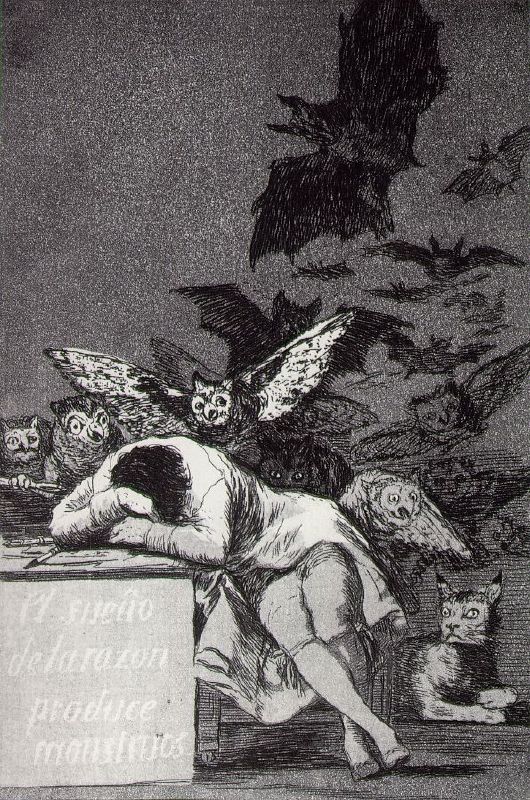
The Sleep of Reason Produces Monsters -- Goya (1797)
If 2666 impossibly haunts The Third Reich from the future, then paranoid Poe haunts it from the past. Last time we checked in, Udo Berger and his beautiful girlfriend Ingeborg had made tentative friends with another German couple while spending the summer at a seaside resort in Spain. Through this pair, they meet up with two nefarious locals, the Wolf and the Lamb; Udo also begins obsessing over a man named El Quemado, a burn victim who rents paddle boats to tourists. For Udo, the holiday is meant to be a working vacation—he’s a wargame enthusiast, and he plans to write a defining strategy for a new game called “The Third Reich” (implicitly, he plays the Nazi’s side). In the meantime, he’s also taken with the hotel’s owner, Frau Else, a German transplant who mysteriously disappears to take care of an ill husband who no one seems to see.
The first part of The Third Reich (published in the Spring ’11 issue) set the stage for dread, mystery, and extreme paranoia—all while on a sunny seaside holiday. The set-up recalls the seemingly innocuous first section of 2666, “The Part About the Critics,” where four European literature professors spend a vacation of sorts in sunny Mexico while ostensibly searching for a mysterious author. The Third Reich showcases the same sinister tension, describing—but never explaining—the stress between differing cultures, the radical alterity of “being on holiday,” of “vacating,” of being in a different place for a different purpose than what is usual, normal.
The second part of The Third Reich (in the new Summer ’11 issue) increases the dread and paranoia, all with a strange, mordant humor. The novel’s conceit is that the writing is Udo’s holiday’s journal; as such, he controls not only perspective and tone, but what details we learn—or don’t learn. It’s what Udo leaves out that becomes increasingly distressing and fascinating. Indeed, at a crucial point in the novel, Udo fails to explain to us why he remains in Spain after his holiday should be over, even as Ingeborg returns to Germany. There is an ostensible explanation—Charly has disappeared and Udo perhaps wants an answer to the mystery (I will withhold further details for fear of spoiling the plot). It seems more likely that Udo remains to work out his strategy for “The Third Reich”; he finds an unlikely gaming partner in El Quemado. Indeed, the wargame begins to define Udo’s perspective at all times—
When I saw from the balcony that the bathers were beating a mass retreat toward the hotels and campgrounds, I went down to the beach. It’s a sad time of day, and the bathers are sad: tired, sated with sun, they turn their gazes toward the line of buildings like soldier s already sure of defeat; with tired steps they cross the beach and the Paseo Maritimo, prudent but with a hint of scorn, of arrogance in the face of remote danger, their peculiar way of turning down side streets where they immediately seek out the shade leading them directly—they’re a tributue—toward the void.
German nihilism on holiday! Still, Udo finds perverse joy in his gaming sessions with El Quemado; in these episodes, his tone escalates to a manic pitch, reminiscent of some of Poe’s crazies (the narrator of “The Tell-Tale Heart” comes to mind in particular), as well as the mounting insanity of Oscar Amalfitano in 2666. And, just as in the early parts of 2666, The Third Reich begins to buzz with rumors of rape. Udo hints at these rumors, but is unwilling to explore them. Also mysterious is the identity of Frau Else’s husband, a pointedly Gothic conceit, of course, that nonetheless may be the beating heart of horror at the center of the story. He haunts Udo’s sleep—
I dreamed that someone was knocking at the door. It was nighttime and when I opened the door I saw someone slipping down the hall. I followed. Unexpectedly we came to a huge dark room filled with the outlines of heavy old furniture. The smell of mildew and dampness was strong. On a bed a shadowy figure was twisting and turning. At first I thought it was an animal. Then I recognized Frau Else’s husband. At last!
I’ve done my best to omit some of the sharp twists in this section of The Third Reich for fear of spoiling the book, but I will add that Part II ends with something of a subtle cliffhanger (as I write the term “subtle cliffhanger” I realize that it is pure oxymoron; mea culpa). In any case, I’m enjoying the serialization very much and look forward to reading Part III.
From Edith Hamilton’s essay “William Faulkner: Sorcerer or Slave,” collected in The Ever Present Past—
Mr. Faulkner’s novels are about ugly people in an ugly land. There is no beauty anywhere. Whether he deliberately excludes it or does not perceive it, no one can say; but at least he says himself that a blossoming pear tree in the moonlight looks like hair streaming up from the head of a drowned woman, each hair distinct in the water from the others. He describes the scent of a blooming shrub, still wet with dew, as sickening. To walk through the woodlands in summer in “a gloom dimmer than the gray desolation of November” is to feel “malicious little eyes” watching (birds? squirrels?) while under foot the oozing earth crawls with snakes.
But the land is worse, far worse, than all of these unpleasant features put together. It ruins the people it nourishes. A dark curse lies on it. It was “already tainted before any white man owned it . . . from that old world’s corrupt and worthless twilight as though in the sailfulls of the old world’s tainted wind which drove the ships.” Columbus’, presumably. The initial curse, connected with the dispossession of the Indians, appears to be—Mr. Faulkner is not quite clear about it—inherited by the North as well as the South, but its full effect is shown concentrated in the South. “Don’t you see?” young Ike McCaslin cries in “The Bear.” “Don’t you see? This whole land, the whole South, is cursed, and all of us who derive from it, whom it ever suckled, lie under the curse.”
The people, thus doomed, are like the land that dooms them. It is part of the fate that molds them. “Our rivers, our land: opaque, slow, violent, shaping and creating the life of man in its implacable and brooking image.” At this point Poe comes irresistibly to mind. “The dank tarn of Auber—the misty mid region of Weir—the ghoul-haunted woodlands of Weir.” It is the point in the realm of romance where extremes meet, Poe’s lovely and lost Ulalume and Mr. Faulkner’s curse-ridden men
As always, the stack overfloweth. Here are a few of the more interesting titles that have landed at Biblioklept International Headquarters recently.
Banana Republican is the first novel by historian Eric Rauchway. The book is a send up of American Imperialism in the 1920s, satirizing the naked greed, corrupt capitalism, and ugly jingoism that infused the rise of the global economy. Fortunately, all of these ills have left American foreign policy forever, right? Satire! Seriously though, Banana Republican looks to the past to reveal that our current foreign debacles are merely an extension of policies that have been around for decades. The protagonist is Tom Buchanan (yes, that Tom Buchanan, the racist football-playing, mistress-slapping lout of The Great Gatsby). Rauchway sends Buchanan into the fiasco of American intervention in Nicaragua in the early 20th century. In an interview with The St. Petersburg Times, Rauchway points out how this scenario allows for an exploration of the American dream from a decidedly different viewpoint than the one we find in Fitzgerald—-
People always see Gatsby as the novel about the American dream. But the character who represents that dream of upward mobility ends up floating facedown in a swimming pool. Tom Buchanan represents the real American dream: having it all and not having to suffer the consequences. I wanted to get away from the somewhat suspect view of the narrator in Gatsby and let Tom speak for himself. . . .
I was interested in writing about the irresponsibility of American foreign policy, so if you take Tom Buchanan in the 1920s, where are we? We’re in Nicaragua. When you look at American foreign policy, in Europe we do pretty well. In South America, not so much. And there’s that tradition in places that are on the edges of empire: Dissolute people get to go there and act badly and no one calls them on it.
Evgenia Citkowitz’s Ethercollects seven short stories and a novella, all united by psychological and emotional complexity. Citkowitz’s characters explore moral dilemmas as they quest for identity, and if that sounds like the stock of contemporary fiction (which it is), the prose, terse, often chilly, and darkly funny, is what set these apart. Here’s Ligaya Mishan, reviewing the hardback edition last year in The New York Times—
Citkowitz’s book is peopled by mothers and fathers who are fumblers at best, unrepentant alcoholics at worst. A few are simply absentees, like the father of Beatty, the British schoolgirl in “Leavers’ Events,” who is omitted from family suppers, “disqualified by his status as a heroin addict.” The girl’s mother, a high-level fashion editor, is hardly more present. The only grown-up in Beatty’s life who actually behaves like one is, oddly enough, the rakish novelist she invites to the opera. After initiating a lazy seduction, he wisely thinks better of it. Again, Citkowitz flouts expectations: her heroine may be momentarily crushed, but soon she has moved to New York, ascended the editorial ladder at a chic magazine, landed her own office and effectively supplanted her mother — a modern-day Electra.
In his promo vid (below) for The Oregon Experiment, author Keith Scribner suggests that, “It’s a novel that explores the ways in which the political, the social, the personal, the domestic are inseparable.” Those are some pretty grand claims, so here are the details: The Oregon Experiment recounts the story of Scanlon and Naomi Pratt, a couple who move from the East Coast to Oregon, where Scanlon begins his first tenure-track job as a professor who studies radical action mass movements. Naomi was once a “genius nose” who worked for perfume companies, but she’s lost her sense of smell; she’s also pregnant with the couple’s first child. Scanlon quickly becomes enamored of Oregon, and becomes particularly intrigued by local separatists and anarchists; Naomi’s nose returns, but she isn’t quite as thrilled as Scanlon about the new scene (particularly Scanlon’s enchantment with Sequoia, leader of the secessionists), although she does connect with Scanlon’s young subject Clay, an anarchist. Scribner propels his novel with ideas rendered in crisp, realistic dialogue. The Oregon Experiment is new from Knopf.
In Chapter 4 of F. Scott Fitzgerald’s The Great Gatsby, narrator Nick Carraway recounts the names of the rich, shallow, parasitic guests who attended Gatsby’s parties. Nick tells us the list comes from “an old time-table” of names he originally recorded in July 5th—significantly, the day after Independence Day: the day after the hopes and dreams of a new country. From the chapter—-
Once I wrote down on the empty spaces of a time-table the names of those who came to Gatsby’s house that summer. It is an old time-table now, disintegrating at its folds, and headed “This schedule in effect July 5th, 1922.” But I can still read the gray names, and they will give you a better impression than my generalities of those who accepted Gatsby’s hospitality and paid him the subtle tribute of knowing nothing whatever about him.
From East Egg, then, came the Chester Beckers and the Leeches, and a man named Bunsen, whom I knew at Yale, and Doctor Webster Civet, who was drowned last summer up in Maine. And the Hornbeams and the Willie Voltaires, and a whole clan named Blackbuck, who always gathered in a corner and flipped up their noses like goats at whosoever came near. And the Ismays and the Chrysties (or rather Hubert Auerbach and Mr. Chrystie’s wife), and Edgar Beaver, whose hair, they say, turned cotton-white one winter afternoon for no good reason at all.
Clarence Endive was from East Egg, as I remember. He came only once, in white knickerbockers, and had a fight with a bum named Etty in the garden. From farther out on the Island came the Cheadles and the O. R. P. Schraeders, and the Stonewall Jackson Abrams of Georgia, and the Fishguards and the Ripley Snells. Snell was there three days before he went to the penitentiary, so drunk out on the gravel drive that Mrs. Ulysses Swett’s automobile ran over his right hand. The Dancies came, too, and S. B. Whitebait, who was well over sixty, and Maurice A. Flink, and the Hammerheads, and Beluga the tobacco importer, and Beluga’s girls.
From West Egg came the Poles and the Mulreadys and Cecil Roebuck and Cecil Schoen and Gulick the state senator and Newton Orchid, who controlled Films Par Excellence, and Eckhaust and Clyde Cohen and Don S. Schwartze (the son) and Arthur McCarty, all connected with the movies in one way or another. And the Catlips and the Bembergs and G. Earl Muldoon, brother to that Muldoon who afterward strangled his wife. Da Fontano the promoter came there, and Ed Legros and James B. (“Rot-Gut.”) Ferret and the De Jongs and Ernest Lilly — they came to gamble, and when Ferret wandered into the garden it meant he was cleaned out and Associated Traction would have to fluctuate profitably next day.
A man named Klipspringer was there so often and so long that he became known as “the boarder.”— I doubt if he had any other home. Of theatrical people there were Gus Waize and Horace O’donavan and Lester Meyer and George Duckweed and Francis Bull. Also from New York were the Chromes and the Backhyssons and the Dennickers and Russel Betty and the Corrigans and the Kellehers and the Dewars and the Scullys and S. W. Belcher and the Smirkes and the young Quinns, divorced now, and Henry L. Palmetto, who killed himself by jumping in front of a subway train in Times Square.
Benny McClenahan arrived always with four girls. They were never quite the same ones in physical person, but they were so identical one with another that it inevitably seemed they had been there before. I have forgotten their names — Jaqueline, I think, or else Consuela, or Gloria or Judy or June, and their last names were either the melodious names of flowers and months or the sterner ones of the great American capitalists whose cousins, if pressed, they would confess themselves to be.
In addition to all these I can remember that Faustina O’brien came there at least once and the Baedeker girls and young Brewer, who had his nose shot off in the war, and Mr. Albrucksburger and Miss Haag, his fiancee, and Ardita Fitz-Peters and Mr. P. Jewett, once head of the American Legion, and Miss Claudia Hip, with a man reputed to be her chauffeur, and a prince of something, whom we called Duke, and whose name, if I ever knew it, I have forgotten.
All these people came to Gatsby’s house in the summer.
Mark Twain’s Fourth of July speech, delivered in Keokuk, Iowa, 1886—
Ladies and gentlemen: I little thought that when the boys woke me with their noise this morning that I should be called upon to add to their noise. But I promise not to keep you long. You have heard all there is to hear on the subject, the evidence is all in and all I have to do is to sum up the evidence and deliver the verdict. You have heard the declaration of independence with its majestic ending, which is worthy to live forever, which has been hurled at the bones of a fossilized monarch, old King George the III, who has been dead these many years, and which will continue to be hurled at him annually as long as this republic lives. You have heard the history of the nation from the first to the last–from the beginning of the revolutionary was, past the days of its great general, Grant, told in eloquent language by the orator of the day. All I have to do is to add the verdict, which is all that can be added, and that is, ‘It is a successful day.’ I thank the officers of the day that I am enabled to once more stand face to face with the citizens that I met thirty years ago, when I was a citizen of Iowa, and also those of a later generation. In the address to-day, I have not heard much mention made of the progress of these last few years–of the telegraph, telephone, phonograph, and other great inventions. A poet has said, ‘Better fifty years of England than all the cycles of Cathay,’ but I say ‘Better this decade than the 900 years of Methuselah.’ There is more done in one year now than Methuselah ever saw in all his life. He was probably asleep all those 900 years. When I was here thirty years ago there were 3,000 people here and they drank 3,000 barrels of whisky a day, and they drank it in public then. I know that the man who makes the last speech on an occasion like this has the best of the other speakers, as he has the last word to say, which falls like a balm on the audience–though this audience has not been bored to-day–and though I can’t say that last word, I will do the next best thing I can, and that is to sit down.

 Lars Iyer’s first novel Spurious (



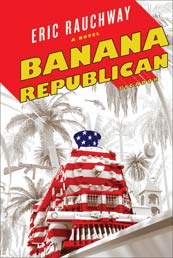 Banana Republican is the first novel by historian Eric Rauchway. The book is a send up of American Imperialism in the 1920s, satirizing the naked greed, corrupt capitalism, and ugly jingoism that infused the rise of the global economy. Fortunately, all of these ills have left American foreign policy forever, right? Satire! Seriously though, Banana Republican looks to the past to reveal that our current foreign debacles are merely an extension of policies that have been around for decades. The protagonist is Tom Buchanan (yes, that Tom Buchanan, the racist football-playing, mistress-slapping lout of The Great Gatsby). Rauchway sends Buchanan into the fiasco of American intervention in Nicaragua in the early 20th century. In an interview with
 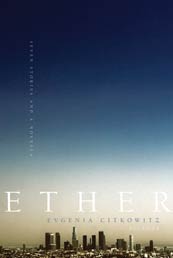 Evgenia Citkowitz’s Ether collects seven short stories and a novella, all united by psychological and emotional complexity. Citkowitz’s characters explore moral dilemmas as they quest for identity, and if that sounds like the stock of contemporary fiction (which it is), the prose, terse, often chilly, and darkly funny, is what set these apart. Here’s Ligaya Mishan, reviewing the hardback edition last year in
  In his promo vid (below) for The Oregon Experiment, author Keith Scribner suggests that, “It’s a novel that explores the ways in which the political, the social, the personal, the domestic are inseparable.” Those are some pretty grand claims, so here are the details: The Oregon Experiment recounts the story of Scanlon and Naomi Pratt, a couple who move from the East Coast to Oregon, where Scanlon begins his first tenure-track job as a professor who studies radical action mass movements. Naomi was once a “genius nose” who worked for perfume companies, but she’s lost her sense of smell; she’s also pregnant with the couple’s first child. Scanlon quickly becomes enamored of Oregon, and becomes particularly intrigued by local separatists and anarchists; Naomi’s nose returns, but she isn’t quite as thrilled as Scanlon about the new scene (particularly Scanlon’s enchantment with Sequoia, leader of the secessionists), although she does connect with Scanlon’s young subject Clay, an anarchist. Scribner propels his novel with ideas rendered in crisp, realistic dialogue. The Oregon Experiment is new from

 Biblioklept