Lost: Lost in the Funhouse

It’s been a while since I’ve written about a stolen book (ostensibly, this blog is all about book theft. But we’re easily distracted here). John Barth’s Lost in the Funhouse is one of my favorite short story collections ever and it’s been MIA from my library for a couple of years now. The collection starts with “Frame Tale,” a one-page (front and back) meta-commentary that informs the whole text. “Frame Tale” is essentially a marginal strip which says “Once upon a time…” on one side and “there was a tale that began…” on the other. The accompanying directions (a number of the stories come with directions; some are to be read aloud, some are to be tape recorded and played back, some are to be read aloud along to looped recording) direct the reader to cut out a strip of paper and connect the opposing ends, creating a Möbius strip, a commentary on the infinite and cyclical nature of story-telling (Barth expanded on this theme in the three linked novellas of Chimera).

funhouse-pbk.gif funhouse-hbk.jpg

My favorite story in the collection is “Petition,” a letter from a distraught Siamese twin, but the most lauded tale in LITF is the title story. “Lost in the Funhouse” recounts the adventures of young Ambrose as he navigates a bizarre amusement park funhouse during a family vacation to the beach one summer. The story is shot through with sexual anxiety and familial tension; Ambrose’s confused (and sometimes confusing) narrative loops discursively, unwinding and then condensing as he trips over his own thoughts. David Foster Wallace riffs off of “Lost in the Funhouse” in his long short story “Westward the Course of Empire Goes” (from Girl With Curious Hair). Ambrose, a semi-autobiographical stand-in as Barth’s pubescent alter-ego, appears as a a much older writing teacher in DFW’s novella. Clever, hunh? And to think, some people hate post-modernism! I feel bad for these folks.

I think that this collection paired with DFW’s Girl With Curious Hair (or, even better Brief Interviews With Hideous Men) makes a great introduction to post-modern writing. The major tropes, themes, and devices are explored in these books in short, digestible chunks full of humor and (surprise!) emotion. Highly recommended.

The Evolution Will Be Televised

If you missed The Simpsons last night, you need to check out the extended couch-gag intro below (may god bless Youtube). Marvel as Homer demonstrates eons of evolution in just over a minute. Best. Intro. Ever.

This isn’t the first time The Simpsons has dealt with evolution and its (nonsensical) opponents. An unbiased comparison between creationism and Darwinism:

And of course, the horror of the Flanders (note the sweet soundtrack to the end of this one courtesy of the Doobie Brothers):

The Biblioklept Interview: Eddie de Oliveira

Last month a local news station reported that Eddie de Oliveira’s book Lucky was being placed under review by the Duval Public School Board. Apparently an upset mother was disturbed by some of the content of the book; instead of calling the school directly, she allegedly went directly to the local news. I reacted by posting this blog, to which Eddie responded. We exchanged a few emails and I tried to contact some of the people involved in this story; I believe Folio tried to follow up this story also, but the leads go nowhere. I still haven’t been able to find out if the book really is “under review,” but I asked my department head (I teach English) if such a review list or “banned list” existed, and she said she’d never heard of such a thing. She then became alarmed and told me to “be careful” with what my classes read. This is kind of an unwritten rule of public education: don’t rock the boat. Play it safe. Books can be dangerous.

There’s nothing dangerous about Lucky, though, and I mean that in the nicest way–it is a book intended for teens, after all. Some down here in the beautiful South may still be alarmed or shocked by the subject matter of a sexually confused teen navigating identity in modern London. However, the real themes here are hardly subversive: Young Adult (YA) fiction has a legacy of exploring what it means to be an individual among a collective, and how young people are to negotiate a “proper” space in society. In the case of Lucky‘s protagonist Sam, that “proper” space is constantly under attack from all directions, as he is repeatedly prompted to identify–is he straight? gay? bisexual? In a way, the novel creates a meta-critique of those who would question its valid, “proper” space in a school library–unfortunately, those would-be censors will probably not read the book, preferring to simply highlight “offending” words.

Lucky tells an important story about the search for identity that all teens have to traverse, and I would have no problem suggesting it to any of my students. Eddie was kind enough to answer a few questions, which you will find below.

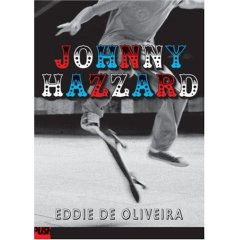
You can find both of Eddie’s books, Lucky and Johnny Hazzard, at Amazon or your local library.
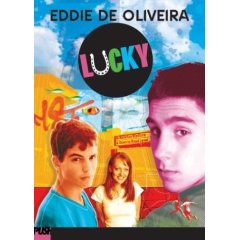
luck.jpg hazz.jpg

Biblioklept: Have you ever stolen a book, and if so, could you
talk a little bit about that experience?

Eddie de Oliveira: I removed the Wide Awake Club book of Ghosts, Monsters
and Legends
from my school library when I was around
ten years-old. The Wide Awake Club was a Saturday
morning kids’ show, and this book was the bomb.

BK: Have you ever borrowed a book and never returned it
(on purpose)?

EO: I have not. I never checked out the Wide Awake Club
book.

BK: What are you reading right now?

EO: I’m reading Four Trials by Senator John Edwards. Amid
all the media hullabaloo about Hillary and Barack,
I’ve been impressed by the one candidate for the
presidency who bothers to combine policies with
explanations on how he’ll implement them. I’m also
impressed by Edwards’ manner, rhetoric and sincerity.
Four Trials was published in 2003, and, as the title
suggests, it recounts four of Edwards’ most defining
moments in the courtroom when he was a trial lawyer,
defending the powerless against medical negligence and
corporate giants.

Next up, I’ll re-read The Perks of Being a Wallflower,
which I first read way back when.

BK: What were your favorite books as a child?

EO: I loved Roald Dahl – especially Charlie and the
Chocolate Factory
and George’s Marvelous Medicine. I
re-read Charlie not so long ago and it really is
special. I remember reading To Kill a Mockingbird and
Lord of the Flies at school and thinking they were
extraordinary – helped, perhaps, by having a brilliant
English teacher back then, Mrs. Martin.

Way before I was 13, I read The Secret Diary of Adrian
Mole aged 13 ¾
and The Growing Pains of Adrian Mole
several times. And, of course, the Wide Awake Club
book of Ghosts, Monsters and Legends
.

BK: You are currently an expatriate, living in Sweden.
Could you say a few words on this?

EO: London was pissing me off and in Sweden, most ‘things’
work very well. It may be colder, but the tap water
tastes like water should and the Stockholm air doesn’t
turn my white earphones black after two days.
Everybody speaks English very well (some better than
my compatriots) which makes learning Swedish rather
hard. Public transport is cheap and, for the most
part, reliable. The overwhelming sense here is that
the government actually gives a shit about its
citizens.

I’ve done some freelance journalism and continued
working on new books and film projects since living
here.

BK: Your book Lucky could be seen to fall under the
rubric of Young Adult fiction. What do you think of YA
as a genre, and was it your initial intention to reach
young people with your book?

EO: Yes, Lucky and Johnny Hazzard are both YA. I think
it’s an important genre and, thankfully, a growing
one. More and more books are being written primarily
with teens in mind, and those of us who write them
have a significant and serious responsibility. That
responsibility is to stay relevant and realistic,
avoiding some kind of The OC type representation of
what it is to be an adolescent. I read Melvyn Burgess’
Doing It, a YA/adult crossover title. He’s a good
writer, no doubt about it, but it really reads like a
middle-aged man writing about teens.

Johnny Hazzard is a love story written for teenage
boys. It’s a hard sell, because teen boy aren’t
renowned for their reading. Probably the finest
compliment I’ve ever received was on a 17-year-old
Texan boy’s myspace page. He listed dozens of bands in
the favourite Music section, a bunch of films in the
Movies section, and, in Books, it just said “I don’t
really read except this one book called Johnny
Hazzard
.”

If I ever stop knowing how a teenager thinks, I’lI
quit YA and begin writing cookbooks.

BK: As you know, a cranky mom in Duval County, here in
sunny Florida, has raised some objections to you book
Lucky having a place in her kid’s school library. Is
there any merit to her objections? If you could speak
with her, what would you say?

EO: There is no merit to her preposterous objections.
Censorship of any form is reprehensible. I don’t
accept that Lucky isn’t suitable for a child. It’s a
book about identity and figuring out where you fit in.
It is not a bomb-making manual.

If I could speak with her, I’d sit her down with a
fine Arctic Daquiri, served on a coaster with the text
of the First Amendment written over it. I’d ask her
what she’s afraid of, and offer her a signed copy of
Johnny Hazzard.

BK: How does one make an Arctic Dacquiri?

EO: Arctic Daquiri
———–
Lots of ice cubes
Winter fruits (berries)
Sugar water
Vodka

Put it in the blender. Absolutely wonderful.

BK: Are you an Edwin or an Edward (or possibly an
Edmund, or just an Eddie)?

EO: I’m neither, I’m an Eduardo. You also left out Edgar.

(ed. note: Biblioklept will now acknowledge an anglocentric bias that we didn’t even know we had!)

BK: According to your Myspace page, you and I are the
same age. How is it that you’ve managed to write and
publish two books, while I’ve accomplished so very,
very little in comparison? But no, seriously, how long
have you been writing? What kind of writing did you do
when you were younger?

EO: I’m motivated by guilt: Each and every day I feel I
haven’t achieved enough, and that motivates me to get
some work done. I have South American parents,
football was on the diet from a young age, and so I
look at my career like that of a footballer’s;
considering they hit their peak at 27 and tend to be
on the slide by 31, it’s not a constructive analogy.

I’ve been writing since I was small – I started out
with school magazines and little plays I’d put on with
my friends, then moved on to big plays I’d put on at
the Edinburgh Festival and in London, and then on to
the fiction novels, short films and journalism.

BK: You seem to be a big Beastie Boys fan. What draws
you to their music? What album is “the” Beastie Boys
album, in your opinion?

EO: The Beastie Boys are the most innovative and important
American band alive. They’re always a step ahead,
doing new things, mixing up genres and sounds. “The”
album for me has to be Paul’s Boutique, which did all
of those things I’ve just mentioned, but on a massive
scale. That record pioneered the art of sampling,
which is now a given in almost every modern musical
style.

Goodbye Blue Monday

A few things:

1. I am still exhausted after my sister-in-law’s wedding this weekend. I was the best man, which was more involved than I had originally believed. Special props to the photographers, the DJ, and the caterer, all friends and family who went above and beyond what was expected. Contact these guys for your next wedding, bar mitzvah, super sweet sixteen, or Guy Fawkes Day party.

2. Luckily, this week is Spring Break, and I have the next couple of days off of work and grad school. What does this mean to you? Well, hopefully I’ll get back on track with the Ontology 101 project, and actually start posting again about books that I’ve stolen (I know that’s what you come here for). You can also look forward to an interview with Eddie de Oliveira, author of Lucky and Johnny Hazzard, to be published later this week. Until then…

3. A few placeholders to quell some of that Monday boredom:

A. Go to Strange Maps. Another great WordPress blog that lives up to its name. Love it!

hollowearth.GIF

B. Tarantino/Rodriguez’s Grindhouse comes out the first week of April. Looks like good old fashioned fun. Check out the full theatrical trailer–

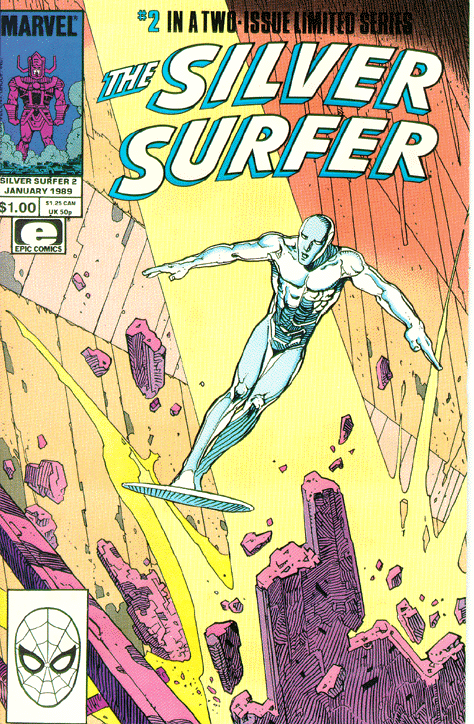
C. Enjoy this Silver Surfer cover art gallery before the upcoming Fantastic Four sequel ruins the best Marvel Comics character ever.

silversurfermoebius2.gif

Cover art by French artist Moebius, who created a line of comic books with Alejandro Jodorowsky in the 1970s.

Midnight Movies

The San Marco Theater in beautiful San Marco, Jacksonville, FL will be playing two very bizarre movies over the next few weekends: El Topo and The Holy Mountain, both by weirdo director Alejandro Jodorowsky. Both movies are Eastern Westerns featuring Christ-like protagonists who negotiate surreal and brutally violent worlds. Jodorowsky’s heroes ritualistically transgress taboo, exploring and re-interpreting colonialism, mythology, sexuality, and the concept of an idealized, subjective self. The Holy Mountain is particularly worth your two hours and six bucks–who wouldn’t want to see disfigured freaks, alchemical self-improvement, genital mutilation, cannibalism, incest and (my favorite scene) frogs and iguanas dressed as Conquistadors and Indians recreating the conquest of South America? Also features full-frontal nudity and numerous executions. Soundtrack by Don Cherry.

El Topo plays March 23rd and 24th at midnight; The Holy Mountain plays March 30th and 31st at midnight.

Also playing at the San Marco Theater beginning March 18th is Old Joy, a 2006 film starring Daniel London and our favorite Palace Brother, Will Oldham. Soundtrack by Yo La Tengo.

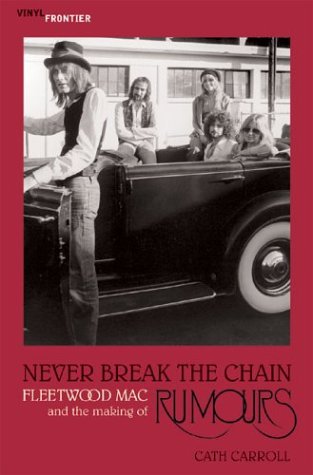
Never Break the Chain–Cath Carroll on Fleetwood Mac

neverbreakthechain.jpg

Never Break the Chain: Fleetwood Mac and the Making of Rumours by Cath Carroll (yes, that Cath Carroll) provides an excellent overview of the long, strange career of Mick Fleetwood and company. Like many of you (I’m guessing), I was introduced to Fleetwood Mac via my parents, who played Rumours ad infinitum. It was one of the first albums I “owned”–from the vinyl, I recorded a cassette copy that I played on my Sony Walkman repeatedly. I believe Born on the USA was on the other side. As the years passed, Fleetwood Mac somehow became very uncool to my ears (i.e., they did not rap, there was a paucity of shredding metallic guitar overtures, etc), then slightly cooler, then totally uncool (i.e. the Clintons, the reunion tour), then very very cool (thank you college, thank you Tusk).

Never Break the Chain is organized chronologically, making it easy for readers such as myself to skip around to sections of greater interest. The majority of Carroll’s research comes from previously published articles from magazines like Creem and Rolling Stone, as well as a few interviews. Carroll navigates the Mac’s bizarre history, detailing the numerous personnel changes. Mick Fleetwood is the book’s undisputed hero, the rock(er) who kept the band together through the tumultuous tempest of three decades. It’s fascinating to see how the band transforms from a British blues rock group from the John Mayall school of rock, to the melodic songwriting team that recorded the utterly-Western masterpiece Rumours.

As the title suggests, the making of Rumours becomes the focal point of the book. Carroll explores the bizarre love quadrangles that erupted within the band during that time, although for my taste there wasn’t quite enough VH1’s Behind the Music trashiness to her analysis. Ditto for the legendary cocaine use that supposedly fueled the FM’s late seventies output, which is largely glossed over.  However, gearheads who can’t get enough descriptions of studio equipment, instrumentation, and production techniques will love this book. Carroll goes into very detailed accounts of how FM approached songwriting–some of the most interesting passages recount how the band arrived at the album sequences. Plenty of in-fighting, plenty of fights with the studio, and a whole chapter devoted to Tusk. On the whole not bad. However, no substitution for actually listening to the albums.

Bibliomania

This Saturday, the missus and I headed to the Jacksonville Fairgrounds for the annual Friends of the Library Sale. Parking was no problem, and the event was well attended but not crowded. Amidst the seemingly endless horde of V.C. Andrews and Robert Ludlum leftovers, we grabbed some great stuff.

I got an extremely handsome first edition of Steinbeck’s The Acts of King Arthur and His Noble Knights, which appears to have never been touched, let alone read. This book will fit nicely within an already-large collection of Arthur book’s I’ve never finished (with the exception of T.H. White’s version, which I devoured as a youth).

35b8b340dca0d12aab1d6010_aa240_l.jpg

While searching through kids books, my special lady came across a hardback edition of Persepolis 2. You may recall I wrote about Satrapi’s first book of Persepolis a few weeks ago. I’m happy to report that the books now exist in a special harmony, together at peace on my shelf.

I also picked up a few books I may never get around to reading, including Ian McEwan’s Atonement. This list-topper won all kinds of awards a few years ago, despite accusations of plagiarism. I’m sure that Gabriel Garcia Marquez’s One Hundred Years of Solitude is like, the best book ever: I’ve thoroughly enjoyed the first fifty pages several times now. I keep promising myself: next summer. The strangest thing is that I didn’t actually own this book before now. The “Oprah Book Club” sticker came off no problem, by the way. Another one that I started years ago in college, a library loan, was John Barth’s The Sot-Weed Factor, a humorous tale of Americana that I couldn’t make heads or tails of as an undergrad. The book is huge; the copy I bought, despite being a paperback edition from the early 80s, has no spinal damage and appears unread. Undoubtedly it will stay this way.

Much more useful, I’m sure, will be The Dictionary of Literary Terms by J.A. Cuddon. This book is fantastic, and I’ve already put it to good use. Cuddon’s approach is exciting: he uses plenty of illustrative examples, and even puts the specialized terminology into historical context–in many ways, this book is like a crash course on the history of rhetoric.

I was thrilled (no really, thrilled) to come across two books from the 33 1/3 series. In this series, one writer takes a close look at just one musical album. I’d already read Chris Ott’s take on Joy Division’s Unknown Pleasures; I was lucky enough to snap up Jimi Hendrix’s Electric Ladyland by John Perry and Prince’s Sign O’ the Times by Michaelangelo Matos. So far, John Perry’s take on Hendrix has been one of the best musical biographies I’ve ever read, which is really saying something (for the record, it’s still no contest against the immortal classic, Crazy from the Heat, by one David Lee Roth). In edition to being concise and well-written, these books are small and have a stylish design. Perfect bathroom reading material.

082641571701_ss500_sclzzzzzzz_v1075163157_.jpg

Of course there were other sundry books bought, and plenty abandoned (I still regret not spending the fifty cents on Bikini Planet, a pulp sci-fi that promised “Benny Hill style humor” What was I thinking?) I could hardly carry our box as it was (although, in the interest of full-disclosure, I am very physically weak).

After the book sale, we headed across Downtown to the Prime Osborn Convention Center. My father had given us free passes to the Home and Patio Show. It was shocking. People were paying five bucks to park, waiting in a line that zigzagged out the door to pay who-knows-how-much to gain entry to what amounted to a bunch of vendors trying to sell you crap. I kept shaking my head in disbelief. Down the road were thousands and thousands of books that were practically being given away, but here people were lining up and paying to be sold things. Ah…Jacksonville! You’ve gotta love it.

Friends of the Library Sale

Are you a nerd living in Jacksonville, Florida with nothing to do this weekend? Do you suffer from bibliomania? Do the stacks and stacks of (unread) books cluttering your living space do nothing to prevent you from buying even more books? If you answered in the affirmative to any of these questions, then mosey on down to (or alternately, simply drive to) the illustrious Jacksonville Fairgrounds for the Friends of the Library book sale. Located in glamorous Exhibit Hall B, the sale promises “7 tractor trailer loads of books; 50% donated; 50% hardcover; sorted; .50 & up.” It’s unclear what the exact breakdown of these books will be (are the half that are donated mutually exclusive from the half that are hardcover? You’ll just have to go and see!)

smlogo.gif

(For the record, I look just the same as the woman pictured above does when I read–calm, cool, and reflective, my fist poised gently (philosophically even) under my chiseled chin, book perched  delicately in my manicured hand, thinking deep and profound thoughts)
The details:

Jacksonville Fair Grounds (Exhibit Hall B)

Friday, March 2nd 10am-8pm

Saturday, March 3rd 10am-6pm

Sunday, March 4th noon-6pm

Robocop-like Strategies of Carceral Negotiation, Racially Heteroglossic Wilds, and More Bad Writing

Even though Denis Dutton discontinued his annual Bad Writing award (published in Philosophy and Literature) way back in 1999, it’s still fun to take a look at some of the worst sentences in academia from years past. Notable winners (?!) include Judith Butler and Frederic Jameson, but my favorite sample comes courtesy Professor Rob Wilson:

“If such a sublime cyborg would insinuate the future as post-Fordist subject, his palpably masochistic locations as ecstatic agent of the sublime superstate need to be decoded as the “now-all-but-unreadable DNA” of a fast deindustrializing Detroit, just as his Robocop-like strategy of carceral negotiation and street control remains the tirelessly American one of inflicting regeneration through violence upon the racially heteroglossic wilds and others of the inner city.”

With sentences like this, it’s no wonder that many people consider academics to be obscurantists, sophists who rely on the trickery of word play to cover up vacuous thoughts (in a candid moment, I might fess up to occasionally dabbling in such writing. OK. I admit it. I confess. Mea culpa. I’m guilty of thousands and thousands of bad sentences. So there.)

Tomorrow, we’ll take a look at how hoaxes perpetrated by Alan Sokal and others have challenged the often-pseudoscientific field of post-modern cultural studies.

Infinite Infanticide (Aldous Huxley’s Ape and Essence)

A few weeks ago, I saw (and loved) Children of Men, and it reminded me of one of my favorite books of all time, Ape and Essence by Alduous Huxley.

Ape and Essence

If you’ve only read one book by Huxley, chances are it was Brave New World, an incredibly prescient novel that really “got it right” so to speak–especially when compared to George Orwell’s vision of a dystopian future, 1984. In 1984, Orwell assumes that a totalitarian regime will hide and distort information from a suppressed public, that a Big Brother will watch our every move. Huxley’s BNW posits a future where the public could care less about information at all, a public that willingly cedes an antiquated ideal of “privacy.” In 1984, books are banned; in BNW no one wants to read (and who would want to read when a trip to the feelies provides a total synesthetic experience?)
But where was I…

So. Yes. Hmmm. Ape and Essence. This is a fantastic book, thoroughly entertaining–blackly sardonic, acidic and biting, yet funny and moving, full of pathos and dread and the possibility of loss, extinction, the end of beauty. I have forced this book on just about everyone I know, to the point that it is now Duck-taped together. Ape and Essence is a frame tale of sorts: it begins (significantly, on the day of Gandhi’s assassination) with two Hollywood types discovering the screenplay for an unmade movie called Ape and Essence. Intrigued by the strange story, the two head out to the desert to meet the writer, only to find that he’s recently died. The surreal and imagistic screenplay is then presented uncut as the remainder of the book. Ape and Essence presents an illiterate, post-apocalyptic world where grave-robbing is the primary profession. The hero of the story is one Dr. Poole, a scientist from New Zealand (New Zealand was isolated enough to resist nuclear holocaust) who arrives with a team of scientists to the West Coast of America. Poole is quickly separated from the other scientists and forced into slave labor, excavating graves. He finds a world where people worship the satanic god Belial, who they believe, in his anger, is responsible for the high numbers of genetically deformed children. These children are ritualistically slaughtered in purification rites that frame the social discourse of this New America. Additionally, procreation is proscribed to a two week ritual-orgy; other than this fortnight of lust and blood, sex and love are completely forbidden. The rest of the book details Poole’s infatuation with a woman named Loola, and their plan to escape to a rumored colony of “hots,” outsiders who don’t accept Belial and orgies and book burning and so on.


bosch-trittico-carro-fieno-3-inferno-2-bassa_jpg.jpg

Like Children of Men, Ape and Essence presents infanticide as the ultimate negation of progress. In both stories, people are both root and agent of their own destruction. But playing against this self-destructive death drive is the drive for life, for beauty, for sex. Neither story is willing–or able, perhaps–to make a definitive statement on which drive will prevail. Both stories resist “happy endings,” or can only be said to have “happy” endings in the simplest of senses. Ultimately, the endings are inconclusive, unsure, tentative at best. Will the human race die out? Are simple gestures of human fellowship, of poetry, of love, are these enough to conquer the infinite infanticide recapitulated within the narrative framework? We leave the theater feeling some hope, we close the book praying (to who?) that the characters will make it to a (never) Promised Land, but somewhere in the margins of our consciousness lurks the possibility of extinction–the predicate of loss that drives any story worth telling.

Nursing Gorilla


Persepolis

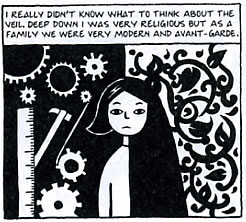
“It was funny to see how Marx and God looked like each other.”

Marjane Satrapi’s Persepolis makes a nice introduction to the graphic novel autobiography for anyone who hasn’t read one before. Marjane’s memoir weaves the political turmoil of the Islamic Revolution with the everyday stuff of childhood experience. As the the repressive Islamic regime revokes liberal freedoms, Marjane’s folks (secular intellectuals, of course) smuggle Iron Maiden posters back from Turkey; young Marjane sneaks cigarettes and rock music to a backdrop of political assassinations and war with Iraq.

persepolis_extract2

Persepolis succeeds by engaging the reader in a personal experience of revolution and cultural alienation. It works as a history lesson and as a coming of age story. Readers who try something different (maybe suspend some prejudices?) will be rewarded with an enriched perspective on a political/cultural upheaval still effecting global politics today.

Early 2007

If you come to this blog regularly, chances are you’re killing a few minutes from what may or may not be a dreary day. So sorry if Biblioklept hasn’t been posting regularly enough to satisfy your cubicle boredom. Early 2007 has been very busy around here, what with bathroom renovations (books, even Time-Life books, will not lay new tile or replumb your corroded pipes), a new school year, and a baby on the way. Between philosophical treatises in graduate school, AP essays to grade, and the self-induced Ontology 101 reading list (“Week 4” begins…uhm…later this week?), I’ve had little time to read anything, let alone get anything decent written.

So well and hence, before January is officially over, The Biblioklept will attempt an assessment of 2007 so far. With one-twelfth of the year already gone, where do we stand?

Books: Okay, I still haven’t made it through David Foster Wallace’s Oblivion, which was published waaaaay back in 2004.  Actually, in the interest of full disclosure, I’ve been attempting the same story repeatedly. My mistake is that I start reading right before I go to sleep–and then I go to sleep immediately. At this rate, I will probably finish anything published in 2007 in late 2011.

Magazines: TodayI got the February issue of The Believer. I still haven’t finished the Dec/Jan issue. A sorry state of affairs for someone who claims to love to read.

Movies: Why have you still not gone to see Children of Men? Go see it in the theater while you still have the chance. This weekend, if time permits, Pan’s Labyrinth. Has anyone seen this one yet?

Music: Lots of great stuff has dropped in 2007. Current favorites–Panda Bear’s Person Pitch, Bobby Conn’s King for a Day, Apostle of Hustle’s National Anthem of Nowhere, Menomena’s Friend or Foe. All of these are great listening and deserve more in-depth reviews, possibly at a later time. Also, Deerhoof’s Friend Opportunity dropped legal style.

TV: I must admit that I love the American Idol auditions (after the schadenfreude of watching losers have their illusions painfully revoked in front of millions, the show turns into pure drivel of course). It was also nice to see Jewel join the judges (do you remember when Jewel was like, alternative?)

Politics: My rage-fatigue has mellowed into a nice warm apathy. Does it matter that the Democrats are “in control”?  

Furniture: I regret passing up an ottoman offered by my uncle.

Wine: I still advocate boxed wines, screwtops will be all the rage in 07.

Pets: As of now, our cat is still alive.

Mythologies–Roland Barthes

“Myth is a language”–Roland Barthes

Everyone should own a copy of Roland BarthesMythologies. Published over 50 years ago, the book seems more relevant than ever. Barthes wields his sense of ironic humor like a scalpel, dissecting the ideological abuse of the post-war spectacle society. In this collection of short essays, Barthes examines the ways in which societies create, use and mediate myths–particularly the way that the “elite,” monied crust of society create new myths–whole systems of myths, really–to control cultural perceptions of “reality.” Barthes uses the language and tools of linguistics in his meditations to examine the malleable space between the signifier and the signified.  Barthes analyzes a range of disparate topics: amateur wrestling, plastic, advertisements for milk and wine, the face of Greta Garbo, children’s toys, and modern film’s conception of the ancient Roman haircut are all considered in relation to how these “everyday” things support the dominant cultural/economic ideology. The methods put forth in  Mythologies are certainly a precursor to what we now call popular culture studies; Barthes is certainly one of the first writers I can think of to dissect mass-mediated, popular culture. And even though it was published half a century ago, Barthes’ keenly ironic style and short-essay format comes across as thoroughly contemporary.

In the final essay of the collection, “Myth Today,” Barthes warns us that the myths we uphold to protect our culture can ultimately destroy the culture. What are the contemporary myth-systems of the United States? What ideology do these myths uphold? Do these myths hold the potential to harm the culture of our great country?

Ways of Seeing

In Ways of Seeing, John Berger riffs off of Walter Benjamin’s famous essay, “The Work of Art in the Age of Mechanical Reproduction,” calling into question how and why images are used and disseminated; in particular, Berger discusses capitalism, the female body, and “fine art.” The internet is clearly the next step in a series of progressions of how information is transmitted, and has been held up as a bastion of information democracy. The personal computer has revolutionized how we view, read, and create images and documents.

Look at the following images. What authority, if any, is present in each image? Who authors the picture? How do history, original context, and cultural paradigms play into how the viewer “reads” the image? What questions do these images provoke?

friends-and-lovers-anki.jpg


dscn1172.JPG

Ontology 101: So What and Who Cares?

Hopefully you’ve had time to sift through and absorb some of the primer. So and well so now you’re probably saying to yourself: “Okay sure, Aristotle, fabulous, Occam’s razor, I’m down, cogito ergo sum, fine, I get it, but so what?”

“So what?” and “Who cares?” are the most fundamental questions in any intellectual pursuit. Asking difficult questions doesn’t necessarily put food on the table or make us more attractive to the opposite sex or give us ten extra years of life.

So what do we gain when we ask: “What is?” and “What is it to exist?” and “What is real?”

Watch the following clip of Deepak Chopra on The Colbert Report. What is Chopra’s ontological position? What applications (political, social, cultural, etc) might his position entail?