He began to wonder about the noise that colors make (Anne Carson’s Autobiography of Red)

It was not the fear of ridicule,

to which everyday life as a winged red person had accommodated Geryon early in life,

but this blank desertion of his own mind

that threw him into despair. Perhaps he was mad. In the seventh grade he had done

a science project on this worry.

It was the year that he began to wonder about the noise that colors make. Roses came

roaring across the garden at him.

He lay on his bed at night listening to the silver light of stars crashing against

the window screen. Most

of those he interviewed for the science project had to admit they did not hear

the cries of the roses

being burned alive in the noonday sun. Like horses, Geryon would say helpfully,

like horses in war.No, they shook their heads.

Why is grass called blades? he asked them. Isn’t it because of the clicking?

They stared at him. You should be

interviewing roses, not people, said the science teacher. Geryon liked this idea.

The last page of his project

was a photograph of his mother’s rosebush under the kitchen window.

Four of the roses were on fire.

They stood up straight and pure on the stalk, gripping the dark like prophets

and howling colossal intimacies

from the back of their fused throats. Didn’t your mother mind—

From Anne Carson’s novel-poem Autobiography of Red.
What is an adjective? (Anne Carson)

What is an adjective? Nouns name the world. Verbs activate the names. Adjectives come from somewhere else. The word adjective (epitheton in Greek) is itself an adjective meaning “placed on top,” “added,” “appended,” “imported,” “foreign.” Adjectives seem fairly innocent additions but look again. These small imported mechanisms are in charge of attaching everything in the world to its place in particularity. They are latches of being.

This is the second paragraph of Anne Carson’s poem-novel-romance-history-etc. Autobiography of Red, a book I got in the mail yesterday from BLCKDGRD (which: thank you man!) and feel a totally electric feeling about. The passage above I mentally highlighted, for classroom purposes, I suppose, and otherwise, and the twists in dives and dips in this book-thing are, I don’t know, what hyperbole should I grab? 

He dreamed (Cormac McCarthy’s Suttree)

He dreamed of a race at the poles who rode on sleds of walrus hide and rucked up horn and ivory all drawn by dogs and bristling with lances and harpoon spears, the hunters shrouded in fur, slow caravans against the late noon winter sunset, against the rim of the world, whispering over the blue snow with their sledloads of piled meat and skins and viscera. Small bloodstained hunters drifting like spores above the frozen chlorine void, from flower to flower of bright vermilion gore across the vast boreal plain.

A feverdream from late in Cormac McCarthy’s novel Suttree. Finished the book again this afternoon, via an Michael Kramer’s audiobook—and lots of rereading. I’ve read the last 20 or so pages three times now, and have some thoughts that may coalesce into a riff around the book’s ending (Does Suttree die?).

Last time I wrote at length about Suttree, I focused on how McCarthy synthesizes so much of literature—particularly American lit—in this novel. The passage above is just one minute but shining detail in a baroque masterpiece bristling with such moments. And while it taps into a sort of primeval American past, it also seems to point outward—maybe to McCarthy’s next novel, Blood Meridian, but also to, I don’t know, William Vollmann’s novel The Rifles.

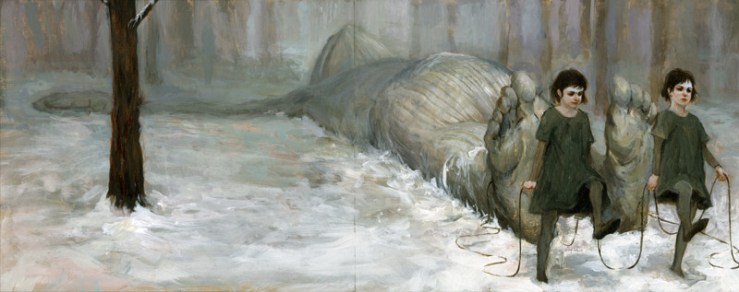
The Whalers — Vincent Hui

whaler1

A last desperate attempt to convince us of the innocence of violence, the good clean fun of horror

The enemy of society on the run toward “freedom” is also the pariah in flight from his guilt, the guilt of that very flight; and new phantoms arise to haunt him at every step. American literature likes to pretend, of course, that its bugaboos are all finally jokes: the headless horseman a hoax, every manifestation of the supernatural capable of rational explanation on the last page—but we are never quite convinced. Huckleberry Finn, that euphoric boys’ book, begins with its protagonist holding off at gun point his father driven half mad by the D.T.’s and ends (after a lynching, a disinterment, and a series of violent deaths relieved by such humorous incidents as soaking a dog in kerosene and setting him on fire) with the revelation of that father’s sordid death. Nothing is spared; Pap, horrible enough in life, is found murdered brutally, abandoned to float down the river in a decaying house scrawled with obscenities. But it is all “humor,” of course, a last desperate attempt to convince us of the innocence of violence, the good clean fun of horror. Our literature as a whole at times seems a chamber of horrors disguised as an amusement park “fun house,” where we pay to play at terror, and are confronted in the innermost chamber with a series of inter-reflecting mirrors which present us with a thousand versions of our own face.

From the introduction to Leslie Fiedler’s Love and Death in the American Novel (1960).

Leisure Hours – John Everett Millais

He saw (Cormac McCarthy’s Suttree)

The fire had died in the room, the candles burned to pools of grease in their dishes. Suttree saw with perfect clarity a parade he’d watched through the legs of the crowd like a thing that passed in a forest, the floats of colored crepe and the band with its drum and horns and the polished wine broadcloth and gold braid and the majordomo in a stained shako wielding a baton and prancing and farting like a brewery horse. He saw what had been so how a caravan of pennanted cars wound through the rain on a dark day and how Clayton in corduroy knickers and aviator’s cap marched with his sisters in a high ceilinged room where the paneled doors were drawn and a nurse in a white uniform called closeorder drill and tapped out the time with a cane and he could remember the stamped brass grapes of an umbrella stand cool and metallic under his tongue and he knew that in that house some soul lay dying.

He saw a pool of oil on a steel drumhead that lay shirred with the pounding of machinery. He saw the blood in his eyelids where he lay in a field in a summer noon and he saw young boys in a pond, pale nates and small bald cods shriveled with the cold and he saw an idiot in a yard in a leather harness chained to a clothesline and it leaned and swayed drooling and looked out upon the alley with eyes that fed the most rudimentary brain and yet seemed possessed of news in the universe denied right forms, like perhaps the eyes of squid whose simian depths seem to harbor with his elbows cocked high as his ears to rest on the dark oak chairarms. He saw a small boy in a schoolyard with a broken arm screaming and how the children watched like animals.

He saw shellfish crusted on the spiles of a wooden bridge and a salt river that ran two ways. Buoybells on a reef where the bones of a schooner broke the shallow surf on the out tide and the sound of the parlous and marbled sea and the seethe of spume and the long clatter of pebbles in the foam. He saw ajar in a garden with mousebones and lint and old sash weights stacked like ingots under a woodshed and the mortised shape of a wagonhub, spokestripped, weatherbleached, oaken, arcane. He saw a dead poodle in a street like a toy dog with its red collar and flannel tongue.

He saw what was so how his sisters came down the steps in their black patentleather shoes and he rode in the car with his mouth on the molding of the rear window and how the cold metal tasted of salt and hummed against his lips and he remembered the attar of rose and candlewax and the facets of a glass doorknob cold and smooth on his tongue.

And he saw old bottles and jars in a row on a board propped up with bricks in a field of sedge and the mixtures of mud and diced weeds within and round white pebbles wherein lay basilisks incubating and secret paths through the sedge and a little clearing with broken bricks, an old limecrusted mortarbox, dry white dogturds. He saw a mooncalf dead in a wet road you could see through it, you could see its bones where it lay pale and blue and naked with eyes as barren as lightbulbs.

And he saw what had been how that old lady who had sat in the stained and cracked photograph like a fierce bird lay cold in state, white satin tucked or quilted and the parched claws that came out of the black stuff of her burial dress looked like the bony hands of some grimmer being crossed at her throat. Black lacquer bier trestled up in a drafty hall and how the rain swung from the rims of the pallbearers’ hats.

A late trip sequence in Cormac McCarthy’s Suttree.

Three Books

image

Love and Death in the American Novel by Leslie A. Fiedler. First edition hardback published by Criterion in 1960. Cover design by Sidney Feinberg. I was dismayed when I first found Fiedler—he’d arrived at his thesis—and supported it with a big fat book—decades before me. I was hipped to this by a kindly professor in graduate school, who suggested I read and then credit Fiedler. I pulled this book out to help me in an American lit course I’m teaching this fall.

IMG_8254

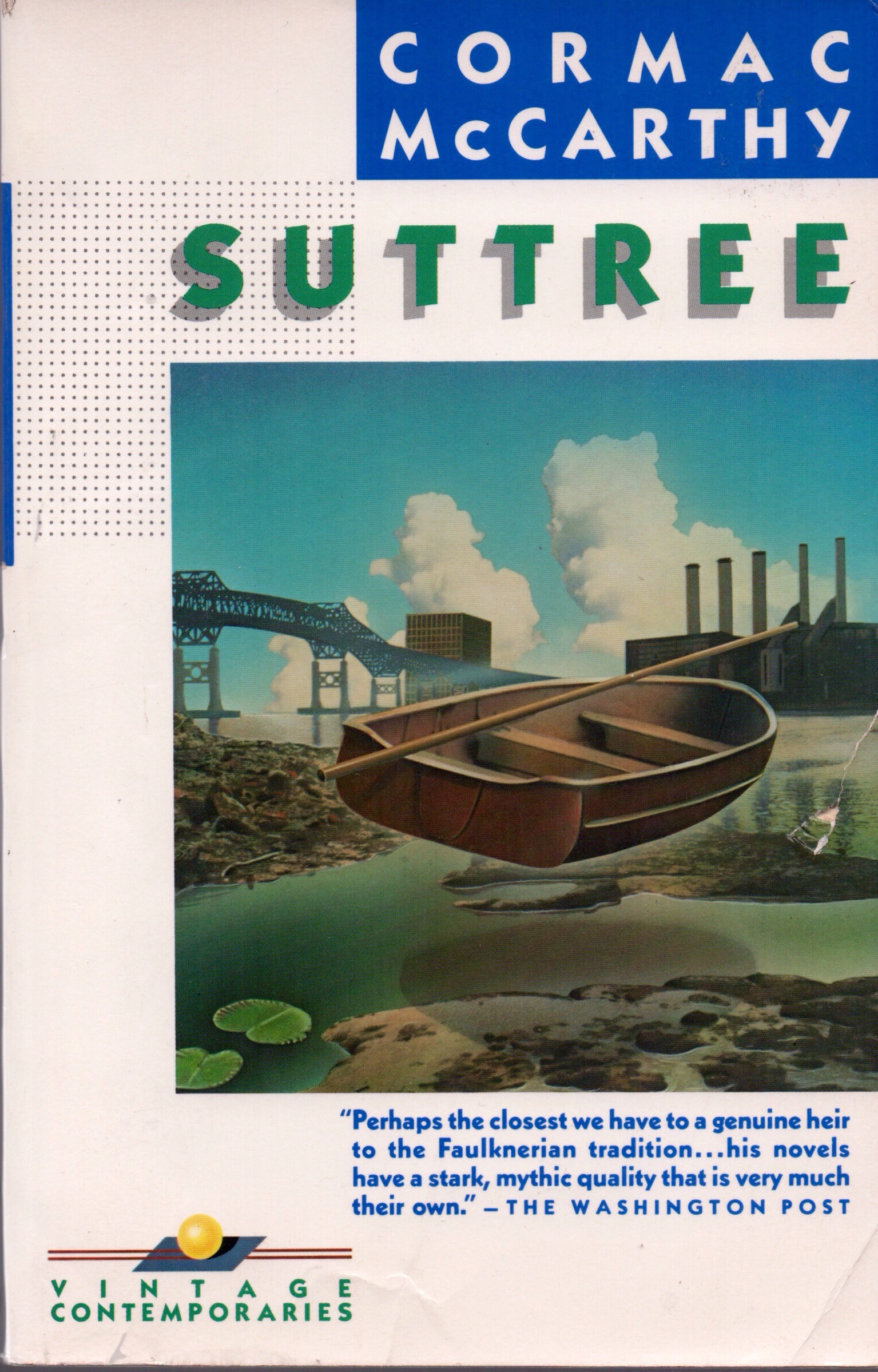
Suttree by Cormac McCarthy. First edition trade paperback published by Vintage Contemporaries. Cover design by Lorraine Louie; cover photo illustration by Marc Tauss. I’ve already written about my love of Vintage Contemporaries covers, and finding this copy of Suttree a few years ago was glorious. I’ve been rereading the novel—auditing it, really, through a superb reading by Michael Kramer. I’ve had this edition out as I go. Suttree, by the way, fits nicely neatly perfectly into Fielder’s thesis about American lit.
IMG_8300

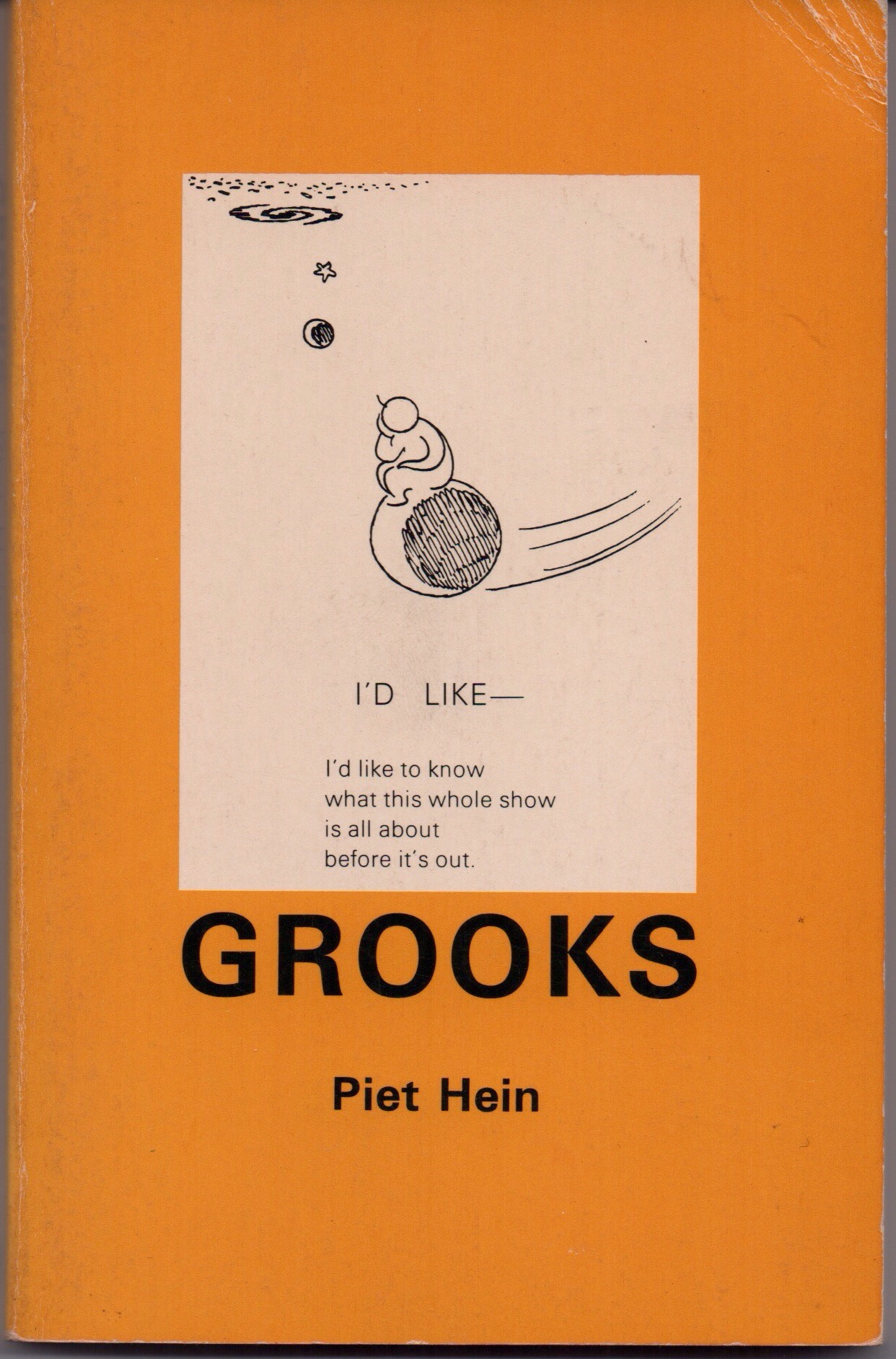
Grooks by Piet Hein. Cute little pocket-sized paperback. Second-edition published by the M.I.T. Press. Cover illustration is by Hein; I can’t find a credit for the designer. I found this in the bookstore the other day when I was looking for something else in the poetry section. Hein’s grooks can be clever, but also occasionally a bit too pithy, if that makes sense. Still.

Summer Fires — Natalia Smirnova

7859230678_e0fdcfb99f_o

Typical male protagonist

The figure of Rip Van Winkle presides over the birth of the American imagination; and it is fitting that our first successful homegrown legend should memorialize, however playfully, the flight of the dreamer from the shrew—into the mountains and out of time, away from the drab duties of home and town toward the good companions and the magic keg of beer. Ever since, the typical male protagonist of our fiction has been a man on the run, harried into the forest and out to sea, down the river or into combat—anywhere to avoid “civilization,” which is to say, the confrontation of a man and a woman which leads to the fall to sex, marriage, and responsibility. One of the factors that determine theme and form in our great books is the strategy of evasion, this retreat to nature and childhood which makes our literature (and life!) so charmingly and infuriatingly “boyish.”

From the introduction of Leslie Fiedler’s Love and Death in the American Novel.

What a Fearful Storm Is Coming — Maurice Sendak

image

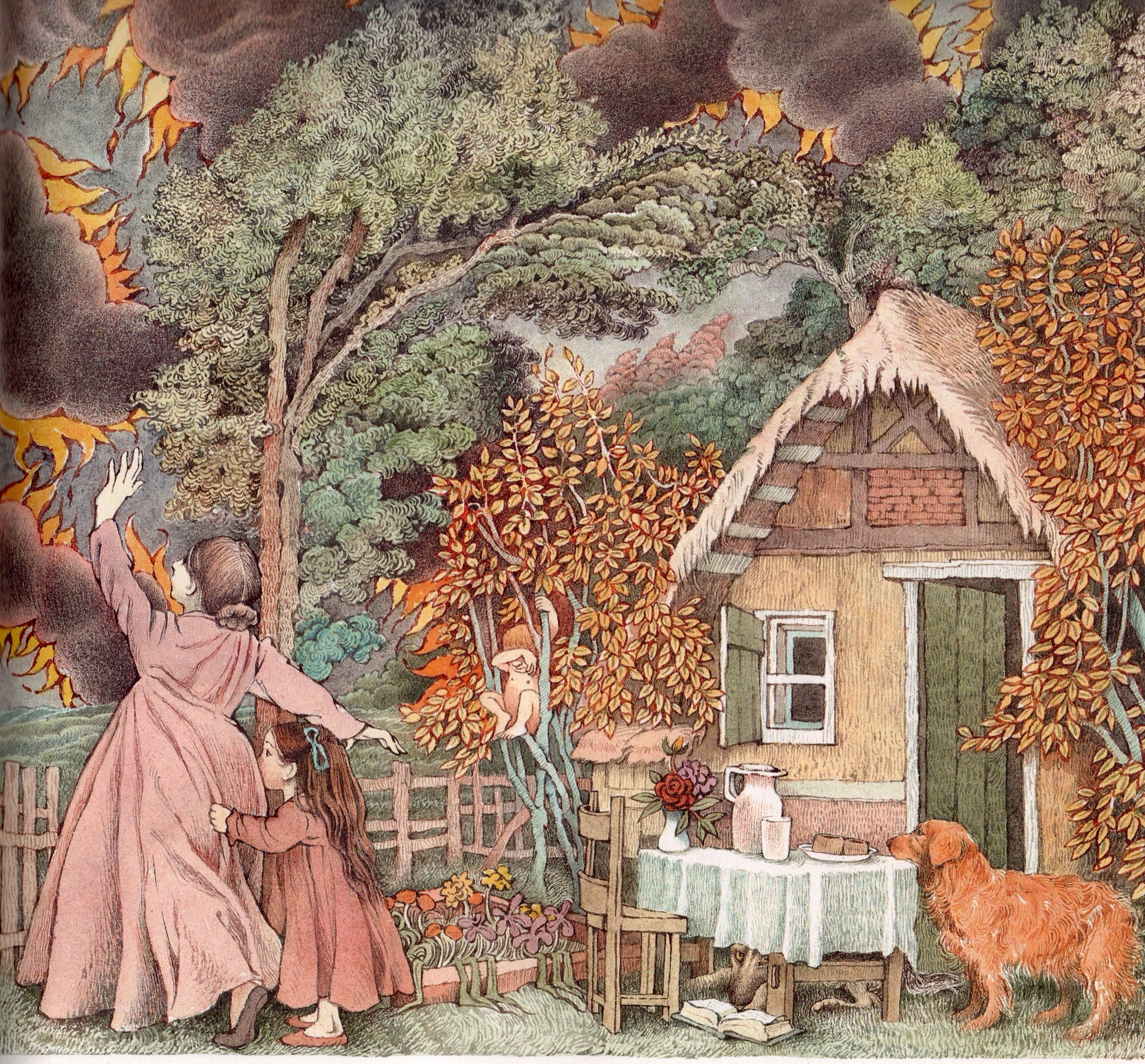
From Maurice Sendak’s retelling of Wilhelm Grimm’s Dear Mili.

The Imaginative Faculty — Rene Magritte

Did Thomas Pynchon publish a novel under the pseudonym Adrian Jones Pearson?

mocksoft

Interesting Pynchonesque Pynchon theory over at Harper’s today: Art Winslow plays with the idea that Thomas Pynchon published a novel called Cow Country under the pseudonym Adrian Jones Pearson. First two paragraphs:

Is it possible that the literary sensibility—person—that produced a clutch of novels under the name Thomas Pynchon has had a fat new novel out since April, under a different name, only to encounter a virtual vacuum of notice? That relative anonymity may have been expected, or might even have been among its aspirations, to prove a point?

Yes and yes. The book in question is called Cow Country, a 540-pager that came out of the chute from Cow Eye Press, a publishing house (if that is what it is) established in 2014 apparently for the express purpose of issuing Cow Country and perhaps related follow-ons, one of which is a centennial reprint of a 1916 eugenicist tract by Madison Grant, tying Americanism—patriotism—to racial purity. (Surely that is a stunt up someone’s sleeve.) Cow Eye Press sports a street address in Cheyenne, Wyoming, that is occupied by a registrar agent for company incorporation in the state, a firm that offers virtual offices in a locale “known for business-friendliness and respect for privacy.”

My baby Biblioklept turns nine today, so nine sets of nine somethings

This blog is nine today (9/9 hey), which seems old for a blog.

Here are nine sets of nine somethings.

Nine Discourses on Commodus by Cy Twombly

Nine novels I want to re-read soon:

  1. J.R., William Gaddis
  2. The Golden Notebook, Doris Lessing
  3. The Lost Scrapbook, Evan Dara
  4. The House of Seven Gables, Nathaniel Hawthorne
  5. The Pale King, David Foster Wallace
  6. The Rings of Saturn, W.G. Sebald
  7. Mumbo Jumbo, Ishmael Reed
  8. Two Serious Ladies, Jane Bowles
  9. Against the Day, Thomas Pynchon

Continue reading “My baby Biblioklept turns nine today, so nine sets of nine somethings” →

Uncanny token of a vanished race (Cormac McCarthy’s Suttree)

In the afternoon he sat in the cool under the bluff. Summer thunderheads were advancing from the south. He leaned back against the rock escarpment. Jagged blades of slate and ratchel stood like stone tools in the loam. Tracks of mice or ground squirrels, a few dry and meatless nuthulls. A dark stone disc. He reached and picked it up. In his hand a carven gorget. He spooned the clay from the face of it with his thumb and read two rampant gods addorsed with painted eyes and helmets plumed, their spangled anklets raised in dance. They bore birdheaded scepters each aloft.

Suttree spat upon the disc and wiped it on the hip of his jeans and studied it again. Uncanny token of a vanished race. For a cold moment the spirit of an older order moved in the rainy air. With a small twig he cleaned each line and groove and with spittle and the tail of his shirt he polished the stone, holding it, a cool lens, in the cup of his tongue, drying it with care. A gray and alien stone of a kind he’d never seen.

He took off his belt and with his pocketknife cut a long thin strip of leather and threaded it through the hole in the gorget and tied the thong and put it around his neck. It lay cool and smooth against his chest, this artifact of dawn where twilight drew across the iron landscape.

Another excerpt from Cormac McCarthy’s Suttree.

Monsters of virtue or bitchery (Leslie Fiedler)

There is a real sense in which our prose fiction is immediately distinguishable from that of Europe, though this is a fact that is difficult for Americans (oddly defensive and flustered in its presence) to confess. In this sense, our novels seem not primitive, perhaps, but innocent, unfallen in a disturbing way, almost juvenile. The great works of American fiction are notoriously at home in the children’s section of the library, their level of sentimentality precisely that of a pre-adolescent. This is part of what we mean when we talk about the incapacity of the American novelist to develop; in a compulsive way he returns to a limited world experience, usually associated with his childhood, writing the same book over and over again until he lapses into silence or self-parody.

Merely finding a language, learning to talk in a land where there are no conventions of conversation, no special class idioms and no dialogue between classes, no continuing literary language – this exhausts the American writer. He is forever beginning, saying for the first time (without real tradition there can never be a second time) what it is like to stand alone before nature, or in a city as appallingly lonely as any virgin forest. He faces, moreover, another problem, which has resulted in a failure of feeling and imagination perceptible at the heart of even our most notable works. Our great novelists, though experts on indignity and assault, on loneliness and terror, tend to avoid treating the passionate encounter of a man and woman, which we expect at the center of a novel. Indeed they rather shy away from permitting in there fictions the presence of any full-fledged, mature women, giving us instead monsters of virtue or bitchery, symbols of the rejection or fear of sexuality.

From the introduction to Leslie Fiedler’s Love and Death in the American Novel (1960).

They found his head. Man had it in a shoebox. (Cormac McCarthy’s Suttree)

I used to work on the river. The Cherokee. Then I was on the Hugh Martin. The H C Murry. It had a better store than them uptown. After the first war they wasnt no more packetboat trade. I was born in nineteen and hundred. Of a night you could hear them boats howlin on the river like souls. The old Martin had a steamhorn could and used to did bring the glass out of folks’ sashes. I went on the river when I was twelve. I weighed a hunnerd and eighty pound then. This white man shot me cause I whipped him. I didnt know no better. I was older then, must of been fourteen. Dumb as shit. I went home and got better and fore I could see him to kill him somebody had done done it. Cut his head off. Wasnt no friend of mine. Thowed my black ass in the jailhouse. Went up the side of my head with they old clubs and shit. I laid there in the dark, they aint give me nothin to eat yet. That was my first acquaintance of the wrath of the path. That’s goin on forty year now and it dont signify a goddamn thing. These bloods down here think it’s somethin to whip up on some police. They think that’s really somethin. Shit. You aint got nothin for it but a busted head. You caint do nothin with them motherfuckers. I wouldnt fight em at all if I could keep from it.

Suttree bent to see his face. Jones blinked, eyeballs like eggs in the mammoth black skull. He must have read his pale friend’s look because he said almost to himself: That’s the truth.

How did you get out?

They found his head. Man had it in a shoebox.

He was unscrewing the bottlecap, taking a drink. His eyes closed and opened slowly in the gloom. This man was a gambler and a whoremaster. He never drunk nor smoked. Run a whorehouse on Front Street that was well known in them days. Boats come in, the hands would all turn out for his place. Streets full of whores, queers any color. Thieves. They come out like roaches whenever you had a dockin. Then this feller cut his head off and carried it around in a shoebox with him. He got drunk one night down on Central Avenue and started showin the old head around. Folks runnin screamin into the streets. Next day I’s out.

Was he crazy?

Who?

The murderer.

I dont know. He didnt kill him to rob him. I guess he was a little bit crazy.

Would you have killed him?

I dont know. I reckon I would if that was how he’d of wanted it.

Suttree took a sip of his beer. He could hear Smokehouse in the outer room again, puttering about, glass clinking. He looked at Jones. Have you ever killed anyone? he said.

Not on purpose, said Jones.

From Cormac McCarthy’s Suttree. I read an echo of Huck and Jim in Sut and Jones, perhaps—a faint, distorted, reverberated echo, sure—but an echo. This episode also seems to obliquely reference Queequeg’s adventures with the shrunken head in Nantucket.