Three Books

image

I, Robot by Isaac Asimov. Hardback. A Doubleday “Book Club Edition.” No clear date of publication, but the jacket design is by Johannes Regn. This book was my father’s. I’ve only kept it because of the cover. I keep it facing out, covering the broken spines of other Asimov novels I’ll never read again.image
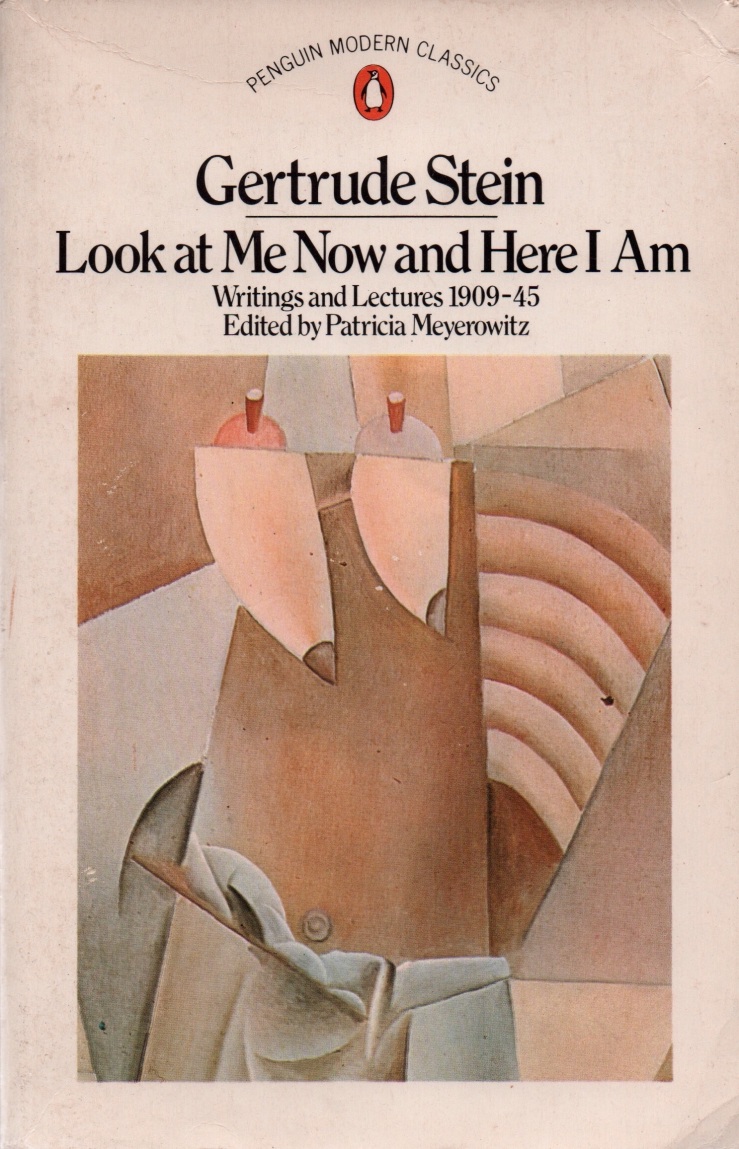
Look at Me Now and Here I Am: Writings and Lectures 1909-1945 by Gertrude Stein (edited by Patricia Meyerowitz. A Penguin Modern Classics trade paperback edition, printed in 1984 (I think) in Great Britain (I think–the colophon is confusing as hell). The cover features a detail from Picasso’s Woman in an Armchair. I spent 10 minutes flicking through Phil Baines’s Penguin by Design but couldn’t determine the designer. The first page bears two bookstore stamps, one from Russakoff’s Bookstore in Philadelphia, and one from the bookstore where I bought it. This is a book one can just pick up and read and random and be rewarded. I’m always reading bits of it so it’s never shelved.image

The Lime Works by Thomas Bernhard. A 2010 first edition trade paperback by Vintage International. The cover design is by Eva Brandstotter, who designed all of these Bernhard editions for Vintage. I was lucky enough to scoop up five TB’s all at once at my favorite used bookstore. I’ve had the urge to read Thomas Bernhard but it’s still too damn hot here in swampy muggy humid Florida to read Thomas Bernhard which I think only makes sense, this sentiment I’ve just expressed, if you’ve actually read Thomas Bernhard.

A review of Gordon Lish’s novel (spokening) Cess

image

-What is the book about?

-Language.

-I mean, like, what’s the plot?

-Okay. I’ll try. The narrator is Gordon Lish—a version of Gordon Lish, of course (Gordon!), who tells us about a cryptographic “test” his aunt, an agent for the National Reconnaissance Office, sent him in 1963.

-Why did she send him this test?

-Poor Gordon was jobless and had a wife and kids to support and-

-You mean his kid the novelist Atticus Lish?

-Please don’t interrupt; no, these, these are other kids; Atticus comes later, but Lish does write about him in Cess. Anyway-

-What does he say about Atticus?

-He writes that “Atticus is, a, you know, a writer by Christ—is a novelist, by Christ, is indeed, if I, by Keerist, may say so myself, ever so proudly so, ever so rivalrously so, a novelist of nothing less than of rank.” Okay?

-Okay.

-So: The narrator gets this “test” from his aunt and-

-What does it look like? What is it?

-It’s a long list of esoteric words.

-May I see?

-It’s a pretty long list.

-How long?

-About 170 pages, about 22 words per page.

-May I see a section then?

-Sure:

image

-Whoa!

-That’s what I thought too! In fact, I first got a digital copy from publisher OR—so I was just reading, you know, on an iPad—which is, I mean, if you can imagine, I wasn’t doing the flicking through thing, the physical browsing thing—so I had no idea that there would be this big long list of words as like, the main course. I was shocked. It was electric. Continue reading “A review of Gordon Lish’s novel (spokening) Cess” →

The Big Red Book of Modern Chinese Literature (Book acquired, 8.07.2015)

IMG_8270

So I finally cracked into Norton’s forthcoming anthology, The Big Red Book of Modern Chinese Literature today. Knowing almost nothing of Chinese literature, I read Can Xue’s story “Hut on the Mountain” first (A+ stuff) and then went back to the beginning to read Lu Xun’s “A Madman’s Diary,” which ends with this line:IMG_8271

—like who wouldn’t want to read a story that ends that way?

Anyway, the book looks really fascinating. Editor Yunte Huang has put together a compelling mix of genres covering the last century. More to come, but here’s Norton’s blurb for now:

A panoramic literary anthology that tells the inner story of China in the twentieth century.

A search for the soul of modern China, this revelatory volume brings together significant works, in outstanding translations, from nearly fifty Chinese writers. It includes poems, essays, fiction, songs, and speeches written in an astonishing array of moods and styles, from sublime lyricism to witty surrealism to poignant documentary to the ironic, the absurd, the transgressive, and the defiant.

Reflecting on his own experience coming of age in China as a student in the time of Tiananmen, Yunte Huang provides essential context in an opening essay and in headnotes, timelines, and brief introductions to the Republican, Revolutionary, and Post-Mao eras. Both personal and authoritative, his selections make for a joyously informative read. From belles lettres to literary propaganda, from poetic revolution to pulp fiction, The Big Red Book is an eye-opening, mesmerizing, and indispensable portrait of China in the tumultuous twentieth century.

It was September now (Cormac McCarthy’s Suttree)

It was September now, a season of rains. The gray sky above the city washed with darker scud like ink curling in a squid’s wake. The blacks can see the boy’s fire at night and glimpses of his veering silhouette slotted in the high nave, outsized among the arches. All night a ruby glow suffuses the underbridge from his garish chancel lamps. The city’s bridges all betrolled now what with old ventriloquists and young melonfanciers. The smoke from their fires issues up unseen among the soot and dust of the city’s right commerce.

Sometimes in the evening Suttree would bring beers and they’d sit there under the viaduct and drink them. Harrogate with questions of city life.

You ever get so drunk you kissed a nigger?

Suttree looked at him. Harrogate with one eye narrowed on him to tell the truth. I’ve been a whole lot drunker than that, he said.

Worst thing I ever done was to burn down old lady Arwood’s house.”

“You burned down an old lady’s house?

Like to of burnt her down in it. I was put up to it. I wasnt but ten year old.

Not old enough to know what you were doing.

Yeah.–Hell no that’s a lie. I knowed it and done it anyways.

Did it burn completely down?

Plumb to the ground. Left the chimbley standin was all. It burnt for a long time fore she come out.

Did you not know she was in there?

I disremember. I dont know what I was thinkin. She come out and run to the well and drawed a bucket of water and thowed it at the side of the house and then just walked on off towards the road. I never got such a whippin in my life. The old man like to of killed me.

Your daddy?

Yeah. He was alive then. My sister told them deputies when they come out to the house, they come out there to tell her I was in the hospital over them watermelons, she told em I didnt have no daddy was how come I got in trouble. But shit fire I was mean when I did have one. It didnt make no difference.

Were you sorry about it? The old lady’s house I mean.

Sorry I got caught.

Suttree nodded and tilted his beer. It occurred to him that other than the melon caper he’d never heard the city rat tell anything but naked truth.

Another vignette from Cormac McCarthy’s Suttree—a transition scene perhaps, but one that draws Suttree and Harrogate closer, even as it underlines their differences.

In my review of Suttree a few years back, I argued that the novel is a grand synthesis of American literature, brimming with literary allusions. I singled out Faulkner’s “A Rose for Emily” as the basis for a later scene with Harrogate, so I can’t help but think of Faulkner’s “Barn Burning” here.

Reviews and riffs of August, 2015 (and an unrelated octopus)

I don’t like August and I’m glad it’s over.

I only wrote a few riffs and reviews in August, failing to write at length about Gordon Lish’s Cess and Victor Hussenot’s The Spectators and Vladimir Nabokov’s Pale Fire. Also: Neal Stephenson’s novel The Diamond Age, which I audited the audiobook of—great stuff, a novel that posits the book as a primary and insuperable technology. And some films too—Michael Mann’s Thief (amazing); Quest for Fire (why were the Baby Boomers so obsessed with cave people?); Ex Machina (a well-acted design-porn riff on Bluebeard that has no real ideas about its central theme, human consciousness).

I also watched and loved and didn’t write about the second season finale of True Detective—loved it—a tragic hyperbole, a big exclamation point, a sympathetic punchline to the season’s paternal anxieties. I found the final shot unexpectedly moving—the season’s female leads moving through the traffic of humanity, strapped with a child, knives, the future.

In August—

I riffed on season 2 of True Detective, arguing for its merits as a neon noir satire.

Ryan Chang and I talked about New American Stories, an anthology edited by Ben Marcus. We riffed on the selections, scope, and the first story, Saïd Sayrafiezadeh’s “Paranoia.”

I wrote a barely-coherent, probably incoherent review of Philip K. Dick’s novel Martian Time-Slip. The sub(or is it super?)text of the review is that I am a Permanently Paranoid American.

I also wound up writing a bit on Paul Kirchner’s trip strip The Bus yesterday. For years now, I’ve run some kind of regular Sunday post to anchor the site—it was death masks for a while, book shelves after…maybe something else I’m forgetting now (?)—but running The Bus was the most fun I had.

I’m not sure what I’ll run this Sunday for a new series, but something serialish so…

Promised octopus, by Utagawa Kuniyoshi—


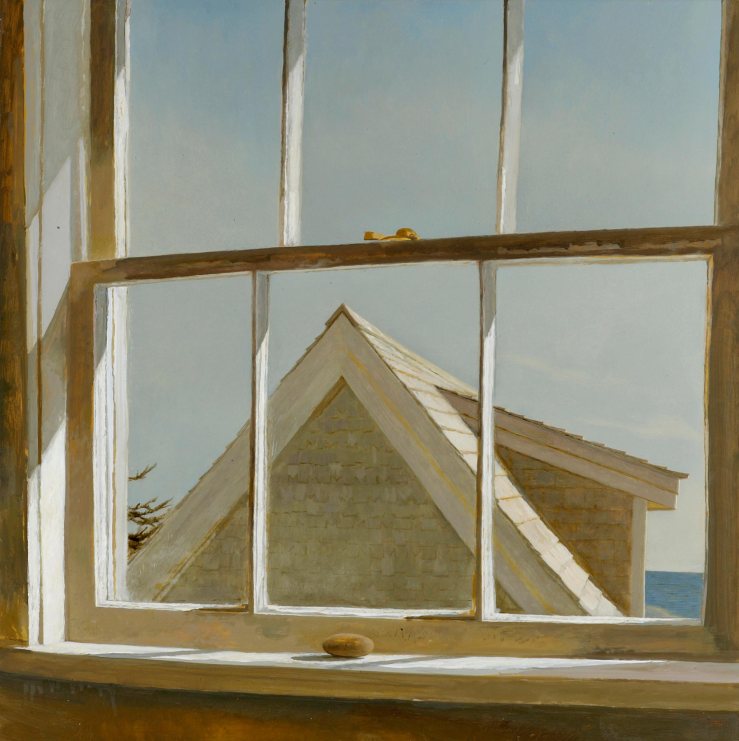
The End of Summer — Bo Bartlett

2006-the-end-of-summer-lg

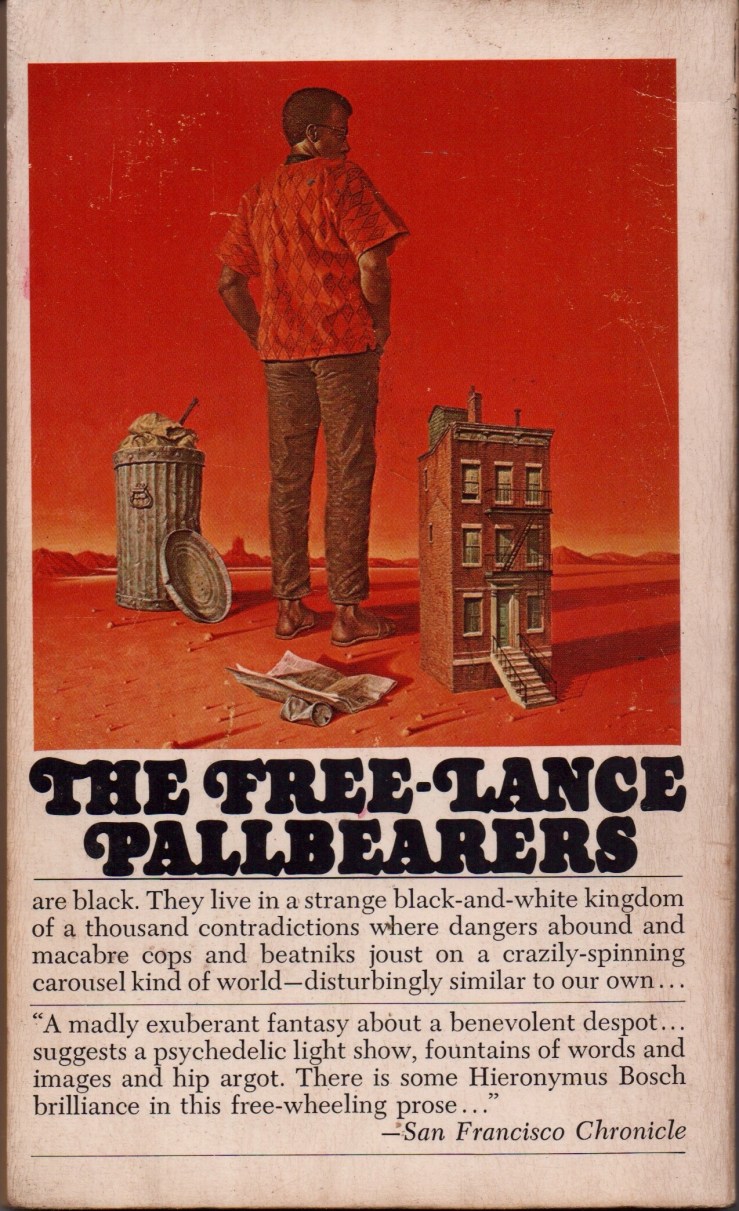
Ishmael Reed (Book acquired, 8.20.2015)

image

I love love love the cover of this Ishmael Reed mass market paperback Bantam edition of The Free-Lance Pallbearers. image

The Bus, Paul Kirchner’s marvelous and surreal comic strip trip

wccAP24 - Imgur

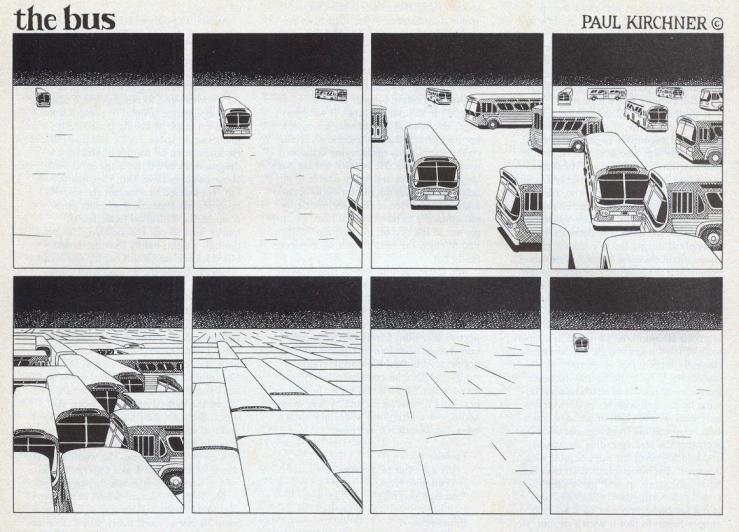
For the past year, I’ve run a strip from Paul Kirchner’s cult classic The Bus each Sunday. The strips come from an album posted at Imgur full of high quality scans. I posted the last scan last week.

The Bus originally ran in Heavy Metal from 1979-1985; Kirchner’s done a few  over 40 new strips over the past few years, as he notes in a recent memoir-piece at The Boston Globe. The new strips will be collected in The Bus 2 from Editions Tanibis. Editions Tanibis also has collected the original run of The Bus in an edition that’s more complete than the Imgur page.

Screenshot 2015-08-30 at 11.51.44 AM

I’ve enjoyed posting the strips tremendously. I first saw a few strips at an image forum I frequent, and quickly found the Imgur album. Posting one each Sunday was my way of, well, not bingeing on them.

WQlfiuH - Imgur

The Bus is a profound strange wonderful trip. Kirchner’s visions often evoke Escher’s paradoxes, and the best of his strips make us attend closely to what we’d otherwise dismiss. The Bus is subtle and sly, occasionally (very occasionally) dark, but also, I would argue, sensitive—there’s something deeply endearing about the strip’s central human protagonist, an often passive (even hapless) passenger, a kind of late-20th century Everyman. Continue reading “The Bus, Paul Kirchner’s marvelous and surreal comic strip trip” →

Crimes of the Moonlight Melonmounter (Cormac McCarthy’s Suttree)

Still Life with Watermelons, Frida Kahlo

Two pairs of brogans went along the rows.

You aint goin to believe this.

Knowin you for a born liar I most probably wont.

Somebody has been fuckin my watermelons.

What?

I said somebody has been …

No. No. Hell no. Damn you if you aint got a warped mind.

I’m tellin you …

“I dont want to hear it.

Looky here.

And here.

They went along the outer row of the melonpatch. He stopped to nudge a melon with his toe. Yellowjackets snarled in the seepage. Some were ruined a good time past and lay soft with rot, wrinkled with imminent collapse.

It does look like it, dont it?

I’m tellin ye I seen him. I didnt know what the hell was goin on when he dropped his drawers. Then when I seen what he was up to I still didnt believe it. But yonder they lay.

What do you aim to do?

Hell, I dont know. It’s about too late to do anything. He’s damn near screwed the whole patch. I dont see why he couldnt of stuck to just one. Or a few.

Well, I guess he takes himself for a lover. Sort of like a sailor in a whorehouse.

I reckon what it was he didnt take to the idea of gettin bit on the head of his pecker by one of them waspers. I suppose he showed good judgment there.

What was he, just a young feller?

I dont know about how young he was but he was as active a feller as I’ve seen in a good while.

Well. I dont reckon he’ll be back.

I dont know. A man fast as he is ought not to be qualmy about goin anywheres he took a notion. To steal or whatever.

What if he does come back?

I’ll catch him if he does.

And then what?

Well. I dont know. Be kindly embarrassin now I think about it.

I’d get some work out of him is what I’d do.

Ought to, I reckon. I dont know.

You reckon to call the sheriff?

And tell him what?

They were walking slowly along the rows.

It’s just the damndest thing I ever heard of. Aint it you? What are you grinnin at? It aint funny. A thing like that. To me it aint.

One of my favorite passages from Cormac McCarthy’s novel Suttree. The title of this post also comes from the novel, several pages later, after the melonmounter has been apprehended.

Entries under “D” from Captain Grose’s Dictionary of the Vulgar Tongue (1811)

The following definitions are from the “D” section of Captain Grose’s Dictionary of the Vulgar Tongue (1811).


DAB. An adept; a dab at any feat or exercise. Dab,
quoth Dawkins, when he hit his wife on the a-se with a
pound of butter.

DACE. Two pence. Tip me a dace; lend me two pence.
CANT.

DADDLES. Hands. Tip us your daddle; give me your hand.
CANT.

DADDY. Father. Old daddy; a familiar address to an old man. To beat daddy mammy; the first rudiments of drum beating, being the elements of the roll.

DAGGERS. They are at daggers drawing; i.e. at enmity,
ready to fight.

DAIRY. A woman’s breasts, particularly one that gives
suck. She sported her dairy; she pulled out her breast.

DAISY CUTTER. A jockey term for a horse that does not lift up his legs sufficiently, or goes too near the ground, and is therefore apt to stumble.

DAISY KICKERS. Ostlers at great inns.

DAM. A small Indian coin, mentioned in the Gentoo code of laws: hence etymologists may, if they please, derive the common expression, I do not care a dam, i.e. I do not care half a farthing for it.

DAMBER. A rascal. See DIMBER.

DAMME BOY. A roaring, mad, blustering fellow, a scourer of the streets, or kicker up of a breeze. Continue reading “Entries under “D” from Captain Grose’s Dictionary of the Vulgar Tongue (1811)” →

I’ve salvaged not a word (Cormac McCarthy’s Suttree)

From all old seamy throats of elders, musty books, I’ve salvaged not a word. In a dream I walked with my grandfather by a dark lake and the old man’s talk was filled with incertitude. I saw how all things false fall from the dead. We spoke easily and I was humbly honored to walk with him deep in that world where he was a man like all men. From the small end of a corridor in the autumn woods he watched me go away to the world of the waking. If our dead kin are sainted we may rightly pray to them. Mother Church tells us so. She does not say that they’ll speak back, in dreams or out. Or in what tongue the stillborn might be spoken. More common visitor. Silent. The infant’s ossature, the thin and brindled bones along whose sulcate facets clove old shreds of flesh and cerements of tattered swaddle. Bones that would no more than fill a shoebox, a bulbous skull. On the right temple a mauve halfmoon.

I read Cormac McCarthy’s Suttree five years ago and still haven’t recovered.

I started listening to the audiobook of it this week as I returned to my fall work (school) commute—the language is marvelous in the reading—but I have to go back and dwell on passages, like the one above, which resonates strongly with so much of McCarthy’s work—the son or grandson communing with the dead father, out of dimness, opposite equals advancing. And damn, somehow I’d forgotten that Suttree had a stillborn twin brother. And that the novel begins with a suicide. More to come.

Three Princesses of the Underworld — Viktor Vasnetsov

William Faulkner’s 4th grade report card

Screenshot 2015-08-28 at 12.27.24 PM

Via The Harry Ransom Center’s Instagram account.

If Nabokov ruled any modern industrial state absolutely, what would he abolish?

image

From Vladimir Nabokov’s 1969 interview with James Mossman for BBC2’s Review. Reprinted in the same year in The Listener, and collected in Strong Opinions.

“The Sisters” — James Joyce

“The Sisters”

by

James Joyce


THERE was no hope for him this time: it was the third stroke. Night after night I had passed the house (it was vacation time) and studied the lighted square of window: and night after night I had found it lighted in the same way, faintly and evenly. If he was dead, I thought, I would see the reflection of candles on the darkened blind for I knew that two candles must be set at the head of a corpse. He had often said to me: “I am not long for this world,” and I had thought his words idle. Now I knew they were true. Every night as I gazed up at the window I said softly to myself the word paralysis. It had always sounded strangely in my ears, like the word gnomon in the Euclid and the word simony in the Catechism. But now it sounded to me like the name of some maleficent and sinful being. It filled me with fear, and yet I longed to be nearer to it and to look upon its deadly work.

Old Cotter was sitting at the fire, smoking, when I came downstairs to supper. While my aunt was ladling out my stirabout he said, as if returning to some former remark of his:

“No, I wouldn’t say he was exactly… but there was something queer… there was something uncanny about him. I’ll tell you my opinion….”

He began to puff at his pipe, no doubt arranging his opinion in his mind. Tiresome old fool! When we knew him first he used to be rather interesting, talking of faints and worms; but I soon grew tired of him and his endless stories about the distillery.

“I have my own theory about it,” he said. “I think it was one of those… peculiar cases…. But it’s hard to say….” Continue reading ““The Sisters” — James Joyce” →

All We Marsmen (PKD)

VWoT196308-0039F27

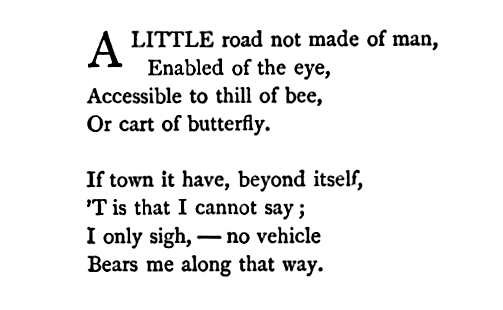
“A little road not made of man” — Emily Dickinson

Screenshot 2015-08-25 at 8