
.jpg)
Category: Books
Delightful way/empty tube (Wittgenstein)
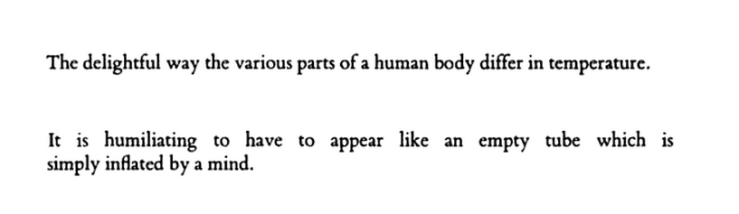 From Culture and Value.
Calling It a Tail Did Not Make It One — Dugald Stewart Walker

Pallas and Centaur — Sandro Botticelli

“A Gold Slipper” by Willa Cather
“A Gold Slipper”
by
Willa Cather
Marshall McKann followed his wife and her friend Mrs. Post down the aisle and up the steps to the stage of the Carnegie Music Hall with an ill-concealed feeling of grievance. Heaven knew he never went to concerts, and to be mounted upon the stage in this fashion, as if he were a “highbrow” from Sewickley, or some unfortunate with a musical wife, was ludicrous. A man went to concerts when he was courting, while he was a junior partner. When he became a person of substance he stopped that sort of nonsense. His wife, too, was a sensible person, the daughter of an old Pittsburgh family as solid and well-rooted as the McKanns. She would never have bothered him about this concert had not the meddlesome Mrs. Post arrived to pay her a visit. Mrs. Post was an old school friend of Mrs. McKann, and because she lived in Cincinnati she was always keeping up with the world and talking about things in which no one else was interested, music among them. She was an aggressive lady, with weighty opinions, and a deep voice like a jovial bassoon. She had arrived only last night, and at dinner she brought it out that she could on no account miss Kitty Ayrshire’s recital; it was, she said, the sort of thing no one could afford to miss.
When McKann went into town in the morning he found that every seat in the music-hall was sold. He telephoned his wife to that effect, and, thinking he had settled the matter, made his reservation on the 11.25 train for New York. He was unable to get a drawing-room because this same Kitty Ayrshire had taken the last one. He had not intended going to New York until the following week, but he preferred to be absent during Mrs. Post’s incumbency.
In the middle of the morning, when he was deep in his correspondence, his wife called him up to say the enterprising Mrs. Post had telephoned some musical friends in Sewickley and had found that two hundred folding-chairs were to be placed on the stage of the concert-hall, behind the piano, and that they would be on sale at noon. Would he please get seats in the front row? McKann asked if they would not excuse him, since he was going over to New York on the late train, would be tired, and would not have time to dress, etc. No, not at all. It would be foolish for two women to trail up to the stage unattended. Mrs. Post’s husband always accompanied her to concerts, and she expected that much attention from her host. He needn’t dress, and he could take a taxi from the concert-hall to the East Liberty station. Continue reading ““A Gold Slipper” by Willa Cather”
Upright Standing Woman — Egon Schiele

Voyage d’Hermès — Moebius

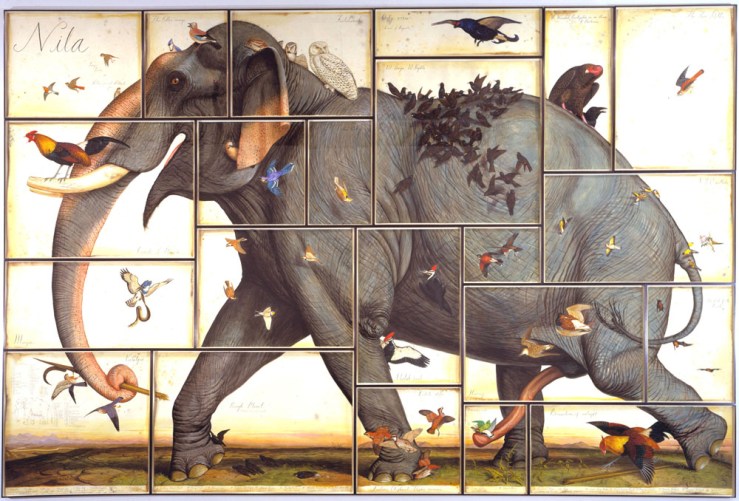
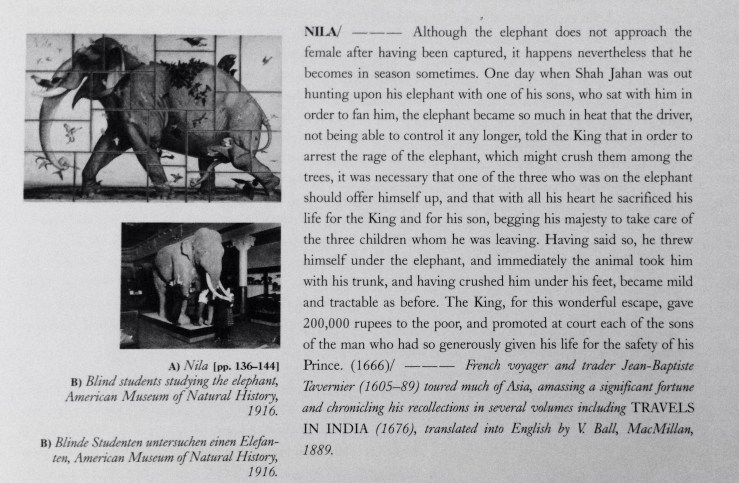
Nila — Walton Ford
The Ogre Received Him As Civilly As An Ogre Can — Gustave Dore

Read “Fantine,” Bret Harte’s Victor Hugo parody
Fantine (after the French of Victor Hugo)
by
Bret Harte
Prologue
As long as there shall exist three paradoxes, a moral Frenchman, a
religious atheist, and a believing skeptic; so long, in fact, as
booksellers shall wait—say twenty-live years—for a new gospel;
so long as paper shall remain cheap and ink three sous a bottle, I
have no hesitation in saying that such books as these are not
utterly profitless. VICTOR HUGO.
To be good is to be queer. What is a good man? Bishop Myriel.
My friend, you will possibly object to this. You will say you know what a good man is. Perhaps you will say your clergyman is a good man, for instance. Bah! you are mistaken; you are an Englishman, and an Englishman is a beast.
Englishmen think they are moral when they are only serious. These Englishmen also wear ill-shaped hats, and dress horribly!
Bah! they are canaille.
Still, Bishop Myriel was a good man,—quite as good as you. Better than you, in fact.
One day M. Myriel was in Paris. This angel used to walk about the streets like any other man. He was not proud, though fine-looking. Well, three gamins de Paris called him bad names. Says one,—
“Ah, mon Dieu! there goes a priest; look out for your eggs and chickens!” What did this good man do? He called to them kindly.
“My children,” said he, “this is clearly not your fault. I recognize in this insult and irreverence only the fault of your immediate progenitors. Let us pray for your immediate progenitors.”
They knelt down and prayed for their immediate progenitors.
The effect was touching.
The Bishop looked calmly around.
“On reflection,” said he gravely, “I was mistaken; this is clearly the fault of Society. Let us pray for Society.”
They knelt down and prayed for Society.
The effect was sublimer yet. What do you think of that? You, I mean.
Everybody remembers the story of the Bishop and Mother Nez Retrousse. Old Mother Nez Retrousse sold asparagus. She was poor; there’s a great deal of meaning in that word, my friend. Some people say “poor but honest.” I say, Bah!
Bishop Myriel bought six bunches of asparagus. This good man had one charming failing: he was fond of asparagus. He gave her a franc, and received three sous change.
The sous were bad,—counterfeit. What did this good Bishop do? He said: “I should not have taken change from a poor woman.”
Then afterwards, to his housekeeper: “Never take change from a poor woman.”
Then he added to himself: “For the sous will probably be bad.”
II
When a man commits a crime, Society claps him in prison. A prison is one of the worst hotels imaginable.
The people there are low and vulgar. The butter is bad, the coffee is green. Ah, it is horrible!
In prison, as in a bad hotel, a man soon loses, not only his morals, but what is much worse to a Frenchman, his sense of refinement and delicacy.
Jean Valjean came from prison with confused notions of Society. He forgot the modern peculiarities of hospitality. So he walked off with the Bishop’s candlesticks.
Let us consider. Candlesticks were stolen; that was evident. Society put Jean Valjean in prison; that was evident, too. In prison, Society took away his refinement; that is evident, likewise.
Who is Society?
You and I are Society.
My friend, you and I stole those candlesticks!
Continue reading “Read “Fantine,” Bret Harte’s Victor Hugo parody”
Prometheus in Chains — Frantisek Kupka

Quicksand (Book acquired, 8.10.2015 + bonus Bowie)

Steve Toltz’s Quicksand is new in the States from Simon & Schuster. Their blurb:
A daring, brilliant new novel from Man Booker Prize finalist Steve Toltz, for fans of Dave Eggers, Martin Amis, and David Foster Wallace: a fearlessly funny, outrageously inventive dark comedy about two lifelong friends.
Liam is a struggling writer and a failing cop. Aldo, his best friend and muse, is a haplessly criminal entrepreneur with an uncanny knack for disaster. As Aldo’s luck worsens, Liam is inspired to base his next book on his best friend’s exponential misfortunes and hopeless quest to win back his one great love: his ex-wife, Stella. What begins as an attempt to make sense of Aldo’s mishaps spirals into a profound story of faith and friendship.
With the same originality and buoyancy that catapulted his first novel, A Fraction of the Whole, onto prize lists around the world—including shortlists for the Man Booker Prize and the Guardian First Book Award—Steve Toltz has created a rousing, hysterically funny but unapologetically dark satire about fate, faith, friendship, and the artist’s obligation to his muse. Sharp, witty, kinetic, and utterly engrossing, Quicksand is a subversive portrait of twenty-first-century society in all its hypocrisy and absurdity.
Bonus “Quicksand”—
Green Interior — Edouard Vuillard

“It Is Necessary to Travel…” — William Burroughs

From The Adding Machine.
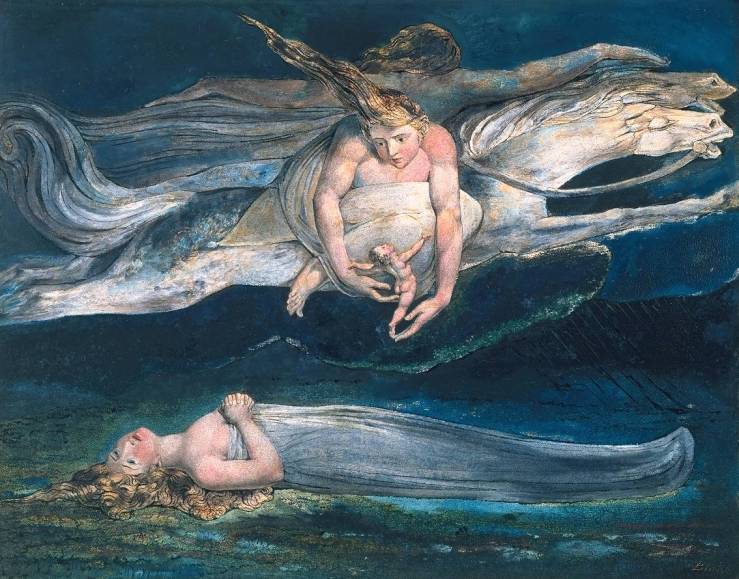
Pity — William Blake
Surprise (Wittgenstein)

From Culture and Value.
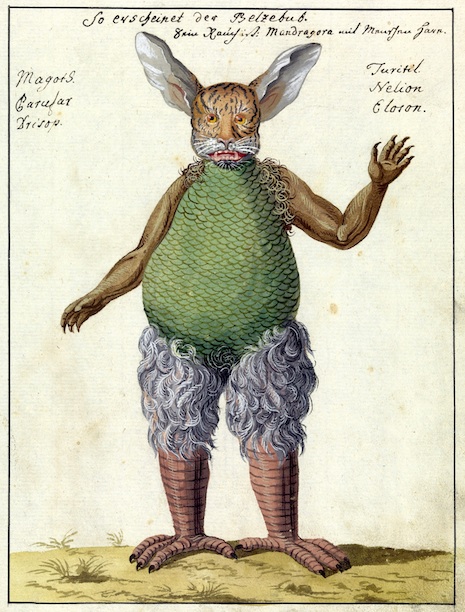
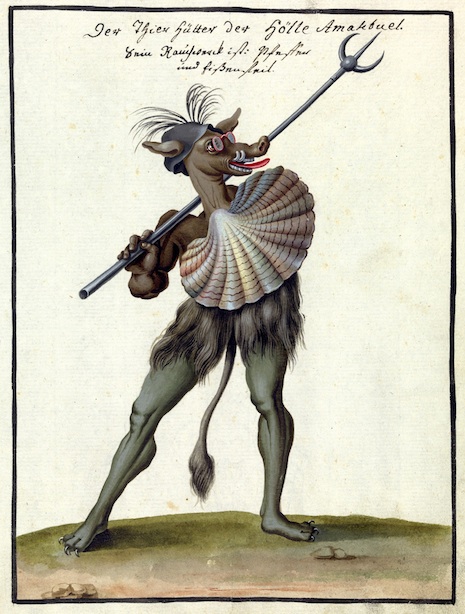
Demonic images from the Compendium rarissimum totius Artis Magicae sistematisatae per celeberrimos Artis hujus Magistros. Anno 1057. Noli me tangere
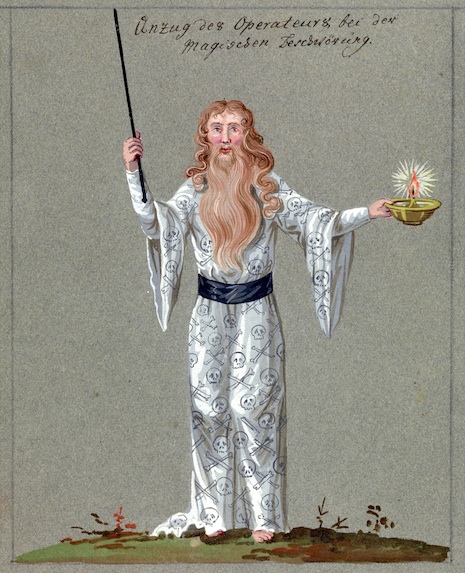
Water color images from Compendium rarissimum totius Artis Magicae sistematisatae per celeberrimos Artis hujus Magistros. Anno 1057. Noli me tangere, which, despite that claim to 1057, was probably produced in the late 18th century. See the whole book at Wellcome Library. Via Idea Fixa.
 Biblioklept