

Category: Books
The Powder of Sympathy
“The Powder of Sympathy”
from
THE SEVEN FOLLIES
OF SCIENCE
To which is Added a Small Budget of Interesting
Paradoxes, Illusions, and Marvels.
BY
JOHN PHIN
This curious occult method of curing wounds is indissolubly associated with the name of Sir Kenelm Digby (born 1603, died 1665), though it was undoubtedly in use long before his time. He himself tells us that he learned to make and apply the drug from a Carmelite, who had traveled in the east, and whom he met in Florence, in 1622. The descendants of Digby are still prominent in England, and O. W. Holmes, in his “One Hundred Days in Europe,” tells us that he had met a Sir Kenelm Digby, a descendant of the famous Sir Kenelm of the seventeenth century, and that he could hardly refrain from asking him if he had any of his ancestor’s famous powder in his pocket.
Digby was a student of chemistry, or at least of the chemistry of those days, and wrote books of Recipes and the making of “Methington [metheglin or mead?] Syder, etc.” He was, as we have seen in the previous article, a believer in palingenesy and made experiments with a view to substantiate that strange doctrine. Evelyn calls him an “errant quack,” and he may have been given to quackery, but then the loose scientific ideas of those days allowed a wide range in drawing conclusions which, though they seem absurd to us, may have appeared to be quite reasonable to the men of that time.
From his book on the subject,we learn that the wound was never to be brought into contact with the powder. A bandage was to be taken from the wound, immersed in the powder, and kept there until the wound healed.
This beats the absent treatment of Christian Science!
The powder was simply pulverized vitriol, that is, ferric sulphate, or sulphate of iron. Continue reading “The Powder of Sympathy”
St. John Devouring the Book from the Apocalypse — Albrecht Durer

Video for Joanna Newsom’s “Sapokanikan” (directed by Paul Thomas Anderson)
The Search for Truth — Rene Magritte

Is it true that Nabokov called Hemingway and Conrad “writers of books for boys”?

From a 1964 Playboy interview. Republished in Strong Opinions.
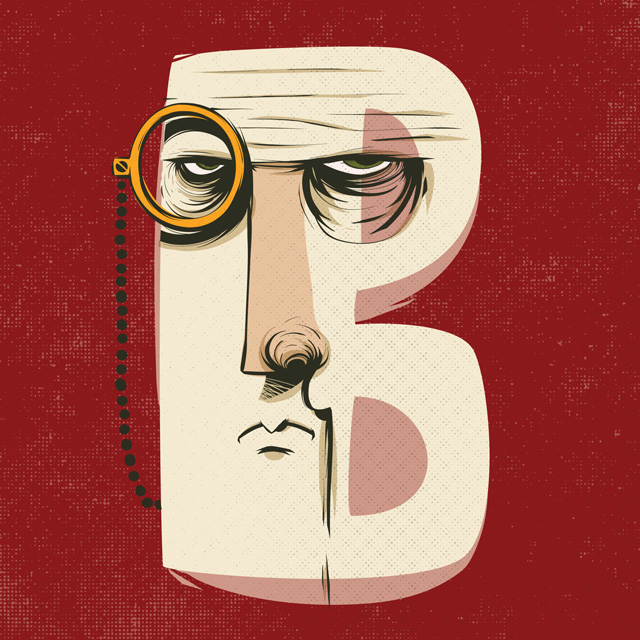
Letter Faces by Caio Beltrão










New American Stories, a collection edited by Ben Marcus (Book acquired, 8.04.2015)

New American Stories is an anthology out now in enormous paperback from Vintage. The collection was collected by collector Ben Marcus. An excerpt from his introduction:
Language is a drug, but a short story cannot be smoked. You can’t inject it. Stories don’t come bottled as a cream. You cannot have a story massaged into you by a bearish old man. You have to stare down a story until it wobbles, yields, then catapults into your face. And yet, as squirrely as they are to capture, stories are the ideal deranger. If they are well made, and you submit to them, they go in clean. Stories deliver their chemical disruption without the ashy hangover, the blacking out, the poison. They trigger pleasure, fear, fascination, love, confusion, desire, repulsion. Drugs get flushed from our systems, but not the best stories. Once they take hold, you couldn’t scrape them out with a knife. While working on this book, I started to think of a it as a medicine chest, filled with beguiling, volatile material, designed by the most gifted technicians. The potent story writers, to me, are the ones who deploy language as a kind of contraband, pumping it into us until we collapse on the floor, writhing, overwhelmed with feeling.
You actually can smoke a short story, but to do so is inadvisable.
I’ll be riffing on the book over the next few weeks with our Correspondent in Colorado, Mr. Ryan Chang.
Here’s the tracklist:
Said Sayrafiezadeh, Paranoia
Rebecca Lee, Slatland
Jesse Ball, The Early Deaths of Lubeck, Brennan, Harp, and CarrDeborah Eisenberg, Some Other, Better Otto
Anthony Doerr, The Deep
Yiyun Li, A Man Like Him
George Saunders, Home
NoViolet Bulawayo, Shhh
Maureen McHugh, Special Economics
Sam Lipsyte, This Appointment Occurs in the Past
Lydia Davis, Men
Donald Antrim, Another Manhattan
Zadie Smith*, Meet the President!
Denis Johnson, The Largesse of the Sea Maiden
Joy Williams, The Country
Christine Schutt, A Happy Rural Seat of Various View Lucinda’s Garden
Don DeLillo, Hammer and Sickle
Mathias Svalina, Play
Lucy Corin, Madmen
Mary Gaitskill, The Arms and Legs of the Lake
Wells Tower, Raw Water
Rachel Glaser, Pee on Water
Tao Lin, Love is a Thing on Sale for More Money than There Exists
Rebecca Curtis, The Toast
Robert Coover, Going for a Beer
Charles Yu, Standard Loneliness Package
Deb Olin Unferth, Wait Till You See Me Dance
Kyle Coma-Thompson, The Lucky Body
Rivka Galchen, The Lost Order
Donald Ray Pollack, Fish Sticks
Kelly Link, Valley of the Girls
Claire Vaye Watkins, The Diggings
*Isn’t she English? I guess it’s the stories that are American.
Cradle — Bo Bartlett

The Sun in His Wrath — William Blake

“The Stolen Body,” a weird short story by H.G. Wells
“The Stolen Body”
by
H.G. Wells
Mr. Bessel was the senior partner in the firm of Bessel, Hart, and Brown, of St. Paul’s Churchyard, and for many years he was well known among those interested in psychical research as a liberal-minded and conscientious investigator. He was an unmarried man, and instead of living in the suburbs, after the fashion of his class, he occupied rooms in the Albany, near Piccadilly. He was particularly interested in the questions of thought transference and of apparitions of the living, and in November, 1896, he commenced a series of experiments in conjunction with Mr. Vincey, of Staple Inn, in order to test the alleged possibility of projecting an apparition of one’s self by force of will through space.
Their experiments were conducted in the following manner: At a prearranged hour Mr. Bessel shut himself in one of his rooms in the Albany and Mr. Vincey in his sitting-room in Staple Inn, and each then fixed his mind as resolutely as possible on the other. Mr. Bessel had acquired the art of self-hypnotism, and, so far as he could, he attempted first to hypnotise himself and then to project himself as a “phantom of the living” across the intervening space of nearly two miles into Mr. Vincey’s apartment. On several evenings this was tried without any satisfactory result, but on the fifth or sixth occasion Mr. Vincey did actually see or imagine he saw an apparition of Mr. Bessel standing in his room. He states that the appearance, although brief, was very vivid and real. He noticed that Mr. Bessel’s face was white and his expression anxious, and, moreover, that his hair was disordered. For a moment Mr. Vincey, in spite of his state of expectation, was too surprised to speak or move, and in that moment it seemed to him as though the figure glanced over its shoulder and incontinently vanished.
It had been arranged that an attempt should be made to photograph any phantasm seen, but Mr. Vincey had not the instant presence of mind to snap the camera that lay ready on the table beside him, and when he did so he was too late. Greatly elated, however, even by this partial success, he made a note of the exact time, and at once took a cab to the Albany to inform Mr. Bessel of this result. Continue reading ““The Stolen Body,” a weird short story by H.G. Wells”
Mad Max: Fury Road film poster by Kilian Eng

Struggle (Wittgenstein)

From Culture and Value.
The Laundress, Blue Room — Felix Vallotton

Optical Parable — Manuel Alvarez Bravo

William Burroughs and Andy Warhol eat rabbit, discuss chicken-fried steak; Nico sings a bit
Plant Architecture — Remedios Varo

 Biblioklept