

Category: Books
Selections from One-Star Amazon Reviews of David Foster Wallace’s Infinite Jest
[Ed. note: I usually don’t preface these one-star Amazon selection riffs with much, other than to note the occasion for the post. In this case, the occasion is my coming to the end of a second reading of Pynchon’s novel Gravity’s Rainbow, a novel that is very much about the military-industrial-entertainment complex. And so well anyway, I keep thinking about Infinite Jest, which I have not read in full since 2002, but plan to reread later this summer. I expected Pynchon to show up a few times in the one-star reviews, but he’s present throughout, often obliquely referenced. Otherwise, the one-star reviews are typical: Rants against academia, “literary elites,” etc. The term “self-indulgent” appears again and again. Only one reviewer bothers to engage the plot though.]
***
slop
passably clever
completely pointless
superfluous logorrhea
spawn of PC Elitist writers
reads like a math textbook
This is the T.S. Eliot Effect
terminally adolescent drivel.
The footnotes have footnotes.
Big words and run-on sentences
utterly lacking in aesthetic merit
I only read the first 50 pages or so
wow, that’s a heck of a lot of words.
challenging, involving, and horrifying
A humorous book? – no. Absurd – Yes.
never made it to the end of chapter one.
I never did get through Gravity’s Rainbow
the magnum opus of American hipsterism.
the worst science fiction novel ever written.
If you like Pynchon, fine, go ahead, you’ll like this.
over a hundred pages of notes that serve no purpose
I pride myself on being an intelegent well read person
At least Pynchon, has humor, literary references, etc.
He probably sold more books on hype than on talent.
All in all, I suppose Wallace will just become a footnote.
this book(?) would not be worth the money if it was free
I trie d to think of Catcher in the Rye, but no comparison.
If you want to be warm, burn your overrated copy of Infinite Jest.
Wallace makes up words which does not help one reading a story.
I think it was in that book that I learned the word “omphaloskepsis.”
I’ll bet Dave had to beat off the nubile young co-eds after they read this one
obviously didn’t follow Elmore Leonard’s last tenet of his “10 Rules for Writing”
I suppose that some might consider Wallace a great writer, but was he popular?
It’s written in the first-person from the point of view of a mentally ill teenager.
he filled it with worthless footnotes that pretend to enlighten the victim of his prose
I just don’t understand how my fellow Amazon reviewers could have scored this book highly.
I realize that this book is considered to be “literature” but IMHO the internal ravings of mentally ill people isn’t literature.
It is called “INFINITE JETS” but there is not a single aircraft within, in fact the book is about people on land with drugs problems.
The book contains an anecdote plagiarized from the humorist, Gerard Hoffnung, who recorded it in the 1950s.
700 pages of clumsy sci-fi and the kind of smarty pants absurdist nonsense you’d expect from a precocious middle schooler
The premise for this novel derives from a Monty Python sketch in which the world’s funniest joke is also fatal.
Oh one other thing that drove me crazy: he started so many sentences with “And but so..” or “So but and…”
if Finnegans Wake was a rancid fart that was proudly left to rip, Infinite Jest is a weak one, lacking sound and odor.
Just a bunch of irrelevant words to set the scene…. not to mention he described everything into painful detail.
a kid thinks he’s going to the dentist but it’s really some sort of counselor and they have a long battle of wits to see which one of them is the bigger booger-eating nerd
DWF is desperately trying to emulate one of the century’s greatest authors, and utterly fails.
Put down the bong, go outside and get some real world experience before putting pen to paper.
Comparing Wallace to Pynchon is like comparing a kettle of sponges to Disney World
Academics also praise it as a badge of courage for (allegedly) reading it
It’s just the narrator’s interior thoughts about trying to buy drugs.
I was two pages in and started to feel confused, zoned out, and lost.
It reads like the stream of consciousness of a spoiled 10th grader.
What I read would have gotten an F in a freshman writing class.
The style is Pynchon. And by style, I mean, an exact duplication
At least, now I know where Dave Eggers ripped off his garbage
sorry Amazon,you definitely missed the boat with this one.
completely lacking in any kind of moral or ethical center
He and this book are simply silly, and a waste of pulp.
Book was a work of art, one I wasted my time viewing.
seems to spend forever talking about tennis and drugs
Characters are unbelievable and are over analyzed
Sure, he was making good points, for the 1990s!
Reading a thesaurus does not count as research.
Over 1000 pages of pseudo-subersiveness.
It’s the tyranny of the English Deparment
I only read about four percent of the book
For my taste, there were too many words
I think his suicide inflated his reviews.
I still feel awful thinking about it.
narcissistic garbage
wannabe Pynchon
Bad read no stars.
…is this an essay?
Generic Pynchon
Troglodyte.
Boring.
Skip it.
The consciousness contained in any text (William H. Gass)
…the consciousness contained in any text is not an actual functioning consciousness; it is a constructed one, improved, pared, paced, enriched by endless retrospection, irrelevancies removed, so that into the ideal awareness that I imagined for the poet, who possesses passion, perception, thought, imagination, and desire, and has them present in amounts appropriate to the circumstances-just as, in the lab, we need more observation than fervor, more imagination than lust-there are introduced patterns of disclosure, hierarchies of value, chains of inference, orders of images, natures of things.
From William H. Gass’s essay “The Book as a Container of Consciousness,” published in his collection Finding a Form and available online as a pdf at Wilson Quarterly.
God’s spoilers (Gravity’s Rainbow)
What you felt stirring across the land… it was the equinox… green spring equal nights… canyons are opening up, at the bottoms are steaming fumaroles, steaming the tropical life there like greens in a pot, rank, dope-perfume, a hood of smell… human consciousness, that poor cripple, that deformed and doomed thing, is about to be born. This is the World just before men. Too violently pitched alive in constant flow ever to be seen by men directly. They are meant only to look at it dead, in still strata, transputrefied to oil or coal. Alive, it was a threat: it was Titans, was an overpeaking of life so clangorous and mad, such a green corona about Earth’s body that some spoiler had to be brought in before it blew the Creation apart. So we, the crippled keepers, were sent out to multiply, to have dominion. God’s spoilers. Us. Counterrevolutionaries. It is our mission to promote death. The way we kill, the way we die, being unique among the Creatures. It was something we had to work on, historically and personally. To build from scratch up to its present status as reaction, nearly as strong as life, holding down the green uprising. But only nearly as strong.
Only nearly, because of the defection rate. A few keep going over to the Titans every day, in their striving subcreation (how can flesh tumble and flow so, and never be any less beautiful?), into the rests of the folksong Death (empty stone rooms), out, and through, and down under the net, down down to the uprising.
In harsh-edged echo, Titans stir far below. They are all the presences we are not supposed to be seeing—wind gods, hilltop gods, sunset gods—that we train ourselves away from to keep from looking further even though enough of us do, leave Their electric voices behind in the twilight at the edge of the town and move into the constantly parted cloak of our nightwalk till
Suddenly, Pan—leaping—its face too beautiful to bear, beautiful Serpent, its coils in rainbow lashings in the sky—into the sure bones of fright—
Don’t walk home at night through the empty country. Don’t go into the forest when the light is too low, even too late. Don’t go into the forest when the light is too low, even too late in the afternoon—it will get you. Don’t sit by the tree like this, with your cheek against the bark.
From Thomas Pynchon’s Gravity’s Rainbow, pages 720-21.
Woman Reading — Utagawa Kuniyoshi

St. Barbara (Werl Altarpiece) — Robert Campin

How the Jackal Got His Scorched Back

An African fairy tale retold by Alena Benesova and translated into English by Ruth Shepherd. The marvelous illustration is by Karel Franta. From Animal Fairy Stories.
St. Ivo — Rogier van der Weyden

More on Jim O’Rourke’s Simple Songs
I was pretty happy when Jim O’Rourke’s new LP Simple Songs showed up in today’s mail. (I tried to take a photo of the record cover, which has this glossy-embossed-Jim-visual-echo-of-the-cover-to-Halfway-to-a-Threeway-thing going on, but it was too glossy, the cover, so here’s the Drag City packing tape that sealed the package):

I’ve already lauded Simple Songs here, based on listening to it dozens of times on NPR last week. Even though the streaming quality wasn’t so bad (and I played it over a proper stereo system), it simply isn’t as good as the full rich sound on the vinyl. (As I write this, I realize that I have a tendency, like many people, I’m thinking, to listen to too much new music digitally, over streaming services or as shitty compressed mp3s, or—even worse!—on YouTube. I think O’Rourke’s songwriting, musicianship, and production can withstand these new technologies, but I’ve also been a huge fan of his for, jeez, 20 years now, so I’m compelled to listen to his work much more closely than, say, New Band with mp3).
Anyway.
Simple Songs is beautiful: Rich, full, personal, and somehow expansive at only eight songs in 33 minutes. O’Rourke seems to have structured the album like a 1970s singer-songwriter record—the sequencing is perfect, with each side culminating in moments that synthesize O’Rourke’s cynicism with real pathos. Worth the long wait.
The LP contains a lyric sheet, as well as the album’s personnel:
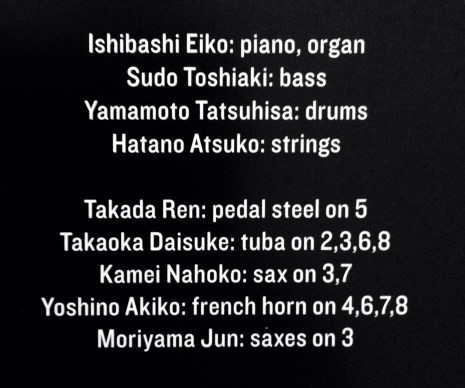
I’m thinking that some of these guys are playing with O’Rourke in this concert from last year (I’m pretty confident that Yamamoto Tatsuhisa is on drums):
The Portinari Altarpiece, St. Mary Magdalen and St. Margaret with Maria Baroncelli and Daughter Margherita Portinari, Right Wing — Hugo van der Goes

Kindle Cover Disasters

Kindle Cover Disasters is a tumblr devoted to Kindle cover disasters. My friend sent me the link so you must suffer too. Here are a few selections that are relatively SFW, but the site itself is not always this, uh, tame. Continue reading “Kindle Cover Disasters”
Marlene Deller — Jack Bush

Guitarra Minhota — Eduardo Viana

Glossary of Hobo Terms
GLOSSARY OF HOBO TERMS
(from Nels Anderson’s The Milk and Honey Route)
This list of words and phrases is in no sense complete. Nor is it solely hobo slang. Many terms began in Hobohemia and were taken up in time by other groups. Other terms are found among both hobo and other groups, but in each case with a different meaning. Indeed, you will find a hobo term with one meaning on the Pacific and another on the Atlantic Seaboard, and still another in the Southland. In this book I have made no strained effort to use much of this freightyard folklore. This is opposite to the practice of many contemporary hobo writers. They think by the use of slang to add a bona fide touch to the fiction they weave. I am including this glossary largely for the information of those of you who may be interested, and for reference if you want to test some of the “authorities” in this field.
Accommodation – A local freight train. It may carry passengers.
Adam and Eve on a raft – Two fried eggs on toast. “Wreck ’em” if they are scrambled. “With their eyes open,” if not.
Alligator bait – Fried or stewed liver. Too costly now for hobos.
Anchor – A pick. Companion tool of the shovel or banjo.
Angel – A person who gives more than you expect. One who takes an interest without trying to reform you.
Angel food – Mission preaching about the Bread of Life.
Angelina – Punk or road kid acting as a hobo’s companion.
A-No-1 – A famous tramp who writes his name “on everything like J. B. King.” He writes books about his alleged adventures. Many young hobos write this monicker on water tanks, and chalk it on box cars.
Auntie – Angelina grown older.
Axle grease – Butter. Sometimes called plaster.
Baldy – Generally an old man “with a high forehead”.
Balloon – A roll of bedding carried on the back; a bindle.
Barnacle – A fellow who sticks to one job a year or more.
Banjo – A short-handled shovel. Continue reading “Glossary of Hobo Terms”
The Mérode Altarpiece — Robert Campin

Critical Mass (Gravity’s Rainbow)
“I think that there is a terrible possibility now, in the World. We may not brush it away, we must look at it. It is possible that They will not die. That it is now within the state of Their art to go on forever—though we, of course, will keep dying as we always have. Death has been the source of Their power. It was easy enough for us to see that. If we are here once, only once, then clearly we are here to take what we can while we may. If They have taken much more, and taken not only from Earth but also from us—well, why begrudge Them, when they’re just as doomed to die as we are? All in the same boat, all under the same shadow… yes… yes. But is that really true? Or is it the best, and the most carefully propagated, of all Their lies, known and unknown?
“We have to carry on under the possibility that we die only because They want us to: because They need our terror for Their survival. We are their harvests… .
“It must change radically the nature of our faith. To ask that we keep faith in Their mortality, faith that They also cry, and have fear, and feel pain, faith They are only pretending Death is Their servant—faith in Death as the master of us all—is to ask for an order of courage that I know is beyond my own humanity, though I cannot speak for others… . But rather than make that leap of faith, perhaps we will choose instead to turn, to fight: to demand, from those for whom we die, our own immortality. They may not be dying in bed any more, but maybe They can still die from violence. If not, at least we can learn to withhold from Them our fear of Death. For every kind of vampire, there is a kind of cross. And at least the physical things They have taken, from”“Earth and from us, can be dismantled, demolished—returned to where it all came from.
“To believe that each of Them will personally die is also to believe that Their system will die—that some chance of renewal, some dialectic, is still operating in History. To affirm Their mortality is to affirm Return. I have been pointing out certain obstacles in the way of affirming Return…”
From pages 539-40 of Thomas Pynchon’s novel Gravity’s Rainbow.
The sermon is from a Jesuit, one Father Rapier, and takes place in one of GR’s stranger episodes (which is really saying something, that adjective there). Before the sermon—a “Critical Mass,” our narrator takes unusual pains to make sure that we get it, that we understand that the Jesuit is here to preach “against return. Here to say that critical mass cannot be ignored. Once the technical means of control have reached a certain size, a certain degree of being connected one to another, the chances for freedom are over for good.”
Compare the Jesuit’s notation of “once, only once” to the passage on pages 412-13 on Kekulé, the snake that eats its own tale: “…a quote from Rilke: ‘Once, only once…’ One of Their favorite slogans. No return, no salvation, no Cycle—”. The sermon also echoes the They/We riff on page 521.
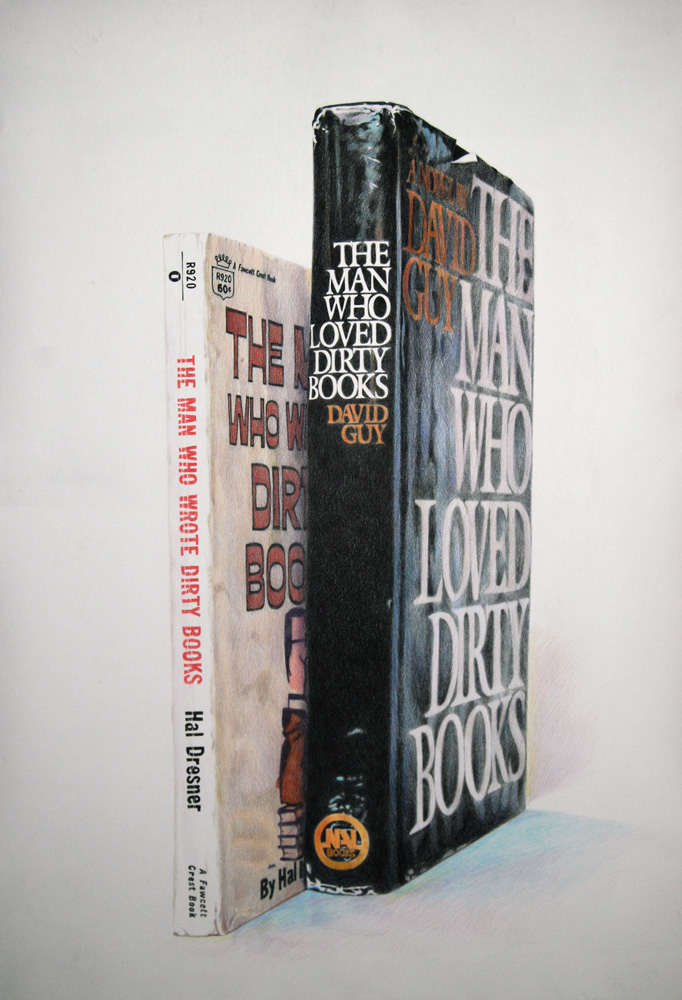
A Dirty Pair — Eric Yahnker
 Biblioklept