Hieroglyphick Bibles and other Marvelous Oddities

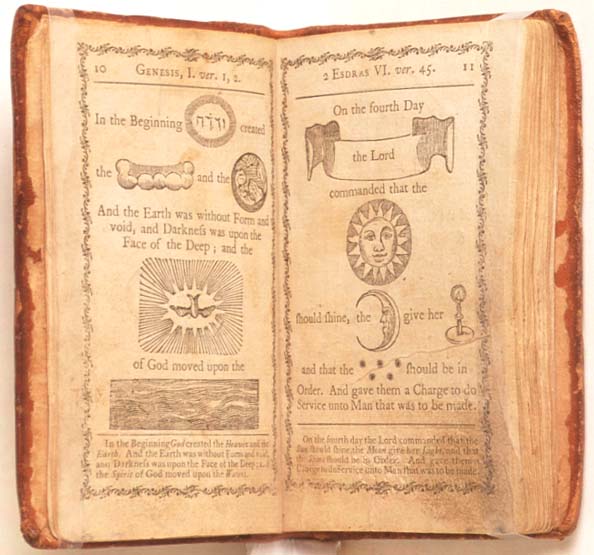
I’ve really been enjoying going through the Library of Congress American Treasures Collection. I came across this Hieroglyphick Bible (1788) the other day and thought it was pretty cool.

hieroglyph.jpg

Of course, I’m a big fan of the graphic novel (as well as the Old Testament) so this was right up my alley. More evidence supporting Scott McCloud‘s argument that the comics form is one of the oldest forms on earth (of course he goes way further back than the eighteenth century, contending that Egyptian hieroglyphs fall into his definition of comics art). Either way, check out LOC’s collection–fun for book nerds and history geeks alike.

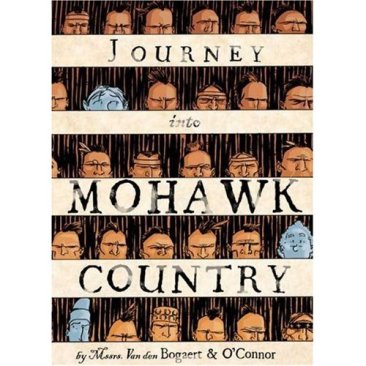
Journey into Mohawk Country–Van den Bogaert and O’Connor


mohawk.jpg

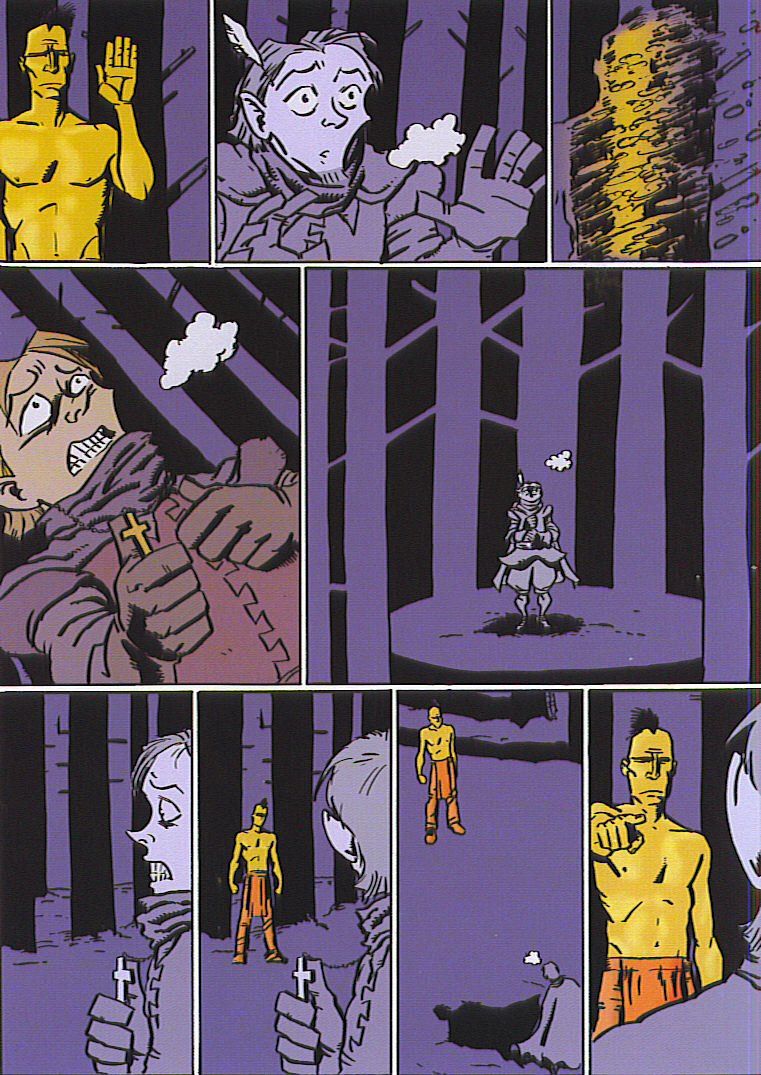
Journey into Mohawk Country is George O’Connor’s adaptation of Harmen Meyndertsz Van den Bogaert’s diary, an historical document detailing the young Dutch explorer’s 1634 journey out west of New Amsterdam to make contact with Indian villages for trade. O’Connor uses Van den Bogaert’s words verbatim, but his graphic novel format allows him extraordinary liberties with the journal’s account. Vague descriptions are literally fleshed out; O’Connor finds innuendo in even the simplest of Van den Bogaert’s entries, illustrating a between-the-lines reading of the Dutchman’s diary. O’Connor even manages to stick a strange epiphanic mystical revelation scene in there. The story itself is pretty simple: Van den Bogaert and his two companions head out into Mohawk country, meet and trade with Indians, eat bear, learn about some alien customs (including a sequence where some Indians show Van den Bogaert how to heal the sick by vomiting on them), and go back to Fort Orange. It’s really the little interpretive scenes around the text-proper, courtesy of O’Connor’s cartoony pictures, that make Journey into Mohawk Country such a pleasure to read. O’Connor’s work here illustrates the first-person narrative’s slippery claims on truth and the limited viability of a “true” historical account. Good stuff.

mohawk2.jpg

Leviathan–Jens Harder

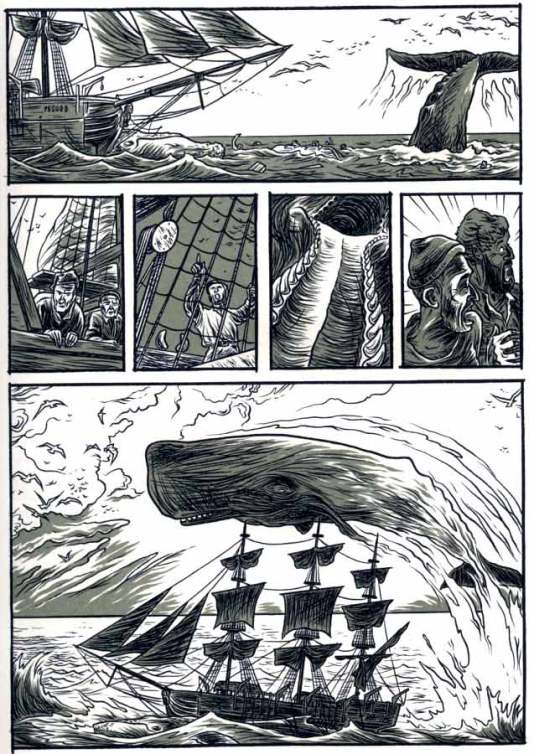
Jens Harder’s Leviathan is a graphic novel in the truest sense. Harder uses scratchy but fluid images to tell the story of a mystical whale who battles a giant squid, saves Noah’s ark, attacks the Pequod, wreaks havoc on a cruise ship, and eventually battles an armada of anachronisms. The only text Harder employs in Leviathan are excerpts and quotes from a variety of sources including the Bible and a host of philosophers; the bulk of quotes come from Melville’s Moby-Dick. Just as that novel begins with an “Etymology” followed by a section called “Extracts,” Harder begins with a section called “Leviathanology,” a collection of quotes about leviathans from the likes of Hobbes, Milton, and the book of Job. These quotes inform the story of Leviathan, connecting the whale to a sublime and unknowable mystery that Harder will explore. Harder’s surreal images often invert notions of “proper” space and time, giving the whale an awesome significance, but also positing the beast as something that denies signification. By eschewing the traditional forms of graphic storytelling, which rely on speech bubbles and clear-cut panel transitions, Harder is able to capture something that is essentially too large to capture. This book works. Highly recommended.

leviathan.jpg

Joe Sacco

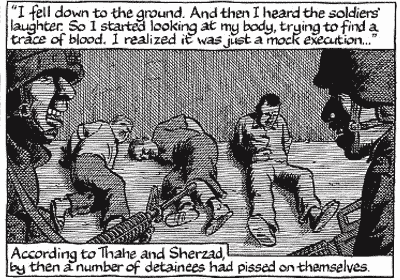
 Joe Sacco’s comic book journalism captures the human elements in disaster, bringing the world’s worst phenomena–war, political oppression, genocide–into a perspective that the average American can understand. Although I was certainly old enough to follow media coverage of the Bosnian War in the nineties, I didn’t really have any clue as to what the whole thing was about until I read Sacco’s alarmingly real Safe Area Goražde, a masterpiece of graphic journalism that puts a human face on planned extinction. Ditto for Palestine, a work detailing Sacco’s years in the Gaza Strip, exploring the Israeli-Palestinian conflict. Palestine distills an ancient and ungraspable conflict into a series of frames, images, faces, and words that becomes somehow easier to confront. Palestine certainly can’t explain the incursions and the stone-throwing and the land grabs and the refugee camps and the food shortages and the torture and the kidnapping–it doesn’t even try–but it does make these abstractions thoroughly concrete. 

Sacco is by no means an impartial, objective observer–he eats and lives with the people he’s writing about, and appears in all his stories as a character. Some of the most poignant moments in Sacco’s work concern simple pleasures–like watching bad action movies on pirated VHS or sharing fresh coffee with a new friend–set against a backdrop of disaster. Like Marjane Satrapi’s Persepolis, Sacco’s comics work as an education in both politics and the humanities. Highly recommended.

Check out Sacco’s recent comics on Iraq, downloadable as pdfs–Trauma on Loan and Complacency Kills.

Also available online in-full, The Underground War in Gaza, originally published by The New York Times Magazine in 2003.

In the Shadow of No Towers–Art Spiegelman

Art Spiegelman’s Maus, released as a graphic novel over twenty years ago, did more to legitimize the comic as an art form than any other work I can think of. It won a Pullitzer Prize Special Award in 1992 (the Pullitzer committee found it hard to classify…perhaps they didn’t want to admit that they were giving a prestigious award to a comic book!), and today Maus is a standard on many college English syllabi.

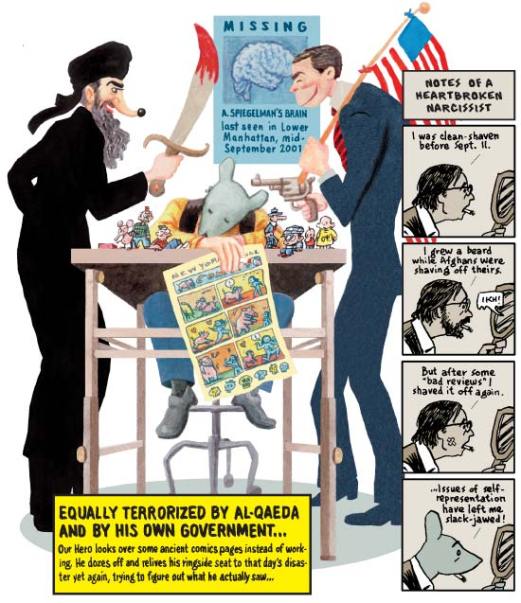
After Maus, Spiegelman worked for The New Yorker for over ten years, quitting in early 2002 after the September 11th attacks to work on a series of broadsheets entitled In the Shadow of No Towers. These broadsheets were collected in 2004 in an unwieldy 15″ x 10″ book.

spiegelman_02_550×637.jpg

Spiegelman lived in downtown Manhattan, right by the towers; his daughter attended school a few blocks away. He saw the towers collapse in person, fleeing for his life with his family. Spiegelman attempts to capture this raw, unmediated, and very personal experience in In the Shadow of No Towers (Sonic Youth’s 2002 album Murray Street works to the same end–only much more abstractly): the narrative is discontiguous, fluctuating from bitter satire to earnest inquiry. Spiegelman’s choice of the broadsheet as his medium (the broadsheets were published monthly by different newspapers as Spiegelman produced them) is tremendously affective: just like the 9/11 attacks, the broadsheets are larger than life, hard to grasp, hyperbolically resisting easy, singular readings. Spiegelman balances bitter attacks against the conformist mentality spurred by the Bush administration with pathos and humor; In the Shadow of No Towers recalls the good-natured satire of broadsheet comics from a hundred years ago, bittersweetening the content. The 2004 collection wisely contextualizes Spiegelman’s work by reprinting broadsheets of “The Yellow Kid” and “The Katzenjammer Kids.”

Like Maus, In the Shadow of No Towers is a fascinating exploration of how disaster confronts and transforms identity. And reflecting its heinous subject, In the Shadow of No Towers ends without concluding: as the foolish Iraq war begins, Spiegelman can no longer shape any meaning or sense from his work. This isn’t a graphic novel–don’t look for a cohesive narrative structure here; instead, In the Shadow of No Towers explores the loose ends, the detritus, the psychic remnants of disaster.

The Religious Experience of Philip K. Dick

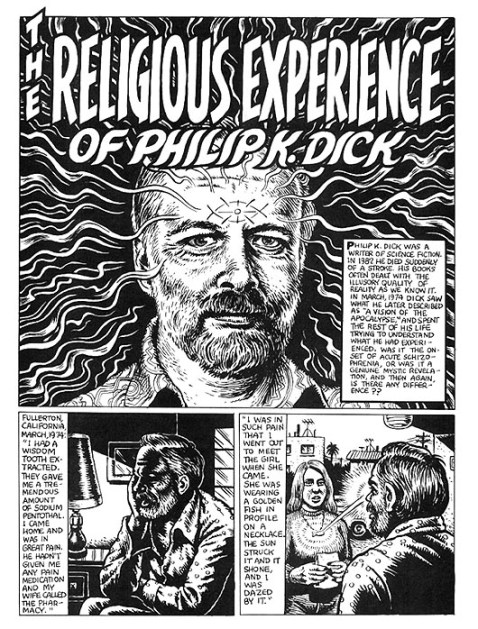
Want to learn about PK Dick’s bizarre apocalypse visions? Sure you do–and who better to tell a bizarre story than underground comix avatar Robert Crumb, whose accoutnt is available here in full.  Dick’s revelations led him to believe that he was coexisting in a Roman Empire that never fell, and that the spirit of the prophet Elijah lived within him. Highly recommended. 

weirdo1.jpg

Guy Fawkes Day and V for Vendetta

“Remember, remember the 5th of November…”

I was lucky enough to live in New Zealand for a few years as a kid, so I got to experience Guy Fawkes Day. We made effigies of Guy, and then we burned them on a bonfire. There was a barbecue, and fireworks. To me it seemed a strange mixture of the Fourth of July and Halloween.

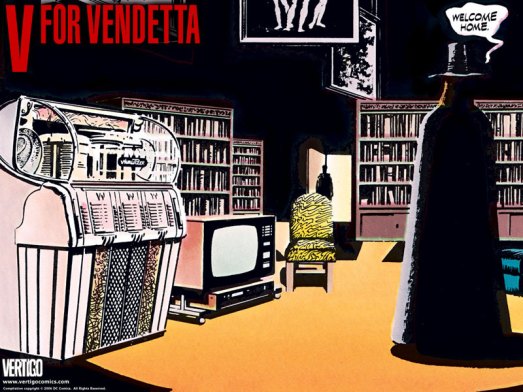
It was a few years after my last Guy Fawkes experience that I read Alan Moore’s V for Vendetta. V, an anarchist who wears a stylized Guy Fawkes mask, wages a vigilante war on a harsh authoritarian government. Along with Frank Miller’s The Dark Knight Returns, V was a first for me, something different than the stuff I was reading at the time, stuff like The Uncanny X-Men and the ill-fated Valiant Comics imprint (I actually made a small fortune selling early Valiant issues I owned).  

A film version of V for Vendetta was released in 2006; Alan Moore famously had his name removed from it. I enjoyed the film, although it certainly wasn’t as good or thought-provoking as Moore’s original story; and even though the film looked good, the passive experience of watching an action movie can’t measure up to David Lloyd’s original art work and that wonderful space between the panels of comics that engages the reader’s imagination.
v_for_vendetta_5_800×600.jpg

This afternoon I finished the first graphic novel of Alan Moore’s  run writing Swamp Thing, and I can’t wait until my library hold on the second graphic novel comes in. I had no idea Saga of the Swamp Thing would be as good as it was, nor as beautifully illustrated; it’s actually much better than V for Vendetta or Moore’s other famed work, Watchmen (and none of these titles are even in the same league as Moore’s masterpiece, From Hell). Alan Moore and Steve Bissette’s run on the DC Comics series essentially led to DC’s creation of the edgier Vertigo imprint for their more “mature” titles, such as The Sandman. These titles helped to change the audiences of “comic books” and helped to make the graphic novel a new standard in the medium (no mean feat, considering the fanboyish culture of comic nerds, a culture that prizes rarity of print run over quality of storytelling).

V for Vendetta illustrates what happens when we don’t allow for dissent, what happens when ideas are both prescribed and proscribed, and all dialogue is muted. Authoritarian governments consolidate their power from the silencing of ideas. A healthy society requires all sorts of opinions, even ones we don’t like. The smiling Americans in this photo aren’t burning effigies of would-be revolutionaries, they are burning something much more dangerous–books.

book-burning.jpg

Jeff Smith–Bone

I got Jeff Smith’s Bone: One Volume Edition in the mail today. I love getting mail, maybe that’s why I love Netflix so much.

This book collects every single issue of Smith’s self-published Bone comic book series, which first came out back in the early nineties…I still have the first couple of issues (think they might be worth anything?)

When Bone originally came out, I was very much into Dave Sim’s Cerebus and other black & white indie comics of a “dark” nature–and despite Dave Sim’s recommendations, Bone was too sweet-natured for me. I couldn’t appreciate Smith’s Walt Kelley-esqe art (the Pogo strip had perplexed me as a kid), and Smith’s layered plot moved too slowly–I realize now it started slow because Smith had all 1300 pages of the series plotted out from the first issue.

A few weeks ago, I was searching through some old graphic novels, looking for a particular Asterix book for some reason, when I came across the first graphic novel in the Bone series, Out from Boneville. I started re-reading it to find that it was waaaaaay funnier than I had realized, and that the art was beautiful and logical and spare and clean. Luckily, Smith has made his work easily accessible, in one big (seriously, this book is heavy) edition.

Will post more on this as I read. 

From Hell: Scary Books–Part II

 Alan Moore (writer), Eddie Campbell (artist).

Alan Moore’s well-researched, 500+ page graphic novel theorizes that the Jack the Ripper murders were in fact a conspiracy to get rid of a royal’s illegitimate child who posed a threat to the Victorian lineage. I can’t say enough good things about this book. I am a huge fan of graphic novels, and this is one of the best, right up there with Art Spiegelman’s Maus, Dave Sim’s Cerebus and Joe Sacco’s Palestine. The intricate plot involves Masonic conspiracy, Victorian sexual mores, 19th century surgery, insanity, and a blood ritual resulting in transcendental time travel. Eddie Campbell’s art does a wonderful tight-rope act in putting order to chaos. His scratchy inks burst with emotion–I can’t imagine a better artist for this story. I actually wonder if some of Moore’s other work (V for Vendetta, Watchmen) would resonate deeper with me had an artist of Campbell’s caliber (Bill Sienkiewicz or Mike Mignola, possibly) worked on those books. I doubt it though. I always recommend this book to persons who don’t think graphic novels are literary. I won’t loan it out though. I don’t want it to go MIA.

(By the way, the Hughes brothers-directed movie adaptation of this novel, starring Johnny Depp, IS NOT the same story at all. I know, hard to believe that Hollywood could screw up great source material, but nonetheless true).