Biblioklept Interviews Camelia Elias, Editor-in-Chief of EyeCorner Press

Camelia Elias is the founder and editor-in-chief of EyeCorner Press, an independent publisher devoted to printing a host of difficult-to-classify writings, including creative academic writing, and poetic fragments and aphorisms. EyeCorner publishes works in English, Danish, and Romanian, as well as bilingual editions. This multilingual approach gels with the publishing house’s fragmentary philosophy, as well as its origins as a collaborative venture between universities in three nations. In addition to her editorial duties, Elias is also one of EyeCorner’s authors; her latest work Pulverizing Portraits is a monograph on the poetry of Lynn Emanuel. Elias is Associate Professor of American Studies at Roskilde University in Denmark and she blogs at FRAG/MENTS. Elias was kind enough to talk with me over a series of emails; in our discussion she defines creative criticism, discusses the value in being open to error, accounts for hostility against deconstruction and post-structuralism in academia, and explains why it doesn’t hurt to throw the word “fuck” into a textbook now and then.

Camelia Elias

Biblioklept: EyeCorner Press is somewhat unusual, even for an indie publisher — a joint venture between universities in Denmark, Finland, and the US that focuses on creative criticism. How did the press come into being?

Camelia Elias: The press came into being as an act of anarchism, if you like, a form of resistance against the idea that academic work must be measured not only against its own standard, but also against the standard that idiotic governments sets for measuring, and hence controlling, intelligence, creativity, and freedom. In 2007 I was editing new research papers written by colleagues and associates of the Institute of Language and Culture at Aalborg University with view to publication by the Faculty of Humanities at AU. A new change in leadership also brought about a new set of ideas. These were rigidly formulated along the newly established injunction passed down by the Danish government, which dictated that all Danish academics must now prioritize publishing with Oxford and Harvard. Without getting into the silly and imbecilic arguments produced for the sustainability of such a demand in reality, the fact remains that many heads of department throughout our Danish universities tried to implement the new regulations literally. The good publishing folks at Aalborg were told that Research News (the publishing venue) was going to close, and no, as the justification for it ran, this was not because the papers were not good enough, but 1) because publishing new research under the aegis of the department was likely to have the undesirable effect of preventing the researchers from expanding their range of publishing possibilities – and hence not consider Oxford and Harvard – and 2) there will be no money for it anymore. Few of us tried to make obvious the stupidity pertaining to the first argument – bad idea, as bosses generally don’t want to be told that they have limited visions – and as to the second argument, pertaining to the precarious, or rather by then non-existent financial support, a few of us also tried to suggest that we could go ‘on demand’ and even work ‘con amore’ for it, which would involve no expenses. The answer was still no. So, there we were, with a few manuscripts in the pipeline and no possibility of getting them out. As the editor of these papers, I felt a responsibility not only towards the writers but also towards the readers who had bothered to peer-review the works. I decided to start EyeCorner Press in my own name, but retain the ties we had in terms of publishing jointly with a few other partner universities. With Brenau University in Gainesville, Georgia, we had just finalized a volume on transatlantic relations (aesthetics and politics) within Cultural Text Studies Series published by Aalborg University Press. We are happy to call them our close allies. University of Georgia, Gwinnett, and Oulu University in Finland followed suit and so did Roskilde University, which became my new working place not long after the Aalborg ‘situation’.

Continue reading “Biblioklept Interviews Camelia Elias, Editor-in-Chief of EyeCorner Press”

Biblioklept Interviews Filmmaker Paul Festa

Paul Festa

Musician, writer, and filmmaker Paul Festa contacted me a few months ago to point out that I’d used a still of Harold Bloom from his film Apparition of the Eternal Church without crediting him. It was the nicest possible email in the world, and after a few pleasant exchanges, he sent me a copy of Apparition along with his new film, The Glitter Emergency. Both films are marked by humor, pathos, and a deep love for music. Paul was kind enough to talk with me about his work over a series of emails. For more info, check out his website.

Biblioklept: Your new film The Glitter Emergency is about a girl with a peg leg who dreams about being a ballerina. There’s a humor in the film that highlights some of the dramatic absurdity to the premise, but there’s also a lot of pathos there. How did the idea for the film come about?

Paul Festa: The germ of the plot itself came from an act Matthew Simmons had me accompany on violin many years ago, when his drag persona Peggy L’Eggs came out onstage as a one-legged ballerina on a rollerskate. But what precipitated the making of the film last year was a profound career crisis that came between the death of an extremely important and beloved mentor and my 40th birthday. I’d worked seriously – feverishly – to become a violinist, but a repetitive strain injury curtailed my musical career. Then I put all that energy and commitment into becoming a writer, but I didn’t achieve any success until almost by accident I became a filmmaker with my experimental documentary Apparition of the Eternal Church, a no-budget personal project that went on to screen throughout the US and Europe and win prizes and get very well reviewed. So at the age of 39 I found my energies and time divided between music, fiction and film, and none of the above had coalesced into a sustainable career and I still didn’t know, squarely into my middle age, what I was going to be when I grew up.

I spent December of 2009 and much of January lying awake through the night listening to my heart beat and it was in that period of grief for my mentor, and panic about my life, that I came up with the idea for this film that would be a comedic metaphor for my experience as an injured artist who finds his way back to his art through supernatural intervention. In the peg-leg ballerina’s case, it’s the vial of Enchanted Glitter; in my own case, it’s film, which enabled me to resume my life as a professional musician. And in both cases, it’s an enchantment much like Dumbo’s feather, a suspension of our self-doubt more than any external magical agent that permits us to do extraordinary things with our lives.

Biblioklept: The Glitter Emergency — at least most of it — is stylized as an early silent film: black and white, placards for dialog and titles, even the jumpiness of an old reel-to-reel machine is replicated. Was this form always part of the project? What prompted your decision to shoot the film this way?

PF: The silent-film aesthetic was there from the get-go, and for several reasons. First of all, the whole project is a star vehicle for Peggy L’Eggs, and as a film presence she was born sixty years too late — she’s Clara Bow and Lillian Gish and Stan Laurel all rolled into one. Second, the convention of silent film, with dialogue represented in intertitles, works perfectly with what I do at the intersection of music and film. In the usual relationship, music is there to serve film, to color it emotionally as soundtrack. What I do is the other way around – I’m using film to illuminate or dramatize music. And so the music has to play uninterrupted, and intertitles work perfectly. When you think of it, it happens in both my films – the last third of Apparition of the Eternal Church consists of silent images of the interview subjects, and text titles, and organ music accompanying.

I don’t have any formal education in film, but when I was a kid my father used to take me to the Avenue Theater out on San Bruno Avenue in San Francisco, where every Friday night they would show a silent film and an early talkie, the silent accompanied on the theater’s Wurlitzer by an old guy named Bob Vaughn who had accompanied these films when they first came out in the 20s. So the look and feel are second nature for me, as they are for my co-director Kevin Clarke, who came up with a lot of the signature silent-film flourishes in Glitter.

Biblioklept: You bring up your first film, Apparition of the Eternal Church, which again is obviously very much about music. The film begins by having a number of people listening to the music of Messiaen on headphones and reacting to it, discussing it, emoting to it, puzzling over it — but the music is withheld from the audience for quite some time. I found it very, very frustrating! Was this by design? What’s the story behind Apparition?

PF: I would never intentionally frustrate an audience, though I might withhold satisfaction for a half hour as Apparition does. The reason for the structure of that film is again to serve the music, to preserve our ability to hear it whole and to some extent on its own terms. I had filmmakers advise me that the film could only work if I dosed out the music in parcels, letting the audience hear it piece by piece, fading it in and out throughout the interviews. I never seriously considered this option – as the playwright Karen Hartman observes early in the film, you don’t talk over Messiaen! It’s not background music. So that is an experience – a trial – I reserved for the interview subjects and spared the audience. And I spared the music from being chopped up and presented piecemeal, which would have rendered it meaningless for the following reason: the piece is composed of two sonic pyramids, one short and preliminary, the next reaching up to what Messiaen understands to be God. If you present a pyramid in pieces, you have a pile of stones and they don’t do anything, much less ascend to heaven.

So my options were to play the music first, before the interviews, to play it after, or not to play it at all. I tend to think the option I chose results in the least frustration – but everyone experiences the film, and the music, differently.

Biblioklept: For the record, I don’t think the frustration is negative at all — the withholding primes anticipation to a level that passes, I don’t know, an itch, I suppose. I wanted to hear what your subjects were hearing. Speaking of the subjects, how did you get people involved in the film? There’s such a wide range of interviewees there, from Harold Bloom to Squeaky Blonde. How long did it all come together?

PF: The subject of frustration in Messiaen is interesting, because some people – including much more sophisticated musicians than I – find a disturbing lack of direction or resolution in his music. It’s static to them – it floats, an object in space that gets bigger or smaller as its relation to you changes, but beyond the change in that spatial relationship it’s not doing anything and it drives you bonkers. And I think that frustration is a species of the torture that eternity threatens, the emptiness of life without end. For theological reasons Messiaen can’t intend that dark gloss on eternal life, and it’s pretty far from my experience of the music, but plenty of people experience it. Hence John Rogers’s observation that despite what the composer intends to portray, “this is what hell is like.”

I interviewed 115 people for Apparition, and 31 are in the film — some of them for just one or two clips. The first interview was with the harpsichord virtuoso and early music guru Albert Fuller, who had taught me chamber music when I was a student at Juilliard in the early 90s, and who taught me in large part by putting on music and talking through it, describing what he heard in “the theater of his imagination,” as he called it. Albert’s interview was so great — so wide ranging ad surprising, starting in laughter and ending in tears — that I felt I needed to keep going. I interviewed pretty much everyone I could get to put on the headphones and sign a release – anyone who walked into my apartment. Several of my English mentors are in the film – I took Bloom’s Shakespeare seminar at Yale, and Rogers’s Milton and Spencer courses, and several classes with Wayne Koestenbaum. Michael Warner, who now heads the Yale English department, I met along with several other cast members in the woods of Tennessee at a gathering of the Radical Faeries. I spent most of three years collecting the interviews, a pace I recommend to anyone doing a project like this.

Biblioklept: You’ll be presenting both movies later this month (in Santa Cruz) with live musical accompaniment. Have you done that before? What can audiences hope to see and hear?

PF: Both Apparition of the Eternal Church and The Glitter Emergency are blessed with having had numerous screenings with live musical accompaniment. Apparition has screened accompanied by some great church organs in the US and Europe, including St. Bartholomew’s Church in New York and Grace Cathedral here in San Francisco. I’ve accompanied Glitter on violin at every public screening since we premiered the rough cut in May of last year. And while the two films have screened before as a double bill, this is the first time both will screen together with live music. In addition to the films and music, the audience should expect a robust discussion afterward. The screening is sponsored by UCSC, where both films screened last year to a terrific film history class where I got some of the most intelligent questions and commentary of any post-screening Q&A.

Biblioklept: Have you ever stolen a book?

PF: I’ve stolen a lot of books, most significantly Virginia Woolf’s Orlando and Thomas di Cantimpre’s Life of Christina Mirabilis. I’ve been boiling them down with some Bible and Franzen and a pinch of Milton and dimly remembered Steinbeck and any year now am expecting it to yield my first novel, Heaven Descending, a sort of bildungsroman amid a world of Hollywood lowlives and Radical Faerie medical marijuana farmers that sparkles with magical realism and catastrophic drug busts. In the fall I had seven weeks at Yaddo in which I laid the foundation for the fourth draft but work on two new films has prevented me from making any progress since New Year’s. Next year is a big year for the project; it turns 10.

The Glitter Emergency will have its Midwest premiere at the Chicago International Movies & Music Festival on Thursday, April 14, at 7:30 p.m., at the Wicker Park Art Center, launching a program that features Kenneth Anger’s two masterpieces, Lucifer Rising and Scorpio Rising – all with live musical accompaniment.

Biblioklept Interviews Steve Hendricks About Torture, Extraordinary Rendition, Liberal Complacency, and His New Book A Kidnapping in Milan

Steve Hendricks is the author of two works of investigative journalism. 2006’s The Unquiet Grave is an examination of how the FBI aided and abetted the erosion of American Indian culture in the United States. Hendricks’s newest book is A Kidnapping in Milan, a nonfiction thriller that exposes the extraordinary rendition of radical imam Abu Omar by the CIA. In our review we noted that “Hendricks combines journalistic clarity with the structure of a detective novel in Kidnapping,” pointing out that what guides “the narrative is a refined sense of moral outrage against the idea that dark deeds done in the dark make our world somehow safer.” Hendricks was kind enough to talk with us via email about his book, torture, the Obama administration, and the rise of the apathetic liberal in America. You can read more at Hendricks’s site.

Biblioklept: Obviously a lot of work went into A Kidnapping in Milan — lots of research and interviews, not to mention the fact that you learned Italian. What made you want to tell this story?

Steve Hendricks: I came to the story somewhat sideways–less because of Abu Omar’s rendition itself than because I was frustrated that no one had written a compelling account of the horror of America’s torture-by-proxy; that is, the horror of the torture that our client states were inflicting on our captives in what amounted to our offshore dungeons. Reporters of course said that the torture was horrific, and sometimes they went into a bit of good detail, but there weren’t any narratives that went deep enough to make us feel that horror–to make us understand in our gut why political torture is not just a crime but a crime against humanity. So I was looking for a story that would allow me to try to write that narrative.

As I researched the renditions that we knew something about (so many renditions, of course, we know nothing or next to nothing about), I came across Abu Omar’s story and was immediately struck by the almost incredible amount of detail that the Italian prosecutor, Armando Spataro, had dug up on the CIA, by the ludicrousness of how the CIA went about the rendition, and by the possibility that Spataro might be a heroic figure. I wasn’t naive about heroes. They’re flawed like all the rest of us. But in America’s “war on terror” the villains–both terrorists and our own war criminals–have so often outnumbered the heroes that if there was a chance of writing a tale that could be somewhat uplifting while at the same time being wrenching (because of Abu Omar’s torment) and comic (because of the CIA’s Keystone Kommandos), that was great. So much the better, for the narrative anyway, that Abu Omar was a terrorist. It made the book more gray than black-and-white. In the end, the story of his torture, which had gotten me into the book, ended up being just one chapter, though to my mind it’s one of the most powerful chapters in the book.

Biblioklept: I think for most readers that chapter, “Torment,” will certainly stand out. I found it fascinating, particularly the historical overview of how various governments have used torture (and “ordeals”) to coerce information from captives. There’s a brutal episode in the chapter that describes how the torturers used a cattle-prod type device on Abu Omar. In narrative terms, we find ourselves sympathizing with this “bad guy,” this enemy-other who’s been locked up in a no-place. How important was it for you to elicit this kind of emotional identification on the reader’s part with Abu Omar? Were you concerned with alienating some potential readers?

Hendricks: It was very important to me that readers empathize with the atrocities visited on Abu Omar. It’s easy for anyone to say that lesser criminals shouldn’t be tortured. But for some people it’s much harder to say that torture shouldn’t be used against our greatest enemies. Yet that’s the test–one test anyway–of whether a deed like torture is evil: does it repulse and degrade us even when we use it against those who are themselves in some measure evil? Yes, I was sure, as you suggest, that my portrayal would alienate some pro-torture readers, but I was more interested in appealing to readers whose minds weren’t made up.

I did hear, shortly after the book’s publication, from one reader who said he was put off that I was advocating a moral view rather than giving a neutral “here’s this side of the story, here’s that side of story.” My response was that most of the supposedly “neutral” descriptions of torture-by-proxy haven’t in fact been neutral. For example, most American media refuse to refer to our use of waterboarding as torture, even though if you asked a hundred torture experts, ninety-nine would say it’s torture. I believed a corrective was needed–not an unfair and ludicrously biased corrective but one that reported the brutal facts unsparingly, which in turn would make plain that the mainstream media, by sins of omission and commission, had gotten things badly wrong.

I would add that there are some crimes so heinous that if you don’t call them heinous, you’re either dishonest, naïve, or a coward. Look at it this way: if an author told the story of the Holocaust as “well, Hitler had his take on it, and the Jews had theirs,” would you trust the author, or would you think him a lout? The torture of a few hundred men is not the same as the murder of millions, but international law deems systematic torture as so awful that it puts it in a class of crime similar to genocide–and it’s not just international law, but American law that does so. The United States has adopted both the Rome Convention and the UN Convention Against Torture as the law of the land, and both laws define political torture as a crime against humanity. The Convention Against Torture, as enacted here, provides jail time for people who send someone to another country to be tortured, and if the tortured person dies, the punishment can even be the death penalty. That’s not something you hear much in the media–that Clinton (who began extraordinary renditions), Bush junior, and now Obama (who continues the rendition program) could be subject to jail time or even death.

All that said, I strongly believe that a writer like me who advocates a moral position is obliged to present the facts in such a way (even if he’s presenting his opinions alongside them) that will allow readers to judge for themselves whether his advocacy is valid. I think I did that in the book, but, in the spirit of what I’m saying here, I’ll leave it to the reader to decide.

Biblioklept: Your book ends in early 2009, where you point out that, from the outset, the Obama administration essentially followed the Bush administration’s policies; Obama has even authorized the assassination of American terror suspects. Over the past few years, the average American’s focus has shifted from US foreign relations to our sagging economy. It seems that there’s a sense among many progressives that our international reputation and morality have been restored simply by electing Obama. Do you worry that there’s too much complacency on the left? What’s at stake in continuing to ignore our government’s abuses?

Hendricks: Absolutely, there’s far too much complacency on the left. Most leftists simply packed up their bags and went home after the 2008 elections, then were utterly dismayed when Obama tacked way to the right on just about everything: on health care, on banking reform, on the stimulus package, on the wars in Afghanistan and Iraq, on torture, and on and on. Some leftists have woken up, but most of them still think that with some pretty tepid nudging, they can bring out the good Obama that they “know” is inside him. Guess what, folks: As he has shown again and again, he’s a corporatist/defense-hawk Democrat, and he’s not going to change unless he has no choice–and at this late date, that’s not going to happen unless he’s threatened with a serious challenge to his renomination in 2012. But of course most progressives, demoralized and limp, are too scared to give him a run for his money and will stand by their man, even if he’s not their man.

I’m endlessly amazed (and depressed) at how little the left learns from the right. Right wingers build power by playing strongly to their base. They push and push their far-right policies, and the national discourse moves rightward with them. Contrast that with progressives, who plead rather than demand and who, when they get into the office, make a mad dash for the center-right. Don’t these people know that in poll after poll a majority of Americans support their (supposed) goals: an end to the illegal wars, a real ban on torture, health care with a public option, accountability for banks, etc.?

As for what’s at stake in continuing to ignore abuses like torture, to my mind the biggest danger is that torture becomes normalized. Ten years ago it would have been thought barbaric to advocate torture. But after the pro-torture drumbeat of the last decade, “leaders” like Bush and Cheney not only can advocate torture but can boast about having ordered it–and face only the smallest blip of public disapproval. If we don’t reckon with our past, ever more Americans will come to see torture as acceptable, and we will have become the barbarians we set out to fight.

Biblioklept: What’s your next project?

Hendricks: A Kidnapping in Milan and my first book, The Unquiet Grave (which was about how the FBI undermined the Indian rights movement of the 1970s), each took about four years–four long years–to complete. So I’m giving myself a break from book-length nonfiction and taking my time mulling the next book. It’s not the easiest part of the job to find a topic will excite both me and a publisher, but the search itself is fun. I get to read a lot of fascinating things, and the time just to think is a luxury. Meanwhile, I’m working on a few magazine articles. One is about some rather astounding health benefits that fasting can yield. Another is about a man who was wrongly convicted of murder but was executed nonetheless. Actually, though, what takes up most of my time these days is a novel for middle grade kids. The book is something like a mystery, it’s mildly futuristic, and it has some political overtones–evidently I can’t keep politics out of my writing. I’m writing it as a way of saying thanks to my eight-year-old for tolerating my many absences, physical and psychological, while I researched and wrote my two books.

Biblioklept: Have you ever stolen a book?

Hendricks: Yes–or rather, to qualify my crime, sort of yes. I once borrowed a book from friends whose house I was sitting, and, meaning to return it, didn’t tell them about their loan. But then I moved away, and the book stayed with me, still unannounced. The book was Peter Matthiessen’s In the Spirit of Crazy Horse, which so moved me and which left me with so many questions, that I wrote The Unquiet Grave as a way of following up on it. I like to think this redeemed my delinquency, and from to time I’ve thought about finding the book’s owners (with whom I’ve lost touch) and letting them know about their honor. But I’m too big a coward. Confronting a terrorist in his own home? Sure. Confessing I purloined a paperback? Too scary.

David Mitchell Discusses His New Novel, The Thousand Autumns of Jacob de Zoet

Hear the whole interview here.

Biblioklept Interviews Adam Langer about His New Book, The Thieves of Manhattan

Adam Langer’s newest novel, The Thieves of Manhattan hits bookstores across the country this week. It’s a smart, funny hybrid that blends and bends genres with startling results. Adam was kind enough to talk to Biblioklept over a series of emails about his new book, truth vs stuff that actually happened, literary hoaxes, and being mistaken for the author of The Magicians. You can read more about Adam Langer at his website, including info on his previous novels Crossing California, The Washington Story, and Ellington Boulevard, and his memoir My Father’s Bonus March. The Thieves of Manhattan is available from Spiegel & Grau.

Biblioklept: Your new novel (or novel-posing-as-memoir-posing-as-novel-posing-as-memoir . . .) The Thieves of Manhattan is about a con game, a literary hoax, and the problems of art and truth, love and theft. It’s also a send-up of the publishing industry and a clever adventure story with a noir flavor and a self-referential sense of humor. I want to talk about all of that, but let’s begin with your protagonist, Ian Minot, a barista with literary aspirations. Early in the novel, he attends a Manhattan party crammed with literary types, most of whom he thinks are poseurs and hacks. At the same time, under his bitterness, we sense that he’d love to be a part of that world. How much of Ian’s experiences correlate to your own with the publishing world? How much hyperbole is in your satire?

Adam Langer: Looking back on writing Thieves, it’s sometimes hard for me to remember exactly where the reality ends and the satirical hyperbole begins. At some point, fact and fiction fuses in my mind, which is, of course, one of the themes of the book. On the one hand, it’s totally true that, as an editor of Book Magazine, I attended many a literary wingding in which actual events described at the book took place. Yes, just as Francine Prose happily greets our hero until she realizes she has confused him with someone else, I too was happily greeted by Ms. Prose until she realized that she thought I was Lev Grossman (Argh). On the other hand, though, a majority of Ian’s experiences and Ian’s biography emerge completely from my imagination—my resumé has a lot of odd items on it, but New York barista isn’t one of them. I liken this experience of melding the actual with the fanciful to one of those live action/animation movies like Who Framed Roger Rabbit? or Mary Poppins, in which the two coexist to create another reality.

B: At the beginning of Thieves, Ian is writing “small,” realistic, character-based stories that no one wants to read. He enters into a literary con with a man named Roth to produce a big adventure story that they will sell as a memoir–as “true,” despite how improbable and fantastical it is. Thieves is in many ways an analysis on our modern obsession for true stories (and the way that “truth” can unravel). Why do people demand truth–even when it might not be what they really want from a narrative?

AL: I think we, or at least speaking for myself, I do want truth from a narrative. When I read a book or see a movie, I do want it to resonate; I want it to either connect with my viewpoints or to challenge them and make me rethink them; I don’t like when my BS-o-meter is constantly going off. But I think people often get bogged down when they confuse Truth with Stuff That Actually Happened. Tim O’Brien has an awesome essay on this topic that kind of blew my mind when I was in college. As for me, I’d much rather read a story of space aliens or baboons or Elizabeth Barrett Browning’s dog that rang true than a self-aggrandizing purportedly-true memoir or celebrity autobiography. There’s a line in Steve Toltz’s A Fraction of the Whole, which I quite liked–”If someone said to me, ‘I’ve got this great story to tell you, and every word of it is an absolute lie!’ I’d be on the edge of my seat.” That line has stuck with me. Also, more prosaically, in the publishing industry, there’s a perception that, with the decline of traditional book coverage, a good novel isn’t enough anymore, that the author needs a compelling biography as well. Ian certainly has this perception and part of his frustration is that he assumes his lack of success is directly related to his lack of an interesting autobiography. He later learns he was wrong regarding just about all of his
perceptions.

B: In his recent book Reality Hunger, David Shields makes a point similar to yours that audiences “get bogged down when they confuse Truth with Stuff That Actually Happened.” Shields also calls for the extinction of the “novelly novel” or the “novel qua novel” — he wants hybrid or “remix” novels. Thieves strikes me as such a novel, clearly in its treatment of memoir vs. novel, but also in its self-aware incorporation of genre fiction tropes from adventure stories and crime noir. Had you tried your hand at crime fiction or adventure tales before Thieves? Were there any difficulties you faced in crafting your hoax story?

AL: I haven’t read Reality Hunger, but my sense is that Shields is probably a lot more dogmatic in his views than I am. I’m not particularly interested in rendering any particular literary form “extinct,” except maybe the genre of Manifestoes That Declare Certain Literary Forms Extinct. I’m a fan of novelly novels just as I am a fan of remix novels or hybrid novels. I love writers who experiment with form and writers who hew to the “well-made-novel” and haven’t advanced past the 19th Century. Though Thieves probably does fit the definition of hybrid or remix, I don’t think that’s all I’ll be writing from now on. As for crime fiction, I’ve dabbled. In fact, the first novel I wrote after moving to New York in 2000 was a thriller of sorts set in the publishing world and concerned a research assistant to a crime novelist who becomes chief suspect once that novelist disappears. It had a lot of problems, and I haven’t taken it out of the drawer in about nine years. Although I have other crime/genre fiction ideas, I think my tastes and skills tend more towards character-based, comic social novels. But putting together the hoax plot was really a blast or a hoot or something like that. It was really incredible fun to try. Normally, when I’m writing, I read certain books to inspire me; while writing Thieves, I was religiously doing New York Times crossword puzzles.

B: Speaking of crossed-words, your narrator Ian uses a rhetorical device that will stand out to many readers: he substitutes the names of famous authors, alter-egos, and literary characters for words he associates them with–so, sex becomes “chinaski,” after Bukowski’s stand-in, a bed becomes a “proust,” a thick head of hair becomes a “chabon,” and so on. How did you come up with this idea?

AL: Well, it seemed to me that so many thrillers I’ve read are filled with jargon, whether hard-boiled patois or technical procedural details, that I thought my narrator needed his own lingo. At the same time, the lingo worked for me because it established Ian’s mindset, one completely immersed in the contemporary literary universe. Before I even started Thieves, I heard this voice that spoke in this literary slang, much of which I didn’t wind up using because I didn’t want to overdose on it. The idea of the slang is that it should be understandable in context without anyone needing to understand or even care about what is being referenced.

B: There is an “answer key,” though–a glossary at the end. Was that your idea? Or was that a publisher’s or editor’s inclusion?

AL: My idea, and I was just having fun with the glossary. I don’t like when readers can flip to the last page and see how it turns out. So, my previous books have featured glossaries, an index, and in the case of Ellington Boulevard, song lyrics.

B: Like you, I’m a big fan of literary hoaxes–so one of my favorite passages in Thieves was a detailed list of various literary forgeries and hoaxes, many of which I’d never heard of, like Li-Hung Chang or the works of Emanuel Morgan and Anne Knish. How much of Thieves was born of your interest in literary hoaxes, and how much research did you do along the way?

AL:: I’ve always been fascinated by literary hoaxes and, while editing Thieves, I was reading as many as I could including the titles you mention, as well as watching great literary hoax movies such as Orson Welles’s F For Fake and Forbidden Lies, the documentary about Norma Khouri, and some awesome YouTube footage of “Margaret B. Jones.” I was slightly disheartened to note how many literary hoaxes have been forgotten. My personal favorites are the Diary of a Young Lady of Fashion in 1764-5 by Madalen King Hall aka Cleone Knox, an incredibly fun read, and the poems of the fictional “Ern Malley,” who has some great turns of phrase no matter how nonsensical. I have no idea what “I am still the black swan of trespass on alien waters” means, but man, it sounds cool.

B: While we’re on literary hoaxes, one of my favorite things about Thieves is that both Clifford Irving and Laura Albert (aka JT LeRoy) blurb it, and then, in the plot, a hoaxer agrees to blurb Ian’s book. How did the Albert/LeRoy blurb come about?

AL: I actually take a very active part in soliciting blurbs for my books, which is partially related to control freakishness and partially related to the fact that, as an author, I much prefer hearing from other writers than from editors, publicists or agents. Clifford Irving’s was the first blurb I got for the book, and getting it was remarkably simple. I found his agent, wrote her a letter that she forwarded to him. We had a very gentlemanly correspondence. I sent him the book and he provided a very generous endorsement. As for Laura, we were introduced via a mutual friend and, after I sent her a galley of the book, we traded dozens of e-mails back and forth and had a number of hilarious, wild and profane telephone conversations. She’s a lot of fun to talk to and correspond with.

My initial idea was to have writers blurb as their alter egos or writer characters in their books—Steven King would write as Jack Torrance, Gary Shteyngart would write as Jerry Shteynfarb, Michael Chabon would write as Grady Tripp, and so on. But I was advised that this would be confusing and most readers who got the joke would think that the blurbs were fake.

B: Have you ever stolen a book?

AL: When I was about eleven, I shoplifted a copy of Arthur C. Clarke’s Fountains of Paradise from Rosen’s Drug Store on Devon Avenue a few blocks away from my house in Chicago. But I felt guilty about it, so the next day, I actually wound up sneaking it back.


Biblioklept Interviews Melville House’s Dennis Johnson

Dennis Johnson, along with wife Valerie Merians, heads Melville House Publishing, an independent book house putting out some of the best stuff on the market today. They also have a bookstore in Brooklyn that regularly hosts all kinds of neat literary-type events. Melville House is the outgrowth of Johnson’s literary blog MobyLives, an insightful source of reportage on the literary world today. In 2007, the Association of American Publishers awarded Melville House the Miriam Bass Award for Creativity in Independent Publishing and in 2009 The Village Voice declared Melville House “The Best Small Press of the Year.” I talked to Johnson by phone last week and he answered my questions with patience and humor. We discussed how Johnson finds the marvelous books he publishes, translation, novellas, and upcoming releases from Melville House. After the interview he was kind enough to ask me about my own blog and offer me some encouraging words. Just a few days after our talk it was announced that one of Melville House’s recent publications, The Confessions of Noa Weber by Gail Hareven had won the 2010 Best Translated Book Award for fiction.

Biblioklept: I want to begin by congratulating Melville House on Hans Fallada’s novel, Every Man Dies Alone. It’s done really well both critically and commercially. The book is something of a “recovered classic,” published just last year for the first time in English. Can you tell us a little bit about how Melville House came to publish the book?

Dennis Johnson: Well, it was a search it’s a real saga about hunting down that book. I’m always interested in finding material from that part of the world and that time of history because I think a good deal of very good literature was lost between the two wars. And it’s just writing that I like a lot. So a friend of mine, the fashion designer Diane von Furstenberg had family that came through that part of the world at that time and I asked her if she had any recommendations and she told me I should look into Hans Fallada, who I’d never heard of. So I tracked down a couple of his titles that had been translated–because he was a bestselling writer here in the 1930s–and it took a while but I found some of those books which had been out of print for a long time and I really loved them. And then, von Furstenberg told me that his best one had never been translated. That was Every Man Dies Alone. And so we set about going after it and acquiring it. And, at that point, once we’d discovered it, it was pretty easy sailing. But tracking down his stuff that had been translated and finding out more about him was really kind of a fun bit of detective work.

B: Did Michael Hoffman translate it specifically for Melville House?

DJ: Yeah, he did. We hired him to do it.

B: Is that normally how you go about with these works–like Nanni Balestrini’s Sandokan or Imre Kertész’s The Union Jack? Hiring a translator?

DJ: Well, there’s a couple of things you can do. You can find the translator, or you can reprint things that have been translated already, if you think it’s already a good translation–that’s a less expensive way to do a translated book. So for example, with the Fallada, I bought some old translations of his other books and published them simultaneously with the new translation of Every Man. There was, you know, there was no old translation to buy. But two of his other books, two great books, one called The Drinker and one called Little Man, What Now? I thought were pretty well translated so we just bought those old translations. They were out of print, they were available [for publication].

B: It seems like a lot of the books you guys put out are–I don’t know how to put it–recovered classics or cult books or just books that English-reading audiences just aren’t necessarily exposed to. Is that purposeful with Melville House?

DJ: I think we have a fairly mixed list. The names you were citing a minute ago . . . Balestrini, he’s only been translated once, I think, thirty or forty years ago. But he’s a very prominent writer in Italy. And it wasn’t exactly a “discovery,” it was just someone that we thought American audiences should know about. Imre Kertész on the other hand is extremely famous, he’s a Nobel Prize winner and he’s published by Knopf. We were thrilled when he wanted to come to Melville House. So, you know, some of these writers are here, some are not. We publish some well known writers, some very obscure writers. We try to mix it up. You know, there’ s no rule, just good literature.

B: Can you talk a little bit about the Contemporary Art of the Novella series? How did it come about?

DJ: Well, we originally had a series called just the Art of the Novella. It’s classics, many of them translated, classics from around the world, lots of European classics, and some of those are new translations that we did it, some are old translations that we reprinted. And that series did really, really well and people really seemed to love it so we decided that we would do a contemporary version of that series and try to mix it up the same way. And so the new series has new discoveries in it, some old reprints, things from around the world, we’re expanding beyond Europe and Russia, we’ve got a native Japanese author named Banana Yoshimoto in it coming out, we’ve got African writers, South American writers . . . It’s been off to a very good launch. I think we’ve done about fourteen or fifteen books in that series so far and it’s going really well. You know, it’s very hard to publish translation in the United States. It doesn’t . . . it doesn’t sell. It’s hard to keep it in store for a long time. And it’s expensive to do translated books because you have to pay your translator. In the Contemporary series we often use new translations because it’s new work that’s never been translated before and that can get very expensive because you’ve got two authors, you know, you have to pay the author, the translator, and that’s why a lot of people are cutting back on doing translations. But we wanted to keep doing translations and we had to figure out a way to keep doing it and one idea we had was, if we had this series of short novels . . . well, one, they’re just cheaper to do, they cost less to buy from another publisher, they cost less to make because they’re less paper and they cost less to translate because they’re shorter. And you know, you pay by how long. So, it suddenly became a more economical way for us to publish translated books. The booksellers, they like the Contemporary series. They get the whole series and they keep it in the store. So, for example, we’re about to do a deal with a new book store in Fort Greene called Greenlight where they would do a whole wall of these books. Other stores do a spin-rack of these books. And they just keep them. And what usually happens with new books is you just get a few weeks in the bookstore and if it doesn’t sell they return it. And so we would get really creamed on the translated work because it wouldn’t have very long in the store and it’s hard to get publicity for them and then they just didn’t have enough time to sell. But, if they’re taking the whole series and keeping them on display, forever, well, then these books have a real chance of surviving. So there were a lot of good reasons for us to do a Contemporary series. And in the end, the reason was that it allowed us to keep doing really good, serious, translated work.

B: What do you think about “rock star” writers like Haruki Murakami and Roberto Bolaño whose English translations sell very well? Does that help the prospects of translated books at all?

DJ: Well, every year there are one or two books that are translated that do very well. But they’re the exception to the rule. At any given point in the year, you look at the New York Times bestseller list for fiction, there’s almost never a translated book on it. Or if there is, it’s some, you know, Scandinavian murder mystery or something. It’s very rare it’s a serious work of literature. So I would say those writers are the exception to the rule. But it’s certainly does help those of us selling translated fiction to be able to point to those things. It encourages booksellers to give us a chance.

B: Can you tell us a little bit about upcoming titles and authors you’re excited about?

DJ: Well, we’re doing another Fallada–

B: Wolf Among Wolves, right?

DJ: We’re doing Wolf among Wolves in May. And we’re doing the paperback for Every Man Dies Alone at the end of this month, as a matter of fact. So those are two that I’m really excited about. We have some really great nonfiction coming out. We just published a book about North Korea called The Cleanest Race. It’s about understanding North Korea through its propaganda. It’s got a lot of really wild art showing the propaganda posters and movie stills and things. And then we’ve got some novels coming out, one from a young British writer named Lee Rourke. It’s the first novel. It’s called The Canal and I think it’s one of the very best novels we’ve ever published. It’s generating a lot of excitement. We’re doing another one with Kertész next year, which is a big novel called Fiasco. He wrote a trilogy years ago about his experience in the camps. What was he, fifteen or something, when he was sent to Auschwitz-Birkenau, working in a Nazi factory trying to turn coal into gasoline? And he wrote a novel called Fatelessness about that and another one called Kaddish for an Unborn Child. And Knopf published Kaddish and Fatelessness but they never published Fiasco. So we’re really excited about that.

B: Something I enjoy about MobyLives is your perspective as a publisher covering real news about book selling.

DJ: Thanks. It’s a labor of love. If you look at the historic arc of the website, you can see that we became more informed by being a publisher. I wasn’t a publisher when I started it and it was much more general-interest reader kind of thing. I try to get help. I try to make the staff here participate, I think it makes it a little more wide-ranging.

B: So, have you ever stolen a book?

DJ: Sure, yeah. I used to steal a lot of books from my brother. I remember stealing Gore Vidal’s Burr. My big brother’s a lot older than me and he left the house when I was a kid and I remember stealing a lot of his books. So Burr yeah, a novel Vidal wrote about Aaron Burr. Fantastic book. I still have it. He hasn’t asked for it back. I don’t think he knows.

The Biblioklept Interview: Mathias Freese

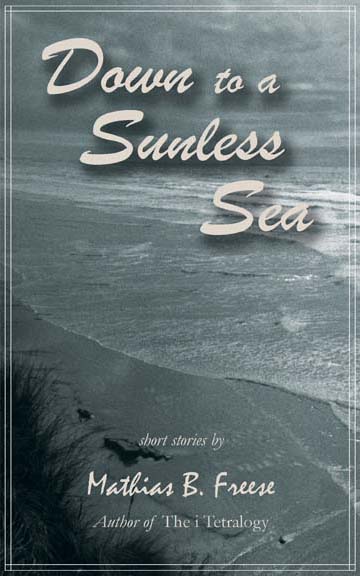
Mathias Freese, author of Down to a Sunless Sea and The i Tetralogy, was kind enough to answer a few questions for us. This interview took place over the course of several emails.

Biblioklept: Have you ever stolen a book? If so, could you tell us a little bit about that?

Mathias Freese: No, I’ve never stolen a book.

B: Have you ever borrowed a book without returning it–purposefully or not?

MF: The amount of guilt for both of these questions, as a young boy, would be too much to bear; and then obsessing about it enters the picture and I’d end up in central casting auditioning for a role in The Possessed.

B: What are you currently reading?

MF: Dan Wakefield’s, New York in the Fifties. Living in Arizona, a geriatric Disneyland, I remember well Brooklyn – Brighton Beach, Manhattan Beach, and Coney Island. I grew up in the Fifties and Wakefield evokes the literary times very well – Ginsburg, Kerouac, Mailer – as well as the cultural sensibilities of the time. I was too young for all this but reading about it evokes Greenwich Village, egg creams, and a great bialy.

B: What are you writing right now?

MF: I am editing a novel, my first, written more than two decades ago. Sojourner is a philosophical tale dealing with the emigration of a young Chinese farmer to the Mountain of Gold (California) as it was called.

B: Sojourner sounds interesting. Is it research-based historical fiction? (Perhaps you hate to classify what you write into a specific genre, of course). Tell us more.

MF: Sojourner began as a 30 page short story in the years 1969 to 1972; I was working on a federal project dealing with racial-ethnic relations in the town of Freeport, on Long Island, NY. I had met a Chinese-American librarian who had written on the emigration to Gum Shan, Mountain of Gold. I researched only details that would be useful for verisimilitude, such as Gum Shan, and began a short story about the subject. The book ultimately reflects my own philosophical needs and emotional cravings for meaning. When submitted to publishers as a novel for young adults almost all of them wrote that I had made an error, and that this fiction was serious and for adults. Who knew? I do believe that the writer is the last to truly appreciate his work. The i Tetralogy which began in 1996, is a more thoroughly researched book , and it is a historical fiction on the Holocaust based on my experiences as an American Jew. I had read a significant amount of the literature on the Holocaust with no intent of being a writer. If you read my “On the Holocaust” in the Pages section of my website, you will get a rather complete statement of my point of view.

B: The Marxist critic Theodor Adorno famously declared: “To write poetry after Auschwitz is barbaric.” How do you interpret this remark?

MF: Adorno’s comment was of its time. I feel what he means, how can we allow beauty in the presence of such unspeakable evil! However, it does not make sense. When you write you metabolize feelings – all kinds – thoughts, experiences and all the rest. When the ancients passed down Homer’s Odysseus orally, the words saturated the listener with meaning and continuity. We must write about the Holocaust until the end of time, although we face psychological resistance every step of the way. I have faced this with The i Tetralogy. One of the most significant gifts of Judaism to civilization is memory. We do not forget – and most assuredly, we do not “put it behind us,” one of the more inane “truisms” in this culture – re: Mel Gibson and Jesse Jackson. Adorno is dead wrong.

B: The back of your book, Down to a Sunless Sea, mentions that you worked for over twenty-five years as a social worker and psychotherapist. Several of the stories in the book seem to explore explicitly psychoanalytical themes, yet these themes are never overstated. Is this purposeful?

MF: I have been accused of being too clinical; I think that is unfair. I use my therapeutic insights when I can while integrating them with my psychological and emotional wisdoms (if that) and try to make a story. I recall covering for a teacher in an eleventh grade class. He was teaching Oedipus Rex. I asked him if I could treat it the way I wanted to. He agreed. In class, in a small review, the students told me that they were up to where Oedipus scratches out his eyeballs, consequently the interpretation was stressed that he chose not to see – and how very symbolic that was. I asked them if they were opened to another way of looking at it. I shared that to me it was a case of displacement. Duh! In effect, he was castrating himself. Titters and titters. I went on to say that they touch their eyes now and make an observation. Finally, one student said that they felt like balls. And away we go! The next day the teacher was bent out of shape because he had heard that I said that Oedipus ripped out his eyes, in effect, his balls. I am sure some students came away believing that balls evolve from eye sockets. Why should I give up insight (no pun intended) no matter where it comes from?

B: I teach eleventh-graders, actually. You never know what weird mutation of what you discussed that they will commit to memory forever. Do you enjoy being in a classroom? Have you ever taught fiction writing? What do you think of MFA programs?

MF: I was terribly misplaced in that career. The consensus was that I was a terrific teacher but I detested the rules, the administration and the deadness. You read “Nicholas.” He has it right. So I studied to become a therapist and it worked very well for me, my craft and my self. I have taught seminars on fiction writing and if you go to the site you will see a course description and in the Pages section there are short essays all dealing with writing. Go nosh. As to MFA programs I have a simple premise: if it is organized, go elsewhere. Same feelings I have about religion, et al. I cannot think of any world class writer who has a MFA. What about good old suffering and pain as a motivator?

B: Many of the stories in Down to a Sunless Sea utilize a very tight, condensed prose style. How much do you edit out of your work?

MF: I like this question in that it touches upon something I truly believe in. Some writers secrete out paragraphs per day. I can’t handle that anality. I write, let us say, 10 pages knowing full well I cut back to maybe 4. The art of writing is revise, revise and revise. I like pruning the story tree so that new growth is inaugurated. Like poetry, which I find, of course, the most condensed of writing, I believe stories should be very tight – let the reader infer rather than I tell. Indeed, one reviewer complained she couldn’t understand the stories, at least in her first reading. Good. Get back to it and reread it. I am not fooling around here and I deserve a better reading if you feel there is more to my stories than Oprahesque fluff.

B: When you re-read “Arnold Schwarzenegger’s Father Was a Nazi” now, do you consider it prescient? How do you think Arnie turned out?

MF: I had a sense about Arnie, of that tom tom in his character, that immigrant feeling that America can be tamed and domesticated to one’s own ends. I associate to Daniel Day-Lewis [in] There Will Be Blood, that tornadic energy to succeed, ambition on speed. In many ways Arnie is an athletic Algeresque character. I was not conscious of making any predictions, but it did feel to me, on a gut level, that he had other measures and goals to achieve and one of them is to marry into a famous family and all the rest. He is a delightful social climber who has denied, at least in the media, his background. I can write about Arnie because I don’t know him and that is the freedom of the writer. Give a writer one telling detail and the rest is extrapolation; think Kafka.

B: You maintain a website, www.mathiasbfreese.com. Do you write certain pieces specifically for the site? Corollary–How does your writing change when you write specifically for hypertext publishing?

MF: Blogging is new to me and I find it frustrating that so few people respond, given that I have had over 8400 hits; something is awry. Nevertheless, I enjoy writing every few days to keep my skills sharp. I am presently sharing a memoir about a fire on Mt. Lemmon in Tucson; it is filled with reflections, moods, sadnesses, and philosophy. Who cares if the reader is bored? I like it. I think the blog is excellent for short pieces, mini essays, faction. The reader gets bored with long pieces, but who knows in this new century of the Borg.

Jonathan Lethem, Emo Comic Books, Realism, Meta-textual Quotes, History’s Actors, and Lazy Writing

There’s a good (and rather long) interview with Jonathan Lethem at the AVClub today. Mr. Lethem is one of our favorite authors here at Biblioklept, Inc. (you may recall our review of his brilliant Fortress of Solitude back in September of 2006 (a mere 1,111 days after the book was initially published)).

In the interview, Lethem references the Talking Heads a number of times, claims to be slowly writing “kind of an emo comic book” for Marvel Comics, goes in-depth on his style and approach to writing, and discusses his new book, You Don’t Love Me, which I have not read yet.

The interview begins with an interesting discussion about realism (specifically, literary realism) which reminded me of an essay I’d read a few days before in the February issue of The Believer by Chris Bachelder (yes, I’m aware that I lazily linked to a Believer article earlier this week).

In “Doctorow’s Brain,” Bachelder ponders on whether such a thing as literary realism can really exist, and if so, what types of books and literature represent that style. I found the essay fascinating–I love all things literary, and I could point plenty of books that could be called “magical realism,” but I would have a really difficult time defining “realism.”  So Bachelder’s inquiry provoked a lot of deep questions about the very nature of writing, communication, memory and history. One of the most fascinating (and scary) pieces of writing he discusses is a quote from one of George W. Bush’s senior advisers, published originally in an October 2004 New York Times Magazine article by Ron Suskind. From Bachelder’s article:

“[…] Ron Suskind’s “Without a Doubt” introduced the Bush administration’s derision of what it calls the “reality-based community”–those reporters who, according to a senior adviser to Bush, “believe that solutions emerge from judicious study of discernible reality.” As the adviser explains to Suskind:

“That’s not the way the world really works anymore. We’re an empire now, and when we act, we create our own reality. And while you’re studying that reality–judiciously, as you will–we’ll act again, creating other new realities, which you can study too, and that’s how things will sort out. We’re history’s actors…and you, all of you, will be left to just study what we do.””

Yikes!