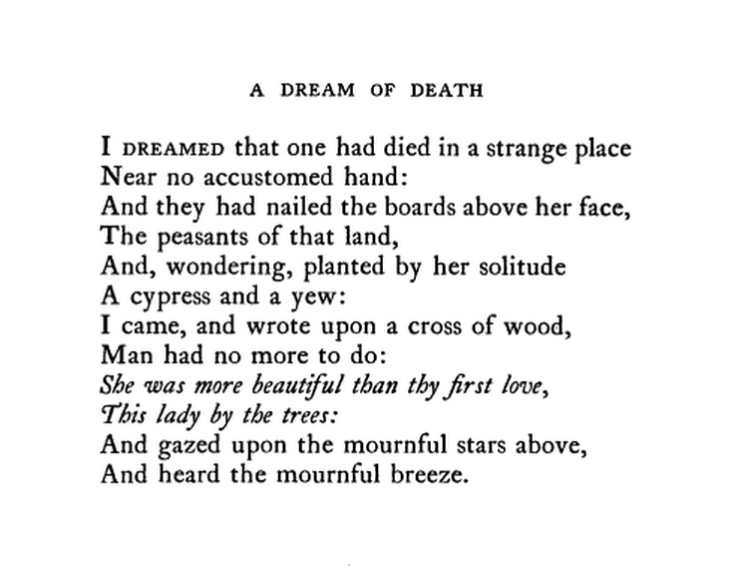
“A Dream of Death” — W.B. Yeats

Capture

A List of Irish Heroes from James Joyce’s Ulysses

One of my favorite passages in Ulysses (it’s from the “Cyclops” chapter, episode 12)—

He wore a long unsleeved garment of recently flayed oxhide reaching to the knees in a loose kilt and this was bound about his middle by a girdle of plaited straw and rushes. Beneath this he wore trews of deerskin, roughly stitched with gut. His nether extremities were encased in high Balbriggan buskins dyed in lichen purple, the feet being shod with brogues of salted cowhide laced with the windpipe of the same beast. From his girdle hung a row of seastones which dangled at every movement of his portentous frame and on these were graven with rude yet striking art the tribal images of many Irish heroes and heroines of antiquity, Cuchulin, Conn of hundred battles, Niall of nine hostages, Brian of Kincora, the Ardri Malachi, Art MacMurragh, Shane O’Neill, Father John Murphy, Owen Roe, Patrick Sarsfield, Red Hugh O’Donnell, Red Jim MacDermott, Soggarth Eoghan O’Growney, Michael Dwyer, Francy Higgins, Henry Joy M’Cracken, Goliath, Horace Wheatley, Thomas Conneff, Peg Woffington, the Village Blacksmith, Captain Moonlight, Captain Boycott, Dante Alighieri, Christopher Columbus, S. Fursa, S. Brendan, Marshal Mac-Mahon, Charlemagne, Theobald Wolfe Tone, the Mother of the Maccabees, the Last of the Mohicans, the Rose of Castille, the Man for Galway, The Man that Broke the Bank at Monte Carlo, The Man in the Gap, The Woman Who Didn’t, Benjamin Franklin, Napoleon Bonaparte, John L. Sullivan, Cleopatra, Savourneen Deelish, Julius Caesar, Paracelsus, sir Thomas Lipton, William Tell, Michelangelo, Hayes, Muhammad, the Bride of Lammermoor, Peter the Hermit, Peter the Packer, Dark Rosaleen, Patrick W. Shakespeare, Brian Confucius, Murtagh Gutenberg, Patricio Velasquez, Captain Nemo, Tristan and Isolde, the first Prince of Wales, Thomas Cook and Son, the Bold Soldier Boy, Arrah na Pogue, Dick Turpin, Ludwig Beethoven, the Colleen Bawn, Waddler Healy, Angus the Culdee, Dolly Mount, Sidney Parade, Ben Howth, Valentine Greatrakes, Adam and Eve, Arthur Wellesley, Boss Croker, Herodotus, Jack the Giantkiller, Gautama Buddha, Lady Godiva, The Lily of Killarney, Balor of the Evil Eye, the Queen of Sheba, Acky Nagle, Joe Nagle, Alessandro Volta, Jeremiah O’Donovan Rossa, Don Philip O’Sullivan Beare. A couched spear of acuminated granite rested by him while at his feet reposed a savage animal of the canine tribe whose stertorous gasps announced that he was sunk in uneasy slumber, a supposition confirmed by hoarse growls and spasmodic movements which his master repressed from time to time by tranquillising blows of a mighty cudgel rudely fashioned out of paleolithic stone.


Speaking of dancers (Kafka)

The necessity of speaking of dancers with exclamation marks. Because in that way one imitates their motion, because one remains in the rhythm and the thought does not then interfere with the enjoyment, because then the action always comes at the end of the sentence and prolongs its effect better.

From Franz Kafka’s diary entry, 16 March 1912.

“Marriage à la Mode” — Katherine Mansfield

“Marriage à la Mode”

by

Katherine Mansfield

On his way to the station William remembered with a fresh pang of disappointment that he was taking nothing down to the kiddies. Poor little chaps! It was hard lines on them. Their first words always were as they ran to greet him, “What have you got for me, daddy?” and he had nothing. He would have to buy them some sweets at the station. But that was what he had done for the past four Saturdays; their faces had fallen last time when they saw the same old boxes produced again.

And Paddy had said, “I had red ribbing on mine bee-fore!”

And Johnny had said, “It’s always pink on mine. I hate pink.”

But what was William to do? The affair wasn’t so easily settled. In the old days, of course, he would have taken a taxi off to a decent toyshop and chosen them something in five minutes. But nowadays they had Russian toys, French toys, Serbian toys—toys from God knows where. It was over a year since Isabel had scrapped the old donkeys and engines and so on because they were so “dreadfully sentimental” and “so appallingly bad for the babies’ sense of form.”

“It’s so important,” the new Isabel had explained, “that they should like the right things from the very beginning. It saves so much time later on. Really, if the poor pets have to spend their infant years staring at these horrors, one can imagine them growing up and asking to be taken to the Royal Academy.” Continue reading ““Marriage à la Mode” — Katherine Mansfield”

Beware

beware

“The Gentle Boy” — Nathaniel Hawthorne

“The Gentle Boy”

by

Nathaniel Hawthorne

In the course of the year 1656 several of the people called Quakers—led, as they professed, by the inward movement of the spirit—made their appearance in New England. Their reputation as holders of mystic and pernicious principles having spread before them, the Puritans early endeavored to banish and to prevent the further intrusion of the rising sect. But the measures by which it was intended to purge the land of heresy, though more than sufficiently vigorous, were entirely unsuccessful. The Quakers, esteeming persecution as a divine call to the post of danger, laid claim to a holy courage unknown to the Puritans themselves, who had shunned the cross by providing for the peaceable exercise of their religion in a distant wilderness. Though it was the singular fact that every nation of the earth rejected the wandering enthusiasts who practised peace toward all men, the place of greatest uneasiness and peril, and therefore in their eyes the most eligible, was the province of Massachusetts Bay.

The fines, imprisonments and stripes liberally distributed by our pious forefathers, the popular antipathy, so strong that it endured nearly a hundred years after actual persecution had ceased, were attractions as powerful for the Quakers as peace, honor and reward would have been for the worldly-minded. Every European vessel brought new cargoes of the sect, eager to testify against the oppression which they hoped to share; and when shipmasters were restrained by heavy fines from affording them passage, they made long and circuitous journeys through the Indian country, and appeared in the province as if conveyed by a supernatural power. Their enthusiasm, heightened almost to madness by the treatment which they received, produced actions contrary to the rules of decency as well as of rational religion, and presented a singular contrast to the calm and staid deportment of their sectarian successors of the present day. The command of the Spirit, inaudible except to the soul and not to be controverted on grounds of human wisdom, was made a plea for most indecorous exhibitions which, abstractedly considered, well deserved the moderate chastisement of the rod. These extravagances, and the persecution which was at once their cause and consequence, continued to increase, till in the year 1659 the government of Massachusetts Bay indulged two members of the Quaker sect with the crown of martyrdom.

An indelible stain of blood is upon the hands of all who consented to this act, but a large share of the awful responsibility must rest upon the person then at the head of the government. He was a man of narrow mind and imperfect education, and his uncompromising bigotry was made hot and mischievous by violent and hasty passions; he exerted his influence indecorously and unjustifiably to compass the death of the enthusiasts, and his whole conduct in respect to them was marked by brutal cruelty. The Quakers, whose revengeful feelings were not less deep because they were inactive, remembered this man and his associates in after-times. The historian of the sect affirms that by the wrath of Heaven a blight fell upon the land in the vicinity of the “bloody town” of Boston, so that no wheat would grow there; and he takes his stand, as it were, among the graves of the ancient persecutors, and triumphantly recounts the judgments that overtook them in old age or at the parting-hour. He tells us that they died suddenly and violently and in madness, but nothing can exceed the bitter mockery with which he records the loathsome disease and “death by rottenness” of the fierce and cruel governor. Continue reading ““The Gentle Boy” — Nathaniel Hawthorne”

Boring (John Berryman)

The official lie (Gravity’s Rainbow)

What did Caesar really whisper to his protégé as he fell? Et tu, Brute, the official lie, is about what you’d expect to get from them—it says exactly nothing. The moment of assassination is the moment when power and the ignorance of power come together, with Death as validator. When one speaks to the other then it is not to pass the time of day with et-tu-Brutes. What passes is a truth so terrible that history—at best a conspiracy, not always among gentlemen, to defraud—will never admit it. The truth will be repressed or in ages of particular elegance be disguised as something else. What will Rathenau, past the moment, years into a new otherside existence, have to say about the old dispensation? Probably nothing as incredible as what he might have said just as the shock flashed his mortal nerves, as the Angel swooped in…

From Thomas Pynchon’s novel Gravity’s Rainbow.

I know Leopold Bloom better than I know my own father (Umberto Eco)

It has been said that fictional characters are underdetermined that is, we know only a few of their properties while real individuals are completely determined, and we should be able to predicate of them each of their known attributes. But although this is true from an ontological point of view, from an epistemological one it is exactly the opposite: nobody can assert all the properties of a given individual or of a given species, which are potentially infinite, while the properties of fictional characters are severely limited by the narrative text and only those attributes mentioned by the text count for the identification of the character.

In fact, I know Leopold Bloom better than I know my own father. Who can say how many episodes of my father’s life are unknown to me, how many thoughts my father never disclosed, how many times he concealed his sorrows, his quandaries, his weaknesses? Now that he is gone, I shall probably never discover those secret and perhaps fundamental aspects of his being. Like the historians described by Dumas, I muse and muse in vain about that dear ghost, lost to me forever. In contrast, I know everything about Leopold Bloom that I need to know—and each time I reread Ulysses I discover something more about him.

From Umberto Eco’s essay “Some Remarks on Fictional Characters,” collected in Confessions of a Young Novelist.

“Aunt Zézé’s Tears,” a short story by Carmen Dolores

“Aunt Zézé’s Tears”

by

Carmen Dolores

Translated from the Portuguese by Isaac Goldberg

From Brazilian Tales

Pale and thin, for eighteen years she had lived with her youngest sister, who had married very early and now possessed five children: two young ladies of marriageable age, a third still in short dresses, and two little boys.

Maria-José, whose nickname was Zézé, had never been beautiful or winning. Upon her father’s death it was thought best that she should go to live with her sister Engracigna’s family. Here she led a monotonous existence, helping to bring up her nephews and nieces, who were born in that young and happy household with a regularity that brooked small intervals between the births.

A long, pointed nose disfigured her face, and her lips, extremely thin, looked like a pale crack. Her thoughtful gaze alone possessed a certain melancholy attractiveness. But even here, her eyes, protruding too far for the harmony of the lines upon her face seemed always to be red, and her brows narrow and sparse.

Of late, an intricate network of wrinkles as fine as hairs, had formed at the corner of her eyes. From her nose, likewise, two furrows ran along the transparent delicacy of her skin and reached either side of her mouth. When she smiled, these wrinkles would cover her countenance with a mask of premature age, and threatened soon to disfigure her entirely. And yet, from habit, and through passive obedience to routine, Maria-José continued to dress like a young girl of eighteen, in brightly colored gowns, thin waists and white hats that ill became her frail and oldish face. Continue reading ““Aunt Zézé’s Tears,” a short story by Carmen Dolores”

The extinction of the dodo (Pynchon’s Gravity’s Rainbow)

He left the dodoes to rot, he couldn’t endure to eat their flesh. Usually, he hunted alone. But often, after months of it, the isolation would begin to change him, change his very perceptions—the jagged mountains in full daylight flaring as he watched into freak saffrons, streaming indigos, the sky his glass house, all the island his tulipomania. The voices—he insomniac, southern stars too thick for constellations teeming in faces and creatures of fable less likely than the dodo—spoke the words of sleepers, singly, coupled, in chorus. The rhythms and timbres were Dutch, but made no waking sense. Except that he thought they were warning him… scolding, angry that he couldn’t understand. Once he sat all day staring at a single white dodo’s egg in a grass hummock. The place was too remote for any foraging pig to’ve found. He waited for scratching, a first crack reaching to net the chalk surface: an emergence. Hemp gripped in the teeth of the steel snake, ready to be lit, ready to descend, sun to black-powder sea, and destroy the infant, egg of light into egg of darkness, within its first minute of amazed vision, of wet downstirred cool by these south-east trades… . Each hour he sighted down the barrel. It was then, if ever, he might have seen how the weapon made an axis potent as Earth’s own between himself and this victim, still one, inside the egg, with the ancestral chain, not to be broken out for more than its blink of world’s light. There they were, the silent egg and the crazy Dutchman, and the hookgun that linked them forever, framed, brilliantly motionless as any Vermeer. Only the sun moved: from zenith down at last behind the snaggleteeth of mountains to Indian ocean, to tarry night. The egg, without a quiver, still unhatched. He should have blasted it then where it lay: he understood that the bird would hatch before dawn. But a cycle was finished. He got to his feet, knee and hip joints in agony, head gonging with instructions from his sleeptalkers droning by, overlapping, urgent, and only limped away, piece at right shoulder arms.

Continue reading “The extinction of the dodo (Pynchon’s Gravity’s Rainbow)”

Read Bret Harte’s short story “Miggles”

“Miggles”

by

Bret Harte

We were eight, including the driver. We had not spoken during the passage of the last six miles, since the jolting of the heavy vehicle over the roughening road had spoiled the Judge’s last poetical quotation. The tall man beside the Judge was asleep, his arm passed through the swaying strap and his head resting upon it—altogether a limp, helpless-looking object, as if he had hanged himself and been cut down too late. The French lady on the back seat was asleep, too, yet in a half-conscious propriety of attitude, shown even in the disposition of the handkerchief which she held to her forehead and which partially veiled her face. The lady from Virginia City, traveling with her husband, had long since lost all individuality in a wild confusion of ribbons, veils, furs, and shawls. There was no sound but the rattling of wheels and the dash of rain upon the roof. Suddenly the stage stopped and we became dimly aware of voices. The driver was evidently in the midst of an exciting colloquy with someone in the road—a colloquy of which such fragments as “bridge gone,” “twenty feet of water,” “can’t pass,” were occasionally distinguishable above the storm. Then came a lull, and a mysterious voice from the road shouted the parting adjuration:

“Try Miggles’s.”

We caught a glimpse of our leaders as the vehicle slowly turned, of a horseman vanishing through the rain, and we were evidently on our way to Miggles’s.

Who and where was Miggles? The Judge, our authority, did not remember the name, and he knew the country thoroughly. The Washoe traveler thought Miggles must keep a hotel. We only knew that we were stopped by high water in front and rear, and that Miggles was our rock of refuge. A ten minutes splashing through a tangled by-road, scarcely wide enough for the stage, and we drew up before a barred and boarded gate in a wide stone wall or fence about eight feet high. Evidently Miggles’s, and evidently Miggles did not keep a hotel.

The driver got down and tried the gate. It was securely locked. “Miggles! O Miggles!”

No answer. Continue reading “Read Bret Harte’s short story “Miggles””

“The Camel’s Back” — F. Scott Fitzgerald

“The Camel’s Back” by F. Scott Fitzgerald

The glazed eye of the tired reader resting for a second on the above title will presume it to be merely metaphorical. Stories about the cup and the lip and the bad penny and the new broom rarely have anything, to do with cups or lips or pennies or brooms. This story Is the exception. It has to do with a material, visible and large-as-life camel’s back.

Starting from the neck we shall work toward the tail. I want you to meet Mr. Perry Parkhurst, twenty-eight, lawyer, native of Toledo. Perry has nice teeth, a Harvard diploma, parts his hair in the middle. You have met him before—in Cleveland, Portland, St. Paul, Indianapolis, Kansas City, and so forth. Baker Brothers, New York, pause on their semi-annual trip through the West to clothe him; Montmorency & Co. dispatch a young man post-haste every three months to see that he has the correct number of little punctures on his shoes. He has a domestic roadster now, will have a French roadster if he lives long enough, and doubtless a Chinese tank if it comes into fashion. He looks like the advertisement of the young man rubbing his sunset-colored chest with liniment and goes East every other year to his class reunion.

I want you to meet his Love. Her name is Betty Medill, and she would take well in the movies. Her father gives her three hundred a month to dress on, and she has tawny eyes and hair and feather fans of five colors. I shall also introduce her father, Cyrus Medill. Though he is to all appearances flesh and blood, he is, strange to say, commonly known in Toledo as the Aluminum Man. But when he sits in his club window with two or three Iron Men, and the White Pine Man, and the Brass Man, they look very much as you and I do, only more so, if you know what I mean.

Now during the Christmas holidays of 1919 there took place in Toledo, counting only the people with the italicized the, forty-one dinner parties, sixteen dances, six luncheons, male and female, twelve teas, four stag dinners, two weddings, and thirteen bridge parties. It was the cumulative effect of all this that moved Perry Parkhurst on the twenty-ninth day of December to a decision. Continue reading ““The Camel’s Back” — F. Scott Fitzgerald”

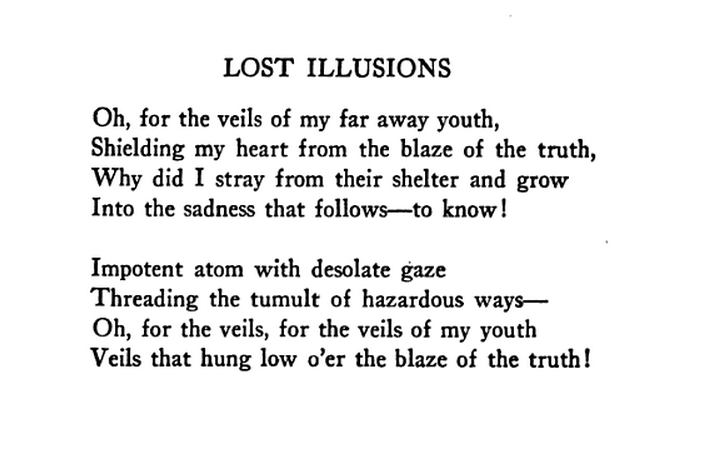
“Lost Illusions” — Georgia Douglas Johnson

Capture

Six Notes from Nathaniel Hawthorne’s Note-Books

Imitators of original authors might be compared to plaster casts of marble statues, or the imitative book to a cast of the original marble.


For a child’s story,–the voyage of a little boat made of a chip, with a birch-bark sail, down a river.


Fourier states that, in the progress of the world, the ocean is to lose its saltness, and acquire the taste of a peculiarly flavored lemonade.


How pleasant it is to see a human countenance which cannot be insincere,–in reference to baby’s smile.


The best of us being unfit to die, what an inexpressible absurdity to put the worst to death!


“Is that a burden of sunshine on Apollo’s back?” asked one of the children,–of the chlamys on our Apollo Belvedere.

From Nathaniel Hawthorne’s American Note-Books.

Place has enshrined the spirit (Eudora Welty)

Place in fiction is the named, identified, concrete, exact and exacting, and therefore credible, gathering spot of all that has been felt, is about to be experienced, in the novel’s progress. Location pertains to feeling; feeling profoundly pertains to – place; place in history partakes of feeling, as feeling about history partakes of place. Every story would be another story, and unrecognizable as art, if it took up its characters and plot and happened somewhere else. Imagine Swann’s Way laid in London, or The Magic Mountain in Spain, or Green Mansions in the Black Forest. The very notion of moving a novel brings ruder havoc to the mind and affections than would a century’s alteration in its time. It is only too easy to conceive that a bomb that could destroy all trace of places as we know them, in life and through books, could also destroy all feelings as we know them, so irretrievably and so happily are recognition, memory, history, valor, love, all the instincts of poetry and praise, worship and endeavor, bound up in place. From the dawn of man’s imagination, place has enshrined the spirit; as soon as man stopped wandering and stood still and looked about him, he found a god in that place; and from then on, that was where the god abided and spoke from if ever he spoke.

From Eudora Welty’s essay “Place in Fiction.”

Taking Tea with Gordon Lish

Ready? I take my tea bag (or you take your teaspoon), one bag or one spoon for each five ounces of water, which is cold when I start and boiling up a rumpus before I pour, which I do, into a teapot that’s already hot, which condition of temperature is crucial.


So I pour furiously boiling water into good and hot teapot over bags or over loose tea or over bags or over tea bomb, slam top down, wrap entire business in dish towel, which is what I saw my mother do during the blizzard of ’46 and it made a tremendous impression on me, she being my mother and all. I understand some people are willing to buy a tea cosy—but, so far as I’m concerned, you’ve got to draw the line somewhere.


Anyhow, it sits for five minutes—you know, it steeps. If the waiting makes you edgy, go fold some paper bags. The next step is the last step, which is to hurry up and divide the product from its makings. Well, truth to tell, there is one more step—but that’s drinking it, drinking tea—which is a step I’m going to get around to, all in good time. When coffee scoots up over a sawbuck a can.

From Gordon Lish’s 1977 piece in The New York Times, “A Teaser on Tea, with a Footnote on Bags.” By way of context for that last line: the price of coffee soared in 1977 after a harsh freeze killed Brazilian crops. High coffee prices led to a coffee boycott. And tea drinking.