The Mother Conspiracy (Gravity’s Rainbow)

Otto is earnestly explaining his views on the Mother Conspiracy. It’s not often a sympathetic girl will listen. The Mothers get together once a year, in secret, at these giant conventions, and exchange information. Recipes, games, key phrases to use on their children. “What did yours use to say when she wanted to make you feel guilty?”

“‘I’ve worked my fingers to the bone!’” sez the girl.

“Right! And she used to cook those horrible casseroles, w-with the potatoes, and onions—”

“And ham! Little pieces of ham—”

“You see, you see? That can’t be accidental! They have a contest, for Mother of the Year, breast-feeding, diaper-changing, they time them, casserole competitions, ja—then, toward the end, they actually begin to use the children. The State Prosecutor comes out on stage. ‘In a moment, Albrecht, we are going to bring your mother on. Here is a Luger, fully loaded. The State will guarantee you absolute immunity from prosecution. Do whatever you wish to do—anything at all. Good luck, my boy.’ The pistols are loaded with blanks, natürlich, but the unfortunate child does not know this. Only the mothers who get shot at qualify for the finals.

Here they bring in psychiatrists, and judges sit with stopwatches to see how quickly the children will crack. ‘Now then, Olga, wasn’t it nice of Mutti to break up your affair with that long-haired poet?’ ‘We understand your mother and you are, ah, quite close, Hermann. Remember the time she caught you masturbating into her glove? Eh?’ Hospital attendants stand by to drag the children off, drooling, screaming, having clonic convulsions. Finally there is only one Mother left on stage. They put the traditional flowered hat on her head, and hand her the orb and scepter, which in this case are a gilded pot roast and a whip, and the orchestra plays Tristan und Isolde.

From Thomas Pynchon’s novel Gravity’s Rainbow.

A Conversation about Evan Dara’s Novel Flee (Part 2)

IMG_5657

[Context/editorial note: I’d been meaning to read Evan Dara’s latest novel Flee for a while, and when Biblioklept contributor Ryan Chang told me he’d be reading it as part of a contemporary literature class I decided to join him. This is the second part of a two-part discussion which took place over a few weeks of emails. We discuss the book’s conclusion, including what some people might think of as “spoilers.”

Read part one of our discussion of  Flee.

The tl;dr version of all of this: Both Ryan and I loved Flee, a 2013 novel about the citizens of a New England town who, uh, flee, for reasons never made entirely clear.  I claim that “Flee is maybe the best novel (so far, anyway) to aesthetically and philosophically address the economic collapse of ’08.” Ryan called it a book “for people who like books to fuck with them and then be their friend.” And I agree with him. — ET]

Ryan Chang: Right–Flee doesn’t prescribe a future, or at least an alternative future. “841” testifies to this. The A-burgian upstakers are no different from the new settlers, rejoicing in the bargains to be had in the town. Carol and Marcus quietly disappear (Spoiler alert). Flee is overall hesitant to prescribe, I think. In my previous e-mail, I was thinking out loud a bit, trying to see if something in the book was pointing to these spaces of the “nonidentical” as Adorno calls it; that Flee as an aesthetic object figures, in exactly what isn’t said, the suffocating presence that squeezes the life out of A-burg, could figure a moment of possibility in absence. Some kind of fracture that, even if it is a failure (as A-burg is, I think), is a temporary moment of reprieve from the administered life.

I’m not sure what the forms of Kimball’s “radical forgiveness” and “hospitality” would be, if he points to them — especially of the former. And is it only that the literary artists get to have all the fun of democracy? Exactly where does democratic critique happen off the page? I’m wondering because it seems that the form of popular critique — save from public protest and other distortions of space — are infected with exploitative capital, with ideology, unwittingly going along with the system that saves the banks before humanity. Additionally: to whom–or what–is forgiveness granted? Hospitality seems more tangible to me, but the phrases Yes? Who’s There? imply exclusion rather than inclusion to me. As if at the door of democracy, the speaker hesitates. Should not a radical affirmation continually say yes rather than no at the door? The questioning yes is skeptical. I wonder if a self-consciousness and -becoming out of administration is required. The molectular make-up of the present absence that suffocates A-Burg and, implicitly, whatever other small town, would have to be transposed, if you like, into another key. To mention Lerner again (briefly) — do you remember that scene in the book, with the first hurricane, the (eventually fictional) threat of Irene destroying the infrastructure as a moment when disparate communities — who would otherwise keep to themselves, much like the voices in Flee — begin convening? That was just a way of getting to the epigraph of the book: “Everything will be as it is now, just a little different.” Continue reading “A Conversation about Evan Dara’s Novel Flee (Part 2)” →

Read “The Dreadful Mucamas” by Lydia Davis

“The Dreadful Mucamas”

by

Lydia Davis

They are very rigid, stubborn women from Bolivia. They resist and sabotage whenever possible.

They came with the apartment. They were bargains because of Adela’s low IQ. She is a scatterbrain.

In the beginning, I said to them: I’m very happy that you can stay, and I am sure that we will get along very well.

This is an example of the problems we are having. It is a typical incident that has just taken place. I needed to cut a piece of thread and could not find my six-inch scissors. I accosted Adela and told her I could not find my scissors. She protested that she had not seen them. I went with her to the kitchen and asked Luisa if she would cut my thread. She asked me why I did not simply bite it off. I said I could not thread my needle if I bit it off. I asked her please to get some scissors and cut it off – now. She told Adela to look for the scissors of la Señora Brodie, and I followed her to the study to see where they were kept. She removed them from a box. At the same time I saw a long, untidy piece of twine attached to the box and asked her why she did not trim off the frayed end while she had the scissors. She shouted that it was impossible. The twine might be needed to tie up the box some time. I admit that I laughed. Then I took the scissors from her and cut it off myself. Adela shrieked. Her mother appeared behind her. I laughed again and now they both shrieked. Then they were quiet. Continue reading “Read “The Dreadful Mucamas” by Lydia Davis” →

Anti-paranoia (Gravity’s Rainbow)

Rain drips, soaking into the floor, and Slothrop perceives that he is losing his mind. If there is something comforting—religious, if you want—about paranoia, there is still also anti-paranoia, where nothing is connected to anything, a condition not many of us can bear for long. Well right now Slothrop feels himself sliding onto the anti-paranoid part of his cycle, feels the whole city around him going back roofless, vulnerable, uncentered as he is, and only pasteboard images now of the Listening Enemy left between him and the wet sky.

Either They have put him here for a reason, or he’s just here. He isn’t sure that he wouldn’t, actually, rather have that reason…

From Thomas Pynchon’s novel Gravity’s Rainbow. The “pasteboard images” line recalls a favorite passage of Moby-Dick.

Even more beautiful emotions (Kafka’s diary entry, 27 March 1912)

27. March. Monday, on the street. The boy who with several others, threw a large ball at a servant girl walking defencelessly in front of them; just as the ball was flying at the girls’ behind I grabbed him by the throat, choked him in a fury, thrust him aside, and swore. Then walked on and didn’t even look at the girl. One quite forgets one’s earthly existence because one is so entirely full of fury is permitted to believe that, given the opportunity, one would in the same way fill oneself with even more beautiful emotions.

Franz Kafka’s diary entry, 27 March 1912. Translation by Joseph Kresh.

“Rain” — Roberto Bolaño

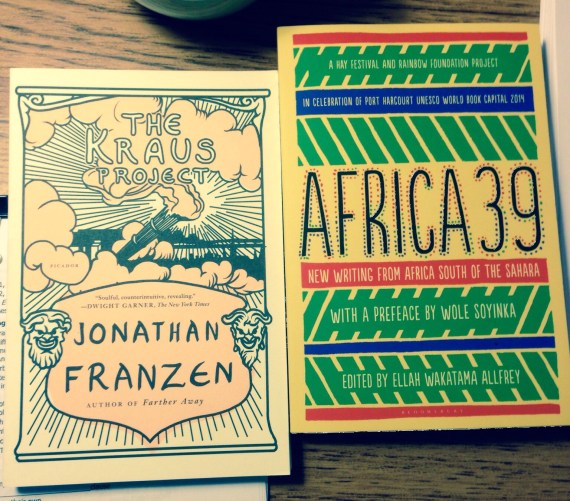
Africa 39, a compilation of new African writing, and Franzen’s Kraus Project (Books acquired, 3.04.2015)

IMG_5182

Got these as desk copies (as opposed to review copies) a few weeks ago. I’ve been picking through Africa 39 more or less at random, in between stretches of Gravity’s Rainbow. Hit or miss so far, as these affairs so often are. Here’s Margaret Busby, one of the panelists who helped compile the book (from The Guardian):

Africa39 is not an exercise constrained by labels, fashion and preconceived rules about genres, nor by what constitutes African writing. Twenty countries are represented by work created in a variety of African and European languages – Kiswahili, Igbo and Lingala as well as English, French, Spanish and Portuguese. Understandably, with the continuing debate about the validity of the “African writer” category, there are those who feel uncomfortable about participating in this venture (indeed, some have chosen to opt out).

Speaking of Gravity’s Rainbow (sort of), it shows up in Jonathan Franzen’s “translation” of Karl Kraus’s essays. I shouldn’t put translation in those suspicious quotation marks; he does translate—but the book he really wants to write is a memoir in footnotes. Maybe you read the excerpt Harper’s published a few years ago?

Michael Hoffman’s long review at NYRB is good. From that piece:

In the same hands done differently, The Kraus Project could have made an entertainment, an intellectual comedy, a bildungsroman about a clever and ambitious young man on a Fulbright in Germany for a couple of years in the early 1980s. The loneliness of abroad would have come into it, separation from a difficult unbookish family in the Midwest and a bookish difficult fiancée at Columbia; the poststructuralist intellectual fashions of the time; a little local color to evoke the bizarrely wonderful extraterritorial and microideological West Berlin of the cold war; what it felt like to be an American in Germany at the time of the Cruises and Pershings and the SS-20s (what price Germany then, not Austria, as what Kraus called a laboratory for destroying the world?); the overbearing influence of the one novel our hero packed in his suitcase full of French theory—it was Gravity’s Rainbow—and the dual terror exerted on him by Pynchon on the one hand and Harold Bloom on the other.

Such a book would somehow have delivered us to the improbable but finally inescapable conclusion that our young American could find no more apt or fruitful literary father for himself than “the angry, apocalyptic, and arguably megalomaniacal Karl Kraus.” The old curmudgeon took care to express his nolo in advance thus: “Many share my views with me. But I don’t share them with them.” As it happened, he also disdained fiction: not an ideal adopted father.

This rich web of circumstance is all present here (Franzen seems to remember everything, or at least to have kept records of everything), but it is packed away in the garrulous and seedy autobiographical footnotes, often going over many pages. Probably the main life of the book is in these. But there is something earnest and faithful and inflexible in Franzen that won’t let him turn away and ironize his former self—“my feeling [is] that I’m still the same person I was at twenty-two.”

… The entire unstable ensemble has something of the rackety allure of the Bremen Town Musicians, or, if you prefer, a new supergroup: the assiduous, dependable Paul Reitter holding things together on bass, the restrained Daniel Kehlmann good for the occasional off-beat tambourine flick (“But Heine is still wonderful, too”), and Franzen riffing and wailing away on free-form lead and clamorous vocals. The Kraus Project really is one of a kind—a strange, space-bending, Cubist, not un-simpatico book.

Read Kobo Abe’s short story “The Magic Chalk”

“The Magic Chalk”

by

Kobo Abe

Next door to the toilet of an apartment building on the edge of the city, in a room soggy with roof leaks and cooking vapors, lived a poor artist named Argon.

The small room, nine feet square, appeared to be larger than it was because it contained nothing but a single chair set against the wall. His desk, shelves, paint box, even his easel had been sold for bread. Now only the chair and Argon were left. But how long would these two remain?


Dinnertime drew near. “How sensitive my nose has become!” Argon thought. He was able to distinguish the colors and proximity of the complex aromas entering his room. Frying port at the butcher’s along the streetcar line: yellow ocher. A southerly wind drifting by the front of the fruit stand: emerald green. Wafting from the bakery: stimulating chrome yellow. And the fish the housewife below was broiling, probably mackerel: sad cerulean blue.


This fact is, Argon hadn’t eaten anything all day. With a pale face, a wrinkled brow, an Adam’s apple that rose and fell, a hunched back, a sunken abdomen, and trembling knees, Argon thrust both hands into his pocket and yawned three times in succession.


His fingers found a stick in his pocket.


“Hey, what’s this? Red chalk. Don’t remember it being there.”


Playing with the chalk between his fingers, he produced another yawn.


“Aah, I need something to eat.”


Without realizing it, Argon began scribbling on the wall with the chalk. First, an apple. One that looked big enough to be a meal in itself. He drew a paring knife beside it so that he could eat it right away. Next, swallowing hard as baking smells curled through the hallway and window to permeate his room, he drew bread. Jam-filled bread the size of a baseball glove. Butter-filled rolls. a loaf as large as a person’s head. He envisioned glossy browned spots on the bread. Delicious-looking cracks, dough bursting through the surface, the intoxicating aroma of yeast. Beside the bread, then, a stick of butter a large a a brick. He thought of drawing some coffee. Freshly brewed, steaming coffee. In a large jug-like cup. On a saucer, three matchbox-size sugar cubes.


“Damn it!” He ground his teeth and buried his face in his hands. “I’ve got to eat!”


Gradually, his consciousness sank into darkness. Beyond the windowpane was a bread and pastry jungle, a mountain of canned goods, a sea of milk, a beach of sugar, a beef and cheese orchard— he scampered about until, fatigued, he fell asleep. Continue reading “Read Kobo Abe’s short story “The Magic Chalk”” →

Selections from One-Star Amazon Reviews of Flannery O’Connor’s Short Story Collections and Novels

[Editorial note: The following citations come from one-star Amazon reviews of various Flannery O’Connor short story collections and novels. To be clear, I’m a big O’Connor fan. I’ve preserved the reviewers’ own styles of punctuation and spelling. More one-star Amazon reviews.].

I wanted to burn it.

I like happy endings.

100 per cent not for me.

I did not finish the book.

This story was agonizing.

I do not like the words used.

To me it was very depressing.

I really, truly hated this book.

The plot was as much a mystery.

They barely even seemed human.

I would not recommend this to anyone.

I had to force myself to finish this book.

I didn’t understand the characters at all.

Not only that, but I really didn’t like them either.

I would never have guessed that the author was female.

I didn’t understand, and I’m fairly certain that I never will.

I think this is the only book I’ve ever felt that I really hated.

One finds it impossible to symapthize or identify with them.

O;Connor is a gifted writer. However this book is dark in tone.

This story just stopped, no solutions to the problems involved.

I think it was a failing of the author to make the character believable.

After reading this book I really need some sunshine and happy voices.

Perhaps most disurbing is the brutal portrayal of violence against children.

Flannery O’Connor is the most depressing writer I have ever had the misfortune to read.

I can’t understand an author who could treat her characters with such callous disregard!

There is little here that resonates with my life’s experiences or my understanding of them.

I would not read this book again without a gun to my head, and I regret ever having picked it up. Continue reading “Selections from One-Star Amazon Reviews of Flannery O’Connor’s Short Story Collections and Novels” →

“Maybe” — Langston Hughes

m

Read Ursula K. Le Guin’s short story “The Stars Below”

“The Stars Below”

by

Ursula K. Le Guin

The wooden house and outbuildings caught fire fast, blazed up, burned down, but the dome, built of lathe and plaster above a drum of brick, would not burn. What they did at last was heap up the wreckage of the telescopes, the instruments, the books and charts and drawings, in the middle of the floor under the dome, pour oil on the heap, and set fire to that. The flames spread to the wooden beams of the big telescope frame and to the clockwork mechanisms. Villagers watching from the foot of the hill saw the dome, whitish against the green evening sky, shudder and turn, first in one direction then in the other, while a black and yellow smoke full of sparks gushed from the oblong slit: an ugly and uncanny thing to see.

It was getting dark, stars were showing in the east. Orders were shouted. The soldiers came down the road in single file, dark men in dark harness, silent.

The villagers at the foot of the hill stayed on after the soldiers had gone. In a life without change or breadth, a fire is as good as a festival. They did not climb the hill, and as the night grew full dark they drew closer together. After a while they began to go back to their villages. Some looked back over their shoulders at the hill, where nothing moved. The stars turned slowly behind the black beehive of the dome, but it did not turn to follow them.

About an hour before daybreak a man rode up the steep zigzag, dismounted by the ruins of the workshops, and approached the dome on foot. The door had been smashed in. Through it, a reddish haze of light was visible, very dim, coming from a massive support-beam that had fallen and had smoldered all night inward to its core. A hanging, sour smoke thickened the air inside the dome. A tall figure moved there and its shadow moved with it, cast upward on the murk. Sometimes it stooped, or stopped, then blundered slowly on.

The man at the door said: “Guennar! Master Guennar!”

The man in the dome stopped still, looking towards the door. He had just picked up something from the mess of wreckage and half-burnt stuff on the floor. He put this object mechanically into his coat pocket, still peering at the door. He came towards it. His eyes were red and swollen almost shut, he breathed harshly in gasps, his hair and clothes were scorched and smeared with black ash.

“Where were you?”

The man in the dome pointed vaguely at the ground. Continue reading “Read Ursula K. Le Guin’s short story “The Stars Below”” →

Literature is like an ear that can hear things beyond the understanding of the language of politics (Italo Calvino)

Literature is necessary to politics above all when it gives a voice to whatever is without a voice, when it gives a name to what as yet has no name, especially to what the language of politics excludes or attempts to exclude. I mean aspects, situations, and languages both of the outer and of the inner world, the tendencies repressed and individuals and in society. Literature is like an ear that can hear things beyond the understanding of the language of politics; it is like an eye that can see beyond the color spectrum perceived by politics. Simply because of the solitary individualism of his work, the writer may happen to explore areas that no one has explored before, within himself or outside, and to make discoveries that sooner or later turn out to be vital areas of collective awareness.


This is still a very indirect, deliberate, and fortuitous use for literature. The writer follows his own road, and chance or social and psychological factors lead him to discover something that may become important for political and social action as well. It is the responsibility of the sociopolitical observer not to leave anything to chance, and to apply his own method to the business of literature in such a way as not to allow anything to escape him.


But there is also, I think, another sort of influence that literature can exert, perhaps not more direct but certainly more intentional on the part of the writer. This is the ability to impose patterns of language, of vision, imagination, mental effort, of the correlation of facts, and in short the creation (and by creation I mean selection and organization) of a model of values that is at the same time aesthetic and ethical, essential to any plan of action, especially in political life.


So it comes about that, having excluded political education from the functions of literature, I find myself stating that I do believe in a type of education by means of literature; a type of education they can yield results only if it is difficult and indirect, if it implies the arduous attainment of literary stringency.


Any results attained by literature, as long as it is stringent and rigorous, may be considered firm ground for all practical activities for anyone who aspires to the construction of a mental order solid and complex enough to contain the disorder of the world within itself; for anyone aiming to establish a method subtle and flexible enough to be the same thing as an absence of any method whatever.

From Italo Calvino’s essay “Right and Wrong Uses of Political Uses of Literature.” Translation by Patrick Creagh. Collected in The Uses of Literature.

There are two wrong ways of thinking of a possible political use for literature (Italo Calvino)

In a word, what I think is that there are two wrong ways of thinking of a possible political use for literature. The first is to claim that literature should voice a truth already possessed by politics; that is, to believe that the sum of political values is the primary thing, to which literature must simply adapt itself. This opinion implies a notion of literature as ornamental and superfluous, but it also implies a notion of politics as fixed and self-confident: an idea that would be catastrophic. I think that such a pedagogical function for politics could only be imagined at the level of bad literature and bad politics.

The other mistaken way is to see literature as an assortment of eternal human sentiments, as the truth of the human language that politics tends to overlook, and that therefore has to be called to mind from time to time. This concept apparently leaves more room for literature, but in practice it assigns it the task of confirming what is already known, or maybe of provoking in a naïve and rudimentary way, by means of the youthful pleasures of freshness and spontaneity. Behind this way of thinking is the notion of a set of established values that literature is responsible for preserving, the classical and immobile idea of literature as the depository of a given truth. If it agrees to take on this role, literature confines itself to a function of consolation, preservation, and regression – a function that I believe does more harm than good.

From Italo Calvino’s essay “Right and Wrong Uses of Political Uses of Literature.” Translation by Patrick Creagh. Collected in The Uses of Literature.

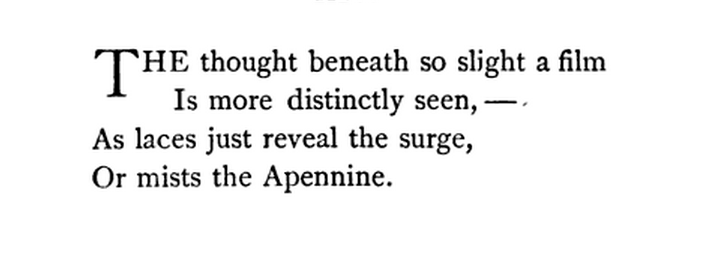
“The thought beneath so slight a film” — Emily Dickinson

ed

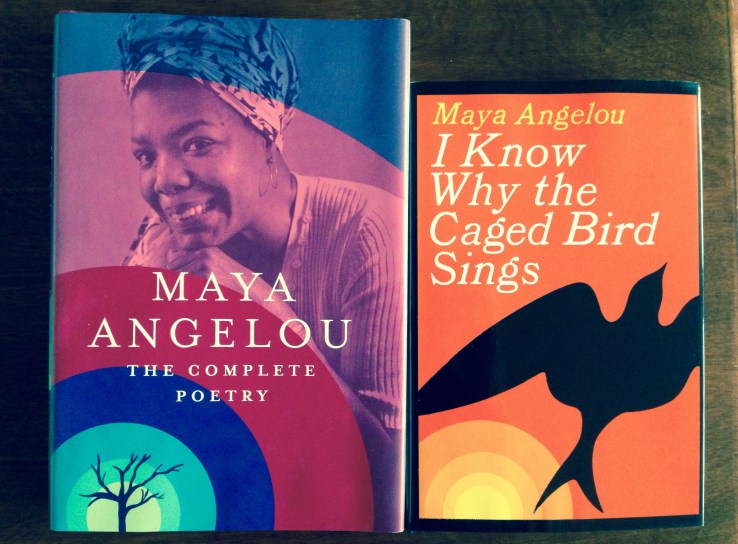
Maya Angelou (Books Acquired, 3.18.2015)

IMG_5573

Random House is reissuing Maya Angelou’s seminal memoir I Know Why the Caged Bird Sings in both hardback and paperback with the original 1970 cover (love love love the cover). The Complete Poetry is also new (in hardback); love how the cover matches Caged Bird.

The paperback reissue of Caged Bird features a new foreword by Oprah Winfrey.

IMG_5575

From The Complete Poetry:

IMG_5576

Read “Springtime à la Carte,” a short story by O. Henry

“Springtime à la Carte”

by

O. Henry

It was a day in March.

Never, never begin a story this way when you write one. No opening could possibly be worse. It is unimaginative, flat, dry and likely to consist of mere wind. But in this instance it is allowable. For the following paragraph, which should have inaugurated the narrative, is too wildly extravagant and preposterous to be flaunted in the face of the reader without preparation.

Sarah was crying over her bill of fare.

Think of a New York girl shedding tears on the menu card!

To account for this you will be allowed to guess that the lobsters were all out, or that she had sworn ice-cream off during Lent, or that she had ordered onions, or that she had just come from a Hackett matinee. And then, all these theories being wrong, you will please let the story proceed.

The gentleman who announced that the world was an oyster which he with his sword would open made a larger hit than he deserved. It is not difficult to open an oyster with a sword. But did you ever notice any one try to open the terrestrial bivalve with a typewriter? Like to wait for a dozen raw opened that way?

Sarah had managed to pry apart the shells with her unhandy weapon far enough to nibble a wee bit at the cold and clammy world within. She knew no more shorthand than if she had been a graduate in stenography just let slip upon the world by a business college. So, not being able to stenog, she could not enter that bright galaxy of office talent. She was a free-lance typewriter and canvassed for odd jobs of copying. Continue reading “Read “Springtime à la Carte,” a short story by O. Henry” →

Reading/Have Read/Should Write About

All of this is basically reading around/between/over Gravity’s Rainbow:

Rereading Roberto Bolaño’s Nazi Literature in the Americas again. (I reviewed it here on this blog over five goddamn years ago). I want to read 2666 (yet) again, so this is…I don’t know…a staving off against that urge?

Yuri Herrera’s excellent novella Signs Preceding the End of the World also makes me want to read 2666. You should read this book (Signs, but also 2666). I will write a Full Goddamn Review—but excellent. Get it from And Other Stories.

Reading GR interspersed with short (often very short) stories from the collection Africa 39—two hits, a miss, and a shrug so far. More thoughts to come.

Can’t and Won’t by Lydia Davis. Like a palate cleanser. Wait. Not the right term. I mean, like, a sorbet—tasteful, tasty, snappy, bright. There are some longer pieces at the end, I see, that I will not get to for awhile. More to come—but let’s get real, you either like what Davis does or you don’t and your indifference, like all indifference, is uninteresting, but not boring or damning, let alone an indictment of your beautiful character. Chill.

David Winters’s collection Infinite Fictions. Damn him! Not really. This book is great—the book I wish that I had written.

I have tried and failed to write about Jason Schwartz’s first book A German Picturesque four goddamn times now.

I don’t think I will even try to write about Gravity’s Rainbow. (Unless I do try).