“Football Weather” — Paul Carroll


“Football Weather”

by

Paul Carroll


As a kid I tried to coax its coming

By sleeping beneath light sheets

Weeks before

The funeral of the summer locusts in the yard;

Then when Granny peeled down the crucifix of

     flypaper that dangled from the ceiling of the

     kitchen

Magic wasn’t needed any longer

To fill the air with pigskins.   The air itself

Acrid, lambent, bright

As the robes of the Chinese gods inside their

     house of glass

In the Field Museum by the lake.

Even practice could be fun—

The way, say, even sepia photographs of old-time

     All Americans could be pirates’ gold

Like my favorite Bill Corbus, Stanford’s “Baby-

     Face Assassin” crouching at right guard, the

     last to play without a helmet on—

And the fun of testing muscles out 

Like new shoes; the odor of the locker room

     pungent

As the inside of a pumpkin;

And the sting of that wet towel twirled against

     bare butt by a genial, roaring Ziggy, Mt.

     Carmel’s All State tackle from Immaculate

     Conception Parish near the mills;

And then the victory, especially the close shaves,

     could feel

Like finally getting beneath a girl’s brassiere

She’ll let you keep

Unhooked for hours while you neck

Until the windshield of your Granddad’s Ford V-8

Becomes filled by a fog

Not even Fu Manchu could penetrate.   Jack,

Next football weather my son Luke will be in high

     school,

Bigger than I was and well-coordinated—but

Couldn’t care a plenary indulgence

If he ever lugs a pigskin down the turf

Or hits a long shot on the court.   At times, I wish he

     would.

So he might taste the happiness you knew

Snagging Chris Zoukis’ low pass to torpedo nine

     long yards to touchdown

And sink archrival Lawrence High

45 years ago come this Thanksgiving Day.   Still,

He has his own intensities

As wild as sports and writing were for us:

Luke’s the seventh Rolling Stone,

His electric guitar elegant and shiny black

As a quiet street at night

Glazed by rain and pumpkin frost.

“Proposal” — Denis Johnson

“Proposal”

by

Denis Johnson


The early inhabitants of this continent
passed through a valley of ice two miles deep
to get here, passed from creature to creature
eating them, throwing away the small bones
and fornicating under nameless stars
in a waste so cold that diseases couldn’t
live in it. Three hundred million
animals they slaughtered in the space of two centuries,
moving from the Bering isthmus to the core
of squalid Amazonian voodoo, one
murder at a time; and although in the modern hour
the churches’ mouths are smeared with us
and all manner of pleading goes up from our hearts,
I don’t think they thought the dark and terrible
swallowing gullet could be prayed to.
I don’t think they found the smell of baking
amid friends in a warm kitchen anything to be revered.
I think some of them had to chew the food
for the old ones after they’d lost all their teeth,
and that their expressions
were like those we see on the faces
of the victims of traffic accidents today.
I think they threw their spears with a sense of utter loss,
as if they, their weapons, and the enormous animals
they pursued were all going to disappear.
As we can see, they were right. And they were us.
That’s what makes it hard for me now to choose one thing
over all the others; and yet surrounded by the aroma
of this Mexican baking and flowery incense
with the kitchen as yellow as the middle
of the sun, telling your usually smart-mouthed
urchin child about the early inhabitants
of this continent who are dead, I figure
I’ll marry myself to you and take my chances,
stepping onto the rock
which is a whale, the ship which is about to set sail
and sink
in the danger that carries us like a mother.

“Ulysses” — Denis Johnson

“Ulysses”

by

Denis Johnson


The hull of the knife and the surf
of our hurting

The outrigger of the bullet and the whitecaps
of our mistakes

The Commander of Suicide
and the archipelago
of the mirror

“The Mortician in San Francisco” — Randall Mann

“The Mortician in San Francisco”

by

Randall Mann


This may sound queer,
but in 1985 I held the delicate hands
of Dan White:
I prepared him for burial; by then, Harvey Milk
was made monument—no, myth—by the years
since he was shot.

I remember when Harvey was shot:
twenty, and I knew I was queer.
Those were the years,
Levi’s and leather jackets holding hands
on Castro Street, cheering for Harvey Milk—
elected on the same day as Dan White.

I often wonder about Supervisor White,
who fatally shot
Mayor Moscone and Supervisor Milk,
who was one of us, a Castro queer.
May 21, 1979: a jury hands
down the sentence, seven years—

in truth, five years—
for ex-cop, ex-fireman Dan White,
for the blood on his hands;
when he confessed that he had shot
the mayor and the queer,
a few men in blue cheered. And Harvey Milk?

Why cry over spilled milk,
some wondered, semi-privately, for years—
it meant “one less queer.”
The jurors turned to White.
If just the mayor had been shot,
Dan might have had trouble on his hands—

but the twelve who held his life in their hands
maybe didn’t mind the death of Harvey Milk;
maybe, the second murder offered him a shot
at serving only a few years.
In the end, he committed suicide, this Dan White.
And he was made presentable by a queer.

“A Glimpse” — Walt Whitman

“A Glimpse”

by

Walt Whitman


A glimpse through an interstice caught,
Of a crowd of workmen and drivers in a bar-room around the stove late of a winter night, and I unremark’d seated in a corner,
Of a youth who loves me and whom I love, silently approaching and seating himself near, that he may hold me by the hand,
A long while amid the noises of coming and going, of drinking and oath and smutty jest,
There we two, content, happy in being together, speaking little, perhaps not a word.

“The Mechanics of an Audience’s Arousal” — David Berman

“The Mechanics of an Audience’s Arousal”

by

David Berman


A young lady patiently waits to cross the street. She is a philosophy student, and while waiting for the traffic light she considers its evenly changing mind.

The light goes green and she steps off the curb. The driver whose mind is wandering does not see the light, strikes the girl, flipping her onto the roof of the car, he brakes and she rolls off onto the street.

She is cut, unconscious, and not breathing. A man in a brown sweater with a book under his arm kneels beside her and begins performing CPR.

He has never touched a woman this beautiful before. Her lips are full and soft. He sends his breath deep down inside of her. Everyone at the rescue scene becomes vaguely uncomfortable.


(via/more)

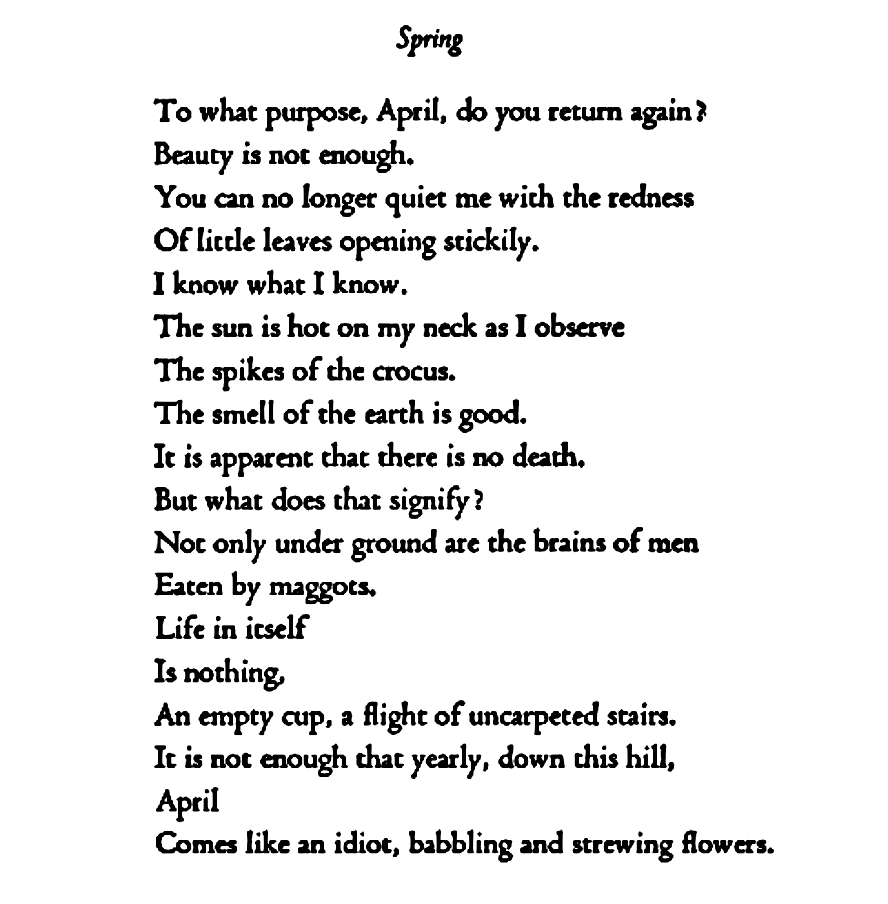
April comes like an idiot, babbling and strewing flowers | Edna St. Vincent Millay

spring

Responsibilities | Grace Paley

It is the responsibility of society to let the poet be a poet

It is the responsibility of the poet to be a woman

It is the responsibility of the poets to stand on street corners giving out poems and beautifully written leaflets also leaflets they can hardly bear to look at because of the screaming rhetoric

It is the responsibility of the poet to be lazy, to hang out and prophesy

It is the responsibility of the poet not to pay war taxes

It is the responsibility of the poet to go in and out of ivory towers and two-room apartments on Avenue C and buckwheat fields and Army camps

It is the responsibility of the male poet to be a woman

It is the responsibility of the female poet to be a woman

It is the poet’s responsibility to speak truth to power, as the Quakers say

It is the poet’s responsibility to learn the truth from the powerless

It is the responsibility of the poet to say many times: There is no freedom without justice and this means economic justice and love justice

It is the responsibility of the poet to sing this in all the original and traditional tunes of singing and telling poems

It is the responsibility of the poet to listen to gossip and pass it on in the way storytellers decant the story of life

There is no freedom without fear and bravery. There is no freedom unless earth and air and water continue and children also continue

It is the responsibility of the poet to be a woman, to keep an eye on this world and cry out like Cassandra, but be listened to this time.

From Grace Paley’s 1986 essay “Poetry and the Women of the World.” Collected in Just as I Thought.

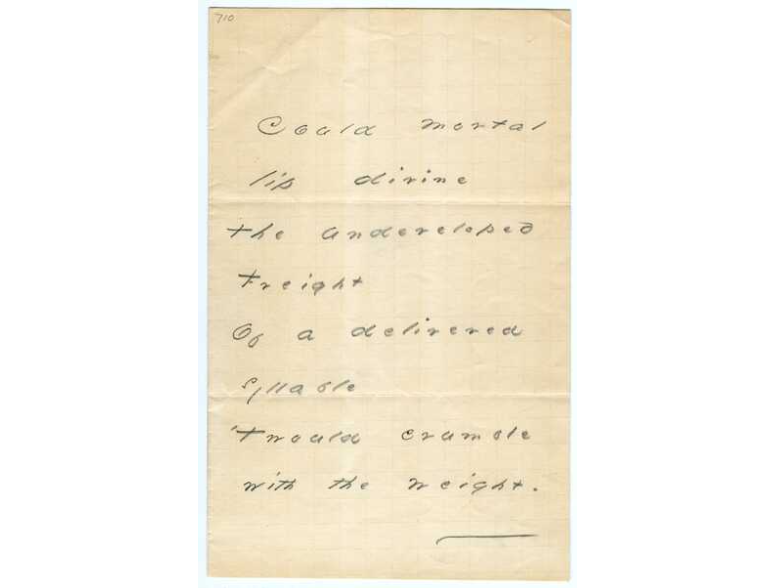
Syllable | Emily Dickinson

Could mortal lip divine
The undeveloped freight
Of a delivered syllable,
‘T would crumble with the weight.

Emily Dickinson

“Florida Road Workers” — Langston Hughes

“Florida Road Workers”

by

Langston Hughes


Hey, Buddy!
Look at me!

I’m makin’ a road
For the cars to fly by on,
Makin’ a road
Through the palmetto thicket
For light and civilization
To travel on.

I’m makin’ a road
For the rich to sweep over
In their big cars
And leave me standin’ here.

Sure,
A road helps everybody.
Rich folks ride —
And I get to see ’em ride.
I ain’t never seen nobody
Ride so fine before.

Hey, Buddy, look!
I’m makin’ a road!

Counterfeit | Emily Dickinson

A Counterfeit — a Plated Person —
I would not be —
Whatever strata of Iniquity
My Nature underlie —
Truth is good Health — and Safety, and the Sky.
How meagre, what an Exile — is a Lie,
And Vocal — when we die —

Emily Dickinson

Grasshopper revision | David Berman

If the fable of “The grasshopper and the ants” was amended so that the world ended before the turn of winter, then the grasshopper would have been wiser and the moral would have vindicated him. In a story, the location of the ending is very deliberate.

From David Berman’s December 1994 essay/poem/riff “Clip-On Tie,” which could be read as a Christmas story, if you like.

“Somnambulism” — Tom Clark

Sharon Olds’ bread

“Bread”

by

Sharon Olds


When my daughter makes bread, a cloud of flour

hangs in the air like pollen. She sifts and

sifts again, the salt and sugar

close as the grain of her skin. She heats the

water to body temperature

with the sausage lard, fragrant as her scalp

the day before hair-wash, and works them together on a

floured board. Her broad palms

bend the paste toward her and the heel of her hand

presses it away, until the dough

begins to snap, glossy and elastic as the torso bending over it,

this ten-year-old girl, random specks of yeast

in her flesh beginning to heat,

her volume doubling every month now, but still

raw and hard. She slaps the dough and it crackles under her palm, sleek and

ferocious and still leashed, like her body, no

breasts rising like bubbles of air toward the surface

of the loaf. She greases the pan, she is

shaped, glazed, and at any moment goes

into the oven, to turn to that porous

warm substance, and then under the

knife to be sliced for the having, the tasting, and the

giving of life.


“Under the Young” — Tom Clark

IMG_3223

“Counterman” — Paul Violi

“Counterman”
by
Paul Violi

What’ll it be?
Roast beef on rye, with tomato and mayo.
Whaddaya want on it?
A swipe of mayo.
Pepper but no salt.
You got it. Roast beef on rye.
You want lettuce on that?
No. Just tomato and mayo.
Tomato and mayo. You got it.
…Salt and pepper?
No salt, just a little pepper.
You got it. No salt.
You want tomato.
Yes. Tomato. No lettuce.
No lettuce. You got it.
…No salt, right?
Right. No salt.
You got it. Pickle?
No, no pickle. Just tomato and mayo.
And pepper.
Pepper.
Yes, a little pepper.
Right. A little pepper.
No pickle.
Right. No pickle.
You got it.
Next!
Roast beef on whole wheat, please,
With lettuce, mayonnaise and a center slice
Of beefsteak tomato.
The lettuce splayed, if you will,
In a Beaux Arts derivative of classical acanthus,
And the roast beef, thinly sliced, folded
In a multi-foil arrangement
That eschews Bragdonian pretensions
Or any idea of divine geometric projection
For that matter, but simply provides
A setting for the tomato
To form a medallion with a dab
Of mayonnaise as a fleuron.
And—as eclectic as this may sound—
If the mayonnaise can also be applied
Along the crust in a Vitruvian scroll
And as a festoon below the medallion,
That would be swell.
You mean like in the Cathedral St. Pierre in Geneva?
Yes, but the swag more like the one below the rosette
At the Royal Palace in Amsterdam.
You got it.
Next!

“Blown Away” — Tom Clark